Introduction
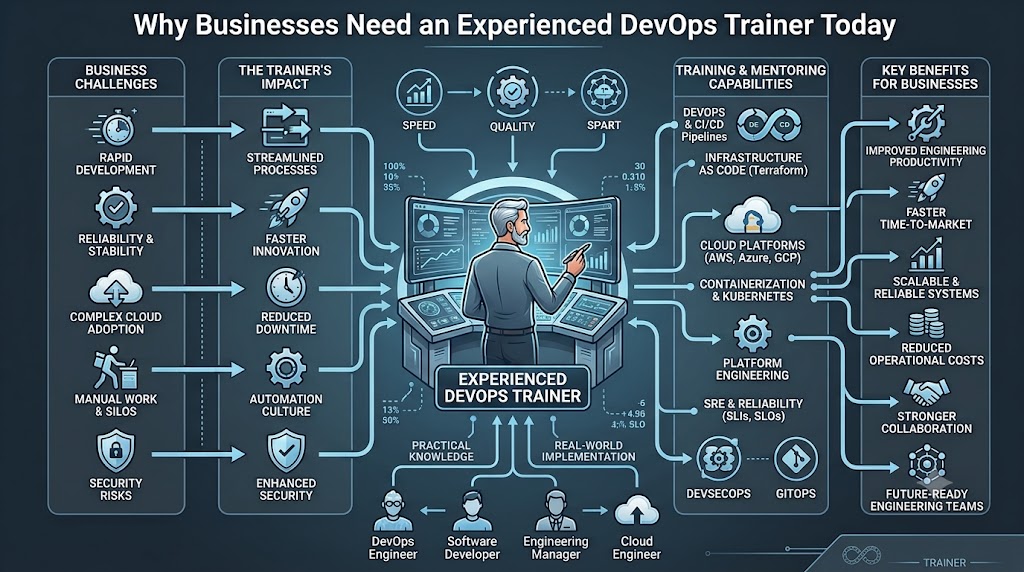
Modern software development demands speed, reliability, and continuous innovation. Organizations are expected to deliver new features faster while maintaining stability, security, and high customer satisfaction. Achieving these goals requires more than adopting new tools—it requires skilled professionals who understand DevOps principles, cloud-native technologies, automation, and modern engineering practices.
This is why organizations increasingly invest in an experienced DevOps Trainer who can bridge the gap between theory and real-world implementation. Whether a company is beginning its DevOps journey or scaling enterprise-wide automation, practical training helps teams build the right skills and confidence to deliver production-ready solutions.
Professionals and organizations looking to strengthen their DevOps capabilities can explore the expertise, mentoring approach, and consulting services offered by Rajesh Kumar at https://www.rajeshkumar.xyz/. An experienced trainer brings practical knowledge gained from real production environments, enabling teams to solve actual business challenges rather than simply learning software tools.
The Growing Importance of DevOps in Modern Business
Digital transformation has changed how businesses develop, deploy, and maintain applications. Traditional software delivery processes often involve manual deployments, communication gaps between development and operations teams, and slow release cycles.
DevOps addresses these challenges by promoting collaboration, automation, continuous integration, continuous delivery, infrastructure as code, monitoring, and continuous improvement.
Organizations adopting DevOps commonly aim to achieve:
- Faster software delivery
- Improved deployment quality
- Better collaboration between teams
- Reduced production incidents
- Improved customer experience
- Increased engineering productivity
- Reliable cloud infrastructure
- Automated operational processes
However, these benefits depend heavily on people and processes—not just technology. This is where an experienced DevOps Trainer plays a critical role.
Why Experience Matters in DevOps Training
Learning DevOps from documentation or online videos provides foundational knowledge, but enterprise environments introduce complexities that require practical understanding.
An experienced trainer helps learners understand:
- Real deployment strategies
- Infrastructure design decisions
- CI/CD implementation challenges
- Kubernetes production management
- Cloud migration planning
- Monitoring and observability
- Security automation
- High availability architecture
- Disaster recovery considerations
- Team collaboration practices
Instead of simply explaining commands, experienced trainers explain why particular approaches work in production environments.
The Role of a DevOps Trainer
A DevOps Trainer helps engineers, developers, operations professionals, architects, and technical managers understand how modern software delivery works from development through production.
Training usually covers:
- DevOps culture
- Version control
- Continuous Integration
- Continuous Delivery
- Infrastructure as Code
- Configuration Management
- Containerization
- Kubernetes
- Cloud Platforms
- Monitoring
- Logging
- Security Automation
- GitOps
- Platform Engineering
- Site Reliability Engineering
The objective is not merely to teach tools but to build engineering capabilities that improve business outcomes.
Why Companies Invest in DevOps Corporate Training
Many organizations hire skilled engineers but discover that individual expertise alone does not guarantee successful DevOps adoption.
DevOps Corporate Training aligns entire engineering teams around consistent practices, standardized workflows, and shared operational principles.
Benefits include:
Standardized Engineering Practices
Teams follow consistent deployment procedures, coding standards, release processes, and operational guidelines.
Better Cross-Team Collaboration
Developers, QA engineers, cloud engineers, security teams, and operations professionals begin working with common goals.
Faster Project Delivery
Automation eliminates repetitive manual work and reduces deployment delays.
Improved Release Quality
Continuous testing and automated pipelines reduce production defects.
Lower Operational Costs
Automation minimizes manual intervention while increasing deployment reliability.
Stronger Knowledge Sharing
Experienced trainers mentor engineers using practical demonstrations, collaborative labs, and real-world examples.
Why Organizations Choose a DevOps Trainer in India
India has become one of the world’s leading technology hubs, supporting startups, global capability centers, multinational enterprises, and cloud-first organizations.
An experienced DevOps Trainer in India understands the unique challenges faced by Indian and global engineering teams, including:
- Rapid project scaling
- Cloud adoption
- Enterprise modernization
- Remote collaboration
- Agile transformation
- Production support
- Multi-cloud infrastructure
- Enterprise security requirements
Practical exposure to diverse industries enables trainers to deliver relevant learning experiences for both domestic and international organizations.
DevOps Consultant: Beyond Training
Training develops technical skills, while a DevOps Consultant helps organizations implement those skills in production environments.
Consulting typically focuses on:
- DevOps maturity assessments
- Automation strategy
- CI/CD implementation
- Infrastructure modernization
- Kubernetes adoption
- Cloud migration
- Monitoring architecture
- Release engineering
- Platform standardization
- Operational excellence
Consultants collaborate with engineering leadership to identify bottlenecks and recommend scalable solutions that improve software delivery.
Kubernetes Trainer for Cloud-Native Success
Containers have become the foundation of modern application deployment, making Kubernetes expertise increasingly valuable.
A skilled Kubernetes Trainer helps engineering teams understand:
- Container fundamentals
- Kubernetes architecture
- Cluster management
- Deployments
- Stateful applications
- Networking
- Storage
- Autoscaling
- Security
- Troubleshooting
- Production operations
Organizations also benefit from Kubernetes Corporate Training, which prepares entire teams to deploy and manage containerized workloads efficiently.
Integrated Docker Kubernetes Training helps engineers understand how containers and orchestration work together to support scalable cloud-native applications.
SRE Training for Reliable Production Systems
Reliability has become a key business requirement. Customers expect applications to remain available around the clock.
A knowledgeable SRE Trainer teaches engineers how to improve system reliability using practical engineering principles rather than reactive troubleshooting.
Topics often include:
- Service Level Indicators (SLIs)
- Service Level Objectives (SLOs)
- Error budgets
- Incident response
- Monitoring
- Alerting
- Capacity planning
- Performance optimization
- Production readiness
- Automation
Organizations also benefit from guidance provided by an experienced SRE Consultant, who helps integrate reliability engineering practices into everyday operations.
Well-designed Site Reliability Engineering Training enables engineering teams to reduce downtime while improving customer experience.
DevSecOps Training for Secure Software Delivery
Security can no longer be treated as the final stage of software development.
Modern organizations integrate security throughout the development lifecycle.
A practical DevSecOps Trainer teaches teams how to build secure pipelines using:
- Static code analysis
- Dependency scanning
- Container security
- Secret management
- Infrastructure security
- Policy enforcement
- Compliance automation
- Vulnerability management
- Security testing
- Continuous monitoring
Comprehensive DevSecOps Corporate Training helps engineering, operations, and security teams collaborate effectively throughout software delivery.
Platform Engineering for Developer Productivity
As organizations scale, engineering teams require standardized platforms that simplify application deployment and infrastructure management.
A Platform Engineering Consultant helps organizations design internal developer platforms that improve consistency and reduce operational complexity.
Common focus areas include:
- Self-service infrastructure
- Developer portals
- Golden deployment paths
- Standardized CI/CD
- Kubernetes platforms
- Infrastructure automation
- Internal tooling
- Governance
- Security integration
Organizations investing in Platform Engineering Training prepare engineering teams to support long-term platform scalability.
Cloud DevOps Consulting for Enterprise Growth
Cloud adoption has transformed software delivery across industries.
An experienced Cloud DevOps Consultant assists organizations in designing scalable, automated cloud environments while optimizing operational efficiency.
Areas of expertise include:
- AWS
- Azure
- Google Cloud
- Cloud migration
- Infrastructure automation
- Cost optimization
- Multi-cloud architecture
- Disaster recovery
- Scalability
- Performance optimization
Businesses using Amazon Web Services often seek guidance from an experienced AWS DevOps Consultant to improve infrastructure reliability, automation, and deployment practices.
Essential Technologies Covered During Training
| Area | Tools / Topics | Business Value |
|---|---|---|
| Infrastructure as Code | Terraform Training | Automated infrastructure provisioning |
| Continuous Integration | Jenkins Training | Faster and reliable builds |
| CI/CD | CI/CD Pipeline Training | Automated software delivery |
| Containers | Docker Kubernetes Training | Cloud-native deployments |
| Kubernetes | Cluster administration | High availability and scalability |
| GitOps | GitOps Training | Declarative deployments |
| Cloud | AWS DevOps | Modern cloud infrastructure |
| Monitoring | Prometheus, Grafana, ELK | Improved observability |
| Security | DevSecOps | Secure software delivery |
| Reliability | SRE | Better production stability |
| Platform Engineering | Internal Developer Platforms | Higher developer productivity |
Why Practical Training Delivers Better Results
Organizations gain greater value when training focuses on hands-on implementation rather than theoretical presentations.
Practical learning enables engineers to:
- Build complete CI/CD pipelines
- Deploy applications using Kubernetes
- Automate infrastructure
- Configure monitoring dashboards
- Secure deployment pipelines
- Troubleshoot production issues
- Understand enterprise deployment patterns
This practical exposure helps engineers apply concepts immediately within their own organizations.
Who Benefits Most from DevOps Training?
Professional DevOps training is valuable for:
- DevOps Engineers
- Cloud Engineers
- Software Developers
- Build and Release Engineers
- Platform Engineers
- SRE Professionals
- DevSecOps Engineers
- System Administrators
- Engineering Managers
- Technical Architects
- Corporate L&D Teams
- Startup Engineering Teams
- Enterprise Technology Leaders
Organizations undergoing digital transformation also benefit from structured consulting and mentoring.
Business Benefits of DevOps, Kubernetes, SRE, and Platform Engineering Training
Organizations that invest in structured technical training often experience measurable operational improvements.
Some key business benefits include:
- Faster software delivery
- Higher deployment confidence
- Improved engineering collaboration
- Better cloud utilization
- Reduced manual effort
- Increased automation
- Lower production downtime
- Improved observability
- Stronger application security
- Better customer satisfaction
- More resilient production systems
- Increased engineering productivity
These improvements help businesses remain competitive while supporting long-term technology growth.
Frequently Asked Questions
1. Why should companies hire a DevOps Trainer?
An experienced DevOps Trainer helps engineering teams understand automation, CI/CD, cloud technologies, infrastructure as code, and operational best practices through practical learning that supports real business goals.
2. What does a DevOps Consultant do?
A DevOps Consultant evaluates existing engineering processes, identifies improvement opportunities, designs automation strategies, implements CI/CD pipelines, and helps organizations modernize software delivery.
3. Who should attend Kubernetes Corporate Training?
Kubernetes Corporate Training is ideal for DevOps engineers, cloud engineers, software developers, platform engineers, operations teams, architects, and organizations adopting containerized applications.
4. How does Site Reliability Engineering Training improve production systems?
Site Reliability Engineering Training teaches monitoring, automation, incident response, observability, capacity planning, and reliability practices that help reduce downtime while improving production stability.
5. Why is Platform Engineering Training becoming important?
Platform Engineering Training helps organizations build standardized internal platforms that simplify application deployment, improve developer productivity, reduce operational complexity, and support scalable cloud-native development.
Conclusion
Technology continues to evolve, but successful digital transformation depends on people as much as platforms. Organizations that invest in practical learning build stronger engineering cultures, improve operational efficiency, and deliver software with greater confidence.
An experienced DevOps Trainer, DevOps Consultant, Kubernetes Trainer, SRE Trainer, DevSecOps Trainer, Platform Engineering Consultant, Cloud DevOps Consultant, and AWS DevOps Consultant provides valuable guidance that extends beyond tools by helping teams understand real-world engineering practices, automation strategies, and production operations.
Whether your organization is adopting DevOps, expanding Kubernetes usage, implementing GitOps, strengthening Site Reliability Engineering, improving security automation, or building modern platform engineering capabilities, structured training and consulting can accelerate progress while reducing operational risk.
To learn more about Rajesh Kumar’s training, consulting, mentoring, and enterprise learning services, visit https://www.rajeshkumar.xyz/ and explore how practical DevOps expertise can help your teams build reliable, secure, and scalable software delivery practices.
