Introduction
Modern enterprises face constant pressure to deliver software faster, improve application quality, strengthen security, and respond quickly to changing business demands. Traditional software development methods often struggle to keep pace with today’s expectations for continuous innovation, rapid releases, and reliable digital services. As organizations adopt cloud-native technologies and automation, the need for a trusted DevOps consulting company has become more important than ever.
A professional DevOps consulting partner helps businesses modernize software delivery, automate repetitive processes, improve collaboration between development and operations teams, and build scalable technology platforms. By combining consulting expertise with practical implementation and corporate training, organizations can accelerate transformation while minimizing operational risks.
Cotocus works with enterprises to support DevOps adoption, cloud modernization, infrastructure automation, Kubernetes implementation, DevSecOps, Site Reliability Engineering (SRE), platform engineering, and digital transformation initiatives. Businesses looking to explore consulting services, enterprise modernization strategies, or corporate technology training can learn more at https://www.cotocus.com/.
Why Modern Enterprises Need a DevOps Consulting Company
Software has become the backbone of nearly every industry. Whether operating in finance, healthcare, retail, manufacturing, education, or technology, organizations rely on reliable applications to serve customers and drive business growth.
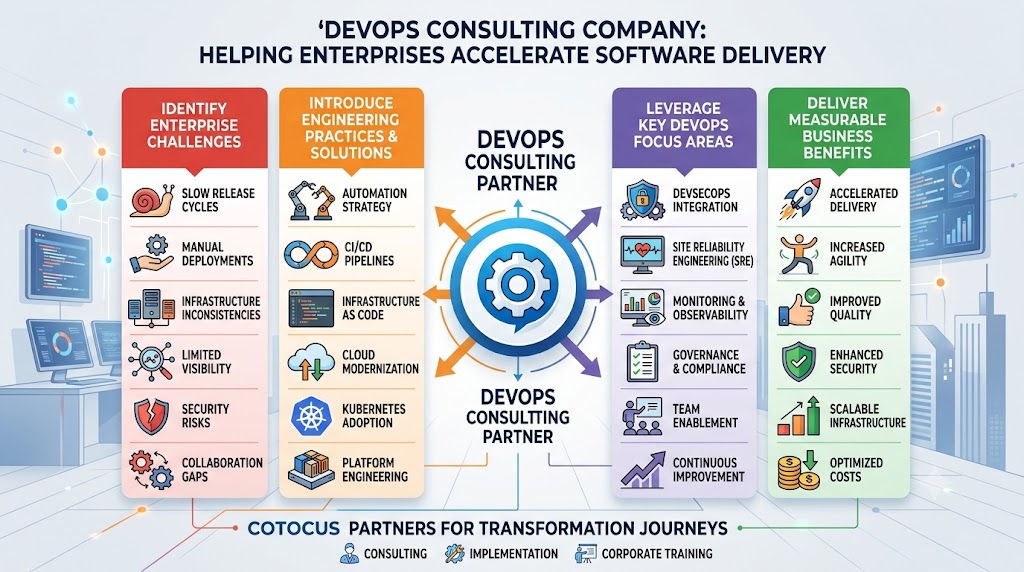
However, many enterprises continue to experience challenges such as:
- Slow software release cycles
- Manual deployment processes
- Infrastructure inconsistencies
- Increasing operational complexity
- Cloud migration challenges
- Limited visibility into production environments
- Security concerns throughout the development lifecycle
- Growing infrastructure costs
- Collaboration gaps across engineering teams
A DevOps consulting company helps organizations address these challenges by introducing proven engineering practices, automation frameworks, modern infrastructure, and continuous improvement strategies.
What Defines an Effective DevOps Consulting Company?
A DevOps consulting company goes beyond recommending tools. It works closely with enterprise teams to understand existing environments, identify bottlenecks, design improvement roadmaps, and implement solutions aligned with business objectives.
Key focus areas typically include:
- DevOps maturity assessment
- CI/CD pipeline implementation
- Infrastructure automation
- Cloud platform modernization
- Kubernetes adoption
- Container strategy
- Monitoring and observability
- DevSecOps integration
- Release management optimization
- Platform engineering
- Reliability engineering
- Team enablement through corporate training
The objective is to create a technology ecosystem that enables continuous delivery while maintaining security, governance, scalability, and operational reliability.
Enterprise Challenges That Slow Software Delivery
Many organizations experience delays because software delivery depends on manual approvals, inconsistent environments, fragmented tooling, or isolated engineering teams.
Common challenges include:
Manual Deployment Processes
Manual deployments increase deployment times and introduce human error. Automation reduces these risks while improving consistency across environments.
Limited Collaboration
When development, operations, testing, and security teams work independently, releases often become slower and more complex.
Infrastructure Management Complexity
Managing infrastructure manually becomes increasingly difficult as applications grow across multiple cloud platforms and environments.
Security Integrated Too Late
Security reviews performed only before production often delay releases and create additional rework.
Lack of Standardization
Different teams using different deployment methods make operational governance difficult.
How DevOps Consulting Accelerates Software Delivery
A structured DevOps consulting engagement focuses on improving the entire software delivery lifecycle.
DevOps Assessment
Consultants evaluate current engineering practices, deployment workflows, infrastructure, organizational processes, and automation maturity.
The assessment identifies opportunities to reduce delivery time while improving quality and stability.
Automation Strategy
Automation reduces repetitive manual activities including:
- Infrastructure provisioning
- Application deployment
- Testing
- Configuration management
- Monitoring
- Compliance validation
Automation allows engineering teams to spend more time delivering business value rather than managing repetitive operational tasks.
CI/CD Pipeline Implementation
Continuous Integration and Continuous Delivery pipelines help organizations deliver software frequently with greater confidence.
Benefits include:
- Faster releases
- Improved testing
- Earlier defect detection
- Reduced deployment failures
- Improved release consistency
Infrastructure as Code
Infrastructure automation enables environments to be created consistently using version-controlled code rather than manual configuration.
This approach improves repeatability while reducing operational errors.
Cloud Modernization and DevOps
Cloud adoption has transformed enterprise IT, but cloud migration alone does not guarantee operational efficiency.
A DevOps consulting company helps organizations:
- Build cloud-native architectures
- Automate cloud provisioning
- Improve scalability
- Enhance disaster recovery
- Optimize operational costs
- Strengthen governance
- Improve cloud security
Cloud modernization also supports faster innovation by enabling engineering teams to provision infrastructure quickly and consistently.
Kubernetes Consulting for Containerized Applications
Containers have become a standard deployment model for modern software applications.
Kubernetes helps organizations manage containers across development, testing, and production environments.
Consulting services often include:
- Kubernetes architecture design
- Cluster implementation
- Workload migration
- High availability planning
- Security hardening
- Monitoring integration
- Performance optimization
- Governance frameworks
Organizations also benefit from Kubernetes corporate training that helps engineering teams confidently manage container platforms.
DevSecOps for Secure Software Delivery
Security is now an essential part of software development.
DevSecOps integrates security throughout the software delivery lifecycle instead of treating it as a final review activity.
Consulting initiatives may include:
- Secure CI/CD pipelines
- Automated vulnerability scanning
- Secrets management
- Container security
- Infrastructure security
- Policy automation
- Compliance validation
- Security awareness training
Embedding security earlier reduces vulnerabilities while supporting faster software releases.
Site Reliability Engineering (SRE)
Modern digital platforms require high availability and predictable performance.
Site Reliability Engineering introduces engineering practices that improve production reliability through automation and measurable service objectives.
Typical SRE consulting areas include:
- SLIs and SLOs
- Incident management
- Root cause analysis
- Monitoring strategy
- Capacity planning
- Reliability automation
- Error budget management
- Operational excellence
Reliable systems improve customer experience while reducing operational disruptions.
Platform Engineering for Enterprise Productivity
Platform engineering helps organizations create standardized internal platforms that simplify software development.
Instead of every development team building infrastructure independently, platform engineering provides reusable capabilities that accelerate delivery.
Benefits include:
- Faster onboarding
- Standardized environments
- Improved governance
- Better developer experience
- Reduced operational overhead
- Consistent deployment practices
Internal developer platforms also simplify compliance and operational management.
Infrastructure Automation
Infrastructure automation enables organizations to provision and manage environments consistently across development, testing, staging, and production.
Automation supports:
- Faster provisioning
- Environment consistency
- Reduced manual effort
- Improved scalability
- Better governance
- Simplified disaster recovery
Infrastructure automation becomes increasingly valuable as cloud environments grow in size and complexity.
Enterprise Corporate Training
Technology transformation depends on skilled people as much as modern tools.
Corporate training helps engineering teams adopt modern practices more effectively.
Training programs commonly cover:
- DevOps fundamentals
- CI/CD
- Kubernetes
- Docker
- Cloud platforms
- Infrastructure as Code
- DevSecOps
- GitOps
- Site Reliability Engineering
- Platform engineering
Practical training enables teams to apply new knowledge directly within enterprise environments.
Business Benefits of DevOps Consulting
Organizations that invest in DevOps consulting often experience measurable improvements across software delivery and operations.
| Traditional IT Delivery | DevOps-Driven Delivery |
|---|---|
| Manual deployments | Automated deployment pipelines |
| Siloed engineering teams | Collaborative cross-functional teams |
| Long release cycles | Frequent software releases |
| Manual infrastructure | Infrastructure as Code |
| Reactive monitoring | Proactive observability |
| Security at the end | Integrated DevSecOps |
| Slow environment provisioning | Automated provisioning |
| Limited scalability | Cloud-native scalability |
| Higher operational risk | Automated governance and consistency |
Why Enterprises Choose Cotocus
Organizations require more than technical advice. They need a consulting partner capable of understanding business goals, operational challenges, and long-term modernization strategies.
Cotocus supports enterprises through a combination of consulting, implementation guidance, cloud expertise, DevOps modernization, automation strategy, Kubernetes enablement, DevSecOps practices, reliability engineering, and corporate technology training. Its practical approach emphasizes sustainable improvements that align technology initiatives with business objectives.
Whether the goal is accelerating software delivery, modernizing cloud infrastructure, improving operational reliability, or building internal engineering capabilities, Cotocus helps organizations move toward more efficient and scalable technology operations.
Frequently Asked Questions
What does a DevOps consulting company do?
A DevOps consulting company helps organizations improve software delivery through automation, CI/CD, cloud adoption, infrastructure modernization, DevSecOps, and engineering best practices.
How does DevOps consulting accelerate software delivery?
By reducing manual processes, implementing automation, improving collaboration, and creating reliable deployment pipelines, organizations can release software more quickly and consistently.
Why is CI/CD important?
CI/CD enables continuous testing, integration, and deployment, reducing release risks while improving delivery speed.
When should an enterprise adopt Kubernetes?
Organizations managing multiple containerized applications or scaling cloud-native workloads often benefit from Kubernetes adoption.
What is Infrastructure as Code?
Infrastructure as Code uses version-controlled definitions to provision infrastructure consistently through automation rather than manual configuration.
How does DevSecOps improve security?
DevSecOps integrates security throughout the software development lifecycle, allowing vulnerabilities to be detected and addressed earlier.
What is Site Reliability Engineering?
SRE applies software engineering principles to operations, improving system reliability, availability, monitoring, and incident management.
Why is corporate DevOps training valuable?
Training equips engineering teams with practical skills needed to adopt modern tools, automation, cloud technologies, and DevOps practices effectively.
How does platform engineering improve developer productivity?
Platform engineering provides standardized internal platforms that reduce repetitive work and enable developers to focus on delivering business value.
How can Cotocus support enterprise transformation?
Cotocus provides consulting, cloud modernization guidance, DevOps implementation support, Kubernetes consulting, infrastructure automation, DevSecOps consulting, SRE practices, platform engineering, and enterprise corporate training to help organizations modernize technology delivery and operational excellence.
Conclusion
Choosing the right DevOps Consulting Company is a strategic decision for enterprises seeking to accelerate software delivery, modernize cloud infrastructure, improve operational reliability, and build scalable engineering practices. By combining automation, cloud-native technologies, secure development processes, platform engineering, and continuous learning, organizations can achieve faster innovation while maintaining governance and quality.
Cotocus partners with enterprises to support these transformation journeys through consulting, implementation guidance, and corporate training tailored to evolving business needs. Whether your organization is planning a DevOps adoption initiative, cloud migration, Kubernetes deployment, DevSecOps implementation, or broader digital transformation, exploring the expertise available at https://www.cotocus.com/ can be a valuable next step toward building a more agile and resilient technology ecosystem.
