Introduction
Voiceover tools help users create spoken audio for videos, ads, training content, podcasts, product demos, eLearning modules, social media clips, audiobooks, presentations, and customer support content. These tools may include AI voice generation, text-to-speech, voice cloning, script editing, pronunciation controls, multilingual voices, audio cleanup, and export options for video production workflows.
Voiceover tools matter because businesses and creators now need more audio and video content across many channels. Hiring voice artists for every small project can be costly and slow, while recording in-house requires equipment, editing skills, and time. Modern voiceover platforms help teams create professional-sounding narration faster, especially for repeatable content like tutorials, explainers, training lessons, and marketing videos.
Common use cases include product explainer videos, eLearning narration, social media videos, YouTube content, audiobooks, app tutorials, sales videos, internal training, multilingual campaigns, and customer onboarding content.
Buyers should evaluate voice quality, language support, pronunciation control, editing workflow, commercial rights, voice cloning rules, security, integrations, export formats, collaboration features, and pricing.
Best for: marketers, educators, video creators, agencies, course creators, SaaS teams, training departments, product teams, podcasters, and businesses that regularly create narrated content.
Not ideal for: projects that require a very specific emotional human performance, regulated voice usage without legal review, or brands needing exclusive custom voice talent for high-value campaigns.
Key Trends in Voiceover Tools
- AI voice generation is becoming more natural, with better pacing, emotion, tone variation, and pronunciation control.
- Multilingual voiceover production is growing, helping brands localize training, ads, courses, and product videos for different regions.
- Voice cloning is becoming more common, but it also increases the need for consent, governance, brand safety, and ethical usage rules.
- Video and voice workflows are merging, with tools offering scripts, captions, avatars, editing, translation, and voiceover in one platform.
- Enterprise voice governance is becoming important, especially for teams using synthetic voices in training, customer communication, or branded campaigns.
- API-based voice generation is expanding, allowing developers to add text-to-speech into apps, learning platforms, support bots, and product experiences.
- Audio cleanup and enhancement features are now expected, including noise removal, volume leveling, filler word removal, and studio-quality processing.
- Brand voice consistency is becoming a business need, especially for companies producing high volumes of product tutorials, help videos, and internal learning content.
- Human-in-the-loop review remains important, especially for emotional storytelling, compliance-heavy content, sensitive topics, and premium brand campaigns.
- Flexible pricing models are expanding, including per-character pricing, subscription credits, creator plans, enterprise contracts, and API usage-based billing.
How We Selected These Tools
The tools in this list were selected based on their practical value for voiceover creation, text-to-speech, AI narration, business content production, developer workflows, and multilingual audio use cases.
Selection criteria included:
- Market adoption and recognition among creators, marketers, educators, developers, and businesses
- Voice quality, naturalness, language coverage, and pronunciation control
- Core voiceover features such as script input, voice selection, editing, export, and project management
- Support for commercial content, training videos, social media, product demos, and eLearning
- Availability of advanced features such as voice cloning, API access, translation, dubbing, or audio editing
- Ease of use for non-technical users such as marketers, educators, and creators
- Security posture signals such as access controls, team features, account management, and enterprise options
- Integration ecosystem with video editors, learning platforms, developer tools, and content workflows
- Fit for different customer segments, including freelancers, SMBs, agencies, mid-market teams, and enterprises
- Value for money based on output quality, flexibility, scale, and workflow fit
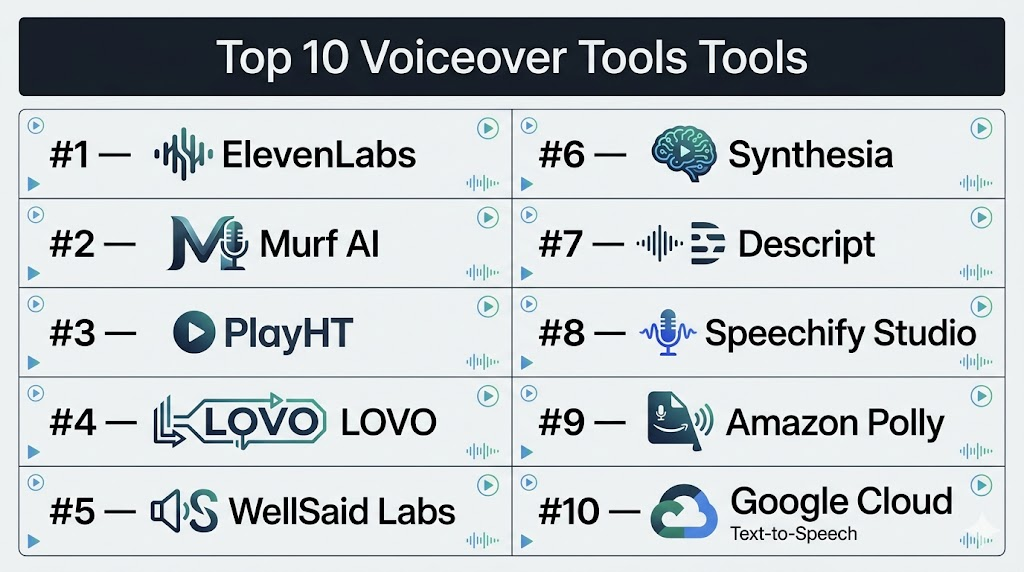
Top 10 Voiceover Tools Tools
#1 — ElevenLabs
Short description: ElevenLabs is an AI voice generation platform used for voiceovers, narration, dubbing, content localization, and synthetic speech creation. It is popular among creators, developers, media teams, educators, and businesses that need natural-sounding AI voices.
Key Features
- AI text-to-speech voice generation
- Voice cloning features depending on plan and permissions
- Multilingual voice support
- Voice style and tone controls
- Dubbing and localization workflows
- API access for developers
- Useful for creators, apps, videos, games, and learning content
Pros
- Strong voice realism for many creative and business use cases
- Useful for multilingual voiceover production
- Good fit for both creators and developer-led workflows
Cons
- Voice cloning requires careful consent and governance
- Teams should review commercial usage terms before publishing
- Advanced controls and scale may require higher plans
Platforms / Deployment
Web / API workflows
Cloud
Security & Compliance
ElevenLabs provides account-based access and business workflow options. Specific security certifications, SSO, audit logs, RBAC, and compliance details should be verified directly by plan or contract. Unknown details should be treated as Not publicly stated.
Integrations & Ecosystem
ElevenLabs works well for modern audio, video, localization, and developer workflows where AI voice generation is part of a larger content pipeline.
Common ecosystem areas include:
- Video production workflows
- Game development workflows
- Learning platforms
- App and product experiences
- Localization workflows
- Developer APIs
Support & Community
ElevenLabs provides documentation, help resources, developer guidance, and support options depending on plan. It has strong visibility among creators and technical teams using AI voice workflows.
#2 — Murf AI
Short description: Murf AI is a voiceover platform for creating AI-generated narration for videos, presentations, training modules, ads, and eLearning content. It is useful for marketers, educators, businesses, and creators who want a guided voiceover production workflow.
Key Features
- AI voice generation from text
- Multiple voice styles and language options
- Voiceover editor with timing and script controls
- Voice cloning options depending on plan and permissions
- Support for presentations, training, and marketing videos
- Team collaboration features depending on plan
- Export options for audio and video workflows
Pros
- Easy for non-technical users to create voiceovers
- Good fit for business videos, eLearning, and training content
- Helpful editor for aligning narration with visual content
Cons
- Advanced features may require higher-tier plans
- Some voice outputs may still need manual adjustment
- Teams should verify commercial usage and cloning policies before use
Platforms / Deployment
Web
Cloud
Security & Compliance
Murf AI provides account-based access and team features depending on plan. Specific enterprise security details, SSO, audit logs, and compliance documentation should be verified directly. Unknown items should be listed as Not publicly stated.
Integrations & Ecosystem
Murf AI fits well into video production and business content workflows where users need voiceovers without setting up a full recording environment.
Common ecosystem areas include:
- eLearning content
- Marketing videos
- Product demos
- Presentation narration
- Training modules
- Explainer video production
Support & Community
Murf AI offers documentation, learning resources, and customer support options depending on plan. It is approachable for marketers, educators, and small teams creating regular narrated content.
#3 — PlayHT
Short description: PlayHT is an AI voice and text-to-speech platform used for voiceovers, audio content, applications, podcasts, learning content, and developer workflows. It supports synthetic voices, voice generation, and API-based speech creation.
Key Features
- AI text-to-speech voice generation
- Large voice library across multiple languages and styles
- Voice cloning features depending on plan and permissions
- API access for developers
- Audio export for video, podcast, and app workflows
- Support for long-form narration
- Useful for creators, businesses, and product teams
Pros
- Strong fit for both creator and developer use cases
- Useful for long-form voice content and narration
- API access supports scalable voice workflows
Cons
- Voice output may require review for tone and pronunciation
- Enterprise security details should be verified before sensitive use
- Voice cloning and commercial usage need careful policy review
Platforms / Deployment
Web / API workflows
Cloud
Security & Compliance
PlayHT provides account-based access and business workflow options. Specific security certifications, SSO, audit logs, RBAC, and compliance details should be verified directly. Unknown details should be written as Not publicly stated.
Integrations & Ecosystem
PlayHT is useful for teams that need AI voice generation inside products, content workflows, or media production pipelines.
Common ecosystem areas include:
- Developer APIs
- Video narration
- Podcast production
- eLearning platforms
- Product voice experiences
- Content automation workflows
Support & Community
PlayHT provides documentation, help resources, and support options depending on user type and plan. Developer-focused users should review API documentation and usage limits carefully.
#4 — LOVO
Short description: LOVO is an AI voiceover and content creation platform used by marketers, creators, educators, and businesses. It offers AI voices, text-to-speech, voice editing, and video-related features for producing narrated content.
Key Features
- AI text-to-speech voice generation
- Voice library with different tones and styles
- Voice cloning features depending on plan and consent rules
- Script editing and voiceover workflow tools
- Video and content creation features depending on product offering
- Multilingual voice support
- Useful for ads, explainer videos, eLearning, and social content
Pros
- Easy workflow for creating narrated content
- Good fit for creators and marketing teams
- Supports multiple voice styles for different content types
Cons
- Some advanced features may be plan-dependent
- Voice quality may vary across languages and voice types
- Teams should review usage rights and voice cloning rules carefully
Platforms / Deployment
Web
Cloud
Security & Compliance
LOVO provides account-based access and business plan options depending on offering. Specific security certifications, SSO, audit logs, and compliance details should be verified directly. Unknown details should be treated as Not publicly stated.
Integrations & Ecosystem
LOVO supports creative content workflows where voiceover is part of video, social, training, or marketing production.
Common ecosystem areas include:
- Marketing videos
- Social media content
- eLearning narration
- Product explainers
- Audio content creation
- Multilingual campaigns
Support & Community
LOVO provides documentation, help resources, and customer support options. It is generally accessible for creators and small teams that need quick AI voiceover production.
#5 — WellSaid Labs
Short description: WellSaid Labs is an AI voice platform focused on business and professional voiceover creation. It is often used by training teams, enterprises, product teams, and content teams that need controlled, high-quality synthetic voice production.
Key Features
- AI voice generation for business content
- Professional voice options and production workflow
- Team collaboration features depending on plan
- Pronunciation and script control options
- Useful for training, product education, and internal content
- Voice consistency for repeatable business narration
- Enterprise-oriented options depending on plan
Pros
- Strong fit for professional and business voiceover use cases
- Useful for teams needing consistent narration style
- Good option for training and product education content
Cons
- May be more business-focused than casual creator tools
- Pricing may not suit very occasional users
- Buyers should verify exact security and usage rights before enterprise rollout
Platforms / Deployment
Web
Cloud
Security & Compliance
WellSaid Labs offers business-oriented account and team capabilities depending on plan. Specific security certifications, SSO, audit logs, RBAC, and compliance information should be verified directly. If uncertain, write Not publicly stated.
Integrations & Ecosystem
WellSaid Labs fits business workflows where voice quality, consistency, and controlled production matter.
Common ecosystem areas include:
- Corporate training
- Product education
- Internal communications
- Learning content
- Marketing narration
- Brand voice workflows
Support & Community
WellSaid Labs provides documentation, support options, and business-focused guidance depending on plan. It is useful for teams that need a more professional voiceover production environment.
#6 — Synthesia
Short description: Synthesia is an AI video creation platform that includes AI avatars, voiceovers, scripts, templates, and video production tools. It is useful for training teams, marketers, sales enablement teams, HR teams, and businesses creating narrated videos at scale.
Key Features
- AI video creation with avatars and voiceovers
- Text-to-video workflow
- Multilingual voice and video localization options
- Templates for training, onboarding, and business videos
- Team collaboration and brand control features depending on plan
- Script-based editing workflow
- Useful for corporate learning, product training, and internal communication
Pros
- Combines voiceover and video creation in one workflow
- Strong fit for training and business communication videos
- Useful for teams creating repeatable narrated video content
Cons
- Not a pure voiceover-only tool
- Avatar-based content may not suit every brand style
- Teams should review usage rights, consent, and security requirements carefully
Platforms / Deployment
Web
Cloud
Security & Compliance
Synthesia provides business and enterprise features depending on plan. Specific certifications, SSO, audit logs, permissions, and compliance details should be verified directly. Unknown details should be written as Not publicly stated.
Integrations & Ecosystem
Synthesia fits teams that want to turn scripts into narrated videos without traditional filming.
Common ecosystem areas include:
- Learning and development
- HR onboarding
- Sales enablement
- Product training
- Internal communication
- Multilingual video localization
Support & Community
Synthesia provides learning resources, templates, documentation, and support options depending on plan. It is especially relevant for business teams that want video plus voiceover in one platform.
#7 — Descript
Short description: Descript is an audio and video editing platform with transcription, voice tools, screen recording, captions, and text-based editing. It is useful for podcasters, creators, marketers, educators, and teams that want to edit spoken content easily.
Key Features
- Text-based audio and video editing
- Voiceover and audio editing workflows
- Transcription and captioning features
- Screen recording and video production tools
- Audio cleanup and filler word removal options
- Collaboration features for teams
- Useful for podcasts, tutorials, social videos, and training content
Pros
- Combines editing, transcription, captions, and voice workflows
- Good for creators who want a simple editing experience
- Useful for repurposing spoken content into multiple formats
Cons
- Not only focused on AI voice generation
- Advanced voice cloning or voiceover features may depend on plan and policy
- Professional audio engineers may still prefer dedicated audio production tools
Platforms / Deployment
Web / Windows / macOS
Cloud
Security & Compliance
Descript provides account-based access and team features depending on plan. Specific enterprise security certifications, SSO, audit logs, and compliance details should be verified directly. Unknown items should be listed as Not publicly stated.
Integrations & Ecosystem
Descript works well for audio-video creators who want transcription, editing, voiceover, and publishing preparation in one workflow.
Common ecosystem areas include:
- Podcast production
- Video editing
- Screen recording
- Social video production
- Training content
- Team collaboration
Support & Community
Descript provides documentation, tutorials, support resources, and a strong creator-focused community. It is especially useful for users who want simpler spoken-content editing.
#8 — Speechify Studio
Short description: Speechify Studio is a voiceover and text-to-speech platform used by creators, businesses, educators, and teams that need AI narration for videos, learning content, ads, and digital media. It focuses on easy voice generation and content production workflows.
Key Features
- AI text-to-speech voice generation
- Voiceover creation for videos and learning content
- Multiple voice and language options depending on plan
- Voice cloning features depending on consent and offering
- Audio export for content workflows
- Script-based voiceover creation
- Useful for creators, educators, marketers, and businesses
Pros
- Easy to use for quick AI voiceover creation
- Useful for learning content, social videos, and digital narration
- Good fit for users who want a simple voice generation workflow
Cons
- Advanced enterprise controls should be verified directly
- Voice quality and language performance may vary by voice
- Buyers should review commercial usage and voice cloning terms
Platforms / Deployment
Web / iOS / Android
Cloud
Security & Compliance
Speechify provides account-based access and product-specific business features depending on plan. Specific enterprise security details, compliance certifications, SSO, audit logs, and RBAC should be verified directly. Unknown details should be written as Not publicly stated.
Integrations & Ecosystem
Speechify Studio is useful for users who need quick narration and spoken content generation across learning, marketing, and creator workflows.
Common ecosystem areas include:
- Learning content
- Social media videos
- Audiobook-style narration
- Marketing videos
- Creator workflows
- Accessibility-focused listening experiences
Support & Community
Speechify provides help resources and user support options depending on product and plan. It is approachable for creators and business users who want simple AI narration tools.
#9 — Amazon Polly
Short description: Amazon Polly is a cloud-based text-to-speech service used by developers and businesses to add synthetic speech into applications, products, call systems, learning tools, and automated workflows. It is best suited for technical teams needing scalable voice generation through APIs.
Key Features
- Cloud-based text-to-speech generation
- API-driven speech synthesis
- Multiple voices and language options
- Support for speech markup controls
- Scalable usage for applications and digital products
- Useful for apps, contact centers, learning systems, and accessibility workflows
- Works within broader cloud application environments
Pros
- Strong fit for developer and enterprise application workflows
- Scales well for product-based text-to-speech needs
- Useful where voice generation must be automated through APIs
Cons
- Less creator-friendly than visual voiceover tools
- Requires technical setup for best use
- Not a full video voiceover editor or creative production suite
Platforms / Deployment
Web / API workflows
Cloud
Security & Compliance
Amazon Polly runs within a broader cloud infrastructure environment with account security, identity management, and access control options. Specific compliance status, data handling requirements, and security configuration should be verified directly for the user’s cloud setup. Unknown details should be listed as Not publicly stated.
Integrations & Ecosystem
Amazon Polly is best for technical teams building voice generation into applications or automated systems.
Common ecosystem areas include:
- Cloud applications
- Contact center workflows
- Learning platforms
- Accessibility features
- Developer APIs
- Automated notification systems
Support & Community
Amazon Polly has technical documentation, developer resources, cloud support options, and a broad developer ecosystem. It is best for teams with engineering capability.
#10 — Google Cloud Text-to-Speech
Short description: Google Cloud Text-to-Speech is a cloud-based speech synthesis service for developers and businesses that need to generate spoken audio from text. It is useful for apps, accessibility tools, customer experiences, learning platforms, and automated content workflows.
Key Features
- API-based text-to-speech generation
- Multiple voices and language options
- Neural voice technology depending on configuration
- Speech customization options
- Scalable cloud infrastructure
- Useful for applications, voice interfaces, training systems, and product workflows
- Works within broader cloud development environments
Pros
- Strong developer-first text-to-speech option
- Useful for scalable speech generation inside applications
- Good fit for teams already using cloud infrastructure
Cons
- Not a simple visual voiceover editor for creators
- Requires technical setup and cloud knowledge
- Creative workflow features are limited compared with dedicated voiceover platforms
Platforms / Deployment
Web / API workflows
Cloud
Security & Compliance
Google Cloud Text-to-Speech runs within a broader cloud environment with identity, access, and security configuration options. Specific compliance coverage, data handling, and security requirements should be verified directly for the chosen cloud setup. Unknown details should be treated as Not publicly stated.
Integrations & Ecosystem
Google Cloud Text-to-Speech is suited for developer and product teams building voice features into software or automated workflows.
Common ecosystem areas include:
- Web and mobile applications
- Accessibility workflows
- Customer support automation
- Learning platforms
- Voice interfaces
- Developer APIs
Support & Community
Google Cloud provides technical documentation, developer resources, cloud support options, and a broad developer community. It is best for teams that can manage cloud-based implementation.
Comparison Table
| Tool Name | Best For | Platform(s) Supported | Deployment | Standout Feature | Public Rating |
|---|---|---|---|---|---|
| ElevenLabs | Creators, developers, and multilingual AI voice workflows | Web / API workflows | Cloud | Natural-sounding AI voice generation | N/A |
| Murf AI | Business videos, eLearning, and marketing voiceovers | Web | Cloud | Guided voiceover editor for business content | N/A |
| PlayHT | Developer and creator voice generation workflows | Web / API workflows | Cloud | AI voice generation with API access | N/A |
| LOVO | Marketing, social, and creator voiceover content | Web | Cloud | AI voices for creative content production | N/A |
| WellSaid Labs | Professional business voiceovers and training content | Web | Cloud | Consistent business-grade synthetic voice production | N/A |
| Synthesia | AI video creation with voiceovers and avatars | Web | Cloud | Text-to-video workflow with voice narration | N/A |
| Descript | Audio-video editing, podcasts, and spoken content | Web / Windows / macOS | Cloud | Text-based editing with voice and transcription tools | N/A |
| Speechify Studio | Simple AI narration and creator workflows | Web / iOS / Android | Cloud | Easy text-to-speech voiceover creation | N/A |
| Amazon Polly | Developer-led application voice generation | Web / API workflows | Cloud | Scalable text-to-speech API | N/A |
| Google Cloud Text-to-Speech | Cloud-based speech synthesis for apps and products | Web / API workflows | Cloud | Developer-first speech generation infrastructure | N/A |
Evaluation & Scoring of Voiceover Tools
The scoring below is comparative and practical. It is based on common voiceover buying needs such as voice quality, editing workflow, language support, integrations, security posture, support, performance, and value. A higher score does not mean the tool is best for every team. A creator, enterprise training team, developer, and agency may need very different voiceover workflows.
| Tool Name | Core (25%) | Ease (15%) | Integrations (15%) | Security (10%) | Performance (10%) | Support (10%) | Value (15%) | Weighted Total (0–10) |
|---|---|---|---|---|---|---|---|---|
| ElevenLabs | 9 | 8 | 8 | 7 | 8 | 7 | 8 | 8.05 |
| Murf AI | 8 | 9 | 7 | 7 | 8 | 8 | 8 | 7.95 |
| PlayHT | 8 | 8 | 8 | 7 | 8 | 7 | 8 | 7.80 |
| LOVO | 8 | 8 | 7 | 6 | 8 | 7 | 8 | 7.50 |
| WellSaid Labs | 8 | 8 | 7 | 8 | 8 | 8 | 7 | 7.75 |
| Synthesia | 8 | 8 | 7 | 8 | 8 | 8 | 7 | 7.75 |
| Descript | 8 | 8 | 7 | 7 | 8 | 8 | 8 | 7.75 |
| Speechify Studio | 7 | 9 | 7 | 6 | 8 | 7 | 8 | 7.45 |
| Amazon Polly | 8 | 6 | 9 | 8 | 9 | 8 | 8 | 8.00 |
| Google Cloud Text-to-Speech | 8 | 6 | 9 | 8 | 9 | 8 | 8 | 8.00 |
How to interpret these scores:
- The scores are comparative and should be used for shortlisting, not as a universal ranking.
- Creator-focused teams should weigh ease of use and voice quality more heavily.
- Developer teams should pay more attention to API access, scalability, and cloud integration.
- Enterprise teams should review security, governance, licensing, consent, and admin controls carefully.
- Always test voice quality with your own scripts before choosing a platform.
Which Voiceover Tools Tool Is Right for You?
Solo / Freelancer
Solo creators and freelancers usually need fast, affordable, and easy voiceover creation. They may create YouTube videos, social posts, tutorials, product demos, ads, podcasts, or client videos. They need simple script input, realistic voices, quick exports, and predictable pricing.
Good options include:
- ElevenLabs for natural AI voice generation
- Murf AI for business-style voiceovers and guided editing
- LOVO for creator-friendly voiceover production
- Descript for editing and spoken-content workflows
- Speechify Studio for simple narration needs
Freelancers should focus on voice quality, commercial usage rights, export options, and how much editing time the tool saves.
SMB
Small and mid-sized businesses often need voiceovers for product demos, training videos, explainers, ads, customer onboarding, social media, and internal communication. They need tools that are easy enough for marketing teams but reliable enough for business use.
Good options include:
- Murf AI for training and marketing videos
- WellSaid Labs for professional business narration
- Synthesia for voiceover plus AI video creation
- Descript for content editing and voice workflow
- ElevenLabs for multilingual or natural-sounding narration
SMBs should evaluate team features, brand consistency, licensing, review workflow, and whether the platform fits existing video production processes.
Mid-Market
Mid-market teams may manage more content, more languages, more stakeholders, and more brand rules. They often need collaboration, shared projects, review workflows, and consistent voice output across departments.
Good options include:
- WellSaid Labs for controlled business voiceover workflows
- Synthesia for repeatable training and internal video production
- Murf AI for structured voiceover projects
- ElevenLabs for advanced AI voice and localization needs
- PlayHT for teams needing both creator and API workflows
Mid-market buyers should test voice consistency, user permissions, project organization, audio export quality, and approval processes.
Enterprise
Enterprise teams often need stronger governance, privacy review, security documentation, legal approval, brand voice consistency, and scalable content workflows. They may use voiceover tools for training, product education, internal communication, support content, accessibility, or product experiences.
Good options include:
- WellSaid Labs for professional business voiceover workflows
- Synthesia for large-scale training and internal video content
- Amazon Polly for developer-led enterprise speech generation
- Google Cloud Text-to-Speech for cloud-based product speech workflows
- ElevenLabs or PlayHT where advanced AI voice generation and APIs are needed
Enterprise teams should involve legal, security, IT, brand, learning, and content operations teams before scaling voiceover use.
Budget vs Premium
Budget-conscious users should avoid buying advanced enterprise tools if they only need occasional narration. Simple AI voice tools may be enough for social media, explainers, internal drafts, and basic training videos.
Budget-friendly or creator-friendly options may include:
- Speechify Studio
- LOVO
- Descript
- Murf AI
- ElevenLabs, depending on usage
Premium or enterprise-oriented options may include:
- WellSaid Labs
- Synthesia
- Amazon Polly
- Google Cloud Text-to-Speech
- PlayHT, depending on API and scale requirements
The best value is not always the cheapest plan. Buyers should compare voice quality, usage rights, export limits, language support, collaboration, and review workflow.
Feature Depth vs Ease of Use
Some voiceover tools are designed for creators and marketers, while others are built for developers or enterprise content systems.
For ease of use:
- Murf AI
- LOVO
- Speechify Studio
- Descript
- Synthesia
For deeper voice generation or developer workflows:
- ElevenLabs
- PlayHT
- Amazon Polly
- Google Cloud Text-to-Speech
- WellSaid Labs
If your team creates videos manually, choose a visual voiceover editor. If your team needs automated speech inside an app or platform, choose an API-first service.
Integrations & Scalability
Voiceover tools are more valuable when they fit into existing content workflows. Marketers may need video editing and social content workflows. Training teams may need learning platforms. Developers may need APIs. Enterprises may need admin controls and approval processes.
Strong integration and scalability choices include:
- Amazon Polly for application-level voice generation
- Google Cloud Text-to-Speech for cloud product workflows
- PlayHT for API-based voice use cases
- ElevenLabs for advanced AI voice workflows
- Synthesia for video and training content production
- Descript for editing and content repurposing workflows
Scalability should include usage volume, project organization, language support, API reliability, export formats, team permissions, and legal review.
Security & Compliance Needs
Security and compliance are important when voiceover tools are used for confidential scripts, internal training, customer communication, regulated content, product announcements, legal materials, or cloned voices.
Teams should evaluate:
- SSO and enterprise authentication options
- MFA availability
- Role-based access control
- Audit logs
- Data retention policies
- Script and audio privacy
- Voice cloning consent controls
- Commercial usage rights
- Human review and approval process
- Vendor security documentation
- API security practices
- Regional data handling requirements
For sensitive content, teams should not rely only on public feature pages. They should request vendor documentation and define internal policies for AI voice usage, especially for voice cloning.
Frequently Asked Questions
1. What are voiceover tools?
Voiceover tools help users create spoken narration for videos, courses, ads, podcasts, apps, presentations, and training content. They may use AI voices, recorded audio, editing tools, text-to-speech, or voice cloning features.
2. Are AI voiceover tools good enough for business videos?
Many AI voiceover tools are good enough for training videos, explainers, product demos, and social content. For premium brand campaigns or emotional storytelling, human voice talent may still be better.
3. What is the difference between text-to-speech and voiceover software?
Text-to-speech converts written text into spoken audio. Voiceover software may include text-to-speech plus editing, timing, pronunciation controls, video sync, voice styles, translation, and export workflows.
4. Which voiceover tool is best for beginners?
Murf AI, LOVO, Speechify Studio, Descript, and Synthesia are friendly options for beginners. The best choice depends on whether you need audio only, video with narration, or editing in one tool.
5. Which tools are best for developers?
Amazon Polly, Google Cloud Text-to-Speech, PlayHT, and ElevenLabs are strong options for developers. They support API-based workflows for apps, platforms, learning systems, and automated voice generation.
6. Can voiceover tools support multiple languages?
Yes, many modern voiceover tools support multiple languages and voices. Buyers should test language quality, pronunciation, accent options, and translation workflow before using them for public content.
7. What pricing models do voiceover tools use?
Pricing may be based on subscriptions, character limits, minutes generated, credits, API usage, voice cloning features, team seats, or enterprise contracts. Buyers should compare pricing against real monthly production volume.
8. Is voice cloning safe to use?
Voice cloning can be useful, but it must be handled carefully. Teams should use clear consent, internal approval rules, brand guidelines, and legal review before using cloned voices in business content.
9. What common mistakes should buyers avoid?
Common mistakes include choosing a tool without testing real scripts, ignoring commercial rights, using cloned voices without consent, skipping pronunciation review, and not checking export quality before publishing.
10. Can voiceover tools replace professional voice artists?
They can replace professional voice artists for many routine videos, internal training, drafts, and scalable content needs. However, human voice artists may still be better for premium ads, emotional storytelling, and highly creative performances.
Conclusion
Voiceover tools help creators, businesses, educators, developers, and marketing teams produce spoken content faster and more consistently. The best tool depends on the use case. A solo creator may prefer ElevenLabs, Murf AI, LOVO, Descript, or Speechify Studio. A business training team may choose WellSaid Labs, Synthesia, or Murf AI. A developer team may prefer Amazon Polly, Google Cloud Text-to-Speech, PlayHT, or ElevenLabs for API-driven speech generation. No single platform is the best for everyone because voice quality, workflow, language support, security, rights, and pricing all matter. The best next step is to shortlist two or three tools, test them with real scripts, compare voice quality, review usage rights, validate security needs, and choose the platform that fits your production workflow.
