Introduction
Video conferencing tools have become essential for modern communication, enabling real-time face-to-face interaction across remote and hybrid teams. These platforms combine video, audio, screen sharing, chat, and collaboration features into a single interface, helping teams stay connected regardless of location.
In the current digital-first work environment, video conferencing is no longer just about meetings—it powers sales demos, virtual events, remote hiring, training sessions, and global collaboration. As organizations scale, they require tools that are reliable, secure, and deeply integrated with their workflows.
Common use cases include:
- Remote team meetings and collaboration
- Client presentations and sales demos
- Webinars and virtual events
- Online training and education
- Recruitment and interviews
Key evaluation criteria for buyers:
- Video and audio quality
- Participant capacity and scalability
- Screen sharing and collaboration tools
- AI features (recording, transcription, summaries)
- Security and privacy controls
- Integration with existing tools
- Ease of use and onboarding
- Pricing flexibility
- Cross-device compatibility
Best for: Remote teams, educators, enterprises, consultants, and customer-facing teams requiring reliable virtual communication.
Not ideal for: Organizations needing full UCaaS platforms with advanced telephony or teams that primarily rely on asynchronous communication.
Key Trends in Video Conferencing Tools
- AI-powered meetings: Auto summaries, highlights, and real-time transcription
- Smart noise cancellation and video enhancement
- Hybrid meeting optimization: Better room + remote integration
- Embedded collaboration: Whiteboards, docs, and workflows inside meetings
- Security-first architecture: Encryption and compliance focus
- Large-scale virtual events support
- Low-bandwidth optimization for global access
- Cross-platform interoperability
- Meeting analytics and engagement tracking
How We Selected These Tools (Methodology)
- High adoption across industries
- Strong feature completeness (video, audio, collaboration)
- Proven reliability and performance
- Security and compliance capabilities
- Integration ecosystem strength
- Ease of use across skill levels
- Innovation in AI and automation
- Scalability from SMB to enterprise
- Customer support and documentation quality
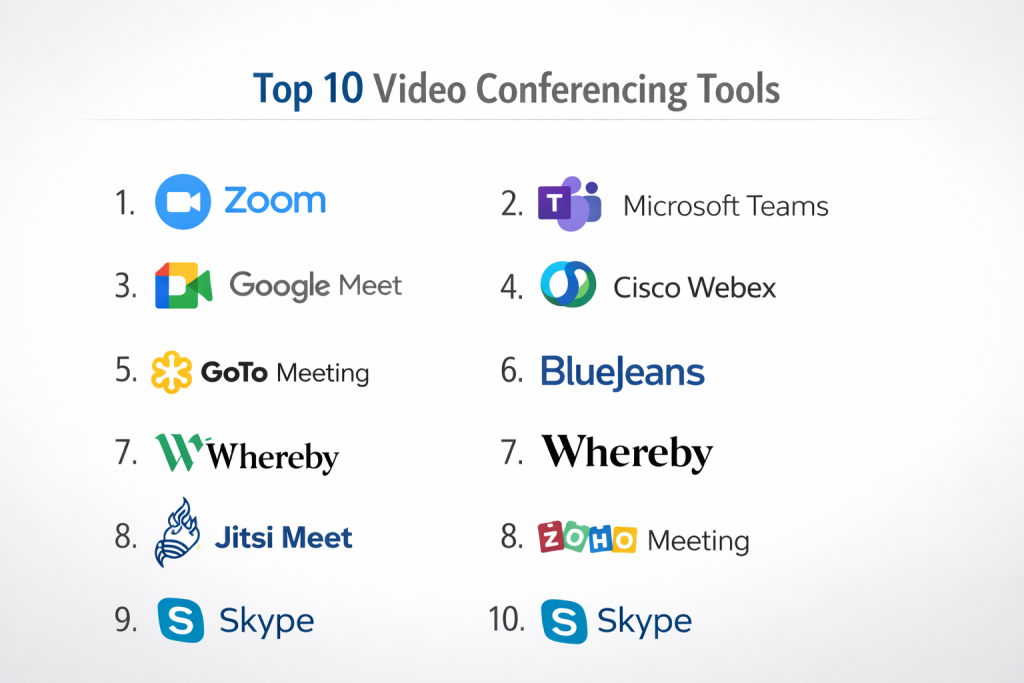
Top 10 Video Conferencing Tools
#1 — Zoom
Short description: A market-leading video conferencing platform known for reliability, ease of use, and strong performance across all meeting sizes.
Key Features
- HD video and audio conferencing
- Breakout rooms
- Screen sharing and whiteboard
- AI meeting summaries
- Webinar and event hosting
- Recording and cloud storage
Pros
- Very easy to use
- Excellent video quality
Cons
- Add-ons required for advanced features
- Security concerns historically (improved now)
Platforms / Deployment
Web / Windows / macOS / Linux / iOS / Android
Cloud
Security & Compliance
Encryption, SSO, MFA (details vary)
Integrations & Ecosystem
Wide ecosystem with productivity and business tools.
- Google Workspace
- Microsoft Teams
- Slack
- Salesforce
Support & Community
Extensive documentation and global user base.
#2 — Microsoft Teams
Short description: A collaboration-focused platform combining video meetings with chat and file sharing, ideal for Microsoft ecosystem users.
Key Features
- Video conferencing and calling
- Persistent chat
- File collaboration
- Meeting recordings
- AI-powered insights
Pros
- Deep Microsoft integration
- Strong enterprise features
Cons
- Complex interface
- Performance can vary
Platforms / Deployment
Web / Windows / macOS / iOS / Android
Cloud
Security & Compliance
SSO, MFA, enterprise compliance (varies)
Integrations & Ecosystem
Deep Microsoft ecosystem integration.
- Outlook
- SharePoint
- OneDrive
Support & Community
Large enterprise support ecosystem.
#3 — Google Meet
Short description: A simple and reliable video conferencing tool integrated with Google Workspace.
Key Features
- Browser-based meetings
- Screen sharing
- Live captions
- Integration with Gmail and Calendar
- Secure access controls
Pros
- No installation required
- Easy to use
Cons
- Limited advanced features
- Less customization
Platforms / Deployment
Web / iOS / Android
Cloud
Security & Compliance
Encryption, SSO (varies)
Integrations & Ecosystem
Native Google ecosystem integration.
- Gmail
- Drive
- Calendar
Support & Community
Strong documentation and widespread use.
#4 — Cisco Webex
Short description: Enterprise-grade conferencing tool with strong security and advanced collaboration features.
Key Features
- HD video meetings
- AI meeting assistant
- Screen sharing
- Webinars and events
- Hardware integration
Pros
- Strong security
- Reliable performance
Cons
- Higher cost
- Complex setup
Platforms / Deployment
Web / Desktop / Mobile
Cloud / Hybrid
Security & Compliance
Enterprise-grade compliance and encryption
Integrations & Ecosystem
Enterprise integrations available.
- Microsoft tools
- CRM systems
Support & Community
Strong enterprise support and documentation.
#5 — GoTo Meeting
Short description: A reliable video conferencing solution designed for business meetings and collaboration.
Key Features
- HD video meetings
- Screen sharing
- Recording
- Mobile access
- Meeting analytics
Pros
- Easy setup
- Stable performance
Cons
- Limited innovation
- Basic UI
Platforms / Deployment
Web / Desktop / Mobile
Cloud
Security & Compliance
Not publicly stated
Integrations & Ecosystem
Supports common integrations.
- CRM tools
- Calendar apps
Support & Community
Standard support; documentation available.
#6 — BlueJeans
Short description: A video conferencing platform focused on high-quality video and enterprise-grade features.
Key Features
- Dolby-powered audio
- HD video
- Screen sharing
- Recording
- Webinar support
Pros
- Strong audio quality
- Enterprise focus
Cons
- Limited popularity
- Fewer integrations
Platforms / Deployment
Web / Desktop / Mobile
Cloud
Security & Compliance
Not publicly stated
Integrations & Ecosystem
Basic integrations.
- Calendar
- Collaboration tools
Support & Community
Moderate support availability.
#7 — Whereby
Short description: A lightweight browser-based video conferencing tool focused on simplicity and ease of access.
Key Features
- No downloads required
- Custom meeting rooms
- Screen sharing
- Recording
- Branding options
Pros
- Extremely simple
- Quick setup
Cons
- Limited scalability
- Fewer advanced features
Platforms / Deployment
Web / Mobile
Cloud
Security & Compliance
Not publicly stated
Integrations & Ecosystem
Minimal integrations.
- APIs
- Basic tools
Support & Community
Limited but improving support.
#8 — Jitsi Meet
Short description: An open-source video conferencing platform that offers flexibility and self-hosting capabilities.
Key Features
- Free video conferencing
- Screen sharing
- Encryption options
- Self-hosting capability
- No account required
Pros
- Open-source
- Highly flexible
Cons
- Requires technical setup
- Limited enterprise features
Platforms / Deployment
Web / Mobile
Cloud / Self-hosted
Security & Compliance
Varies / N/A
Integrations & Ecosystem
Open APIs and community integrations.
- Custom integrations
- Developer tools
Support & Community
Strong open-source community support.
#9 — Zoho Meeting
Short description: A budget-friendly video conferencing solution integrated with the Zoho ecosystem.
Key Features
- Video meetings
- Webinar hosting
- Screen sharing
- Recording
- Analytics
Pros
- Affordable
- Good integration with Zoho
Cons
- Limited advanced features
- UI improvements needed
Platforms / Deployment
Web / Mobile
Cloud
Security & Compliance
Not publicly stated
Integrations & Ecosystem
Zoho ecosystem integrations.
- Zoho CRM
- Zoho Projects
Support & Community
Good SMB-level support.
#10 — Skype
Short description: A long-standing communication tool offering video calls and messaging for individuals and businesses.
Key Features
- Video calls
- Voice calls
- Messaging
- Screen sharing
- Call recording
Pros
- Familiar interface
- Easy to use
Cons
- Declining relevance
- Limited modern features
Platforms / Deployment
Web / Desktop / Mobile
Cloud
Security & Compliance
Varies / N/A
Integrations & Ecosystem
Limited integrations.
- Microsoft ecosystem
Support & Community
Basic support and legacy user base.
Comparison Table (Top 10)
| Tool Name | Best For | Platform(s) Supported | Deployment | Standout Feature | Public Rating |
|---|---|---|---|---|---|
| Zoom | All users | All platforms | Cloud | Video quality | N/A |
| Microsoft Teams | Enterprise | All platforms | Cloud | Integration | N/A |
| Google Meet | SMB | Web/Mobile | Cloud | Simplicity | N/A |
| Cisco Webex | Enterprise | All platforms | Hybrid | Security | N/A |
| GoTo Meeting | SMB | All platforms | Cloud | Reliability | N/A |
| BlueJeans | Enterprise | All platforms | Cloud | Audio quality | N/A |
| Whereby | Small teams | Web | Cloud | Simplicity | N/A |
| Jitsi Meet | Developers | Web/Mobile | Hybrid | Open-source | N/A |
| Zoho Meeting | SMB | Web/Mobile | Cloud | Affordability | N/A |
| Skype | Individuals | All platforms | Cloud | Familiarity | N/A |
Evaluation & Scoring of Video Conferencing Tools
| Tool Name | Core (25%) | Ease (15%) | Integrations (15%) | Security (10%) | Performance (10%) | Support (10%) | Value (15%) | Weighted Total (0–10) |
|---|---|---|---|---|---|---|---|---|
| Zoom | 9 | 9 | 8 | 7 | 9 | 8 | 8 | 8.5 |
| Microsoft Teams | 9 | 7 | 10 | 9 | 8 | 8 | 8 | 8.6 |
| Google Meet | 7 | 9 | 7 | 7 | 8 | 7 | 9 | 7.9 |
| Cisco Webex | 9 | 6 | 8 | 9 | 9 | 8 | 7 | 8.3 |
| GoTo Meeting | 7 | 8 | 6 | 6 | 7 | 7 | 8 | 7.2 |
| BlueJeans | 7 | 7 | 6 | 6 | 8 | 7 | 7 | 7.1 |
| Whereby | 6 | 9 | 5 | 6 | 7 | 6 | 8 | 6.9 |
| Jitsi Meet | 7 | 6 | 7 | 7 | 6 | 7 | 9 | 7.1 |
| Zoho Meeting | 7 | 8 | 6 | 6 | 7 | 7 | 8 | 7.2 |
| Skype | 6 | 8 | 5 | 6 | 6 | 6 | 8 | 6.6 |
Interpretation:
These scores are comparative and designed to help shortlist tools. A higher score reflects balanced strengths across usability, features, and value—not necessarily the best fit for every use case. Always align scores with your specific needs.
Which Video Conferencing Tool Is Right for You?
Solo / Freelancer
Zoom, Google Meet, or Whereby for simplicity and low setup.
SMB
Zoho Meeting or GoTo Meeting for affordability and ease of use.
Mid-Market
Zoom or Microsoft Teams for balance of features and scalability.
Enterprise
Cisco Webex or Microsoft Teams for security and advanced capabilities.
Budget vs Premium
- Budget: Zoho Meeting, Jitsi
- Premium: Webex, Zoom Enterprise
Feature Depth vs Ease of Use
- Deep features: Teams, Webex
- Easy: Zoom, Google Meet
Integrations & Scalability
- Strong integrations: Teams, Zoom
- Flexible: Jitsi
Security & Compliance Needs
- High security: Webex, Teams
- Moderate: Zoom, Google Meet
Frequently Asked Questions (FAQs)
1. What is a video conferencing tool?
It enables real-time video communication over the internet, often with screen sharing and collaboration features.
2. Are these tools secure?
Most offer encryption and authentication, but security levels vary by provider and plan.
3. Which tool is best for large meetings?
Zoom and Webex are commonly used for large-scale meetings and webinars.
4. Can I record meetings?
Yes, most platforms offer recording features, sometimes as paid add-ons.
5. Do I need to install software?
Some tools like Google Meet and Whereby work directly in browsers.
6. What internet speed is required?
A stable broadband connection is recommended for HD video.
7. Can these tools integrate with CRM systems?
Yes, many tools integrate with CRM and productivity platforms.
8. Are free plans available?
Most tools offer limited free plans with restrictions.
9. How do I choose the right tool?
Consider features, team size, integrations, and budget.
10. What are alternatives to video conferencing?
Phone calls, messaging apps, and collaboration platforms.
Conclusion
Video conferencing tools have become a cornerstone of modern communication, enabling teams to collaborate effectively across distances. While platforms like Zoom and Microsoft Teams dominate with feature-rich ecosystems, simpler tools like Google Meet and Whereby offer ease of use for smaller teams. Enterprise-grade solutions such as Cisco Webex provide advanced security and reliability for large organizations, while open-source options like Jitsi offer flexibility for technical users. The best choice ultimately depends on your team size, workflow complexity, and integration needs. Before making a decision, shortlist a few tools, test them in real scenarios, and ensure they align with your communication goals and infrastructure.
