Introduction
Vector Search Tooling refers to platforms that enable similarity-based search using vector embeddings, allowing applications to understand semantic relationships between text, images, or other unstructured data. Unlike traditional keyword search, vector search finds items based on meaning and context, making it essential for AI, recommendation systems, and knowledge retrieval.
These tools are critical as enterprises increasingly deploy AI for semantic search, recommendations, and analytics, enabling faster and more accurate results across large datasets.
Real-world use cases include
- Semantic search in knowledge bases and document repositories
- Recommendation engines for eCommerce and media platforms
- Chatbots and virtual assistants with context-aware responses
- Image, video, and audio similarity search
- AI/ML feature retrieval for embeddings-based models
What buyers should evaluate
- Accuracy and relevance of vector similarity search
- Supported embedding types (text, image, multi-modal)
- Scalability for large datasets
- Latency and real-time search performance
- Integration with AI/ML pipelines and data sources
- Deployment flexibility (cloud, on-prem, hybrid)
- API and SDK support
- Security and access control
- Observability and performance monitoring
- Cost and licensing model
Best for: AI teams, data scientists, developers, enterprises implementing semantic search or AI-powered recommendations
Not ideal for: Teams using only keyword-based search or small-scale experimental AI projects
Key Trends in Vector Search Tooling
- Adoption of LLM-based embeddings for semantic understanding
- Real-time indexing for dynamic datasets
- Multi-modal search across text, image, and audio
- Cloud-native vector databases for scalability
- Integration with ML pipelines and MLOps workflows
- Open-source and managed service options
- Low-latency, high-throughput search
- AI-assisted similarity tuning
- Embedding compression for cost efficiency
- Secure and compliant multi-party data search
How We Selected These Tools
- Accuracy and performance of similarity search
- Support for modern embeddings (text, image, multi-modal)
- Integration with AI/ML pipelines
- Scalability for enterprise workloads
- Real-time indexing capabilities
- Security and compliance adherence
- Deployment flexibility (cloud, on-prem, hybrid)
- Usability for developers and teams
- Vendor reputation or open-source adoption
- Practical applicability for enterprise AI
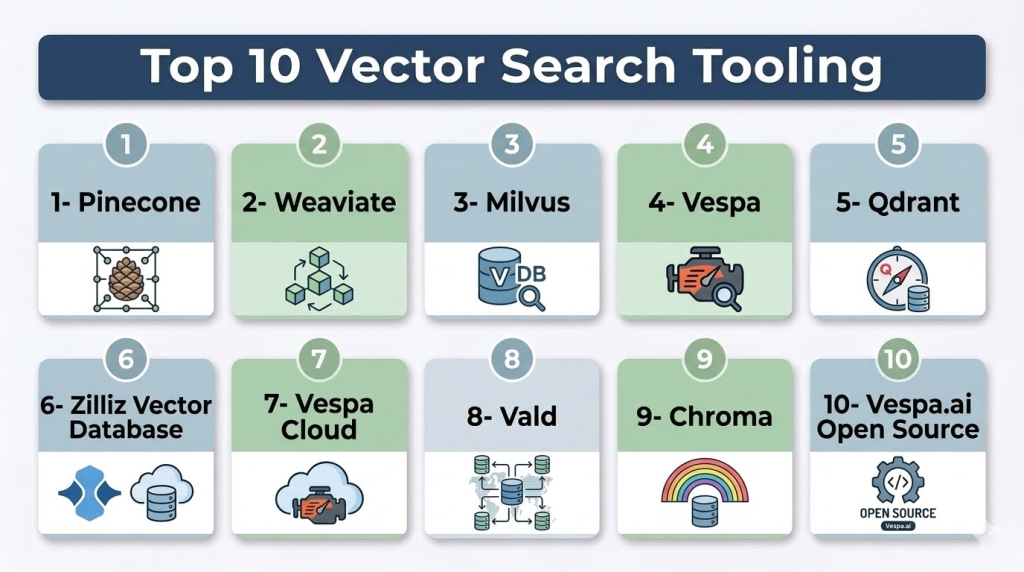
Top 10 Vector Search Tooling
1- Pinecone
Short description: Pinecone is a fully managed vector database optimized for high-speed similarity search at scale, suitable for AI and ML applications.
Key Features
- Real-time vector indexing and search
- Multi-dimensional similarity metrics
- Scalable architecture for millions of vectors
- API-first design
- Integration with AI embeddings
- Automatic sharding and scaling
- Analytics dashboards
Pros
- Fully managed and scalable
- Low-latency performance
- Easy AI integration
Cons
- SaaS-only
- Costs scale with dataset size
Platforms / Deployment
- Cloud
Security & Compliance
- Encryption and access control
- Not publicly stated
Integrations & Ecosystem
- Python SDK, REST API
- AI embeddings (OpenAI, Hugging Face)
- ML pipeline integration
Support & Community
Managed support and active developer community
2- Weaviate
Short description: Weaviate is an open-source vector search engine supporting semantic search for AI embeddings with multi-modal capabilities.
Key Features
- Real-time vector indexing
- Multi-modal search support
- Graph-based relationships
- Modular AI model integration
- Scalable clustering
- API and SDK support
- Observability dashboards
Pros
- Open-source and flexible
- Multi-modal and semantic search
- Scalable architecture
Cons
- Self-hosting requires expertise
- Smaller enterprise ecosystem
Platforms / Deployment
- Cloud / Self-hosted / Hybrid
Security & Compliance
- Not publicly stated
Integrations & Ecosystem
- Hugging Face, OpenAI embeddings
- Kubernetes deployment
- REST APIs and Python SDK
Support & Community
Active open-source community and enterprise options
3- Milvus
Short description: Milvus is an open-source vector database for high-performance similarity search in AI and ML applications.
Key Features
- GPU-accelerated search
- Distributed and fault-tolerant
- Supports billions of vectors
- Multi-metric similarity search
- Cloud-native deployment options
- API and SDK support
- Monitoring and analytics
Pros
- High-performance for large datasets
- Open-source flexibility
- AI/ML integration-ready
Cons
- Infrastructure setup required
- GPU resources can be costly
Platforms / Deployment
- Cloud / Self-hosted / Hybrid
Security & Compliance
- Not publicly stated
Integrations & Ecosystem
- Python, Java, REST APIs
- ML embeddings integration
- Kubernetes support
Support & Community
Open-source and enterprise community
4- Vespa
Short description: Vespa is an open-source platform for real-time vector and semantic search, combining search, AI ranking, and recommendations.
Key Features
- Real-time vector search
- Multi-modal embeddings
- AI-powered ranking and recommendations
- Distributed and scalable architecture
- API-first platform
- Analytics dashboards
- Integration with ML pipelines
Pros
- Scalable semantic search
- Supports multi-modal AI embeddings
- Enterprise-ready
Cons
- Requires DevOps knowledge
- Self-managed setup complexity
Platforms / Deployment
- Cloud / Self-hosted
Security & Compliance
- Not publicly stated
Integrations & Ecosystem
- Python, Java, REST APIs
- AI embeddings and ML pipelines
Support & Community
Open-source community and technical documentation
5- Qdrant
Short description: Qdrant is a vector database with Python-native support for semantic search and AI embeddings.
Key Features
- Real-time vector indexing
- Multi-dimensional similarity metrics
- Python SDK
- Distributed and scalable
- Metadata filtering for hybrid search
- API-first design
- Analytics dashboards
Pros
- Python integration
- Open-source flexibility
- Low-latency search
Cons
- Self-hosting required for full control
- Smaller ecosystem
Platforms / Deployment
- Cloud / Self-hosted / Hybrid
Security & Compliance
- Not publicly stated
Integrations & Ecosystem
- Python SDK, REST APIs
- AI embeddings
- ML workflow integration
Support & Community
Open-source and developer-focused
6- Zilliz Vector Database
Short description: Zilliz provides a GPU-powered vector database optimized for high-scale AI and ML similarity search.
Key Features
- GPU acceleration
- Distributed and fault-tolerant
- Real-time search and updates
- Multi-modal embeddings
- API and SDK integration
- Analytics dashboards
- Scalable clustering
Pros
- High performance for large datasets
- Real-time search
- AI-ready
Cons
- GPU infrastructure may be costly
- Setup complexity
Platforms / Deployment
- Cloud / Self-hosted / Hybrid
Security & Compliance
- Not publicly stated
Integrations & Ecosystem
- Python, REST APIs
- ML embeddings integration
- Kubernetes support
Support & Community
Enterprise support and open-source community
7- Vespa Cloud
Short description: Cloud-managed Vespa provides real-time vector search and AI-powered recommendations without self-hosting.
Key Features
- Fully managed service
- Multi-modal vector search
- AI-based ranking
- API and SDK integration
- Analytics dashboards
- Scalable infrastructure
- Automated updates
Pros
- Fully managed
- Enterprise-ready
- Easy integration
Cons
- Cloud-only
- Limited on-prem control
Platforms / Deployment
- Cloud
Security & Compliance
- Not publicly stated
Integrations & Ecosystem
- REST APIs
- AI embeddings
- SaaS and ML pipelines
Support & Community
Managed enterprise support
8- Vald
Short description: Vald is an open-source real-time vector search engine for AI and ML similarity applications.
Key Features
- Real-time indexing
- Distributed and fault-tolerant
- Multi-modal embeddings
- GPU acceleration
- API-first architecture
- Analytics dashboards
- Multi-party support
Pros
- Open-source flexibility
- Real-time performance
- Multi-modal support
Cons
- Self-hosting required
- Limited enterprise support
Platforms / Deployment
- Cloud / Self-hosted / Hybrid
Security & Compliance
- Not publicly stated
Integrations & Ecosystem
- Python, Go APIs
- AI embeddings and ML pipelines
Support & Community
Open-source community
9- Chroma
Short description: Chroma is a developer-friendly vector database for embedding-based search and AI retrieval.
Key Features
- Real-time vector search
- Python SDK and REST API
- Multi-modal embeddings
- Distributed and scalable
- Metadata filtering
- Analytics dashboards
- Hybrid search support
Pros
- Easy Python integration
- Open-source flexibility
- Fast and scalable
Cons
- Self-hosted required
- Smaller ecosystem
Platforms / Deployment
- Cloud / Self-hosted / Hybrid
Security & Compliance
- Not publicly stated
Integrations & Ecosystem
- Python SDK, REST APIs
- AI embeddings and ML pipelines
Support & Community
Open-source and developer community
10- Vespa.ai Open Source
Short description: Vespa.ai provides an open-source platform for high-performance semantic and vector search across multiple data types.
Key Features
- Distributed vector search
- Multi-modal embeddings
- AI ranking and relevance tuning
- Real-time updates
- API-first architecture
- Analytics dashboards
- Scalable architecture
Pros
- High-performance and flexible
- Open-source and customizable
- Multi-modal AI-ready
Cons
- Self-hosting requires expertise
- Enterprise features require configuration
Platforms / Deployment
- Cloud / Self-hosted
Security & Compliance
- Not publicly stated
Integrations & Ecosystem
- Python, Java, REST APIs
- AI embeddings and ML pipelines
Support & Community
Open-source community and enterprise support
Comparison Table
| Tool | Best For | Platform(s) | Deployment | Standout Feature | Public Rating |
|---|---|---|---|---|---|
| Pinecone | AI/ML pipelines | Cloud | Cloud | Fully managed | N/A |
| Weaviate | Multi-modal embeddings | Cloud/Self-hosted | Hybrid | Graph-based relationships | N/A |
| Milvus | High-performance AI | Cloud/Self-hosted | Hybrid | GPU acceleration | N/A |
| Vespa | Enterprise AI | Cloud/Self-hosted | Hybrid | AI ranking & recommendations | N/A |
| Qdrant | Python ML pipelines | Cloud/Self-hosted | Hybrid | Python-native SDK | N/A |
| Zilliz | Large-scale AI | Cloud/Self-hosted | Hybrid | GPU-powered search | N/A |
| Vespa Cloud | Managed vector search | Cloud | Cloud | Fully managed & scalable | N/A |
| Vald | Real-time AI | Cloud/Self-hosted | Hybrid | Open-source, real-time | N/A |
| Chroma | Developer-friendly | Cloud/Self-hosted | Hybrid | Python-native integration | N/A |
| Vespa.ai OS | Open-source semantic search | Cloud/Self-hosted | Hybrid | Multi-modal AI-ready | N/A |
Evaluation & Scoring of Vector Search Tooling
| Tool | Core (25%) | Ease (15%) | Integrations (15%) | Security (10%) | Performance (10%) | Support (10%) | Value (15%) | Weighted Total |
|---|---|---|---|---|---|---|---|---|
| Pinecone | 9 | 9 | 8 | 8 | 9 | 8 | 8 | 8.6 |
| Weaviate | 8 | 8 | 8 | 7 | 8 | 7 | 8 | 7.9 |
| Milvus | 9 | 7 | 8 | 7 | 9 | 7 | 8 | 8.1 |
| Vespa | 8 | 7 | 8 | 7 | 8 | 7 | 8 | 7.8 |
| Qdrant | 8 | 8 | 7 | 7 | 8 | 7 | 8 | 7.8 |
| Zilliz | 9 | 7 | 8 | 7 | 9 | 7 | 8 | 8.1 |
| Vespa Cloud | 8 | 8 | 8 | 8 | 8 | 7 | 8 | 7.9 |
| Vald | 8 | 7 | 7 | 7 | 8 | 7 | 7 | 7.5 |
| Chroma | 8 | 8 | 7 | 7 | 8 | 7 | 7 | 7.6 |
| Vespa.ai OS | 8 | 7 | 8 | 7 | 8 | 7 | 8 | 7.8 |
Which Vector Search Tool Is Right for You?
Solo / Freelancer
- Chroma, Qdrant
Lightweight and open-source tools for small projects
SMB
- Weaviate, Vespa Cloud, Vald
Flexible cloud and hybrid solutions for mid-scale AI
Mid-Market
- Pinecone, Milvus, Zilliz
High-performance vector search for enterprise AI
Enterprise
- Vespa, Vespa.ai Open Source
Scalable semantic search with multi-modal AI support
Budget vs Premium
- Budget: Chroma, Vald, Qdrant
- Premium: Pinecone, Zilliz, Vespa
Feature Depth vs Ease of Use
- Ease: Vespa Cloud, Qdrant
- Depth: Pinecone, Milvus, Vespa
Integrations & Scalability
- Best: Pinecone, Milvus, Zilliz
Security & Compliance Needs
- Enterprise-ready: Pinecone, Vespa, Zilliz
Frequently Asked Questions
1- What is vector search tooling?
It enables semantic similarity search using embeddings instead of keyword matching.
2- Can these tools handle multiple data types?
Yes, most support text, images, audio, and multi-modal embeddings.
3- Do they integrate with AI/ML pipelines?
Yes, APIs and SDKs allow seamless integration.
4- Are there open-source options?
Yes, Weaviate, Milvus, Vald, Chroma, and Vespa.ai Open Source are open-source.
5- Can these tools scale for enterprise datasets?
Yes, GPU-accelerated and cloud-native options handle billions of vectors.
6- Are these tools cloud-only?
Some are fully managed cloud services; others support hybrid or self-hosted deployments.
7- How do they support AI embeddings?
They integrate with frameworks like OpenAI, Hugging Face, and custom embeddings.
8- What industries benefit most?
AI, eCommerce, knowledge management, media, and enterprise semantic search.
9- Can they perform real-time search?
Yes, most platforms provide low-latency, real-time vector search.
10- How should I choose the right tool?
Consider scale, embedding type, deployment, integration, and budget before adoption.
Conclusion
Vector Search Tooling is essential for semantic search, recommendations, and AI knowledge retrieval, providing fast, accurate, and scalable similarity search across multi-modal datasets.
Choosing the right tool depends on project scale, deployment preferences, and integration needs. A practical approach is to shortlist platforms, pilot embeddings and queries, and validate performance and scalability before full enterprise deployment.
