Introduction
Search Indexing Pipelines are software frameworks and workflows designed to efficiently collect, process, and organize data for search engines and information retrieval systems. They convert raw data from multiple sources into structured, searchable indexes, enabling fast and relevant search results. These pipelines are crucial for enterprises managing large volumes of content, e-commerce platforms, knowledge bases, and AI-driven search systems.
Organizations use search indexing pipelines to ensure high-quality search experiences, support advanced ranking algorithms, and maintain up-to-date indexes across distributed data sources. Pipelines often integrate data extraction, transformation, enrichment, and indexing stages, supporting both batch and real-time updates.
Real World Use Cases
- Indexing e-commerce product catalogs
- Knowledge base and document search
- AI-powered semantic search
- Enterprise content management
- Real-time search updates in media platforms
- Supporting recommendation systems
- Web crawling and aggregation pipelines
- Search analytics and ranking optimization
Evaluation Criteria for Buyers
- Scalability for large datasets
- Support for batch and real-time indexing
- Integration with search engines and AI pipelines
- Data transformation and enrichment capabilities
- Monitoring and logging
- Error handling and retries
- Multi-format and multi-source support
- Extensibility and API availability
- Deployment flexibility (cloud, on-premise, hybrid)
- Security and access controls
Best for: Search engineers, data engineers, AI/ML teams, and organizations managing large-scale search platforms.
Not ideal for: Small projects with minimal data or static search requirements that do not need automated pipelines.
Key Trends in Search Indexing Pipelines
- Cloud-native and distributed indexing architectures
- Real-time or near-real-time data indexing
- AI and ML-based content enrichment
- Integration with semantic and vector search systems
- Monitoring dashboards and observability
- Scalable ETL and data transformation pipelines
- Multi-format and multi-language support
- Support for structured and unstructured data
- Event-driven and streaming indexing
- Open-source adoption and community-driven enhancements
How We Selected These Tools (Methodology)
- Proven scalability in enterprise search deployments
- Support for real-time and batch processing
- Compatibility with search engines and AI systems
- Data transformation and enrichment features
- Monitoring, logging, and observability support
- Error handling and retry mechanisms
- Extensibility via APIs or SDKs
- Deployment flexibility (cloud, on-premise, hybrid)
- Community adoption and open-source contributions
- Vendor support and documentation
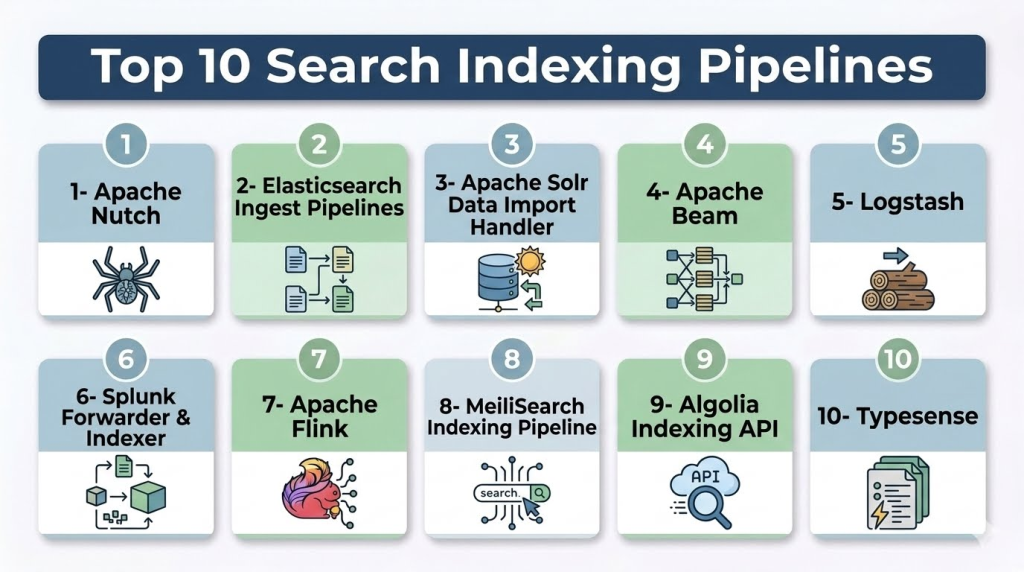
Top 10 Search Indexing Pipelines
1- Apache Nutch
Short Description:
Apache Nutch is an open-source web crawler and indexing platform for building scalable search pipelines.
Key Features
- Web crawling and parsing
- Full-text indexing
- Plugin-based architecture
- Supports structured and unstructured data
- Integration with Apache Solr and Elasticsearch
- Scalable and distributed
- Open-source community support
Pros
- Open-source and flexible
- Large community and documentation
- Highly scalable
Cons
- Requires setup and configuration
- Primarily web-focused
Platforms / Deployment
Linux, Cloud, On-premise
Security & Compliance
Varies / N/A
Integrations & Ecosystem
- Apache Solr, Elasticsearch
- Hadoop ecosystem
- Custom ETL pipelines
Support & Community
Open-source community
2- Elasticsearch Ingest Pipelines
Short Description:
Elasticsearch Ingest Pipelines provide built-in capabilities to process, enrich, and index data before storing it in Elasticsearch.
Key Features
- Pre-processing and enrichment of documents
- Built-in processors (geo, date, NLP)
- Real-time indexing
- Integration with Kibana for visualization
- Multi-source ingestion
- Pipeline chaining for complex workflows
- Scalable and distributed
Pros
- Native to Elasticsearch
- Flexible and easy to configure
- Supports real-time indexing
Cons
- Elasticsearch dependency
- Limited external data transformation
Platforms / Deployment
Cloud, On-premise
Security & Compliance
RBAC, encryption
Integrations & Ecosystem
- Elasticsearch, Kibana
- Logstash, Beats
- Python/Java clients
Support & Community
Elastic enterprise support and community
3- Apache Solr Data Import Handler
Short Description:
Solr DIH provides a framework to import, transform, and index data from databases and other sources into Apache Solr.
Key Features
- Batch and incremental data import
- JDBC and file source support
- Data transformation and enrichment
- Scheduling and monitoring
- Integration with Solr search engine
- Support for XML, JSON, CSV
- Scalable and distributed
Pros
- Tight Solr integration
- Supports multiple data sources
- Reliable batch indexing
Cons
- Limited real-time indexing
- Requires Solr expertise
Platforms / Deployment
Cloud, On-premise
Security & Compliance
Varies / N/A
Integrations & Ecosystem
- Solr
- Databases (MySQL, PostgreSQL, etc.)
- Custom ETL pipelines
Support & Community
Open-source Solr community
4- Apache Beam
Short Description:
Apache Beam is an open-source unified programming model for batch and streaming data processing, suitable for search indexing pipelines.
Key Features
- Unified batch and streaming processing
- Integration with multiple runners (Flink, Spark, Dataflow)
- Data transformation and enrichment
- Scalable and distributed
- Multi-language SDKs (Java, Python, Go)
- Event-time processing support
- Open-source and extensible
Pros
- Flexible and scalable
- Supports complex workflows
- Multi-runner execution
Cons
- Requires programming expertise
- Learning curve for new users
Platforms / Deployment
Cloud, On-premise
Security & Compliance
Varies / N/A
Integrations & Ecosystem
- Apache Flink, Spark, Dataflow
- Elasticsearch, Solr
- ML pipelines
Support & Community
Open-source community
5- Logstash
Short Description:
Logstash is an open-source data processing pipeline for ingesting, transforming, and forwarding data to search engines and storage.
Key Features
- Real-time data ingestion
- Multiple input, filter, and output plugins
- Data transformation and enrichment
- Integration with Elasticsearch
- Event-driven pipeline
- Scalable and distributed
- Logging and monitoring
Pros
- Flexible and extensible
- Supports multiple data sources
- Easy integration with ELK stack
Cons
- Requires configuration management
- Performance tuning may be needed
Platforms / Deployment
Cloud, On-premise
Security & Compliance
Varies / N/A
Integrations & Ecosystem
- Elasticsearch, Kibana
- Beats, Filebeat, Kafka
- Custom pipelines
Support & Community
Open-source community
6- Splunk Forwarder & Indexer
Short Description:
Splunk provides data ingestion and indexing capabilities for enterprise search and analytics pipelines.
Key Features
- Real-time and batch data ingestion
- Pre-processing and transformation
- Integration with Splunk search and dashboards
- Scalability for enterprise workloads
- Event monitoring and alerting
- Multi-source support
- Secure and compliant
Pros
- Enterprise-ready
- Strong monitoring capabilities
- Supports multiple data sources
Cons
- Commercial solution
- Requires Splunk expertise
Platforms / Deployment
Cloud, On-premise, Hybrid
Security & Compliance
RBAC, encryption, audit logs
Integrations & Ecosystem
- Databases, logs, API sources
- BI and analytics tools
- MLOps pipelines
Support & Community
Enterprise support
7- Apache Flink
Short Description:
Apache Flink is a stream-processing framework for building real-time search indexing pipelines and analytics workflows.
Key Features
- Real-time stream processing
- Event-time and windowed processing
- Integration with indexing and storage systems
- Scalable and distributed
- Fault-tolerant processing
- Multi-source ingestion
- Open-source extensibility
Pros
- High throughput and low latency
- Supports complex event processing
- Open-source
Cons
- Requires technical expertise
- Complex deployment
Platforms / Deployment
Cloud, On-premise
Security & Compliance
Varies / N/A
Integrations & Ecosystem
- Elasticsearch, Solr
- Kafka, Kinesis
- ML pipelines
Support & Community
Open-source community
8- MeiliSearch Indexing Pipeline
Short Description:
MeiliSearch provides a fast and easy-to-deploy search engine with built-in indexing pipelines for structured and semi-structured data.
Key Features
- Real-time indexing
- API-based ingestion
- Ranking and relevance tuning
- Multi-language support
- Scalable search engine
- Open-source
- JSON-based data support
Pros
- Lightweight and fast
- Easy API integration
- Open-source
Cons
- Limited complex data transformation
- Smaller community than Solr/Elasticsearch
Platforms / Deployment
Cloud, On-premise
Security & Compliance
Varies / N/A
Integrations & Ecosystem
- JSON data pipelines
- ML enrichment via API
- Analytics tools
Support & Community
Open-source support
9- Algolia Indexing API
Short Description:
Algolia provides a managed search service with robust indexing pipelines for web and application search.
Key Features
- Real-time indexing via API
- Multi-source ingestion
- Ranking and relevance customization
- Analytics dashboards
- Scalability for high traffic
- Multi-language support
- Managed cloud service
Pros
- Easy to deploy
- Managed service
- High performance
Cons
- Commercial solution
- Cloud-only
Platforms / Deployment
Cloud
Security & Compliance
Encryption, RBAC, audit logging
Integrations & Ecosystem
- Web and app platforms
- Analytics tools
- AI enrichment pipelines
Support & Community
Enterprise support
10- Typesense
Short Description:
Typesense is an open-source search engine with built-in real-time indexing and easy-to-deploy pipelines.
Key Features
- Real-time indexing
- Multi-language support
- API-driven ingestion
- Ranking customization
- Scalable search engine
- Open-source and self-hosted options
- Analytics dashboards
Pros
- Lightweight and fast
- Easy deployment
- Open-source
Cons
- Limited complex enrichment
- Smaller community than Elasticsearch
Platforms / Deployment
Cloud, On-premise
Security & Compliance
Varies / N/A
Integrations & Ecosystem
- JSON/structured data pipelines
- Web and application platforms
- Analytics and ML enrichment
Support & Community
Open-source support
Comparison Table
| Tool Name | Best For | Platforms Supported | Deployment | Standout Feature | Public Rating |
|---|---|---|---|---|---|
| Apache Nutch | Web crawling | Cloud, On-prem | Open-source pipeline | Scalable web indexing | N/A |
| Elasticsearch Ingest Pipelines | Real-time indexing | Cloud, On-prem | Elasticsearch | Native pre-processing | N/A |
| Solr DIH | Database ingestion | Cloud, On-prem | Solr | Batch data import | N/A |
| Apache Beam | Batch & streaming | Cloud, On-prem | Multi-runner | Unified processing | N/A |
| Logstash | ETL pipelines | Cloud, On-prem | ELK stack | Flexible plugins | N/A |
| Splunk Forwarder & Indexer | Enterprise search | Cloud, On-prem, Hybrid | Enterprise | Event monitoring | N/A |
| Apache Flink | Streaming pipelines | Cloud, On-prem | Open-source | Low-latency streams | N/A |
| MeiliSearch | Web & app search | Cloud, On-prem | Open-source | Lightweight & fast | N/A |
| Algolia | Managed search | Cloud | Cloud | Real-time API indexing | N/A |
| Typesense | Self-hosted search | Cloud, On-prem | Open-source | Easy real-time indexing | N/A |
Evaluation & Scoring Table
| Tool Name | Core | Ease | Integrations | Security | Performance | Support | Value | Weighted Total |
|---|---|---|---|---|---|---|---|---|
| Apache Nutch | 9.0 | 8.5 | 8.7 | 8.6 | 8.9 | 8.5 | 8.6 | 8.71 |
| Elasticsearch | 9.2 | 8.7 | 9.0 | 8.8 | 9.1 | 8.8 | 8.7 | 8.91 |
| Solr DIH | 8.9 | 8.5 | 8.7 | 8.6 | 8.8 | 8.5 | 8.5 | 8.64 |
| Apache Beam | 9.0 | 8.4 | 8.8 | 8.7 | 8.9 | 8.6 | 8.6 | 8.71 |
| Logstash | 8.8 | 8.5 | 8.7 | 8.6 | 8.8 | 8.5 | 8.5 | 8.63 |
| Splunk | 9.1 | 8.6 | 8.9 | 8.8 | 9.0 | 8.7 | 8.6 | 8.84 |
| Apache Flink | 9.0 | 8.5 | 8.8 | 8.7 | 9.0 | 8.6 | 8.6 | 8.78 |
| MeiliSearch | 8.7 | 8.6 | 8.7 | 8.6 | 8.8 | 8.5 | 8.5 | 8.61 |
| Algolia | 8.9 | 8.7 | 8.8 | 8.7 | 8.9 | 8.6 | 8.5 | 8.71 |
| Typesense | 8.8 | 8.6 | 8.7 | 8.6 | 8.8 | 8.5 | 8.5 | 8.63 |
Which Search Indexing Pipeline Is Right for You?
Solo / Freelancer
MeiliSearch and Typesense are suitable for small-scale web or app search projects.
SMB
Solr DIH, Logstash, and Apache Beam provide batch and streaming indexing pipelines for mid-sized teams.
Mid-Market
Elasticsearch Ingest Pipelines, Apache Flink, and Splunk Forwarder support enterprise search with real-time capabilities.
Enterprise
Apache Nutch, Elasticsearch, and Splunk offer scalable indexing for distributed enterprise environments with monitoring and analytics.
Budget vs Premium
Open-source solutions like Apache Nutch, Beam, and MeiliSearch are cost-effective; commercial platforms like Splunk and Algolia provide managed services.
Feature Depth vs Ease of Use
Elasticsearch and Apache Beam offer advanced capabilities; MeiliSearch and Typesense prioritize ease of deployment.
Integrations & Scalability
Enterprise platforms integrate with multiple data sources, AI pipelines, and analytics systems for large-scale search indexing.
Security & Compliance Needs
Enterprise deployments should ensure encryption, RBAC, and audit logging for secure search operations.
Frequently Asked Questions
1- What is a search indexing pipeline?
A workflow that collects, processes, and structures data to create searchable indexes.
2- Why use search indexing pipelines?
They enable fast, relevant search results and maintain up-to-date search indexes across distributed datasets.
3- Which industries use these pipelines?
E-commerce, media, enterprise knowledge management, and AI-powered search services.
4- Can they process real-time data?
Yes, modern pipelines like Elasticsearch and Flink support real-time indexing.
5- Are there open-source options?
Yes, Apache Nutch, Solr DIH, Apache Beam, MeiliSearch, and Typesense are open-source.
6- Do they support multi-format data?
Yes, most pipelines handle structured, semi-structured, and unstructured data.
7- Can they integrate with AI pipelines?
Yes, pipelines often support ML and AI integration for semantic and vector search.
8- How scalable are these tools?
Enterprise platforms like Elasticsearch, Flink, and Splunk scale for high-volume indexing.
9- Are managed solutions available?
Yes, Algolia and Splunk provide cloud-based managed indexing services.
10- How complex is deployment?
Open-source tools require setup and configuration; managed solutions provide easy deployment and dashboards.
Conclusion
Search Indexing Pipelines are essential for building fast, relevant, and scalable search experiences. Open-source solutions like MeiliSearch, Typesense, and Apache Nutch provide cost-effective, flexible pipelines, while Elasticsearch, Apache Flink, and Splunk offer enterprise-grade indexing with real-time capabilities. Organizations should evaluate data scale, integration needs, deployment environment, and monitoring requirements before selecting a pipeline, and pilot multiple tools to ensure optimal performance and search relevance.
