Introduction
Treasury ALM Software helps banks, credit unions, insurers, treasury teams, and financial institutions manage the relationship between assets, liabilities, liquidity, interest rate exposure, funding costs, and balance sheet risk. In simple words, it helps finance and risk teams understand how changes in rates, deposits, loans, cash flows, market conditions, and funding pressure can affect earnings, liquidity, capital, and long-term financial stability.
Treasury ALM matters because financial institutions cannot rely only on static reports or spreadsheet models when balance sheets are affected by changing rates, liquidity movements, customer behavior, and regulatory expectations. A strong ALM platform gives treasury, finance, risk, and executive teams a governed way to test scenarios, forecast cash flows, analyze interest rate risk, prepare ALCO reports, and make better funding decisions.
Real-world use cases include:
- Interest rate risk management for measuring earnings and economic value sensitivity
- Liquidity risk analysis for monitoring funding gaps and cash flow pressure
- Balance sheet forecasting for planning assets, liabilities, deposits, and loans
- ALCO reporting for executive and board-level treasury decisions
- Stress testing for checking how the institution performs under adverse scenarios
- Funds transfer pricing for allocating funding costs across business lines
Evaluation Criteria for Buyers:
- Interest rate risk modeling
- Liquidity risk analysis
- Cash flow forecasting
- Scenario and stress testing
- Balance sheet simulation
- Regulatory reporting support
- Data integration capability
- Workflow governance and auditability
- ALCO reporting and dashboards
- Deployment flexibility and support quality
Best for: Treasury ALM Software is best for banks, credit unions, insurers, lending institutions, treasury departments, CFO teams, risk teams, ALCO committees, and financial institutions that need structured balance sheet modeling, interest rate risk analysis, liquidity planning, and scenario-based decision support.
Not ideal for: Treasury ALM Software may not be ideal for very small businesses, non-financial companies with simple cash needs, or teams that only need basic cash management. In those cases, treasury management systems, budgeting software, business intelligence tools, or spreadsheet-based models may be enough.
Key Trends in Treasury ALM Software
- Integrated treasury and risk workflows are becoming more important because institutions want one connected view of liquidity, rates, funding, and balance sheet performance.
- Scenario-based planning is now a core requirement because treasury teams need to understand how changing rates, deposits, loan demand, and market shocks affect earnings and liquidity.
- Cloud and hybrid deployment models are gaining attention as institutions look for scalable computation, faster reporting, and lower infrastructure burden.
- Data governance and auditability are becoming must-have capabilities because ALM results are used for board reporting, regulatory review, and executive decisions.
- Behavioral modeling is becoming more important for non-maturity deposits, prepayments, early withdrawals, loan behavior, and customer response to rate changes.
- Liquidity stress testing is becoming more closely linked with treasury planning, cash flow forecasting, and funding strategy.
- ALCO reporting automation is reducing manual spreadsheet preparation and helping treasury teams create more consistent management reports.
- AI-assisted analytics are starting to support anomaly detection, assumption review, scenario suggestions, and faster interpretation of risk outputs.
- Interoperability with core banking, ERP, data warehouses, and reporting tools is now critical because ALM accuracy depends on clean and timely data.
- Model governance and validation are becoming stronger buying criteria as institutions need explainable assumptions and defensible results.
How We Selected These Tools
The tools in this list were selected based on their relevance to treasury ALM, balance sheet management, liquidity risk, interest rate risk, and financial institution risk workflows. The goal is not to claim one universal winner, but to give buyers a practical comparison of recognized platforms across enterprise, mid-market, banking, credit union, and quantitative use cases.
Selection factors include:
- Market recognition in treasury, ALM, banking risk, or balance sheet management
- Support for interest rate risk, liquidity risk, and balance sheet forecasting
- Scenario modeling and stress testing capabilities
- Fit for banks, credit unions, insurers, and treasury-led institutions
- Workflow support for ALCO reporting and governance
- Integration with core banking, treasury, finance, and data platforms
- Ability to support regulatory, executive, and board-level reporting
- Deployment flexibility across cloud, self-hosted, and hybrid environments
- Support quality, documentation, onboarding, and implementation ecosystem
- Practical buyer fit across enterprise, mid-market, and specialist teams
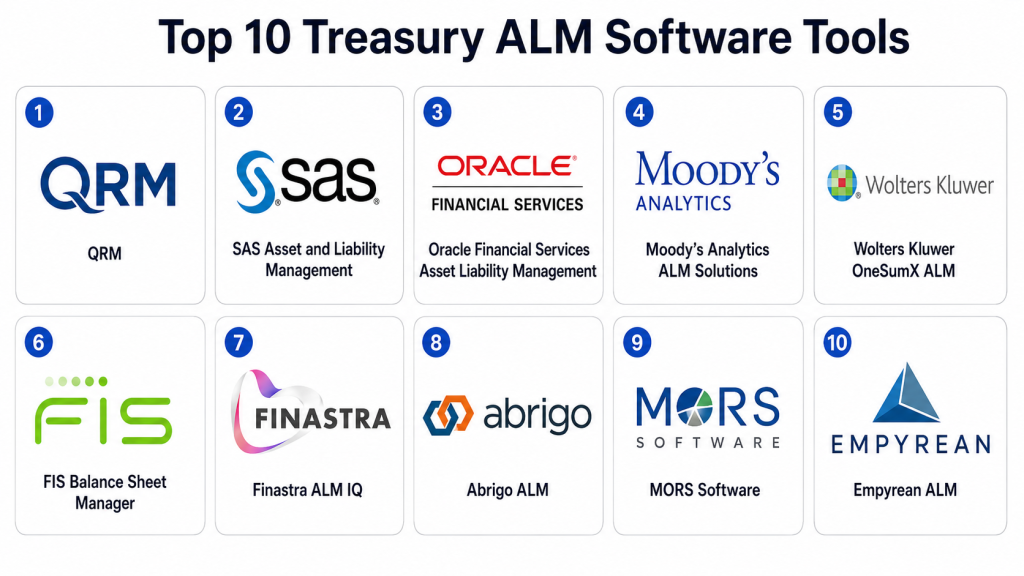
Top 10 Treasury ALM Software Tools
1- QRM
Short description: QRM is a specialized financial risk and balance sheet management platform used by banks and financial institutions for asset liability management, liquidity risk, interest rate risk, and treasury analytics. It is well suited for organizations that need detailed balance sheet simulation and advanced ALM modeling.
Key Features
- Asset liability management modeling
- Interest rate risk analysis
- Liquidity risk stress testing
- Balance sheet simulation
- Funds transfer pricing support
- Earnings and value sensitivity analysis
- Treasury and finance risk reporting
Pros
- Strong fit for banks with complex balance sheet structures
- Deep ALM and treasury risk modeling capabilities
- Useful for liquidity, funding, and interest rate risk planning
Cons
- May require specialized ALM and treasury knowledge
- Implementation can be complex for smaller institutions
- Pricing and configuration details vary by customer need
Platforms / Deployment
Cloud / Self-hosted / Hybrid / Varies by implementation
Security & Compliance
QRM is used in financial services environments where access control, governance, auditability, and data protection are important. Specific certifications, encryption controls, SSO, MFA, and compliance details should be verified directly with the vendor. Not publicly stated for every deployment.
Integrations & Ecosystem
QRM typically connects with banking, treasury, finance, and risk data sources to support a centralized ALM process. It is commonly used where institutions need to combine loan, deposit, market, cash flow, and accounting data into one modeling environment.
Common integration areas include:
- Core banking systems
- Treasury systems
- General ledger data
- Risk data warehouses
- Liquidity reporting tools
- Business intelligence platforms
Support & Community
QRM provides specialized implementation support, training, documentation, and domain expertise for financial institutions. Community visibility may be more limited than broad enterprise software vendors, but the platform is highly focused on treasury and ALM use cases.
2- SAS Asset and Liability Management
Short description: SAS Asset and Liability Management supports banks and financial institutions with interest rate risk, liquidity risk, balance sheet modeling, and stress testing. It is suitable for institutions that need advanced analytics, strong modeling depth, and integration with broader risk systems.
Key Features
- Interest rate risk measurement
- Funding liquidity risk analysis
- Scenario and stress testing
- Cash flow and repricing analysis
- Behavioral risk modeling support
- Integration with third-party and open modeling approaches
- Enterprise analytics and reporting capabilities
Pros
- Strong analytics and modeling capabilities
- Useful for large and complex financial institutions
- Fits organizations already using SAS risk or analytics environments
Cons
- May require skilled analytics and risk teams
- Implementation can require planning and data preparation
- Smaller institutions may find it more advanced than needed
Platforms / Deployment
Cloud / Self-hosted / Hybrid depending on configuration
Security & Compliance
SAS commonly supports enterprise security features such as user permissions, access controls, authentication integration, and auditability depending on deployment. Specific certifications and compliance controls should be verified directly with the vendor. Not publicly stated for every configuration.
Integrations & Ecosystem
SAS integrates with enterprise data platforms, statistical models, risk systems, reporting tools, and finance environments. It is useful for institutions that want ALM analytics connected with broader risk management and data science workflows.
Common integration areas include:
- Enterprise data warehouses
- Risk analytics platforms
- Finance and accounting systems
- Reporting dashboards
- Statistical model libraries
- Identity and access management systems
Support & Community
SAS offers enterprise support, documentation, training, professional services, and a mature analytics community. Support levels vary by product package, contract, and deployment model.
3- Oracle Financial Services Asset Liability Management
Short description: Oracle Financial Services Asset Liability Management is part of Oracle’s financial services analytical environment and supports balance sheet risk, interest rate risk, liquidity analysis, and treasury decision-making. It is a strong fit for large banks and institutions already using Oracle infrastructure.
Key Features
- Balance sheet forecasting
- Interest rate risk analysis
- Liquidity risk measurement
- Scenario analysis and simulation
- Cash flow modeling
- Regulatory and management reporting support
- Integration with Oracle financial services data models
Pros
- Strong fit for large banks and Oracle-based environments
- Broad financial services analytics ecosystem
- Supports connected risk, finance, and compliance workflows
Cons
- Can be complex to implement and administer
- May require Oracle ecosystem expertise
- Smaller teams may find the platform too heavy
Platforms / Deployment
Cloud / Self-hosted / Hybrid depending on Oracle configuration and customer environment
Security & Compliance
Oracle enterprise platforms commonly support identity management, access controls, encryption options, audit logs, and administrative governance. Specific certifications and compliance coverage vary by product, cloud region, and deployment. Buyers should verify directly with Oracle.
Integrations & Ecosystem
Oracle Financial Services Asset Liability Management integrates with Oracle databases, financial services applications, banking systems, risk data repositories, and enterprise reporting tools.
Common integration areas include:
- Oracle Database and data platforms
- Core banking platforms
- Finance and accounting systems
- Risk and compliance systems
- Regulatory reporting tools
- Enterprise identity systems
Support & Community
Oracle provides enterprise support, implementation partners, documentation, training, consulting services, and a large technology ecosystem. Support experience depends on the customer agreement and implementation scope.
4- Moody’s Analytics ALM Solutions
Short description: Moody’s Analytics ALM Solutions support balance sheet management, risk analysis, liquidity planning, and financial resilience. They are useful for banks and financial institutions that need a structured view of assets, liabilities, risk exposure, and scenario impact.
Key Features
- Balance sheet risk management
- Asset and liability analysis
- Scenario-based planning
- Liquidity and funding risk support
- Credit and economic scenario context
- Portfolio and institution-level analysis
- Risk and finance reporting support
Pros
- Strong financial risk and analytics orientation
- Useful for institutions that need balance sheet and scenario insight
- Fits organizations seeking structured risk and finance decision support
Cons
- Functionality may vary across Moody’s Analytics solutions
- Implementation may require careful data mapping
- Best suited for financial institutions rather than general businesses
Platforms / Deployment
Cloud / Hybrid / Varies by solution and customer setup
Security & Compliance
Enterprise security capabilities are generally expected for financial risk platforms, including controlled access and governance features. Specific certifications, encryption controls, SSO, MFA, and audit capabilities should be verified directly with the vendor. Not publicly stated for every configuration.
Integrations & Ecosystem
Moody’s Analytics solutions can connect with financial datasets, risk systems, economic scenario libraries, portfolio systems, and reporting environments. The ecosystem is especially relevant for institutions that need external risk data and analytics expertise.
Common integration areas include:
- Balance sheet data sources
- Credit and portfolio systems
- Economic scenario datasets
- Risk data warehouses
- Regulatory reporting workflows
- Finance and planning tools
Support & Community
Moody’s Analytics provides enterprise support, advisory services, documentation, implementation guidance, and financial risk expertise. Support depth varies by solution package and customer agreement.
5- Wolters Kluwer OneSumX ALM
Short description: Wolters Kluwer OneSumX ALM helps financial institutions manage asset and liability processes, interest rate risk, liquidity risk, and balance sheet reporting. It is particularly relevant for institutions that need risk, finance, and regulatory workflows in a connected environment.
Key Features
- Asset liability management support
- Interest rate risk monitoring
- Liquidity risk analysis
- Funding concentration analysis
- Scenario analysis and stress testing
- Regulatory reporting workflow support
- Data governance and reporting controls
Pros
- Strong regulatory and finance-risk alignment
- Useful for banks with reporting and governance needs
- Supports structured risk and compliance workflows
Cons
- May be more complex than needed for small teams
- Implementation requires good data preparation
- Product details may vary by region and package
Platforms / Deployment
Cloud / Hybrid / Varies by product configuration
Security & Compliance
OneSumX is designed for regulated financial services environments and commonly includes governance, user access control, reporting controls, and auditability. Specific security certifications and compliance coverage should be verified directly with the vendor. Not publicly stated for every setup.
Integrations & Ecosystem
OneSumX integrates with banking systems, finance platforms, reporting tools, and risk data environments. It is especially useful where ALM must connect with regulatory reporting and finance workflows.
Common integration areas include:
- Core banking systems
- Finance and accounting platforms
- Risk data warehouses
- Regulatory reporting systems
- Capital and liquidity tools
- Workflow and approval systems
Support & Community
Wolters Kluwer provides enterprise support, regulatory knowledge, implementation assistance, documentation, and advisory services. Support availability varies by product package and region.
6- FIS Balance Sheet Manager
Short description: FIS Balance Sheet Manager helps financial institutions analyze balance sheet risk, liquidity, capital, and performance. It is designed to connect finance and risk teams so they can evaluate future balance sheet outcomes and identify potential threats or opportunities.
Key Features
- Balance sheet analysis
- Liquidity and capital planning support
- Risk and performance insight
- Scenario simulation and stress testing
- Forecasting for future balance sheet performance
- Support for finance and risk collaboration
- Management reporting capabilities
Pros
- Strong fit for financial institutions needing unified balance sheet insight
- Helps connect finance, treasury, and risk functions
- Useful for simulation-driven planning and executive reporting
Cons
- Best suited for financial institutions rather than general treasury teams
- Product configuration may vary by customer environment
- Implementation can require cross-functional coordination
Platforms / Deployment
Cloud / Hybrid / Varies by customer setup
Security & Compliance
FIS solutions are commonly used in financial services environments where security, access control, and governance are important. Specific certifications, encryption, SSO, MFA, audit logs, and compliance coverage should be verified directly with the vendor. Not publicly stated for every configuration.
Integrations & Ecosystem
FIS Balance Sheet Manager can integrate with financial institution systems, accounting data, treasury workflows, risk systems, and reporting tools. It is most valuable when connected to reliable balance sheet and funding data.
Common integration areas include:
- Core banking data
- Treasury systems
- Accounting and finance systems
- Liquidity data sources
- Risk reporting tools
- Executive dashboard platforms
Support & Community
FIS provides enterprise support, implementation services, documentation, and financial technology expertise. Support terms vary based on contract, modules, and customer requirements.
7- Finastra ALM IQ
Short description: Finastra ALM IQ is an asset liability management solution designed for banks that need deeper understanding of balance sheet exposure, risk positions, and future performance. It supports treasury and risk teams with modeling, analysis, and decision support.
Key Features
- Asset liability management modeling
- Balance sheet exposure analysis
- Scenario and simulation support
- Liquidity and interest rate risk insight
- Reporting for bank treasury teams
- Data-driven ALM decision support
- Support for faster analysis of balance sheet positions
Pros
- Strong fit for banks using Finastra or related banking environments
- Helps treasury teams understand exposure and future balance sheet behavior
- Suitable for ALM and risk reporting workflows
Cons
- Best suited for banking use cases
- Functionality may depend on configuration and integration
- Publicly available details may be limited for some modules
Platforms / Deployment
Cloud / Varies by Finastra configuration
Security & Compliance
Finastra serves financial institutions and typically supports enterprise security expectations. Specific details such as certifications, SSO, MFA, encryption, audit logs, and compliance coverage should be verified directly with the vendor. Not publicly stated for every deployment.
Integrations & Ecosystem
Finastra ALM IQ can be valuable in banking environments where ALM is connected with lending, core banking, treasury, and reporting data. It is especially relevant for institutions already using Finastra’s financial technology ecosystem.
Common integration areas include:
- Banking platforms
- Treasury data sources
- Risk reporting environments
- Finance systems
- Data warehouses
- Management reporting tools
Support & Community
Finastra provides enterprise support, implementation services, product documentation, and a financial services partner ecosystem. Support experience may vary by product scope and customer agreement.
8- Abrigo ALM
Short description: Abrigo ALM is designed for banks and credit unions that need interest rate risk, liquidity risk, scenario analysis, and ALCO reporting support. It is especially relevant for community financial institutions looking to move beyond spreadsheet-heavy ALM processes.
Key Features
- Interest rate risk analysis
- Liquidity risk management
- What-if scenario analysis
- ALCO reporting support
- Instrument-level cash flow assumptions
- Rate environment modeling
- Centralized web-based modeling workflow
Pros
- Strong fit for banks and credit unions
- More approachable for community institutions than very large enterprise platforms
- Helps reduce spreadsheet version-control issues
Cons
- May not offer the same depth as large enterprise risk suites
- Best suited for financial institutions, not general enterprises
- Advanced customization may vary by package
Platforms / Deployment
Web / Cloud-based model
Security & Compliance
Abrigo serves banks and credit unions, so security and governance are important parts of the buyer evaluation. Specific details such as SSO, MFA, encryption, audit logs, and certifications should be verified directly with the vendor. Not publicly stated for every configuration.
Integrations & Ecosystem
Abrigo ALM connects with financial institution data sources to support ALM modeling, cash flow assumptions, and reporting. It is useful for institutions that want a more controlled and repeatable ALCO process.
Common integration areas include:
- Core banking systems
- Loan and deposit data
- Finance reports
- ALCO reporting packages
- Risk dashboards
- Data import and export workflows
Support & Community
Abrigo provides support, onboarding, documentation, and financial institution-focused resources. It is especially relevant for banks and credit unions that want domain-specific guidance.
9- MORS Software
Short description: MORS Software offers treasury, ALM, and compliance solutions with a focus on small and medium-sized banks. It is designed to provide an integrated environment for treasury operations, risk management, and asset liability management.
Key Features
- Integrated treasury and ALM workflows
- Liquidity risk monitoring
- Interest rate risk analysis
- Compliance support
- Data management automation
- Reporting for small and medium-sized banks
- Risk and treasury process centralization
Pros
- Strong fit for small and medium-sized banks
- Combines treasury, ALM, and compliance in one environment
- Helps reduce manual system maintenance and fragmented processes
Cons
- May be less suited for very large global institutions with highly complex needs
- Public details may be limited compared with larger vendors
- Advanced customization and ecosystem depth should be verified
Platforms / Deployment
Cloud / Varies by customer setup
Security & Compliance
MORS serves banking and compliance-focused environments, where access control, auditability, and governance are important. Specific certifications, security controls, SSO, MFA, and encryption details should be verified directly with the vendor. Not publicly stated for every configuration.
Integrations & Ecosystem
MORS Software is designed to centralize treasury and ALM workflows for banks, helping teams reduce separate manual processes. Its integration value depends on how well it connects with each institution’s banking and reporting systems.
Common integration areas include:
- Core banking platforms
- Treasury data sources
- Finance systems
- Risk reporting tools
- Compliance workflows
- Management reporting systems
Support & Community
MORS provides specialized support for treasury, ALM, and compliance use cases. Its community may be smaller than global enterprise vendors, but its focus on small and medium-sized banks can be valuable for targeted implementations.
10- Empyrean ALM
Short description: Empyrean ALM supports financial institutions with asset liability management, modeling, scenario analysis, and reporting. It is positioned for institutions that want integrated modeling functionality to support better treasury and balance sheet decisions.
Key Features
- Asset liability management modeling
- Interest rate risk analysis
- Liquidity and balance sheet planning support
- Scenario modeling
- ALCO reporting support
- Integrated financial modeling workflows
- Decision support for bank finance teams
Pros
- Useful for banks seeking modern ALM modeling workflows
- Supports practical balance sheet and treasury analysis
- Can help reduce manual reporting and modeling effort
Cons
- Publicly available product details may be limited
- Best suited for financial institutions rather than general enterprises
- Buyers should validate integrations and support depth carefully
Platforms / Deployment
Cloud / Varies by customer configuration
Security & Compliance
Security and compliance details should be verified directly with the vendor. Buyers should ask about SSO, MFA, encryption, role-based access, audit logs, data residency, and regulatory support. Not publicly stated for every configuration.
Integrations & Ecosystem
Empyrean ALM is most useful when connected with reliable banking, deposit, loan, treasury, and reporting data. Buyers should evaluate how easily it fits their existing technology stack.
Common integration areas include:
- Core banking systems
- Loan and deposit data
- Treasury reporting
- Finance data sources
- ALCO reporting workflows
- Management dashboards
Support & Community
Empyrean provides product support and implementation guidance for financial institution ALM use cases. Support levels, onboarding services, and community depth should be confirmed during vendor evaluation.
Comparison Table
| Tool Name | Best For | Platform Supported | Deployment | Standout Feature | Public Rating |
|---|---|---|---|---|---|
| QRM | Large banks and treasury risk teams | Enterprise environments | Cloud / Self-hosted / Hybrid | Deep balance sheet and ALM modeling | N/A |
| SAS Asset and Liability Management | Advanced risk analytics teams | Web / Enterprise environments | Cloud / Self-hosted / Hybrid | Strong analytics and stress testing | N/A |
| Oracle Financial Services Asset Liability Management | Large banks using Oracle ecosystem | Web / Enterprise environments | Cloud / Self-hosted / Hybrid | Integrated risk and finance analytics | N/A |
| Moody’s Analytics ALM Solutions | Banks needing risk and balance sheet insight | Web / Enterprise environments | Cloud / Hybrid | Scenario-based balance sheet analysis | N/A |
| Wolters Kluwer OneSumX ALM | Regulated financial institutions | Web / Enterprise environments | Cloud / Hybrid | Risk, finance, and regulatory workflow alignment | N/A |
| FIS Balance Sheet Manager | Financial institutions needing unified balance sheet insight | Web / Enterprise environments | Cloud / Hybrid | Risk and performance simulation | N/A |
| Finastra ALM IQ | Banks using Finastra ecosystem | Web / Banking environments | Cloud / Varies | Balance sheet exposure analysis | N/A |
| Abrigo ALM | Banks and credit unions | Web | Cloud | ALCO reporting and interest rate risk workflows | N/A |
| MORS Software | Small and medium-sized banks | Web / Banking environments | Cloud / Varies | Integrated treasury and ALM for banks | N/A |
| Empyrean ALM | Bank finance and ALM teams | Web / Banking environments | Cloud / Varies | Integrated ALM modeling workflows | N/A |
Evaluation & Scoring of Treasury ALM Software
The scoring below is comparative and buyer-oriented. It should be used for shortlisting, not as a final purchasing decision. A tool with a lower weighted total may still be the best fit if it matches your institution’s balance sheet structure, regulatory needs, team skills, and technology stack.
| Tool Name | Core 25% | Ease 15% | Integrations 15% | Security 10% | Performance 10% | Support 10% | Value 15% | Weighted Total |
| QRM | 9 | 6 | 8 | 8 | 9 | 8 | 7 | 7.95 |
| SAS Asset and Liability Management | 9 | 6 | 8 | 8 | 9 | 8 | 7 | 7.95 |
| Oracle Financial Services Asset Liability Management | 8 | 6 | 9 | 8 | 8 | 8 | 7 | 7.75 |
| Moody’s Analytics ALM Solutions | 8 | 7 | 8 | 8 | 8 | 8 | 7 | 7.75 |
| Wolters Kluwer OneSumX ALM | 8 | 7 | 8 | 8 | 8 | 8 | 7 | 7.75 |
| FIS Balance Sheet Manager | 8 | 7 | 8 | 8 | 8 | 8 | 7 | 7.75 |
| Finastra ALM IQ | 8 | 7 | 8 | 7 | 8 | 7 | 7 | 7.50 |
| Abrigo ALM | 7 | 8 | 7 | 7 | 7 | 8 | 8 | 7.45 |
| MORS Software | 7 | 8 | 7 | 7 | 7 | 7 | 8 | 7.35 |
| Empyrean ALM | 7 | 8 | 7 | 7 | 7 | 7 | 8 | 7.35 |
How to interpret the scores:
- Core score reflects ALM depth, interest rate risk, liquidity modeling, balance sheet simulation, and scenario support.
- Ease score reflects usability, onboarding simplicity, workflow clarity, and reporting convenience.
- Integration score reflects compatibility with banking systems, treasury platforms, finance tools, and data warehouses.
- Security score reflects visible enterprise governance signals and expected controls, not unverified certifications.
- Performance score reflects suitability for complex modeling, large datasets, and repeated scenario runs.
- Value score reflects practical buyer fit relative to capability, complexity, and likely implementation effort.
Which Treasury ALM Software Tool Is Right for You?
Solo / Freelancer
Solo consultants, independent treasury advisors, and ALM specialists usually need flexibility, reporting support, and the ability to work with client data rather than a large permanent enterprise deployment. In many cases, they may work inside a client’s existing platform such as QRM, SAS, Oracle, FIS, or Moody’s Analytics.
For independent modeling work, lighter analytics tools or spreadsheet-driven models may still be practical, but they lack the governance and repeatability of dedicated ALM platforms. Consultants should focus on tools that allow exportable reports, scenario documentation, and clear assumption management.
SMB
Small and mid-sized financial institutions should prioritize ease of implementation, ALCO reporting, interest rate risk analysis, and liquidity visibility. Abrigo ALM, MORS Software, and Empyrean ALM may be strong options for banks and credit unions that want practical ALM workflows without the complexity of very large enterprise platforms.
SMBs should avoid buying more system than they can maintain. The best platform is usually one that reduces spreadsheet dependency, supports repeatable reporting, and helps management understand balance sheet risk clearly.
Mid-Market
Mid-market banks and financial institutions often need stronger modeling than community institutions but may not want the full complexity of a large global risk platform. Moody’s Analytics, Wolters Kluwer OneSumX, FIS Balance Sheet Manager, Finastra ALM IQ, and QRM can be suitable depending on the institution’s ALM maturity.
Mid-market buyers should evaluate data integration, reporting flexibility, model assumptions, and regulatory workflow support. They should also test whether the platform can handle both routine ALCO reporting and more advanced stress scenarios.
Enterprise
Large banks, insurers, and complex financial institutions need scalable ALM platforms with strong governance, data integration, model flexibility, and performance. QRM, SAS, Oracle, Moody’s Analytics, Wolters Kluwer, and FIS are strong enterprise candidates depending on the institution’s architecture and risk priorities.
Enterprise buyers should focus on model governance, audit logs, role-based access, scenario libraries, balance sheet scale, integration depth, and regulatory reporting. The best enterprise platform is often the one that fits the institution’s broader risk and finance ecosystem.
Budget vs Premium
Budget-conscious institutions should first define whether they need basic ALCO reporting, interest rate risk analysis, liquidity stress testing, or full enterprise balance sheet simulation. A community bank may not need a large global platform if a simpler ALM tool meets reporting and governance needs.
Premium platforms become more valuable when the institution needs advanced analytics, large-scale modeling, multi-entity reporting, strong integration, governance workflows, and enterprise support. Buyers should compare total cost, not just license price.
Feature Depth vs Ease of Use
QRM, SAS, and Oracle offer strong feature depth for sophisticated ALM and risk teams, but they may require more specialized skills. Abrigo, MORS, and Empyrean may be more approachable for institutions that need practical ALM workflows and faster adoption.
A tool with advanced functionality is not always the best choice if the team cannot maintain models, assumptions, and reports. Buyers should balance modeling power with usability and internal capability.
Integrations & Scalability
Treasury ALM depends heavily on accurate data. A platform must connect with core banking systems, deposit data, loan data, treasury systems, market data, accounting systems, and reporting tools. Weak integration can turn even a strong ALM platform into a manual process.
Large institutions should prioritize APIs, data governance, reconciliation, batch processing, and enterprise data warehouse compatibility. Smaller institutions should look for simpler data import, validation, and reporting workflows.
Security & Compliance Needs
Security and compliance are critical because ALM platforms process sensitive balance sheet, funding, deposit, loan, and financial risk data. Buyers should evaluate access controls, SSO, MFA, audit logs, encryption, role-based permissions, data residency, and change tracking.
Institutions should not assume certifications or controls without vendor confirmation. Security review should include IT, risk, compliance, finance, and procurement teams before final selection.
Frequently Asked Questions
1- What is Treasury ALM Software?
Treasury ALM Software helps financial institutions manage assets, liabilities, liquidity, interest rate risk, funding exposure, and balance sheet performance. It gives treasury and risk teams a structured way to model scenarios, forecast cash flows, and prepare ALCO reports.
2- Who uses Treasury ALM Software?
Treasury ALM Software is mainly used by banks, credit unions, insurers, lending institutions, treasury teams, CFO offices, ALCO committees, and risk departments. It is most valuable for organizations with complex balance sheets and financial risk exposure.
3- What is the difference between Treasury Management Software and ALM Software?
Treasury Management Software focuses more on cash, payments, bank accounts, liquidity operations, and treasury transactions. ALM Software focuses more on long-term balance sheet risk, interest rate risk, funding gaps, liquidity stress, and earnings sensitivity.
4- How much does Treasury ALM Software cost?
Pricing varies widely based on vendor, modules, deployment model, number of users, data volume, integrations, and implementation services. Most enterprise vendors use custom pricing. Buyers should review license costs, onboarding, support, training, and long-term maintenance.
5- What are the most important features in Treasury ALM Software?
The most important features include interest rate risk modeling, liquidity analysis, balance sheet forecasting, cash flow simulation, stress testing, ALCO reporting, audit trails, scenario management, and integration with core banking and finance systems.
6- Can small banks and credit unions use Treasury ALM Software?
Yes, small banks and credit unions can benefit from Treasury ALM Software, especially when they need better ALCO reporting, interest rate risk analysis, and liquidity visibility. They should select tools that are easy to implement and not overly complex for their team size.
7- How long does Treasury ALM implementation take?
Implementation time depends on data quality, integrations, reporting needs, model complexity, and internal readiness. Smaller deployments may move faster, while large enterprise projects need deeper data mapping, validation, workflow design, and user training.
8- What are common mistakes when choosing ALM Software?
Common mistakes include focusing only on features, ignoring data readiness, underestimating implementation effort, and selecting a tool without involving treasury, finance, risk, IT, and compliance teams. Buyers should also avoid assuming that spreadsheet processes can be migrated without cleanup.
9- Does Treasury ALM Software support regulatory reporting?
Many Treasury ALM platforms support reporting workflows, governance, auditability, stress testing, and data validation that help with regulatory expectations. Exact regulatory reporting coverage varies by vendor, jurisdiction, and product module, so buyers should verify requirements directly.
10- What are alternatives to Treasury ALM Software?
Alternatives include spreadsheets, business intelligence tools, treasury management systems, financial planning software, and custom analytics models. These may work for simple use cases, but dedicated ALM platforms are better when governance, scenario modeling, auditability, and balance sheet complexity are important.
Conclusion
Treasury ALM Software helps financial institutions turn balance sheet risk, liquidity pressure, interest rate exposure, and funding complexity into structured, measurable, and reportable insights. The best platform depends on institution size, data maturity, regulatory expectations, treasury workflow, and internal modeling skill. QRM and SAS are strong for advanced ALM analytics, Oracle and Wolters Kluwer fit larger risk and finance ecosystems, Moody’s Analytics and FIS support broad balance sheet insight, while Abrigo, MORS, and Empyrean can be practical for banks and credit unions seeking focused ALM workflows. Buyers should shortlist two or three platforms, run a pilot with real balance sheet data, validate integrations, review security controls, and confirm that the chosen tool supports both ALCO reporting and strategic treasury decision-making.
