Introduction
Procure-to-Pay Suites help organizations manage the complete buying journey from purchase request to supplier payment. In simple words, these platforms connect procurement, approvals, purchase orders, receiving, invoice processing, payment workflows, supplier collaboration, and spend visibility in one structured system. Instead of handling purchasing through emails, spreadsheets, manual approvals, and disconnected finance tools, a Procure-to-Pay Suite gives teams a controlled and trackable process.
Procure-to-Pay Suites matter because businesses need better control over spending, supplier performance, invoice accuracy, policy compliance, and cash flow. When procurement and accounts payable are disconnected, companies often face delayed approvals, duplicate invoices, missed discounts, poor spend visibility, and weak audit trails. A strong P2P suite helps teams reduce manual work, improve compliance, speed up invoice cycles, and create better collaboration between procurement, finance, suppliers, and business users.
Real-world use cases include:
- Purchase request management for employees who need goods or services.
- Approval workflow automation for budget owners, finance teams, and procurement teams.
- Purchase order creation to standardize buying and supplier communication.
- Invoice matching to compare invoices with purchase orders and receipts.
- Supplier collaboration for catalogs, documents, onboarding, and order updates.
- Spend visibility for finance leaders, procurement heads, and business managers.
- Compliance control to reduce off-contract buying and policy violations.
Evaluation Criteria for Buyers:
- End-to-end P2P coverage from requisition to payment.
- Ease of use for employees, approvers, suppliers, and finance teams.
- Invoice automation including matching, exception handling, and approvals.
- Supplier management including onboarding, portals, catalogs, and communication.
- ERP and finance integrations for accounting, payment, tax, and reporting workflows.
- Spend analytics for visibility into categories, suppliers, departments, and budgets.
- Workflow flexibility for approvals, policies, thresholds, and business rules.
- Security controls such as role-based access, audit logs, SSO, and data protection.
- Scalability for multi-location, multi-entity, and global procurement operations.
- Support and implementation quality for adoption, training, and long-term success.
Best for: Procure-to-Pay Suites are best for procurement teams, finance teams, accounts payable teams, operations leaders, CFOs, shared service centers, enterprise buyers, mid-market companies, and organizations that want stronger control over purchasing and supplier payments.
Not ideal for: Very small businesses with simple purchasing needs may not need a full P2P suite. If a company only handles a few invoices each month or does not require formal approvals, a basic accounting tool, spreadsheet process, or lightweight expense management system may be enough.
Key Trends in Procure-to-Pay Suites
- AI-assisted invoice processing is helping teams extract data, detect errors, route exceptions, and reduce manual entry.
- Touchless procurement workflows are becoming more important as businesses want faster approvals and fewer manual handoffs.
- Supplier portals are becoming central because companies need better supplier communication, document exchange, catalog updates, and invoice visibility.
- Embedded spend analytics is helping procurement leaders find savings opportunities, policy gaps, supplier risks, and budget leakage.
- ERP-native integrations are becoming a major buying factor because procurement, finance, and payment data must stay aligned.
- Procurement orchestration is gaining attention as companies connect P2P suites with sourcing, contracts, intake, AP automation, and supplier management.
- Mobile approvals are becoming expected because managers need to approve requests, purchase orders, and invoices from anywhere.
- Compliance automation is improving through approval rules, budget checks, preferred supplier guidance, and audit trails.
- Mid-market adoption is growing as more companies want enterprise-style procurement control without heavy implementation complexity.
- Supplier risk and ESG visibility are becoming more relevant as businesses evaluate supplier performance, compliance, sustainability, and continuity.
How We Selected These Tools
The tools in this list were selected based on their relevance to procure-to-pay workflows, market recognition, procurement depth, invoice automation, supplier collaboration, integration strength, and suitability for different company sizes.
Evaluation logic included:
- End-to-end P2P capability across requests, approvals, purchasing, receiving, invoicing, and payment workflows.
- Market adoption and recognition among procurement, finance, and accounts payable teams.
- Feature completeness for purchasing, supplier management, catalog buying, invoice processing, and spend analytics.
- Enterprise readiness for governance, compliance, audit trails, and multi-entity workflows.
- Ease of use for requesters, approvers, buyers, suppliers, and AP users.
- Integration ecosystem with ERP, finance, tax, payment, sourcing, contract, and reporting systems.
- Security and control signals such as roles, permissions, audit history, and authentication options.
- Scalability for SMB, mid-market, and enterprise procurement teams.
- Support and onboarding strength for implementation, training, and long-term adoption.
- Practical buyer fit across different industries, maturity levels, and operating models.
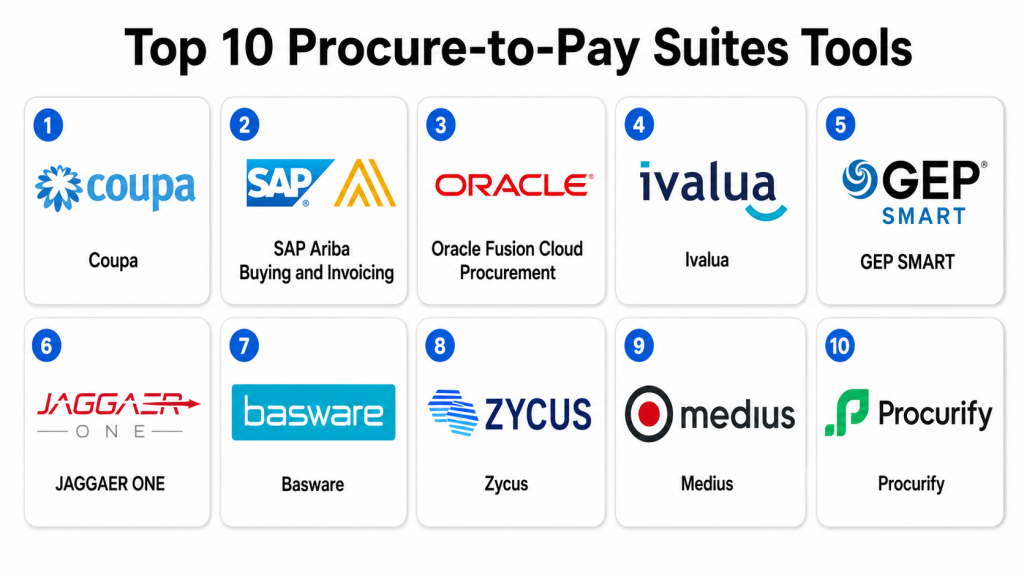
Top 10 Procure-to-Pay Suites Tools
1- Coupa
Short description: Coupa is a widely recognized business spend management platform that supports procurement, invoicing, supplier management, expenses, contracts, and spend analytics. It is best suited for mid-market and enterprise organizations that want strong spend control and end-to-end visibility.
Key Features
- Purchase requisition and approval workflows.
- Purchase order management and supplier collaboration.
- Invoice automation with matching and exception handling.
- Supplier information and risk management capabilities.
- Spend analytics and savings visibility.
- Contract and sourcing support through the broader Coupa platform.
- Policy controls for compliant buying and approval routing.
Pros
- Strong spend visibility across procurement and finance workflows.
- Broad platform coverage beyond basic P2P.
- Good fit for organizations that want centralized spend control.
Cons
- Implementation can require process redesign and strong internal ownership.
- May feel complex for smaller companies with basic needs.
- Pricing and module selection can vary based on enterprise scope.
Platforms / Deployment
Web / Cloud
Security & Compliance
Coupa commonly supports enterprise access controls, role-based permissions, approval audit trails, and authentication options. Specific certifications and compliance requirements should be confirmed during vendor review.
Integrations & Ecosystem
Coupa has a broad ecosystem for procurement, finance, ERP, supplier, and spend management workflows. It is often used by organizations that need procurement to connect with accounting, sourcing, contracts, and payment systems.
Common integration areas include:
- ERP systems.
- Accounting platforms.
- Supplier networks.
- Contract management tools.
- Payment systems.
- Business intelligence tools.
Support & Community
Coupa provides enterprise support, documentation, training resources, implementation partners, and customer success services. Its community is strong among procurement, finance, and spend management professionals.
2- SAP Ariba Buying and Invoicing
Short description: SAP Ariba Buying and Invoicing helps organizations manage purchasing, supplier collaboration, invoice processing, and procurement compliance. It is especially useful for enterprises already using SAP systems or companies with complex supplier networks.
Key Features
- Guided buying and purchase request workflows.
- Purchase order creation and supplier communication.
- Invoice management and matching workflows.
- Supplier network collaboration.
- Catalog-based buying and preferred supplier support.
- Policy-based approval routing.
- Integration with SAP ERP and finance systems.
Pros
- Strong fit for SAP-centric organizations.
- Mature supplier network and enterprise procurement capabilities.
- Scalable for global procurement operations.
Cons
- Implementation can be complex for organizations with fragmented processes.
- User experience may require training and change management.
- Best results often depend on strong SAP ecosystem alignment.
Platforms / Deployment
Web / Cloud
Security & Compliance
SAP Ariba commonly supports enterprise-grade access controls, audit trails, supplier governance, and authentication options. Specific certifications, regulatory requirements, and data controls should be validated with SAP during evaluation.
Integrations & Ecosystem
SAP Ariba works well with SAP ERP, SAP S/4HANA, supplier networks, procurement workflows, and finance operations. It is often selected by companies that want procurement and payables tightly connected with SAP finance processes.
Common integration areas include:
- SAP ERP systems.
- Supplier networks.
- Catalog providers.
- Contract tools.
- Finance and accounting systems.
- Reporting and analytics platforms.
Support & Community
SAP provides documentation, enterprise support, implementation partners, training programs, and a large procurement ecosystem. Community strength is high among SAP customers, procurement transformation teams, and enterprise finance users.
3- Oracle Fusion Cloud Procurement
Short description: Oracle Fusion Cloud Procurement is an enterprise procurement suite that supports purchasing, supplier management, sourcing, contracts, approvals, and procurement analytics. It is a strong choice for organizations using Oracle Cloud ERP or Oracle finance systems.
Key Features
- Self-service procurement and requisition management.
- Purchasing and purchase order workflows.
- Supplier qualification and supplier management.
- Procurement contracts and sourcing capabilities.
- Invoice and finance process alignment through Oracle ecosystem.
- Embedded analytics and reporting.
- Approval workflows and policy controls.
Pros
- Strong integration with Oracle ERP and finance processes.
- Suitable for large organizations with complex purchasing needs.
- Good platform depth across procurement, supplier, and contract workflows.
Cons
- Best fit is usually for Oracle-centered technology environments.
- Setup and configuration may require experienced implementation support.
- Smaller companies may find the platform broader than needed.
Platforms / Deployment
Web / Cloud
Security & Compliance
Oracle enterprise cloud products commonly support role-based access, audit trails, identity management, encryption controls, and administrative governance. Specific certifications and compliance needs should be confirmed directly during procurement.
Integrations & Ecosystem
Oracle Fusion Cloud Procurement is built to connect procurement with finance, ERP, projects, supplier management, and reporting in the Oracle ecosystem.
Common integration areas include:
- Oracle Cloud ERP.
- Oracle finance systems.
- Supplier management tools.
- Contract workflows.
- Reporting and analytics systems.
- Enterprise identity platforms.
Support & Community
Oracle provides enterprise support, implementation partners, documentation, training, and customer success resources. Its community is strong among Oracle ERP, finance, procurement, and enterprise operations teams.
4- Ivalua
Short description: Ivalua is a source-to-pay platform that supports procurement, supplier management, contracts, sourcing, invoicing, and spend management. It is best for organizations that need configurable procurement workflows and broad spend coverage.
Key Features
- End-to-end source-to-pay process support.
- Procure-to-pay workflow automation.
- Supplier information and performance management.
- Contract and sourcing management.
- Invoice processing and matching support.
- Spend analytics and category visibility.
- Configurable workflows and business rules.
Pros
- Strong flexibility for complex procurement environments.
- Good fit for direct, indirect, and services procurement.
- Broad source-to-pay capabilities in one platform.
Cons
- Configuration flexibility can increase implementation effort.
- May require strong procurement process maturity.
- Smaller teams may not need the full platform depth.
Platforms / Deployment
Web / Cloud
Security & Compliance
Ivalua commonly supports enterprise controls such as permissions, workflows, audit trails, and authentication options. Specific certifications and compliance requirements should be confirmed with the vendor.
Integrations & Ecosystem
Ivalua integrates with ERP, finance, sourcing, supplier, contract, and analytics environments. It is often used by organizations that need procurement processes tailored across regions, categories, and business units.
Common integration areas include:
- ERP systems.
- Finance and AP platforms.
- Supplier portals.
- Contract lifecycle tools.
- Spend analytics tools.
- Data warehouses.
Support & Community
Ivalua provides documentation, customer support, implementation partners, training resources, and advisory services. Its community is strong among procurement transformation, source-to-pay, and enterprise spend management teams.
5- GEP SMART
Short description: GEP SMART is a unified procurement platform covering sourcing, procurement, supplier management, contracts, savings tracking, and spend analytics. It is suitable for enterprise and mid-market organizations that want a broad procurement suite with strong visibility.
Key Features
- Procure-to-pay workflow management.
- Purchase requisitions, approvals, and purchase orders.
- Supplier management and collaboration.
- Invoice and procurement process support.
- Contract and sourcing capabilities.
- Spend analysis and savings tracking.
- Configurable workflows and dashboards.
Pros
- Broad procurement suite with strong spend visibility.
- Useful for organizations managing multiple procurement functions.
- Strong fit for procurement transformation programs.
Cons
- Implementation scope can vary depending on modules selected.
- May require process standardization before rollout.
- Advanced configuration may need expert support.
Platforms / Deployment
Web / Cloud
Security & Compliance
GEP SMART commonly includes enterprise access controls, workflow auditability, user permissions, and administrative controls. Specific compliance claims should be verified during vendor evaluation.
Integrations & Ecosystem
GEP SMART connects procurement, sourcing, supplier, contract, and spend analytics processes. It is often used where procurement teams want a unified view of spend and suppliers.
Common integration areas include:
- ERP systems.
- Finance platforms.
- Supplier systems.
- Contract repositories.
- Reporting tools.
- Spend data sources.
Support & Community
GEP provides implementation services, customer support, documentation, training, and consulting support. Community strength is strongest among enterprise procurement, supply chain, and sourcing teams.
6- JAGGAER ONE
Short description: JAGGAER ONE is a procurement platform that supports source-to-pay, supplier management, category management, contracts, invoicing, and spend analytics. It is often used by organizations with complex supplier networks, regulated procurement needs, or industry-specific buying requirements.
Key Features
- Procure-to-pay and source-to-pay workflows.
- Supplier management and supplier collaboration.
- Contract management and sourcing support.
- Invoice processing and purchase order workflows.
- Category and spend management capabilities.
- Analytics and reporting dashboards.
- Support for complex procurement operations.
Pros
- Strong supplier management and procurement depth.
- Good fit for complex industries and large procurement teams.
- Broad functionality across sourcing, procurement, and supplier workflows.
Cons
- May require detailed implementation planning.
- User adoption can depend on training and process clarity.
- Smaller teams may find it more advanced than necessary.
Platforms / Deployment
Web / Cloud
Security & Compliance
JAGGAER commonly supports enterprise access controls, permissions, workflow history, and auditability. Specific security certifications and compliance details should be confirmed directly.
Integrations & Ecosystem
JAGGAER ONE is designed to connect procurement, sourcing, supplier, contracts, and invoice workflows with enterprise systems.
Common integration areas include:
- ERP systems.
- Supplier networks.
- Contract systems.
- Spend analytics tools.
- Finance platforms.
- Reporting systems.
Support & Community
JAGGAER provides enterprise support, documentation, implementation services, training, and customer success resources. Its community is strong among procurement, supply chain, education, manufacturing, and regulated buying teams.
7- Basware
Short description: Basware is a procure-to-pay and accounts payable automation platform focused on invoice automation, e-invoicing, procurement workflows, supplier collaboration, and spend visibility. It is useful for organizations that want to improve AP efficiency and connect invoices with procurement controls.
Key Features
- Invoice automation and electronic invoicing.
- Purchase order and invoice matching.
- Supplier portal and collaboration support.
- Procurement workflow support.
- Spend visibility and analytics.
- Exception handling and approval routing.
- Integration with ERP and finance systems.
Pros
- Strong AP automation and invoice processing capabilities.
- Good fit for organizations with high invoice volumes.
- Useful supplier collaboration and e-invoicing support.
Cons
- Procurement depth may depend on selected modules.
- Full value often requires strong ERP integration.
- May be more AP-centered than some broader source-to-pay suites.
Platforms / Deployment
Web / Cloud
Security & Compliance
Basware commonly supports enterprise access controls, audit trails, workflow approvals, and secure invoice processing. Specific certifications and compliance coverage should be confirmed during vendor review.
Integrations & Ecosystem
Basware integrates with ERP, finance, procurement, supplier, and payment workflows. It is especially relevant where invoice automation and supplier document exchange are high priorities.
Common integration areas include:
- ERP systems.
- Finance and AP platforms.
- Supplier portals.
- E-invoicing networks.
- Payment workflows.
- Reporting systems.
Support & Community
Basware provides documentation, enterprise support, onboarding services, and customer success resources. Its community is strongest among AP automation, finance transformation, and procure-to-pay teams.
8- Zycus
Short description: Zycus is a source-to-pay platform that supports procurement, sourcing, contracts, supplier management, invoicing, spend analysis, and procurement automation. It is suitable for companies that want AI-assisted procurement workflows and stronger spend management.
Key Features
- Procure-to-pay workflow automation.
- Purchase requisitions, approvals, and purchase orders.
- Supplier management and collaboration.
- Invoice automation and matching support.
- Spend analytics and savings visibility.
- Contract and sourcing modules.
- AI-assisted procurement capabilities across selected workflows.
Pros
- Broad source-to-pay coverage in one platform.
- Strong spend analytics orientation.
- Useful for procurement teams looking for automation and visibility.
Cons
- Implementation scope can vary based on module selection.
- Advanced workflows may require configuration and training.
- Smaller teams may not need the full suite.
Platforms / Deployment
Web / Cloud
Security & Compliance
Zycus commonly supports enterprise access controls, role-based permissions, approval workflows, and audit trails. Specific certifications should be verified directly with the vendor.
Integrations & Ecosystem
Zycus connects procurement, sourcing, supplier, contract, invoice, and analytics workflows. It is often used by organizations looking to centralize spend intelligence and procurement execution.
Common integration areas include:
- ERP systems.
- Finance systems.
- Supplier databases.
- Contract tools.
- Spend analytics platforms.
- Reporting systems.
Support & Community
Zycus provides product documentation, support services, implementation assistance, and training resources. Its community is strongest among procurement operations, sourcing, spend management, and AP automation teams.
9- Medius
Short description: Medius is a procure-to-pay and AP automation platform focused on purchasing, invoice automation, supplier collaboration, payments, and spend visibility. It is especially relevant for mid-market and enterprise teams that want to improve invoice processing and procurement control.
Key Features
- Purchase requisition and approval workflows.
- Purchase order management.
- Invoice capture, matching, and exception handling.
- Supplier collaboration and document exchange.
- Spend analytics and reporting.
- Payment workflow support.
- ERP integration for finance and procurement alignment.
Pros
- Strong AP automation and invoice processing capabilities.
- Good fit for mid-market companies modernizing finance operations.
- Practical workflows for procurement and accounts payable teams.
Cons
- Broader procurement depth may depend on modules and configuration.
- Complex ERP environments may require integration planning.
- May not be as broad as larger enterprise source-to-pay suites.
Platforms / Deployment
Web / Cloud
Security & Compliance
Medius commonly supports workflow controls, access permissions, approval audit trails, and secure finance process handling. Specific certifications and compliance requirements should be confirmed with the vendor.
Integrations & Ecosystem
Medius integrates with ERP, accounting, procurement, supplier, and payment environments. It is commonly used by companies looking to connect purchasing with invoice automation.
Common integration areas include:
- ERP systems.
- Accounting tools.
- Supplier portals.
- Payment platforms.
- AP workflows.
- Reporting tools.
Support & Community
Medius provides customer support, implementation services, documentation, onboarding resources, and partner support. Its community is strong among finance, AP automation, and mid-market procurement teams.
10- Procurify
Short description: Procurify is a spend management and procure-to-pay platform designed for growing businesses that need better purchasing control, approval workflows, budgets, purchase orders, and spend visibility. It is a practical option for SMB and mid-market teams.
Key Features
- Purchase request and approval workflows.
- Purchase order creation and tracking.
- Budget visibility and spend controls.
- Vendor and supplier management support.
- Receiving and invoice workflow support.
- Mobile-friendly approval experience.
- Reporting and spend insights.
Pros
- Easier to adopt than many enterprise-heavy P2P suites.
- Good fit for growing teams that need budget and purchasing control.
- Practical user experience for requesters and approvers.
Cons
- May not offer the same enterprise depth as larger suites.
- Advanced global procurement requirements may need stronger platforms.
- Complex AP automation needs may require additional tools or integrations.
Platforms / Deployment
Web / Cloud
Security & Compliance
Procurify commonly supports permissions, approval workflows, audit trails, and access controls. Specific certifications and compliance claims should be verified during vendor review.
Integrations & Ecosystem
Procurify connects purchasing, budgets, approvals, vendors, and finance workflows. It is often used by teams that need structured purchasing without enterprise-level complexity.
Common integration areas include:
- Accounting systems.
- ERP tools.
- Payment workflows.
- Expense tools.
- Supplier records.
- Reporting systems.
Support & Community
Procurify provides documentation, onboarding support, customer success resources, and training materials. Its community is strongest among SMB, mid-market, finance, operations, and purchasing teams.
Comparison Table
| Tool Name | Best For | Platform Supported | Deployment | Standout Feature | Public Rating |
|---|---|---|---|---|---|
| Coupa | Enterprise spend management | Web | Cloud | End-to-end spend visibility | N/A |
| SAP Ariba Buying and Invoicing | SAP-centric procurement teams | Web | Cloud | Supplier network and SAP integration | N/A |
| Oracle Fusion Cloud Procurement | Oracle ERP users | Web | Cloud | Native Oracle finance and procurement alignment | N/A |
| Ivalua | Configurable source-to-pay workflows | Web | Cloud | Flexible procurement process design | N/A |
| GEP SMART | Enterprise procurement transformation | Web | Cloud | Unified procurement suite | N/A |
| JAGGAER ONE | Complex supplier and procurement operations | Web | Cloud | Supplier management depth | N/A |
| Basware | AP automation and e-invoicing | Web | Cloud | Invoice automation strength | N/A |
| Zycus | Spend analytics and procurement automation | Web | Cloud | AI-assisted procurement workflows | N/A |
| Medius | Mid-market AP and P2P automation | Web | Cloud | Invoice automation and purchasing control | N/A |
| Procurify | Growing SMB and mid-market teams | Web | Cloud | Easy purchasing and budget control | N/A |
Evaluation & Scoring of Procure-to-Pay Suites
| Tool Name | Core 25% | Ease 15% | Integrations 15% | Security 10% | Performance 10% | Support 10% | Value 15% | Weighted Total |
|---|---|---|---|---|---|---|---|---|
| Coupa | 9 | 8 | 9 | 8 | 9 | 8 | 7 | 8.25 |
| SAP Ariba Buying and Invoicing | 9 | 7 | 9 | 8 | 9 | 8 | 7 | 8.10 |
| Oracle Fusion Cloud Procurement | 9 | 7 | 9 | 8 | 9 | 8 | 7 | 8.10 |
| Ivalua | 9 | 7 | 8 | 8 | 8 | 8 | 8 | 8.05 |
| GEP SMART | 8 | 8 | 8 | 8 | 8 | 8 | 8 | 8.00 |
| JAGGAER ONE | 8 | 7 | 8 | 8 | 8 | 8 | 7 | 7.60 |
| Basware | 8 | 8 | 8 | 8 | 8 | 8 | 8 | 8.00 |
| Zycus | 8 | 8 | 8 | 8 | 8 | 8 | 8 | 8.00 |
| Medius | 8 | 8 | 8 | 8 | 8 | 8 | 8 | 8.00 |
| Procurify | 7 | 9 | 7 | 7 | 8 | 8 | 9 | 7.85 |
The scoring is comparative and should be used as a starting point, not as a final buying decision. Enterprise teams may value integration depth and governance more than ease of use, while SMB teams may prioritize fast adoption and practical budget control. A tool with a slightly lower score may still be the better fit if it matches your ERP, approval process, invoice volume, supplier base, and implementation budget. Buyers should run a pilot with real procurement and invoice workflows before making a final decision.
Which Procure-to-Pay Suite Tool Is Right for You?
Solo / Freelancer
Solo professionals and freelancers usually do not need a full procure-to-pay suite unless they manage purchasing operations for clients. A lightweight purchasing or accounting workflow may be enough for simple vendor payments and expense tracking. If a consultant helps clients design procurement processes, Procurify can be useful for demonstrating structured purchasing workflows in smaller organizations.
For independent procurement advisors, the best approach is to understand enterprise platforms such as Coupa, SAP Ariba, Oracle, Ivalua, and GEP SMART, while recommending simpler tools for small clients. A full P2P suite becomes useful only when approval workflows, purchase orders, supplier records, and invoice controls become difficult to manage manually.
SMB
SMBs should focus on ease of use, quick implementation, budget control, purchase approvals, and simple finance integrations. Procurify, Medius, Basware, and Zycus can be strong options depending on whether the business needs purchasing control, AP automation, or broader spend visibility.
An SMB should avoid overbuying a large enterprise platform unless procurement complexity is growing quickly. The best fit is usually a tool that supports purchase requests, approvals, budget visibility, supplier records, purchase orders, and invoice workflows without requiring a large implementation team.
Mid-Market
Mid-market companies often need stronger procurement governance because they manage more suppliers, more departments, and higher invoice volumes. Coupa, Ivalua, GEP SMART, Zycus, Medius, Basware, and Procurify can all be relevant depending on the maturity of the procurement function.
If the business needs strong AP automation, Basware or Medius may be a practical fit. If the company needs broader source-to-pay coverage, Coupa, Ivalua, GEP SMART, or Zycus may be stronger choices. Mid-market buyers should prioritize ERP integration, workflow flexibility, supplier adoption, and reporting quality.
Enterprise
Enterprises usually need scalable workflows, global controls, multi-entity support, ERP integration, supplier collaboration, compliance reporting, and advanced spend analytics. Coupa, SAP Ariba, Oracle Fusion Cloud Procurement, Ivalua, GEP SMART, and JAGGAER ONE are strong enterprise candidates.
Enterprise buyers should focus on governance, integration depth, auditability, approval complexity, supplier network support, and long-term procurement transformation. The best tool is not always the easiest tool; it is the one that can handle complex approval chains, supplier policies, tax requirements, invoice matching rules, and global procurement operations.
Budget vs Premium
Budget-focused buyers should start with platforms that are easier to adopt and provide practical value quickly. Procurify, Medius, Basware, and Zycus may be suitable depending on company size and process needs. These tools can help teams reduce manual purchasing work and improve invoice control without necessarily taking on a very large transformation project.
Premium buyers should consider Coupa, SAP Ariba, Oracle Fusion Cloud Procurement, Ivalua, GEP SMART, and JAGGAER ONE when procurement complexity is high. These platforms are better suited for organizations that need advanced supplier management, global scalability, deep ERP integration, sourcing alignment, contract connection, and enterprise reporting.
Feature Depth vs Ease of Use
Coupa, SAP Ariba, Oracle, Ivalua, GEP SMART, and JAGGAER ONE offer strong feature depth for larger procurement teams. They are useful when companies need broad capabilities across procurement, sourcing, supplier management, invoice automation, contracts, and analytics. However, deeper platforms usually require stronger planning, governance, and training.
Procurify, Medius, Basware, and Zycus can be easier for teams focused on specific P2P or AP automation goals. Buyers should choose feature depth when procurement complexity is high and choose ease of use when adoption speed and simplicity matter more.
Integrations & Scalability
Integration is one of the most important factors in P2P software selection. The platform should connect smoothly with ERP, accounting, finance, tax, supplier, payment, reporting, and identity systems. If procurement and finance data do not sync properly, teams may face duplicate records, approval delays, invoice exceptions, and poor reporting.
Large organizations should prioritize tools with strong ERP integration and scalable workflow design. SAP Ariba is often strong for SAP environments, Oracle is strong for Oracle environments, and Coupa, Ivalua, GEP SMART, JAGGAER, Basware, Zycus, Medius, and Procurify should be evaluated based on available connectors, APIs, and implementation requirements.
Security & Compliance Needs
Procurement involves sensitive supplier, pricing, contract, tax, bank, and invoice data. Buyers should verify role-based access, SSO, MFA, audit trails, encryption, approval logs, data retention, and administrative controls before selecting a tool. Security review should include both internal users and supplier-facing workflows.
Highly regulated companies should also evaluate segregation of duties, approval evidence, invoice audit trails, supplier onboarding controls, and compliance reporting. A strong P2P suite should help finance and procurement teams prove who requested, approved, received, matched, changed, and paid each transaction.
Frequently Asked Questions
1- What is a Procure-to-Pay Suite?
A Procure-to-Pay Suite is software that manages the buying process from purchase request to supplier payment. It usually includes requisitions, approvals, purchase orders, receiving, invoice matching, supplier collaboration, and payment workflow support.
2- What is the difference between procure-to-pay and source-to-pay?
Procure-to-pay focuses on purchasing execution and invoice payment, while source-to-pay includes earlier activities such as sourcing, supplier selection, negotiation, and contract management. Many modern platforms support both, but the depth varies by vendor.
3- Who should use Procure-to-Pay Suites?
Procurement teams, finance departments, accounts payable teams, operations leaders, CFOs, and shared service centers benefit most from P2P suites. They are especially useful for organizations with many suppliers, frequent purchases, multiple approvers, and high invoice volumes.
4- What features are most important in a P2P suite?
Important features include purchase requests, approval workflows, purchase orders, receiving, invoice matching, supplier portals, spend analytics, ERP integration, audit trails, and role-based access. The best feature set depends on company size and process complexity.
5- How much does Procure-to-Pay Software cost?
Pricing varies based on vendor, modules, users, transaction volume, invoice volume, supplier count, integrations, and support needs. Many enterprise vendors use custom pricing, so buyers should request quotes based on real procurement and AP requirements.
6- How long does P2P implementation take?
Implementation time depends on process complexity, ERP integration, supplier onboarding, approval workflows, data migration, and user training. A smaller deployment can move faster, while enterprise rollouts often require phased implementation across departments or regions.
7- What are common mistakes when choosing a P2P suite?
Common mistakes include selecting a tool without mapping workflows, ignoring supplier adoption, underestimating ERP integration, skipping AP requirements, and focusing only on purchase approvals. Buyers should involve procurement, finance, AP, IT, and business users early.
8- Can P2P suites reduce invoice errors?
Yes, P2P suites can reduce invoice errors through purchase order matching, receipt matching, approval controls, duplicate invoice detection, exception workflows, and better supplier communication. The level of improvement depends on data quality and process discipline.
9- Do P2P suites integrate with ERP systems?
Most leading P2P suites integrate with ERP and finance systems, but integration depth varies. Buyers should validate master data sync, purchase order flow, invoice posting, payment updates, tax handling, supplier data, and reporting requirements before purchase.
10- Are P2P suites suitable for small businesses?
Some P2P tools are suitable for small and growing businesses, especially when they need budget control, approval workflows, and purchase order discipline. However, very small businesses may only need basic accounting, expense, or invoice tools until purchasing complexity increases.
Conclusion
Procure-to-Pay Suites help organizations bring structure, visibility, and control to the entire purchasing and payment lifecycle. The right platform can reduce manual approvals, improve invoice accuracy, strengthen supplier collaboration, support policy compliance, and give finance and procurement leaders clearer spend visibility. Coupa, SAP Ariba, Oracle Fusion Cloud Procurement, Ivalua, GEP SMART, and JAGGAER ONE are strong choices for enterprise procurement teams, while Basware, Zycus, Medius, and Procurify can be strong fits for AP automation, mid-market growth, and practical purchasing control. The best tool depends on your company size, ERP environment, supplier base, invoice volume, approval complexity, and procurement maturity. Start by shortlisting two or three tools, run a pilot with real purchase and invoice workflows, validate integrations and security, and then scale the platform once users, suppliers, and finance teams are comfortable with the process.
