Introduction
Trade Surveillance Systems help financial institutions monitor trading activity for suspicious behavior, market abuse, policy violations, insider trading signals, spoofing, layering, wash trades, manipulation, and unusual execution patterns. In simple terms, these platforms act like a monitoring layer across orders, trades, communications, alerts, and market activity so compliance teams can detect risky behavior before it becomes a regulatory or reputational problem.
Trade surveillance matters because financial markets are increasingly fast, electronic, multi-asset, and data-heavy. Banks, brokers, exchanges, hedge funds, asset managers, and trading firms need stronger monitoring controls to identify abnormal patterns across equities, fixed income, derivatives, FX, crypto, and other markets.
Real-world use cases include:
- Detecting spoofing, layering, and market manipulation
- Monitoring insider trading and restricted-list violations
- Reviewing trader behavior across orders and executions
- Investigating alerts with audit-ready case management
- Supporting regulatory compliance and internal policy enforcement
Buyers should evaluate:
- Asset class coverage
- Alert accuracy and false-positive reduction
- AI and machine learning capabilities
- Case management workflows
- Regulatory reporting support
- Data ingestion and integration flexibility
- Communication surveillance integration
- Audit trails and investigation history
- Security and access controls
- Scalability across regions and trading venues
Best for: Banks, broker-dealers, exchanges, hedge funds, asset managers, proprietary trading firms, compliance teams, surveillance analysts, legal teams, and risk teams that need reliable monitoring across trading behavior and market abuse risks.
Not ideal for: Very small firms with minimal trading activity, teams that only need basic broker reports, or organizations without the resources to manage alerts, investigations, and compliance workflows properly.
Key Trends in Trade Surveillance Systems
- AI-driven alert prioritization is becoming more important as firms try to reduce false positives and focus analysts on the most meaningful risks.
- Cross-market surveillance is gaining traction because manipulation can occur across multiple venues, asset classes, and related instruments.
- Communication and trade surveillance convergence is increasing as firms connect trader chats, emails, calls, orders, and executions for deeper investigation context.
- Cloud-based surveillance platforms are becoming more common because firms want faster deployment, elastic data processing, and simpler upgrades.
- Real-time and near-real-time monitoring is now expected for high-risk trading environments where delayed detection can create regulatory exposure.
- Explainable surveillance models are becoming important because compliance teams need to understand why an alert was generated.
- Crypto and digital asset surveillance is expanding as more institutions monitor digital asset trading risks, wash trading, and market manipulation.
- Workflow automation is improving investigation efficiency through alert routing, escalation rules, evidence capture, and case documentation.
- Data quality management is a major focus because surveillance depends on clean order, trade, market, reference, and user data.
- Regulatory adaptability matters because firms must update surveillance logic as rules, markets, products, and enforcement priorities evolve.
How We Evaluated Trade Surveillance Systems
The following Top 10 platforms were selected using practical buyer-focused criteria:
- Market adoption and recognition among banks, brokers, asset managers, exchanges, hedge funds, and regulated financial institutions.
- Core surveillance coverage, including market abuse detection, insider trading monitoring, spoofing, layering, wash trades, and unusual trading behavior.
- Multi-asset and cross-market capability, especially for firms trading across equities, fixed income, FX, derivatives, commodities, and digital assets.
- Alert quality and investigation workflow, including case management, escalation, audit trails, and analyst productivity tools.
- AI, analytics, and automation depth, including anomaly detection, behavior analytics, risk scoring, and false-positive reduction.
- Integration flexibility, including data ingestion from order management systems, execution management systems, market data feeds, communication tools, and data warehouses.
- Security posture signals, including role-based access, audit logs, encryption, SSO, and enterprise administration.
- Regulatory fit, including support for global compliance expectations and surveillance reporting workflows.
- Scalability and performance, especially for high-volume trading environments and global operations.
- Customer fit, including suitability for enterprise institutions, mid-market firms, specialist compliance teams, and digital asset businesses.
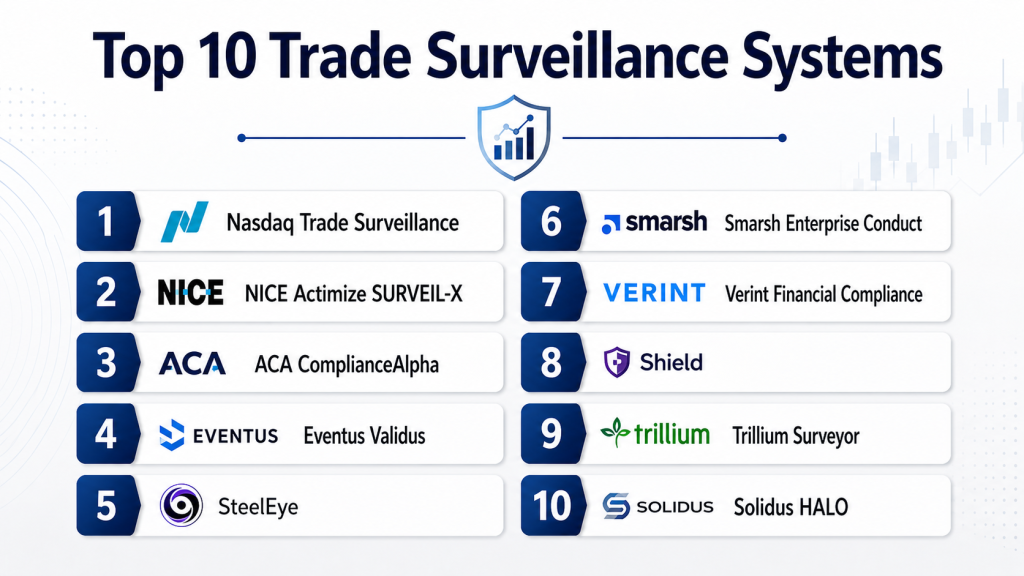
Top 10 Trade Surveillance Systems
#1 — Nasdaq Trade Surveillance
Short description: Nasdaq Trade Surveillance is a well-known surveillance solution used by exchanges, regulators, brokers, and financial institutions to monitor market activity and identify suspicious trading behavior.
It is designed for organizations that need strong market abuse monitoring across high-volume trading environments.
The platform can help detect patterns such as spoofing, layering, manipulation, unusual order activity, and other suspicious behaviors.
It is especially relevant for firms that need exchange-grade surveillance capabilities and scalable monitoring.
Nasdaq’s market infrastructure background gives the platform strong credibility in trading and surveillance workflows.
The system is best suited for institutions that require robust analytics, alerting, and investigative workflows.
It can support surveillance teams that need visibility across venues, asset classes, and market activity.
Nasdaq Trade Surveillance is a strong option for firms seeking proven market monitoring depth.
Key Features
- Market abuse detection workflows
- Spoofing and layering surveillance
- Cross-market monitoring capabilities
- Alert generation and prioritization
- Case investigation support
- Scalable market data processing
- Surveillance analytics and reporting
Pros
- Strong fit for exchanges, regulators, and large financial institutions.
- Deep market infrastructure and surveillance expertise.
- Suitable for high-volume and complex trading environments.
Cons
- May be more advanced than smaller firms require.
- Implementation can involve significant data and workflow planning.
- Pricing and configuration may vary by institutional needs.
Platforms / Deployment
Cloud / Hosted / Enterprise deployment options vary
Security & Compliance
Enterprise security controls are expected, including permission-based access and audit workflows.
Specific certifications: Not publicly stated.
Integrations & Ecosystem
Nasdaq Trade Surveillance fits into institutional trading, market infrastructure, and regulatory monitoring environments. It is useful when firms need to connect order, trade, market, reference, and participant data into surveillance workflows.
- Order and trade data feeds
- Market data systems
- Regulatory reporting workflows
- Exchange and venue systems
- Case management workflows
- Enterprise analytics tools
Support & Community
Support is enterprise-focused and typically includes implementation guidance, customer support, onboarding, and surveillance expertise. Community is institutional rather than open public community-based.
#2 — NICE Actimize SURVEIL-X
Short description: NICE Actimize SURVEIL-X is an enterprise surveillance platform designed to help financial institutions monitor trading behavior, communications, and conduct risk.
It is especially relevant for banks, broker-dealers, asset managers, and large regulated firms that need integrated surveillance across multiple channels.
The platform can support trade surveillance, communications surveillance, conduct analytics, and investigation workflows.
Its value is strongest when firms want to connect trader activity with contextual communication data.
SURVEIL-X is designed for compliance teams that need to reduce noise, prioritize alerts, and manage investigations efficiently.
It can support complex surveillance requirements across global markets and regulatory environments.
The platform is best suited for larger institutions with mature compliance and surveillance programs.
NICE Actimize SURVEIL-X is a strong choice for firms seeking integrated conduct and market surveillance.
Key Features
- Trade and communications surveillance
- Conduct risk monitoring
- AI-assisted alert prioritization
- Case management and investigations
- Behavioral analytics
- Multi-channel data monitoring
- Enterprise compliance workflows
Pros
- Strong for firms that need both trade and communication surveillance.
- Suitable for large regulated financial institutions.
- Good focus on conduct risk and investigation workflows.
Cons
- May be complex for smaller compliance teams.
- Implementation may require broad data integration.
- Advanced features can require careful configuration and tuning.
Platforms / Deployment
Cloud / Hosted / Enterprise deployment options vary
Security & Compliance
Enterprise access controls, audit trails, and workflow controls are expected.
Specific certifications: Not publicly stated.
Integrations & Ecosystem
NICE Actimize SURVEIL-X is designed to integrate with trading systems, communication platforms, compliance workflows, and enterprise data sources. It is most valuable when firms combine trade and conduct data.
- OMS and EMS data
- Communication channels
- Market data feeds
- Compliance systems
- Case management workflows
- Enterprise data platforms
Support & Community
Support is enterprise-focused and usually includes implementation, onboarding, training, product support, and account management. Public community activity is limited compared with developer-first software.
#3 — ACA ComplianceAlpha
Short description: ACA ComplianceAlpha is a compliance technology platform used by investment advisers, private funds, asset managers, and financial firms to manage compliance, surveillance, and risk workflows.
It includes capabilities for trade surveillance, employee compliance, personal trading review, marketing review, regulatory workflows, and compliance program management.
The platform is especially useful for firms that want trade surveillance as part of a broader compliance operating system.
It is well suited for hedge funds, private equity firms, investment advisers, and asset managers that need structured compliance oversight.
ComplianceAlpha helps teams centralize policies, reviews, alerts, attestations, and workflow documentation.
Its strength is the combination of compliance management and surveillance workflows rather than only market abuse monitoring.
The platform can help compliance teams improve consistency and reduce manual review work.
ACA ComplianceAlpha is a strong fit for firms seeking integrated compliance and surveillance operations.
Key Features
- Trade surveillance and compliance monitoring
- Personal trading and employee compliance workflows
- Case and issue management
- Compliance calendar and task tracking
- Policy and attestation workflows
- Regulatory and risk management support
- Reporting and audit documentation
Pros
- Strong fit for investment advisers and private funds.
- Combines surveillance with broader compliance program management.
- Useful for teams replacing spreadsheets and manual reviews.
Cons
- May not be as specialized for exchange-grade market abuse surveillance.
- Feature depth depends on modules selected.
- Larger trading institutions may need more advanced cross-market analytics.
Platforms / Deployment
Cloud / Web-based / Managed platform
Security & Compliance
Compliance workflow controls and user permissions are expected.
Specific certifications: Not publicly stated.
Integrations & Ecosystem
ACA ComplianceAlpha fits into compliance operations and can connect with trading, employee compliance, reporting, and documentation workflows. It is best for firms that want surveillance tied to compliance program management.
- Trade data feeds
- Employee compliance systems
- Policy workflows
- Compliance calendars
- Reporting tools
- Document and review workflows
Support & Community
Support is vendor-led and commonly includes onboarding, compliance expertise, training, and customer support. The platform is supported by ACA’s broader compliance services ecosystem.
#4 — Eventus Validus
Short description: Eventus Validus is a trade surveillance and market risk platform designed for financial institutions, exchanges, brokers, futures commission merchants, and digital asset firms.
It is known for supporting surveillance across multiple asset classes and trading environments.
The platform helps compliance teams detect market abuse patterns, review alerts, investigate events, and manage surveillance workflows.
Validus is especially relevant for firms that need configurable alerts and strong support for both traditional and digital asset markets.
It can serve broker-dealers, exchanges, hedge funds, and proprietary trading firms with active trading operations.
The system focuses on practical surveillance workflows, alert review, and investigative efficiency.
It is a strong option for firms seeking a specialized surveillance platform rather than a broader compliance suite.
Eventus Validus is well suited for teams that need flexible trade surveillance across evolving markets.
Key Features
- Trade surveillance alerting
- Market abuse detection
- Multi-asset monitoring
- Digital asset surveillance support
- Case management workflows
- Risk and exception monitoring
- Configurable rules and alerts
Pros
- Strong focus on specialized trade surveillance.
- Good fit for both traditional and digital asset trading environments.
- Practical alert and case workflow capabilities.
Cons
- Broader compliance management may require additional systems.
- Data integration quality strongly affects effectiveness.
- Configuration and tuning are important to reduce false positives.
Platforms / Deployment
Cloud / Hosted / Enterprise deployment options vary
Security & Compliance
Enterprise controls and audit-ready workflows are expected.
Specific certifications: Not publicly stated.
Integrations & Ecosystem
Eventus Validus is designed to connect with order, trade, market, and reference data across trading environments. It is especially useful when surveillance teams need flexible ingestion and alert workflows.
- OMS and EMS data
- Exchange data
- Market data feeds
- Broker systems
- Digital asset trading venues
- Case management workflows
Support & Community
Support is vendor-led and focused on surveillance implementation, configuration, onboarding, and ongoing customer assistance. Community is specialized rather than broad public community-based.
#5 — SteelEye
Short description: SteelEye is a regulatory technology platform that supports trade surveillance, communications surveillance, transaction reporting, record keeping, and compliance oversight.
It is designed for financial firms that need to manage regulatory data, detect suspicious activity, and maintain audit-ready records.
SteelEye is especially relevant for firms that want surveillance and regulatory reporting capabilities in one platform.
The platform can support compliance teams by centralizing trade data, communications data, reporting workflows, and investigation tools.
It is useful for banks, brokers, asset managers, and trading firms that need scalable compliance technology.
SteelEye’s value is strongest when organizations want to unify surveillance and regulatory data management.
It can help reduce fragmented compliance workflows and improve investigation visibility.
SteelEye is a strong option for firms seeking a modern compliance and surveillance platform.
Key Features
- Trade surveillance workflows
- Communications surveillance support
- Regulatory reporting capabilities
- Record keeping and data management
- Alert and investigation workflows
- Compliance analytics
- Multi-source data ingestion
Pros
- Combines surveillance with broader regulatory technology capabilities.
- Useful for firms that want centralized compliance data.
- Strong fit for teams managing reporting and surveillance together.
Cons
- Firms needing only trade surveillance may not need the broader platform.
- Implementation depends heavily on data source readiness.
- Advanced workflows may require configuration and compliance expertise.
Platforms / Deployment
Cloud / Web-based / Managed platform
Security & Compliance
Enterprise security controls are expected, including access permissions and audit workflows.
Specific certifications: Not publicly stated.
Integrations & Ecosystem
SteelEye is designed to ingest and manage regulatory, trading, and communication data. It is useful for firms seeking a connected compliance data foundation.
- Trading system data
- Communication channels
- Regulatory reporting workflows
- Data archives
- Case management tools
- Compliance dashboards
Support & Community
Support is vendor-led and generally includes onboarding, implementation assistance, customer support, and regulatory technology guidance. Public community is limited.
#6 — Smarsh Enterprise Conduct
Short description: Smarsh Enterprise Conduct is a conduct and communications surveillance solution that helps firms monitor communications, behavior, and risk indicators across regulated environments.
While Smarsh is widely associated with communications capture and archiving, its surveillance capabilities are relevant for firms connecting conduct risk with trade oversight.
The platform is useful for compliance teams that need to review emails, chats, voice, collaboration tools, and other communication channels.
It supports investigation workflows where trader communications may provide context for suspicious trading activity.
For trade surveillance programs, Smarsh is often valuable as a communications surveillance and evidence layer.
It is best paired with trade data surveillance systems when firms need complete market abuse investigations.
The platform is especially relevant for regulated financial services firms with complex communication environments.
Smarsh Enterprise Conduct is a strong choice for firms prioritizing communication-driven conduct surveillance.
Key Features
- Communications surveillance
- Conduct risk monitoring
- Archiving and record keeping support
- Search and investigation workflows
- Policy-based review processes
- Multi-channel communication capture
- Compliance workflow support
Pros
- Strong for communication surveillance and conduct monitoring.
- Useful evidence layer for market abuse investigations.
- Good fit for regulated financial firms with many communication channels.
Cons
- Not a pure trade surveillance OMS or execution-monitoring platform.
- Best results may require integration with trade surveillance systems.
- Scope depends on communication channels and configuration.
Platforms / Deployment
Cloud / Hosted / Enterprise deployment options vary
Security & Compliance
Enterprise security and access controls are expected.
Specific certifications: Not publicly stated.
Integrations & Ecosystem
Smarsh Enterprise Conduct fits into surveillance programs by connecting communication review with compliance investigations. It can complement trade surveillance tools by adding behavioral and communication context.
- Email systems
- Chat platforms
- Voice records
- Collaboration tools
- Archive systems
- Compliance review workflows
Support & Community
Support is vendor-led and typically includes onboarding, implementation, support resources, and customer assistance. Community is mainly enterprise compliance-focused.
#7 — Verint Financial Compliance
Short description: Verint Financial Compliance supports compliance recording, communications capture, surveillance, and risk monitoring for regulated financial services firms.
It is especially relevant for organizations that need to capture and supervise voice, electronic communications, and trader interactions.
The platform helps compliance teams review communication activity, identify risk indicators, and support investigation workflows.
For trade surveillance programs, Verint is useful when communication records must be linked to trading behavior and regulatory investigations.
It is most relevant for banks, broker-dealers, trading floors, and financial institutions with complex communication channels.
Its strength is compliance capture and communication oversight rather than standalone trade order surveillance.
Firms may pair it with trade surveillance tools for a more complete monitoring environment.
Verint Financial Compliance is a strong choice for communication-heavy regulated trading environments.
Key Features
- Communications capture and monitoring
- Voice recording compliance support
- Electronic communication supervision
- Risk and conduct monitoring workflows
- Search and investigation tools
- Audit and record keeping support
- Enterprise compliance controls
Pros
- Strong fit for voice and communication compliance.
- Useful for regulated trading floors and broker environments.
- Supports investigation and evidence management workflows.
Cons
- Not a full standalone market abuse trade surveillance system.
- Works best when integrated with trade data monitoring tools.
- Implementation depends on communication channel complexity.
Platforms / Deployment
Cloud / Hosted / Enterprise options vary
Security & Compliance
Enterprise access controls and audit support are expected.
Specific certifications: Not publicly stated.
Integrations & Ecosystem
Verint Financial Compliance is part of a broader communications and compliance technology environment. It is useful when firms need to capture, supervise, and investigate communications.
- Voice recording systems
- Email and messaging channels
- Compliance archives
- Surveillance workflows
- Case investigation tools
- Enterprise communication systems
Support & Community
Support is enterprise-focused and usually includes implementation, technical support, training, and account management depending on contract scope.
#8 — Shield
Short description: Shield is a communications compliance and surveillance platform designed for financial institutions that need to capture, monitor, and analyze employee communications.
It helps compliance teams identify risky conversations, policy violations, and conduct concerns across channels.
While Shield is not only a trade surveillance platform, it is relevant for firms that need communication surveillance as part of market abuse and conduct monitoring.
The platform can help connect suspicious communications with broader investigation workflows.
It is useful for banks, brokers, asset managers, and regulated firms that use multiple digital communication tools.
Shield’s strength is communication intelligence, surveillance workflow, and review automation.
It can complement trade surveillance systems by adding communication context to trading investigations.
Shield is a strong fit for firms modernizing communication compliance and surveillance operations.
Key Features
- Communications capture and monitoring
- AI-assisted communication surveillance
- Policy violation detection
- Review and investigation workflows
- Multi-channel communication support
- Compliance analytics
- Risk-based alerting
Pros
- Strong for communication surveillance and modern collaboration channels.
- Useful for reducing manual review burden.
- Good complement to trade surveillance systems.
Cons
- Not a full standalone order and trade surveillance platform.
- Best value depends on communication data coverage.
- Trade-specific monitoring may require integration with other systems.
Platforms / Deployment
Cloud / Web-based / Enterprise options vary
Security & Compliance
Enterprise security features are expected, but specific certifications should be confirmed directly.
Specific certifications: Not publicly stated.
Integrations & Ecosystem
Shield integrates with communication channels and compliance workflows to help firms supervise employee communications. It can support broader surveillance programs when paired with trading data.
- Email platforms
- Messaging apps
- Collaboration tools
- Compliance archives
- Case workflows
- Risk dashboards
Support & Community
Support is vendor-led and usually includes onboarding, implementation guidance, customer support, and compliance workflow assistance.
#9 — Trillium Surveyor
Short description: Trillium Surveyor is a trade surveillance platform focused on detecting market manipulation and suspicious trading behavior.
It is designed for broker-dealers, exchanges, regulators, and trading firms that need detailed market abuse surveillance.
The platform can help identify spoofing, layering, wash trading, marking the close, and other questionable trading patterns.
Surveyor is especially relevant for firms that need strong visual investigation tools and market replay-style analysis.
It supports compliance analysts by helping them review alerts and understand trading behavior in context.
The platform is best suited for organizations that need specialized trade surveillance rather than a general compliance suite.
Its strength is focused market manipulation detection and investigation support.
Trillium Surveyor is a strong option for firms seeking dedicated trading behavior surveillance.
Key Features
- Market manipulation surveillance
- Spoofing and layering detection
- Alert review and investigation workflows
- Visual trade reconstruction
- Broker and market data monitoring
- Case support and analysis tools
- Pattern-based surveillance
Pros
- Strong focus on market abuse detection.
- Useful investigation tools for trading behavior analysis.
- Good fit for broker-dealers and surveillance teams.
Cons
- May require additional systems for broader compliance management.
- Data quality and integration setup are critical.
- Scope may be narrower than enterprise conduct platforms.
Platforms / Deployment
Cloud / Hosted / Enterprise options vary
Security & Compliance
Access controls and audit workflows are expected for compliance users.
Specific certifications: Not publicly stated.
Integrations & Ecosystem
Trillium Surveyor is designed to ingest trading and market data for surveillance review. It works best when connected with clean order, execution, and market event data.
- Order data
- Execution data
- Market data
- Broker systems
- Case workflows
- Compliance reporting tools
Support & Community
Support is vendor-led and specialized around surveillance implementation, alert tuning, product usage, and compliance workflow support.
#10 — Solidus HALO
Short description: Solidus HALO is a trade surveillance and market integrity platform known for digital asset and crypto market surveillance use cases.
It is designed for exchanges, brokers, financial institutions, and digital asset businesses that need to monitor trading activity for manipulation and suspicious patterns.
The platform is especially relevant for crypto markets where wash trading, spoofing, layering, and cross-venue manipulation risks can be significant.
It can also support broader market surveillance workflows depending on the firm’s trading environment.
Solidus HALO helps compliance teams monitor market abuse indicators and manage investigations.
Its strength is digital asset surveillance and market integrity monitoring.
Firms working with crypto or tokenized assets may find it particularly relevant.
Solidus HALO is a strong option for organizations needing surveillance across digital asset trading activity.
Key Features
- Digital asset trade surveillance
- Market manipulation detection
- Wash trading and spoofing monitoring
- Alert and investigation workflows
- Cross-venue surveillance support
- Market integrity analytics
- Compliance workflow tools
Pros
- Strong fit for crypto and digital asset surveillance.
- Useful for exchanges, brokers, and digital asset firms.
- Focused on market integrity and manipulation detection.
Cons
- Traditional finance firms may need to validate fit for non-digital asset workflows.
- Broader compliance capabilities may require additional systems.
- Surveillance quality depends on venue and data coverage.
Platforms / Deployment
Cloud / Hosted / Enterprise options vary
Security & Compliance
Enterprise security controls are expected, but specific certifications should be confirmed directly.
Specific certifications: Not publicly stated.
Integrations & Ecosystem
Solidus HALO fits into digital asset trading and market integrity ecosystems. It helps organizations connect trading data, venue activity, alerts, and investigations.
- Crypto exchanges
- Digital asset brokers
- Market data feeds
- Trading venues
- Case workflows
- Compliance dashboards
Support & Community
Support is vendor-led and focused on surveillance implementation, customer success, compliance workflow setup, and product assistance.
Comparison Table
| Tool Name | Best For | Platform Supported | Deployment | Standout Feature | Public Rating |
|---|---|---|---|---|---|
| Nasdaq Trade Surveillance | Exchanges, regulators, and large institutions | Enterprise platform | Cloud / Hosted / Enterprise | Exchange-grade market surveillance | N/A |
| NICE Actimize SURVEIL-X | Banks and large regulated financial firms | Enterprise platform | Cloud / Hosted / Enterprise | Trade and communications surveillance | N/A |
| ACA ComplianceAlpha | Investment advisers and private funds | Web platform | Cloud | Compliance program plus surveillance workflows | N/A |
| Eventus Validus | Brokers, exchanges, FCMs, and digital asset firms | Enterprise platform | Cloud / Hosted | Flexible multi-asset surveillance | N/A |
| SteelEye | Firms needing surveillance and regulatory data workflows | Web platform | Cloud | Surveillance plus regulatory reporting | N/A |
| Smarsh Enterprise Conduct | Communication and conduct surveillance teams | Enterprise platform | Cloud / Hosted | Communication surveillance and evidence capture | N/A |
| Verint Financial Compliance | Trading floors and communication-heavy firms | Enterprise platform | Cloud / Hosted / Enterprise | Voice and communication compliance | N/A |
| Shield | Modern communication compliance teams | Web platform | Cloud | AI-assisted communication surveillance | N/A |
| Trillium Surveyor | Broker-dealers and market abuse surveillance teams | Enterprise platform | Cloud / Hosted | Visual trade behavior investigation | N/A |
| Solidus HALO | Crypto and digital asset market surveillance | Enterprise platform | Cloud / Hosted | Digital asset market integrity monitoring | N/A |
Evaluation & Scoring of Trade Surveillance Systems
| Tool Name | Core 25% | Ease 15% | Integrations 15% | Security 10% | Performance 10% | Support 10% | Value 15% | Weighted Total 0–10 |
|---|---|---|---|---|---|---|---|---|
| Nasdaq Trade Surveillance | 10 | 7 | 9 | 9 | 10 | 9 | 7 | 8.80 |
| NICE Actimize SURVEIL-X | 9 | 7 | 9 | 9 | 9 | 9 | 7 | 8.40 |
| Eventus Validus | 9 | 8 | 8 | 8 | 9 | 8 | 8 | 8.35 |
| SteelEye | 8 | 8 | 8 | 8 | 8 | 8 | 8 | 8.00 |
| ACA ComplianceAlpha | 8 | 8 | 7 | 8 | 7 | 8 | 8 | 7.70 |
| Trillium Surveyor | 8 | 7 | 8 | 8 | 8 | 8 | 7 | 7.75 |
| Solidus HALO | 8 | 8 | 8 | 8 | 8 | 7 | 8 | 7.95 |
| Smarsh Enterprise Conduct | 7 | 8 | 8 | 8 | 7 | 8 | 8 | 7.65 |
| Verint Financial Compliance | 7 | 7 | 8 | 8 | 7 | 8 | 7 | 7.35 |
| Shield | 7 | 8 | 8 | 8 | 7 | 7 | 8 | 7.55 |
The scoring is comparative and should be used to create a shortlist, not to select a universal winner. A platform with strong trade surveillance may score higher for market abuse monitoring, while a communications-focused platform may be better for conduct investigations. Buyers should evaluate data coverage, asset class fit, alert quality, regulatory needs, and implementation complexity. The best system is the one that fits the firm’s risk profile, trading activity, and compliance operating model.
Which Trade Surveillance System Is Right for You?
Solo / Freelancer
Solo traders and very small firms usually do not need a full enterprise trade surveillance system. If trading activity is limited, broker reports, basic compliance review, and manual monitoring may be enough. However, if the firm manages outside capital or operates under regulatory supervision, surveillance expectations can increase quickly.
Small advisory firms may benefit from broader compliance platforms like ACA ComplianceAlpha if they need employee compliance, personal trading review, and structured compliance workflows. A specialized market abuse platform may be unnecessary unless trading activity is active and complex.
SMB
Small and mid-sized financial firms should look for platforms that are practical to implement, easy to configure, and strong enough to handle key surveillance risks. Eventus Validus, SteelEye, ACA ComplianceAlpha, Trillium Surveyor, and Solidus HALO may be useful depending on market type and regulatory needs.
SMBs should avoid buying a system that is too complex for their team to operate. Alert volume, case workflow, analyst capacity, and data quality should be reviewed before implementation.
Mid-Market
Mid-market firms need stronger integration, better alert management, and broader coverage across order, trade, communication, and market data sources. Eventus Validus, SteelEye, NICE Actimize SURVEIL-X, Nasdaq Trade Surveillance, and Trillium Surveyor can fit different mid-market needs.
At this stage, firms should evaluate case management, audit trails, reporting, and escalation workflows. Surveillance should become a repeatable operational process rather than an occasional manual review.
Enterprise
Large banks, broker-dealers, exchanges, and global financial institutions need scalable platforms with strong data ingestion, cross-market analytics, case management, audit controls, and governance. Nasdaq Trade Surveillance, NICE Actimize SURVEIL-X, SteelEye, Smarsh, Verint, and other enterprise platforms may fit depending on surveillance scope.
Enterprise buyers should run a formal proof of concept using real trade and communication data. They should validate alert logic, false-positive rates, data lineage, permission models, and reporting expectations before deployment.
Budget vs Premium
Budget-conscious firms should focus on core risk coverage first. A lower-cost tool that handles the firm’s most important surveillance obligations may be better than an expensive platform that the team cannot fully operate.
Premium platforms are better suited for firms with complex products, high trading volume, global activity, multiple data sources, and strict regulatory obligations. The premium value usually comes from scale, analytics depth, workflow controls, and vendor support.
Feature Depth vs Ease of Use
Nasdaq Trade Surveillance, NICE Actimize SURVEIL-X, and other enterprise systems provide deep surveillance capabilities but may require more implementation effort. Platforms like ACA ComplianceAlpha or SteelEye may provide broader compliance usability depending on the firm’s needs.
Buyers should balance depth with analyst productivity. A powerful surveillance platform is only useful if compliance teams can understand alerts, investigate efficiently, and document decisions properly.
Integrations & Scalability
Trade surveillance depends heavily on integrations. Important sources include order management systems, execution management systems, market data feeds, broker systems, exchange data, communication platforms, HR data, restricted lists, and reference data.
Scalability matters because trading volume, market coverage, and regulatory requirements can grow. Buyers should choose a system that can handle more data, more users, more asset classes, and more investigation workflows over time.
Security & Compliance Needs
Security is critical because surveillance systems handle sensitive trading, employee, client, and investigation data. Buyers should evaluate role-based access, audit logs, encryption, SSO, MFA, data retention, and segregation of duties.
Compliance teams should request vendor documentation directly when certifications are not publicly stated. Firms should also confirm whether the system supports internal policies, regulatory reviews, and audit-ready evidence retention.
Frequently Asked Questions FAQs
1. What is a Trade Surveillance System?
A Trade Surveillance System monitors trading activity to detect suspicious behavior and possible market abuse.
It reviews orders, trades, executions, market data, and sometimes communications.
The goal is to identify risks such as spoofing, layering, wash trading, insider trading, and manipulation.
Compliance teams use alerts and case workflows to investigate potential issues.
A strong system helps firms reduce regulatory, operational, and reputational risk.
2. Who needs trade surveillance software?
Banks, broker-dealers, exchanges, hedge funds, asset managers, market makers, and trading firms often need trade surveillance software.
Any firm with regulated trading activity may need monitoring controls.
The need increases when trading volume, asset classes, venues, and trader count increase.
Digital asset firms may also need surveillance to monitor wash trading and manipulation.
Small firms should evaluate requirements based on their regulatory obligations.
3. How does trade surveillance reduce compliance risk?
Trade surveillance reduces compliance risk by creating a structured way to detect, review, and document suspicious trading activity.
It helps compliance teams identify patterns that may be difficult to find manually.
Case management workflows allow analysts to investigate and record decisions.
Audit trails support internal reviews and regulatory inquiries.
The system does not eliminate risk, but it improves visibility and control.
4. What types of market abuse can surveillance systems detect?
Surveillance systems may detect spoofing, layering, wash trading, marking the close, insider trading signals, front-running, and unusual trading patterns.
Some systems also monitor cross-market manipulation and restricted-list violations.
Detection depends on data quality, asset class coverage, alert logic, and model configuration.
No system catches every possible issue automatically.
Human review remains important for accurate investigations.
5. What is the difference between trade surveillance and communications surveillance?
Trade surveillance focuses on orders, trades, executions, prices, volumes, and market behavior.
Communications surveillance focuses on emails, chats, calls, collaboration tools, and employee messages.
Many compliance investigations require both types of data.
For example, suspicious trading may need communication evidence to understand intent.
Large firms often connect both systems for stronger conduct monitoring.
6. How much does trade surveillance software cost?
Pricing varies by vendor, trading volume, asset classes, number of users, deployment model, data sources, and modules selected.
Enterprise platforms often use custom pricing rather than public fixed pricing.
Costs may include implementation, integrations, support, data storage, and tuning.
Buyers should calculate total cost of ownership, not only license fees.
If exact pricing is not public, treat it as Varies / N/A.
7. How long does implementation usually take?
Implementation depends on data readiness, system complexity, integration scope, and surveillance coverage.
A focused deployment may be faster, while enterprise programs can require longer planning and testing.
Data mapping, alert tuning, case workflow design, and user training are key steps.
Firms should test the system with real trading scenarios before going live.
A phased implementation often reduces risk.
8. What are common mistakes when implementing trade surveillance?
Common mistakes include poor data quality, weak alert tuning, unclear ownership, and insufficient analyst training.
Some firms also generate too many false positives and overwhelm compliance teams.
Another mistake is failing to document investigation decisions consistently.
Buyers should define policies, escalation rules, and review workflows before deployment.
Surveillance is not just software; it is an operational program.
9. Can AI improve trade surveillance?
AI can improve trade surveillance by helping detect anomalies, prioritize alerts, and identify unusual behavior patterns.
It can also reduce analyst workload when used carefully.
However, AI models must be explainable enough for compliance teams to trust and defend decisions.
AI should not replace human judgment in regulatory investigations.
The best use of AI is to support analysts, not remove accountability.
10. What data does a trade surveillance system need?
A trade surveillance system typically needs order data, execution data, market data, reference data, account data, trader information, and instrument details.
For advanced investigations, it may also need communications data and restricted-list information.
Data must be accurate, complete, and timely.
Bad data can create missed alerts or false positives.
Data governance is one of the most important parts of surveillance success.
Conclusion
Trade Surveillance Systems are essential for financial firms that need to detect suspicious trading behavior, investigate alerts, document decisions, and support regulatory compliance. Platforms such as Nasdaq Trade Surveillance, NICE Actimize SURVEIL-X, ACA ComplianceAlpha, Eventus Validus, SteelEye, Smarsh Enterprise Conduct, Verint Financial Compliance, Shield, Trillium Surveyor, and Solidus HALO each serve different needs. Some are strongest for market abuse monitoring, some specialize in communications and conduct surveillance, and others combine surveillance with broader regulatory compliance workflows.
The best trade surveillance system depends on firm size, trading volume, asset classes, regulatory exposure, communication channels, data quality, and analyst capacity. Buyers should shortlist two or three platforms, run a proof of concept with real trading data, evaluate alert quality, validate integrations, review security controls, and confirm that compliance teams can manage investigations efficiently. A strong surveillance platform should not only generate alerts; it should help firms build a disciplined, auditable, and scalable compliance monitoring program.
