Introduction
RegTech Monitoring Tools help financial institutions, fintech companies, insurance firms, crypto businesses, and regulated enterprises monitor compliance risks, regulatory changes, suspicious activity, sanctions exposure, fraud signals, and policy violations. These platforms reduce manual compliance work by using automation, risk scoring, watchlist screening, transaction monitoring, case management, alerts, and audit-ready reporting.
RegTech monitoring matters because compliance teams must respond faster to changing regulations, financial crime risks, identity fraud, cybersecurity requirements, and internal governance expectations. Manual monitoring is often slow, inconsistent, and difficult to scale across regions, products, and customer segments.
Real-world use cases include:
- AML transaction monitoring and suspicious activity detection.
- Sanctions, PEP, and adverse media screening.
- Regulatory change monitoring and policy impact analysis.
- Crypto transaction risk monitoring.
- Employee communication, conduct, and insider risk monitoring.
Buyers should evaluate:
- AML and fraud detection capabilities.
- Sanctions, PEP, and watchlist screening.
- Regulatory intelligence and change tracking.
- Case management and investigation workflows.
- AI and rules-based risk scoring.
- Audit logs, reporting, and evidence management.
- Identity management and role-based access control.
- Integrations with core banking, payments, CRM, KYC, and data systems.
- Deployment flexibility and scalability.
- Security, compliance, and data governance controls.
Best for: RegTech Monitoring Tools are best for banks, fintech platforms, crypto exchanges, payment companies, insurance firms, lenders, wealth management firms, compliance teams, risk teams, legal teams, audit teams, and security leaders that need continuous visibility into regulatory and financial crime risks.
Not ideal for: Very small businesses with limited regulatory exposure may not need a full RegTech monitoring platform. In those cases, basic compliance checklists, manual reviews, or lightweight KYC tools may be enough until transaction volume, regulatory risk, or customer complexity increases.
Key Trends in RegTech Monitoring Tools
- AI-assisted risk detection: RegTech platforms are increasingly using machine learning and AI to reduce false positives, prioritize alerts, and detect complex risk patterns.
- Real-time transaction monitoring: Financial firms now expect near real-time monitoring for payments, crypto flows, account activity, and fraud signals.
- Regulatory change intelligence: Compliance teams need automated tracking of changing rules, policy obligations, and jurisdiction-specific requirements.
- Stronger identity and access governance: SSO, MFA, RBAC, audit logs, and least-privilege access are becoming baseline expectations.
- Integrated case management: Alerts are more useful when connected to investigations, evidence, approvals, escalation workflows, and reporting.
- Crypto compliance monitoring: Blockchain analytics and wallet risk scoring are now important for exchanges, fintechs, and financial institutions exposed to digital assets.
- Adverse media and entity risk screening: Monitoring now extends beyond sanctions lists to media risk, corporate ownership, PEP exposure, and reputational risk.
- Explainable AI and auditability: Regulators and internal auditors need clear explanations for risk decisions, model outputs, alert logic, and compliance actions.
- Cloud-first compliance operations: Many RegTech tools are cloud-based, but regulated firms still evaluate data residency, encryption, tenant controls, and access governance.
- Unified risk monitoring: Buyers increasingly want one platform or connected ecosystem for AML, fraud, sanctions, regulatory change, conduct, and operational risk.
How We Selected RegTech Monitoring Tools
The Top 10 tools were selected using a practical compliance and risk-focused evaluation approach:
- Market adoption and recognition: Tools with strong mindshare across banks, fintechs, crypto firms, insurers, and regulated enterprises were prioritized.
- Monitoring depth: Platforms were evaluated for AML monitoring, sanctions screening, regulatory intelligence, fraud detection, case management, and risk analytics.
- Security posture: Tools with enterprise access controls, audit logs, encryption, identity integration, and governance features were considered stronger.
- Integration ecosystem: Strong compatibility with banking systems, payments platforms, KYC tools, CRM, data warehouses, and investigation workflows was important.
- Scalability: Platforms suitable for high-volume alerts, transactions, customers, and multi-region compliance operations received higher consideration.
- AI and automation: Risk scoring, alert prioritization, false-positive reduction, workflow automation, and investigation support were considered.
- Regulatory coverage: Tools with strong coverage across AML, sanctions, fraud, regulatory change, crypto compliance, and conduct risk were favored.
- Ease of compliance operations: Case workflows, dashboards, reporting, and audit-ready evidence handling were important.
- Customer fit: The list balances enterprise compliance platforms, financial crime tools, regulatory intelligence systems, and specialized crypto monitoring solutions.
- Long-term value: The final selection considers whether each platform can support evolving compliance requirements and operational growth.
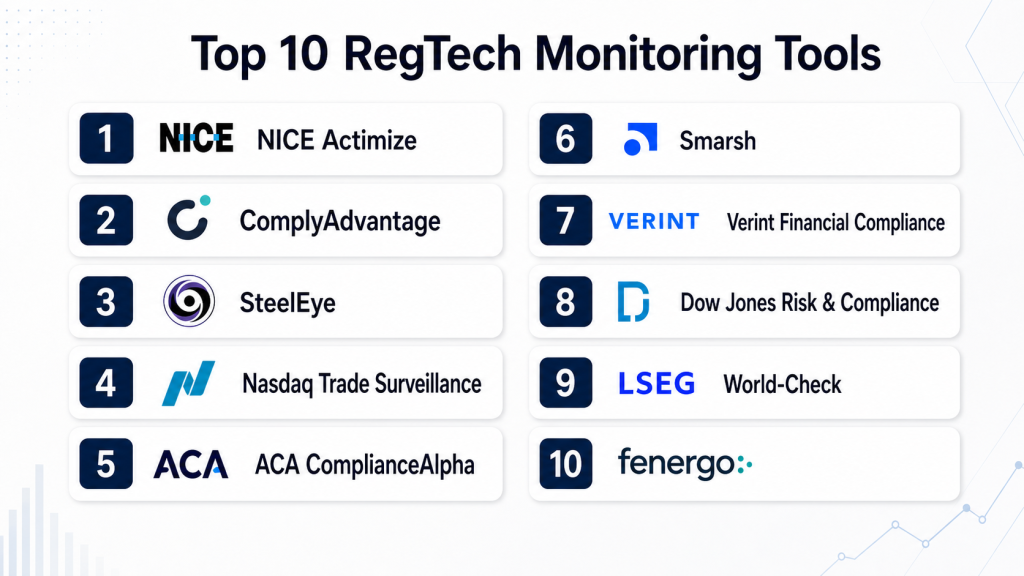
Top 10 RegTech Monitoring Tools
#1 — NICE Actimize
Short description:
NICE Actimize is a major financial crime, fraud, and compliance monitoring platform used by banks, financial institutions, and regulated enterprises.
It helps organizations detect suspicious activity, monitor transactions, manage alerts, investigate cases, and reduce financial crime risk.
The platform is especially relevant for AML, fraud prevention, sanctions monitoring, market surveillance, and enterprise risk operations.
NICE Actimize is built for complex compliance environments with high transaction volumes and strict regulatory expectations.
It supports rules, analytics, AI-assisted risk detection, and workflow-based investigation processes.
The platform is best suited for larger organizations that need mature compliance monitoring and enterprise-grade governance.
Implementation may require planning, data integration, model tuning, and compliance operations expertise.
For financial institutions with advanced monitoring needs, NICE Actimize is one of the strongest enterprise options.
Key Features
- AML transaction monitoring.
- Fraud detection and prevention.
- Sanctions and watchlist screening support.
- Case management and investigation workflows.
- Alert scoring and prioritization.
- Market surveillance capabilities.
- Reporting and audit support.
Pros
- Strong fit for large financial institutions.
- Mature financial crime monitoring capabilities.
- Good case management and investigation depth.
Cons
- Can be complex to implement.
- May require specialized compliance and data teams.
- More suitable for enterprise environments than small firms.
Platforms / Deployment
Web / Cloud / Hybrid options may vary by customer configuration.
Security & Compliance
Enterprise security capabilities may include SSO, role-based access controls, encryption, audit logs, and administrative governance. Specific certifications and compliance claims should be verified directly with the vendor.
Integrations & Ecosystem
NICE Actimize is typically integrated into complex banking, payment, compliance, and investigation ecosystems. Its value increases when connected with transaction systems, customer data, identity records, and case workflows.
- Core banking systems.
- Payment platforms.
- KYC and customer onboarding systems.
- Case management workflows.
- Data warehouses.
- Fraud and risk systems.
- APIs and enterprise connectors.
Support & Community
NICE Actimize provides enterprise support, implementation services, documentation, training, and customer success resources. Community strength is strongest among banking, financial crime, fraud, and compliance professionals.
#2 — ComplyAdvantage
Short description:
ComplyAdvantage is a RegTech platform focused on AML screening, transaction monitoring, sanctions checks, PEP screening, adverse media monitoring, and financial crime risk detection.
It is commonly used by fintechs, banks, payment firms, crypto platforms, lending businesses, and regulated companies.
The platform helps compliance teams identify risky customers, suspicious transactions, sanctioned entities, and negative media exposure.
ComplyAdvantage is especially useful for firms that need automated monitoring across global risk data and customer activity.
It supports API-driven workflows, onboarding checks, ongoing monitoring, and case investigation processes.
Its strength is combining financial crime data with workflow automation and practical compliance monitoring.
Smaller firms may value its flexibility, while larger firms may use it as part of a broader compliance stack.
It is best for organizations that need modern AML and sanctions monitoring with strong automation.
Key Features
- Sanctions, PEP, and watchlist screening.
- Adverse media monitoring.
- AML transaction monitoring.
- Customer risk scoring.
- Ongoing monitoring.
- Case management and alert workflows.
- API-based integration options.
Pros
- Strong for AML and sanctions monitoring.
- Useful for fintech and digital financial services.
- API-friendly for onboarding and ongoing checks.
Cons
- Complex enterprise needs may require additional systems.
- Alert tuning may require compliance expertise.
- Pricing can vary based on usage and modules.
Platforms / Deployment
Web / Cloud / API-based deployment.
Security & Compliance
ComplyAdvantage provides enterprise-oriented controls such as access management, encryption, user permissions, and audit-friendly workflows. Specific certifications should be verified directly with the vendor.
Integrations & Ecosystem
ComplyAdvantage is designed to connect with digital onboarding, payments, compliance, and risk operations systems.
- KYC platforms.
- Payment systems.
- Core banking platforms.
- CRM systems.
- Case management tools.
- Data platforms.
- APIs and webhooks.
Support & Community
ComplyAdvantage provides documentation, support resources, onboarding assistance, and customer success options. Its ecosystem is especially relevant for fintech, payments, crypto, banking, and AML compliance teams.
#3 — Fenergo
Short description:
Fenergo is a client lifecycle management and compliance platform used by financial institutions to manage onboarding, KYC, AML, regulatory compliance, and client data workflows.
It helps banks and financial firms improve customer due diligence, regulatory onboarding, entity data management, and ongoing compliance monitoring.
The platform is especially relevant for corporate banking, investment banking, wealth management, and capital markets environments.
Fenergo focuses on reducing manual onboarding complexity while improving regulatory control and customer lifecycle visibility.
It supports rules-driven workflows, regulatory logic, document handling, risk assessment, and client data governance.
Its strength is combining KYC, CLM, compliance workflows, and regulatory coverage in a structured platform.
Implementation can be significant because client lifecycle processes are often complex and data-heavy.
It is best for financial institutions that need strong onboarding, KYC, and regulatory workflow monitoring.
Key Features
- Client lifecycle management.
- KYC and AML workflow support.
- Customer due diligence.
- Regulatory rules and policy workflows.
- Document and data collection.
- Entity data management.
- Ongoing client risk monitoring.
Pros
- Strong for financial services onboarding and KYC.
- Good fit for complex institutional client workflows.
- Helps standardize regulatory processes.
Cons
- May be too specialized for non-financial businesses.
- Implementation may require process redesign.
- Best suited for organizations with complex client data needs.
Platforms / Deployment
Web / Cloud / Deployment options may vary by customer configuration.
Security & Compliance
Fenergo supports enterprise compliance workflows and security-oriented controls such as permissions, auditability, and regulated data handling. Specific certifications and security details should be verified with the vendor.
Integrations & Ecosystem
Fenergo commonly integrates with systems used for customer onboarding, entity data, regulatory screening, document management, and banking operations.
- KYC data providers.
- Screening tools.
- CRM systems.
- Document management systems.
- Core banking systems.
- Data governance platforms.
- APIs and enterprise connectors.
Support & Community
Fenergo provides enterprise implementation support, documentation, onboarding services, training, and customer success resources. Community strength is strongest among financial services compliance, client onboarding, and regulatory operations teams.
#4 — Chainalysis
Short description:
Chainalysis is a blockchain analytics and crypto compliance monitoring platform used by crypto exchanges, financial institutions, regulators, investigators, and law enforcement teams.
It helps organizations monitor crypto transactions, assess wallet risk, investigate blockchain activity, and detect illicit finance patterns.
The platform is especially relevant for digital asset compliance, AML monitoring, sanctions exposure, fraud investigation, and crypto risk management.
Chainalysis supports transaction monitoring, risk scoring, investigation tools, and compliance workflows for blockchain-based activity.
It is valuable for organizations that need visibility into digital asset movements and counterparty risk.
Its strength is specialized blockchain intelligence and crypto transaction monitoring.
It is not a general-purpose compliance platform for all regulatory needs.
It is best for crypto-native firms and financial institutions exposed to digital asset risk.
Key Features
- Crypto transaction monitoring.
- Wallet and entity risk scoring.
- Blockchain investigation tools.
- Sanctions exposure monitoring.
- Illicit finance pattern detection.
- Alerts and compliance workflows.
- Support for digital asset risk analysis.
Pros
- Strong specialization in blockchain analytics.
- Useful for crypto AML and investigation workflows.
- Good fit for exchanges and digital asset businesses.
Cons
- Not a full general-purpose RegTech platform.
- Mainly relevant for blockchain and crypto exposure.
- Requires crypto compliance knowledge.
Platforms / Deployment
Web / Cloud.
Security & Compliance
Chainalysis supports regulated compliance use cases and enterprise access controls. Specific security certifications and compliance details should be verified directly with the vendor.
Integrations & Ecosystem
Chainalysis integrates with crypto compliance operations, transaction systems, investigation workflows, and risk management processes.
- Crypto exchanges.
- Wallet monitoring systems.
- Digital asset transaction platforms.
- Investigation workflows.
- Compliance case systems.
- APIs and data feeds.
- Risk operations tools.
Support & Community
Chainalysis provides customer support, training, investigative resources, documentation, and compliance-focused education. Community strength is strong among crypto compliance, blockchain intelligence, and investigation teams.
#5 — Dow Jones Risk and Compliance
Short description:
Dow Jones Risk and Compliance provides data, screening, and monitoring tools for sanctions, PEPs, adverse media, state-owned companies, watchlists, and third-party risk.
It is used by financial institutions, corporations, compliance teams, legal teams, and risk departments.
The platform helps organizations screen customers, suppliers, partners, and entities against high-risk data sources.
It is especially relevant for AML, anti-bribery, sanctions compliance, due diligence, and third-party risk monitoring.
Dow Jones is known for risk data coverage and intelligence used in compliance decision-making.
Its strength is entity risk intelligence rather than full workflow execution for every compliance function.
It may be used alongside case management, onboarding, transaction monitoring, and GRC tools.
It is best for organizations that need trusted risk data for screening and ongoing monitoring.
Key Features
- Sanctions and watchlist screening.
- PEP monitoring.
- Adverse media intelligence.
- Third-party risk data.
- Entity and ownership risk information.
- Due diligence support.
- Data feeds and screening integrations.
Pros
- Strong risk intelligence and screening data.
- Useful for AML, sanctions, and third-party risk.
- Good fit for regulated enterprises and financial firms.
Cons
- May require integration with workflow tools.
- Not always a full end-to-end compliance operations platform.
- Pricing and coverage may depend on selected data products.
Platforms / Deployment
Web / Cloud / Data feeds and API options may vary.
Security & Compliance
Enterprise data access controls, permissions, and secure delivery options may be available depending on product and contract. Specific certifications should be verified directly with the vendor.
Integrations & Ecosystem
Dow Jones Risk and Compliance is commonly integrated into screening, onboarding, due diligence, risk, and compliance workflows.
- KYC systems.
- AML screening platforms.
- Third-party risk tools.
- Case management systems.
- Procurement and vendor systems.
- APIs and data feeds.
- Compliance workflow platforms.
Support & Community
Dow Jones provides enterprise support, documentation, account management, data support, and onboarding resources. Its ecosystem is strong among compliance, legal, AML, and third-party risk teams.
#6 — LexisNexis Risk Solutions
Short description:
LexisNexis Risk Solutions provides risk data, identity verification, fraud detection, AML compliance, sanctions screening, and financial crime monitoring solutions.
It is used by banks, fintechs, insurers, government agencies, healthcare organizations, and regulated businesses.
The platform helps organizations assess identity risk, detect fraud, screen entities, and monitor compliance exposure.
It is especially relevant where identity management, financial crime prevention, and regulatory monitoring intersect.
LexisNexis Risk Solutions offers broad data assets and analytics for decision-making across customer lifecycle and risk operations.
Its strength is combining identity intelligence, fraud signals, and compliance risk data.
Implementation requirements depend on the specific products, workflows, and integrations selected.
It is best for organizations that need data-driven risk monitoring and identity-based compliance controls.
Key Features
- Identity verification and risk assessment.
- Fraud detection and prevention.
- AML and sanctions screening support.
- Entity and customer risk monitoring.
- Financial crime compliance tools.
- Data analytics and risk scoring.
- API and data integration options.
Pros
- Strong data and identity risk capabilities.
- Useful for fraud, AML, and compliance monitoring.
- Broad fit across financial services and regulated industries.
Cons
- Product scope can be broad and complex.
- Buyers must select the right modules carefully.
- Implementation may require data and risk operations expertise.
Platforms / Deployment
Web / Cloud / API and data service options may vary by product.
Security & Compliance
LexisNexis Risk Solutions supports regulated data and risk workflows, but specific security controls and certifications should be validated for the selected product and contract.
Integrations & Ecosystem
LexisNexis Risk Solutions integrates with onboarding, fraud prevention, compliance, payments, and identity workflows.
- KYC and onboarding systems.
- Fraud platforms.
- Payment systems.
- Banking platforms.
- Insurance systems.
- Case management tools.
- APIs and data feeds.
Support & Community
LexisNexis Risk Solutions provides enterprise support, documentation, data services, implementation assistance, and account management. Community strength is strongest in fraud, identity, AML, insurance, and financial risk teams.
#7 — Thomson Reuters Regulatory Intelligence
Short description:
Thomson Reuters Regulatory Intelligence helps compliance, legal, and risk teams monitor regulatory changes, understand obligations, and track regulatory developments.
It is useful for organizations operating across multiple jurisdictions and regulatory domains.
The platform helps teams stay informed about rule changes, enforcement trends, policy updates, and compliance obligations.
It is especially relevant for financial services, legal departments, compliance teams, and regulatory affairs professionals.
Regulatory Intelligence is more focused on regulatory monitoring and knowledge than transaction-level AML monitoring.
Its strength is regulatory content, analysis, and change awareness.
Organizations may use it alongside GRC, policy management, and compliance workflow systems.
It is best for teams that need structured regulatory intelligence and change monitoring.
Key Features
- Regulatory change monitoring.
- Compliance intelligence and analysis.
- Jurisdiction-specific regulatory tracking.
- Alerts and updates.
- Policy and obligation awareness.
- Research and regulatory content.
- Support for compliance planning.
Pros
- Strong regulatory intelligence coverage.
- Useful for legal, risk, and compliance teams.
- Good for monitoring changing rules and obligations.
Cons
- Not a transaction monitoring tool.
- May require workflow tools for implementation tracking.
- Best suited for teams with regulatory analysis needs.
Platforms / Deployment
Web / Cloud.
Security & Compliance
Security features may include user access controls and enterprise account management. Specific certifications and compliance controls should be verified with the vendor.
Integrations & Ecosystem
Thomson Reuters Regulatory Intelligence is often used as part of a broader regulatory change management and compliance operations ecosystem.
- GRC platforms.
- Policy management systems.
- Legal research workflows.
- Compliance calendars.
- Risk management tools.
- Document management systems.
- Enterprise knowledge systems.
Support & Community
Thomson Reuters provides documentation, support resources, account assistance, expert content, and training options. Community strength is strong among legal, compliance, regulatory affairs, and financial services professionals.
#8 — Wolters Kluwer OneSumX
Short description:
Wolters Kluwer OneSumX is a regulatory reporting, risk, finance, and compliance platform used by banks and financial institutions.
It helps organizations manage regulatory reporting obligations, risk calculations, finance data, and compliance processes.
The platform is especially relevant for institutions that need structured regulatory reporting and supervisory compliance workflows.
OneSumX supports data management, reporting automation, risk management, and regulatory change alignment.
It is commonly considered by banks that operate in complex regulatory environments.
Its strength is regulatory reporting depth and financial services compliance expertise.
The platform may be more specialized than general-purpose compliance monitoring tools.
It is best for financial institutions that need robust regulatory reporting and risk compliance support.
Key Features
- Regulatory reporting.
- Risk and finance data management.
- Compliance workflow support.
- Supervisory reporting capabilities.
- Data validation and controls.
- Regulatory change alignment.
- Audit and reporting support.
Pros
- Strong for banking regulatory reporting.
- Good fit for complex financial compliance environments.
- Supports structured data and reporting controls.
Cons
- More specialized than general EMS or GRC tools.
- Implementation can be data-intensive.
- Best suited for financial institutions.
Platforms / Deployment
Web / Cloud / Deployment options may vary by customer configuration.
Security & Compliance
OneSumX supports regulated financial reporting and compliance workflows. Specific security features, certifications, and compliance details should be verified directly with Wolters Kluwer.
Integrations & Ecosystem
OneSumX is commonly connected with banking, finance, regulatory reporting, and risk data environments.
- Core banking systems.
- Finance systems.
- Risk platforms.
- Data warehouses.
- Regulatory reporting workflows.
- ERP systems.
- APIs and enterprise data connectors.
Support & Community
Wolters Kluwer provides enterprise support, regulatory expertise, documentation, onboarding assistance, and customer services. Community strength is strongest among banking risk, finance, and regulatory reporting professionals.
#9 — MetricStream
Short description:
MetricStream is a governance, risk, and compliance platform that supports enterprise risk management, regulatory compliance, policy management, audits, controls, and issue tracking.
It helps organizations monitor compliance obligations, manage controls, track risks, and coordinate remediation activities.
MetricStream is especially relevant for large enterprises that need structured GRC workflows across departments and regions.
It can support regulatory change management, compliance assessments, audits, operational risk, and third-party risk monitoring.
The platform is broader than financial crime RegTech and is useful for enterprise-wide compliance operations.
Its strength is unified GRC workflow management and control monitoring.
Implementation can require process design, stakeholder alignment, and governance maturity.
It is best for enterprises that need centralized risk and compliance monitoring across many business units.
Key Features
- Enterprise GRC management.
- Regulatory compliance tracking.
- Risk and control monitoring.
- Audit management.
- Policy and issue management.
- Third-party risk workflows.
- Dashboards and reporting.
Pros
- Strong enterprise GRC capabilities.
- Useful for compliance, audit, and risk teams.
- Good for centralized governance workflows.
Cons
- May be complex for smaller teams.
- Requires thoughtful configuration.
- Not focused only on AML or transaction monitoring.
Platforms / Deployment
Web / Cloud / Deployment options may vary by customer configuration.
Security & Compliance
MetricStream supports enterprise security and governance controls such as role-based access, permissions, auditability, and compliance workflows. Specific certifications should be verified directly with the vendor.
Integrations & Ecosystem
MetricStream connects with risk, audit, compliance, policy, third-party, and enterprise data systems.
- ERP systems.
- HR systems.
- IT risk tools.
- Third-party risk platforms.
- Audit systems.
- BI and reporting tools.
- APIs and connectors.
Support & Community
MetricStream provides enterprise support, implementation services, documentation, training, and customer success resources. Community strength is strong among GRC, audit, compliance, and operational risk teams.
#10 — Behavox
Short description:
Behavox is a compliance, conduct, and communication monitoring platform used by financial institutions and regulated enterprises to detect risky behavior, policy violations, and insider threats.
It helps organizations monitor employee communications, collaboration channels, and conduct signals for compliance and risk management.
The platform is especially relevant for regulated firms that need surveillance across communications, trading-related behavior, misconduct risk, and internal policy compliance.
Behavox uses analytics and AI-assisted detection to identify patterns that may indicate compliance issues or behavioral risk.
It is more specialized than broad GRC or AML platforms because it focuses strongly on communication and conduct monitoring.
Its strength is insider risk, conduct surveillance, and communications compliance.
Implementation may require legal, privacy, HR, security, and compliance alignment.
It is best for regulated organizations that need proactive monitoring of employee conduct and communications risk.
Key Features
- Communication monitoring.
- Conduct risk surveillance.
- Insider threat detection support.
- AI-assisted risk analytics.
- Alert and case workflows.
- Policy violation monitoring.
- Investigation support.
Pros
- Strong for employee conduct and communication surveillance.
- Useful for regulated financial environments.
- Helps detect behavioral and insider risk patterns.
Cons
- Not a general AML transaction monitoring tool.
- Requires careful privacy and legal governance.
- Best suited for regulated enterprises with conduct risk needs.
Platforms / Deployment
Web / Cloud / Deployment options may vary by customer configuration.
Security & Compliance
Behavox supports compliance-sensitive monitoring workflows and enterprise controls. Specific security certifications, data handling controls, and compliance details should be verified directly with the vendor.
Integrations & Ecosystem
Behavox integrates with enterprise communication, collaboration, investigation, and compliance systems.
- Email platforms.
- Chat and collaboration tools.
- Communication archives.
- Case management workflows.
- Compliance systems.
- HR and security workflows.
- APIs and enterprise connectors.
Support & Community
Behavox provides enterprise onboarding, support, documentation, and implementation resources. Community strength is strongest among compliance surveillance, insider risk, conduct monitoring, and regulated financial services teams.
Comparison Table Top 10
| Tool Name | Best For | Platform Supported | Deployment | Standout Feature | Public Rating |
|---|---|---|---|---|---|
| NICE Actimize | Enterprise AML, fraud, and financial crime monitoring | Web | Cloud / Hybrid varies | Mature financial crime monitoring | N/A |
| ComplyAdvantage | AML, sanctions, PEP, and adverse media screening | Web / API | Cloud | Modern AML and risk data automation | N/A |
| Fenergo | KYC, client lifecycle, and regulatory onboarding | Web | Cloud varies | Client lifecycle compliance workflows | N/A |
| Chainalysis | Crypto transaction and blockchain risk monitoring | Web | Cloud | Blockchain analytics and wallet risk scoring | N/A |
| Dow Jones Risk and Compliance | Sanctions, PEP, adverse media, and third-party risk data | Web / Data feeds | Cloud varies | Risk intelligence data coverage | N/A |
| LexisNexis Risk Solutions | Identity risk, fraud, AML, and compliance monitoring | Web / API | Cloud varies | Identity and risk data intelligence | N/A |
| Thomson Reuters Regulatory Intelligence | Regulatory change monitoring and compliance intelligence | Web | Cloud | Regulatory content and obligation tracking | N/A |
| Wolters Kluwer OneSumX | Banking regulatory reporting and risk compliance | Web | Cloud / Hybrid varies | Regulatory reporting depth | N/A |
| MetricStream | Enterprise GRC and compliance monitoring | Web | Cloud varies | Unified risk, controls, and compliance workflows | N/A |
| Behavox | Conduct, communication, and insider risk monitoring | Web | Cloud varies | Employee communication surveillance | N/A |
Evaluation & Scoring of RegTech Monitoring Tools
| Tool Name | Core 25% | Ease 15% | Integrations 15% | Security 10% | Performance 10% | Support 10% | Value 15% | Weighted Total 0–10 |
|---|---|---|---|---|---|---|---|---|
| NICE Actimize | 10 | 7 | 9 | 9 | 9 | 9 | 8 | 8.75 |
| ComplyAdvantage | 9 | 8 | 9 | 8 | 8 | 8 | 9 | 8.50 |
| Fenergo | 9 | 7 | 8 | 9 | 8 | 8 | 8 | 8.15 |
| Chainalysis | 9 | 8 | 8 | 8 | 9 | 8 | 8 | 8.35 |
| Dow Jones Risk and Compliance | 8 | 8 | 8 | 8 | 8 | 8 | 8 | 8.00 |
| LexisNexis Risk Solutions | 9 | 7 | 9 | 8 | 9 | 8 | 8 | 8.35 |
| Thomson Reuters Regulatory Intelligence | 8 | 8 | 7 | 8 | 8 | 8 | 8 | 7.85 |
| Wolters Kluwer OneSumX | 9 | 7 | 8 | 9 | 9 | 8 | 8 | 8.25 |
| MetricStream | 8 | 7 | 8 | 9 | 8 | 8 | 8 | 7.95 |
| Behavox | 8 | 7 | 8 | 8 | 8 | 8 | 7 | 7.65 |
The scores are comparative and should be used as a shortlist guide, not as a universal ranking.
Financial crime platforms score higher for AML, fraud, transaction monitoring, and investigation workflows.
Regulatory intelligence tools score higher for tracking rule changes, obligations, and policy impacts.
Enterprise GRC platforms score higher for control monitoring, audit workflows, and cross-functional governance.
Buyers should validate data coverage, security controls, integrations, alert quality, false-positive rates, and regulatory fit through a pilot.
Which RegTech Monitoring Tool Is Right for You?
Solo / Freelancer
Solo professionals usually do not need a full RegTech monitoring platform unless they provide compliance consulting, legal advisory, crypto investigation, or financial risk services. A lightweight regulatory intelligence or research tool may be enough for individual use.
Choose a simple option if you need:
- Regulatory updates.
- Compliance research.
- Basic risk reference data.
- Small-scale due diligence.
- Manual policy tracking.
Avoid enterprise-grade AML or GRC platforms unless you manage regulated operations, customer screening, or transaction monitoring at scale.
SMB
SMBs and fintech startups should focus on automation, ease of integration, pricing flexibility, and practical compliance coverage. ComplyAdvantage, Chainalysis, and selected LexisNexis Risk Solutions products may be useful depending on the business model.
SMB buyers should prioritize:
- API-based onboarding checks.
- Sanctions and PEP screening.
- Adverse media monitoring.
- Transaction risk alerts.
- Case management basics.
- Clear pricing and usage controls.
- Fast implementation.
The best choice depends on whether the SMB handles payments, crypto, lending, customer onboarding, or regulated financial products.
Mid-Market
Mid-market organizations often need stronger monitoring coverage, scalable case management, better audit trails, and integrations with CRM, payment, KYC, data, and reporting systems. ComplyAdvantage, Fenergo, LexisNexis Risk Solutions, MetricStream, and Thomson Reuters Regulatory Intelligence can fit different needs.
Mid-market buyers should evaluate:
- Alert volumes.
- False-positive management.
- Regulatory coverage.
- Workflow automation.
- Identity and access controls.
- Reporting quality.
- Data integration requirements.
- Support and onboarding.
The right platform should improve compliance operations without overwhelming teams with unnecessary complexity.
Enterprise
Enterprises should prioritize scale, data quality, global regulatory coverage, workflow governance, security, auditability, and advanced integrations. NICE Actimize, Fenergo, Wolters Kluwer OneSumX, MetricStream, LexisNexis Risk Solutions, Dow Jones Risk and Compliance, and Service-oriented risk ecosystems may be strong options depending on requirements.
Enterprise buyers should validate:
- SSO and MFA.
- RBAC and admin controls.
- Encryption and audit logs.
- Data residency and privacy needs.
- Transaction volume handling.
- Model governance.
- Integration architecture.
- Regulatory reporting quality.
- Investigation workflows.
- Support and implementation services.
Large firms should run pilots using real alert, transaction, customer, and regulatory data.
Budget vs Premium
Budget-friendly RegTech tools may work for basic screening, regulatory tracking, and small-volume monitoring. Premium platforms are better for high-volume AML, fraud, regulatory reporting, case management, and enterprise risk governance.
Choose budget-friendly tools when:
- Transaction volume is low.
- Screening needs are basic.
- The team is small.
- Compliance workflows are simple.
- You need quick implementation.
Choose premium tools when:
- Regulatory exposure is high.
- Alert volume is large.
- You operate across jurisdictions.
- You need advanced case workflows.
- You require strong audit evidence.
- You manage financial crime, fraud, or complex compliance risk.
Feature Depth vs Ease of Use
Feature-rich platforms provide strong monitoring, analytics, reporting, and compliance governance, but they may require longer implementation. Easier tools improve adoption and speed but may lack advanced enterprise controls.
Choose feature depth for:
- AML transaction monitoring.
- Regulatory reporting.
- Complex investigations.
- Multi-region compliance.
- Banking and financial services governance.
- Advanced risk analytics.
Choose ease of use for:
- Simple screening.
- Small compliance teams.
- Fast onboarding.
- Basic dashboards.
- Low transaction volume.
- Startup or SMB workflows.
Integrations & Scalability
RegTech Monitoring Tools must connect with systems that hold customer, transaction, account, identity, payment, and regulatory data. Poor integrations can create manual work and compliance blind spots.
Important integrations include:
- Core banking systems.
- Payment platforms.
- KYC and onboarding systems.
- CRM platforms.
- Data warehouses.
- Case management tools.
- Identity providers.
- ERP and finance systems.
- Communication archives.
- Reporting and BI tools.
Scalability should include transaction volume, alert volume, entity screening, case workflows, user roles, API usage, regional expansion, and regulatory coverage.
Security & Compliance Needs
Security is critical because RegTech systems often process sensitive customer, transaction, identity, compliance, and investigation data. Buyers should involve security, legal, risk, and compliance teams early in the selection process.
Validate:
- SSO and SAML support.
- MFA compatibility.
- Role-based access control.
- Audit logs.
- Encryption.
- Data residency options.
- Admin permissions.
- API security.
- User provisioning and deprovisioning.
- Compliance documentation.
- Model governance and explainability.
For Zero Trust environments, access should follow least-privilege principles, strong authentication, continuous monitoring, and clear administrative controls.
Frequently Asked Questions FAQs
1. What are RegTech Monitoring Tools?
RegTech Monitoring Tools help organizations monitor regulatory, financial crime, fraud, sanctions, conduct, and compliance risks.
They automate tasks such as screening, transaction monitoring, regulatory change tracking, alerting, and case management.
These tools are especially important for banks, fintechs, insurers, crypto firms, and regulated enterprises.
They help compliance teams reduce manual work and improve audit readiness.
The main goal is to detect risk earlier and manage compliance obligations more consistently.
2. How are RegTech Monitoring Tools different from GRC platforms?
RegTech Monitoring Tools often focus on regulatory technology use cases such as AML, sanctions, fraud, KYC, and regulatory change monitoring.
GRC platforms are broader and usually cover governance, risk, controls, audits, policies, and enterprise compliance workflows.
Some tools overlap because enterprise GRC platforms can include compliance monitoring modules.
RegTech tools are often more specialized for financial services and regulatory operations.
The right choice depends on whether your main need is financial crime monitoring, regulatory intelligence, or broad governance.
3. What pricing models are common for RegTech Monitoring Tools?
Most RegTech tools use subscription pricing based on users, modules, transaction volume, screening volume, API usage, or enterprise agreements.
Some tools charge separately for data coverage, monitoring features, case management, integrations, or advanced analytics.
Enterprise pricing is often custom because compliance needs vary widely by industry, geography, and scale.
Buyers should ask for complete pricing that includes onboarding, support, data usage, and integration costs.
If pricing is not publicly clear, use “Varies / N/A” instead of assuming exact cost.
4. How long does implementation usually take?
Implementation time depends on the tool type, data complexity, transaction volume, integration needs, and compliance workflows.
Basic screening tools may be implemented faster than enterprise AML, GRC, or regulatory reporting platforms.
Complex deployments may require data mapping, system integration, rule tuning, alert design, user roles, and training.
Teams should start with a focused pilot before scaling to multiple regions or products.
The best implementation approach includes compliance, IT, security, operations, and business stakeholders.
5. What are common mistakes when choosing a RegTech tool?
A common mistake is choosing a tool based only on brand name without testing data coverage and alert quality.
Another mistake is ignoring false-positive rates, investigation workflows, and integration effort.
Some teams buy tools that are too broad, while others choose tools that are too limited for future compliance growth.
Security, data privacy, user permissions, and audit requirements are also sometimes evaluated too late.
The best approach is to run a pilot with real data, real workflows, and real compliance scenarios.
6. Are RegTech Monitoring Tools secure?
Many RegTech Monitoring Tools support enterprise security features such as SSO, MFA, RBAC, encryption, audit logs, and admin controls.
However, security capabilities vary by vendor, plan, deployment model, and customer configuration.
Because these tools handle sensitive customer, transaction, and investigation data, security review is essential.
Buyers should verify access controls, data residency, API security, encryption, and auditability.
Security teams should be involved before production deployment.
7. Can RegTech tools help with AML compliance?
Yes, many RegTech tools support AML compliance through customer screening, transaction monitoring, risk scoring, case management, and suspicious activity detection.
AML-focused tools can help identify unusual transaction patterns, sanctioned entities, high-risk customers, and adverse media exposure.
They can also support investigation workflows and audit-ready evidence collection.
However, tools do not replace compliance judgment or regulatory responsibility.
Organizations still need policies, trained analysts, governance, and proper escalation procedures.
8. Can RegTech Monitoring Tools reduce false positives?
Yes, modern RegTech tools may reduce false positives through better data matching, risk scoring, segmentation, rules tuning, machine learning, and alert prioritization.
False-positive reduction is important because compliance teams often waste time reviewing low-quality alerts.
However, performance depends on data quality, configuration, customer profiles, transaction patterns, and monitoring rules.
Buyers should test false-positive rates during a pilot using realistic data.
The goal is not only fewer alerts, but better and more explainable alerts.
9. What integrations should buyers look for?
Important integrations include core banking, payments, KYC, CRM, ERP, data warehouses, case management, identity providers, and reporting tools.
For AML use cases, transaction and customer data integrations are essential.
For regulatory change monitoring, integration with policy, GRC, and workflow systems may matter more.
For conduct monitoring, communication and collaboration platform integrations are important.
The right integrations reduce manual work and improve monitoring accuracy.
10. Can small fintech companies use RegTech Monitoring Tools?
Yes, small fintech companies can use RegTech tools, especially for onboarding checks, sanctions screening, PEP monitoring, adverse media, and transaction monitoring.
They should choose tools that are API-friendly, scalable, and practical for their transaction volume.
A startup does not always need a large enterprise platform at the beginning.
However, it should select a tool that can grow as customer volume and regulatory exposure increase.
Compliance teams should also document policies and procedures alongside tool adoption.
Conclusion
RegTech Monitoring Tools are essential for organizations that need stronger visibility into AML risk, sanctions exposure, fraud signals, regulatory changes, conduct issues, and compliance workflows. NICE Actimize, ComplyAdvantage, Fenergo, Chainalysis, Dow Jones Risk and Compliance, LexisNexis Risk Solutions, Thomson Reuters Regulatory Intelligence, Wolters Kluwer OneSumX, MetricStream, and Behavox each serve different compliance needs, from financial crime monitoring to regulatory intelligence and enterprise GRC.
The best RegTech Monitoring Tool depends on your business model, regulatory exposure, transaction volume, risk appetite, integration needs, and security expectations. A smart next step is to shortlist two or three tools, run a pilot with real compliance scenarios, validate security and access controls, test integrations, review alert quality, and confirm that the platform improves monitoring, investigation, and audit readiness before scaling.
