Introduction
Trade Finance Platforms are software solutions that help financial institutions and businesses manage international trade transactions, including letters of credit, guarantees, and supply chain financing. In simple terms, these platforms digitize and streamline trade finance processes that were traditionally paper-heavy and slow.
In today’s global economy, organizations face complex cross-border transactions, regulatory compliance requirements, and demand for faster trade processing. Modern trade finance platforms now include automation, blockchain integrations, and real-time visibility to improve efficiency and reduce risk.
Real-world use cases include:
- Managing letters of credit and guarantees
- Supply chain financing and invoice financing
- Trade document processing and validation
- Compliance and regulatory reporting
- Risk assessment and fraud prevention
What buyers should evaluate:
- Trade lifecycle management capabilities
- Integration with banking and ERP systems
- Automation and workflow tools
- Compliance and regulatory support
- Scalability across regions
- Security and data protection
- Reporting and analytics
- Ease of use
- Deployment flexibility
- Cost and ROI
Best for: Banks, financial institutions, exporters, importers, and enterprises involved in global trade operations.
Not ideal for: Small businesses with limited international trade exposure or simple domestic transactions.
Key Trends in Trade Finance Platforms
- Blockchain-based trade finance solutions for transparency
- AI-driven risk assessment and fraud detection
- Cloud-native trade finance platforms
- Automation of document processing and workflows
- Integration with global trade networks and APIs
- Real-time transaction tracking and visibility
- Digitization of letters of credit and guarantees
- Compliance automation for global regulations
- API-first architecture for ecosystem connectivity
- Enhanced security and audit capabilities
How We Evaluate Trade Finance Platforms (Methodology)
- Market adoption and vendor credibility
- Depth of trade finance functionality
- Ease of use and configurability
- Integration with banking, ERP, and trade systems
- Security and compliance capabilities
- Reporting and analytics features
- Scalability across global operations
- Vendor support and onboarding
- Flexibility and customization
- Value for cost
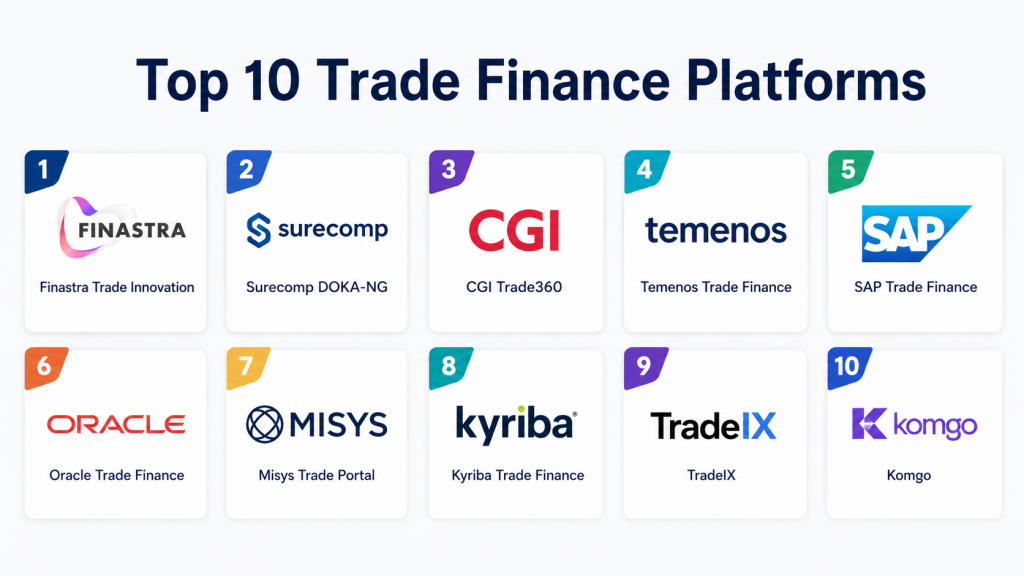
Top 10 Trade Finance Platforms
#1 — Finastra Trade Innovation
Short description :
Finastra Trade Innovation is a comprehensive trade finance platform designed for banks and financial institutions. It supports letters of credit, guarantees, and supply chain finance. Known for scalability and integration capabilities. Suitable for large enterprises. Provides automation and analytics tools. Helps streamline global trade operations.
Key Features
- Trade lifecycle management
- Letters of credit processing
- Workflow automation
- Reporting dashboards
- Integration tools
- Analytics
Pros
- Scalable platform
- Strong integration
Cons
- Complex implementation
- High cost
Platforms / Deployment
Cloud / On-premise
Security & Compliance
SSO, MFA, encryption, RBAC
Integrations & Ecosystem
Integrates with banking and enterprise systems.
- Core banking
- ERP systems
- APIs
Support & Community
Enterprise-level support.
#2 — Surecomp DOKA-NG
Short description :
Surecomp DOKA-NG is a digital trade finance platform offering end-to-end trade management. It supports document processing and compliance workflows. Known for flexibility and scalability. Suitable for banks and financial institutions. Provides analytics and reporting. Helps improve trade operations efficiency.
Key Features
- Trade processing
- Document management
- Workflow automation
- Reporting
- Analytics
Pros
- Flexible platform
- Strong compliance features
Cons
- Learning curve
- Pricing
Platforms / Deployment
Cloud
Security & Compliance
Encryption, access controls
Integrations & Ecosystem
- APIs
- Banking systems
Support & Community
Good support available.
#3 — CGI Trade360
Short description :
CGI Trade360 is a cloud-based trade finance platform offering real-time visibility and automation. It supports global trade transactions. Known for scalability and integration. Suitable for enterprises. Provides analytics and reporting tools. Helps manage trade operations efficiently.
Key Features
- Trade lifecycle management
- Real-time tracking
- Workflow automation
- Reporting
- Analytics
Pros
- Real-time visibility
- Scalable platform
Cons
- Complex setup
- Pricing
Platforms / Deployment
Cloud
Security & Compliance
SSO, encryption
Integrations & Ecosystem
- APIs
- Banking systems
Support & Community
Enterprise support.
#4 — Temenos Trade Finance
Short description :
Temenos Trade Finance is a platform designed for banks to manage trade finance operations. It supports letters of credit, guarantees, and financing. Known for integration with core banking systems. Suitable for large institutions. Provides analytics and reporting. Helps improve trade efficiency.
Key Features
- Trade finance management
- Workflow automation
- Reporting
- Analytics
- Integration tools
Pros
- Strong integration
- Enterprise scalability
Cons
- Implementation complexity
- Pricing
Platforms / Deployment
Cloud
Security & Compliance
SSO, MFA, encryption
Integrations & Ecosystem
- Core banking
- APIs
Support & Community
Enterprise-level support.
#5 — SAP Trade Finance
Short description :
SAP Trade Finance is part of the SAP ecosystem offering trade finance management capabilities. It supports document processing and compliance. Known for integration with ERP systems. Suitable for enterprises. Provides analytics and reporting. Helps streamline trade operations.
Key Features
- Trade lifecycle management
- Document processing
- Workflow automation
- Reporting
- Analytics
Pros
- Strong ERP integration
- Scalable platform
Cons
- Complex setup
- High cost
Platforms / Deployment
Cloud / On-premise
Security & Compliance
SSO, MFA, encryption
Integrations & Ecosystem
- SAP ERP
- APIs
Support & Community
Strong enterprise support.
#6 — Oracle Trade Finance
Short description :
Oracle Trade Finance is a platform designed for managing global trade operations. It supports automation and compliance workflows. Known for scalability and integration. Suitable for enterprises. Provides analytics and reporting. Helps improve trade processes.
Key Features
- Trade management
- Workflow automation
- Reporting
- Analytics
- Integration tools
Pros
- Strong integration
- Enterprise scalability
Cons
- Complex implementation
- Pricing
Platforms / Deployment
Cloud
Security & Compliance
SSO, MFA, encryption
Integrations & Ecosystem
- Oracle systems
- APIs
Support & Community
Enterprise support available.
#7 — Misys Trade Portal
Short description :
Misys Trade Portal is a digital trade finance solution offering client connectivity and transaction management. It supports document processing and workflows. Known for usability and integration. Suitable for banks and enterprises. Provides reporting tools. Helps improve customer experience.
Key Features
- Trade portal
- Document processing
- Workflow automation
- Reporting
- Integration tools
Pros
- User-friendly
- Strong connectivity
Cons
- Limited advanced features
- Pricing
Platforms / Deployment
Cloud
Security & Compliance
Encryption, access controls
Integrations & Ecosystem
- APIs
- Banking systems
Support & Community
Moderate support.
#8 — Kyriba Trade Finance
Short description :
Kyriba offers trade finance capabilities within its treasury platform. It supports risk management and financing workflows. Known for analytics and integration. Suitable for enterprises. Provides reporting tools. Helps improve trade finance visibility.
Key Features
- Trade finance management
- Risk management
- Analytics
- Reporting
- Integration tools
Pros
- Strong analytics
- Integrated platform
Cons
- Limited standalone features
- Pricing
Platforms / Deployment
Cloud
Security & Compliance
Encryption, access controls
Integrations & Ecosystem
- APIs
- Treasury systems
Support & Community
Good enterprise support.
#9 — TradeIX
Short description :
TradeIX is a blockchain-based trade finance platform offering transaction management and transparency. It supports digital trade processes. Known for innovation and flexibility. Suitable for banks and fintechs. Provides analytics and reporting. Helps improve trade efficiency.
Key Features
- Blockchain-based processing
- Trade management
- Analytics
- Reporting
- Integration tools
Pros
- Innovative platform
- Transparent processes
Cons
- Emerging ecosystem
- Limited adoption
Platforms / Deployment
Cloud
Security & Compliance
Encryption, access controls
Integrations & Ecosystem
- APIs
- Trade networks
Support & Community
Growing support.
#10 — Komgo
Short description :
Komgo is a blockchain-based trade finance platform focused on commodity trade. It supports document digitization and compliance. Known for transparency and security. Suitable for enterprises. Provides reporting tools. Helps streamline trade processes.
Key Features
- Blockchain-based trade
- Document digitization
- Compliance tools
- Reporting
- Integration tools
Pros
- Transparent platform
- Strong security
Cons
- Niche focus
- Limited features
Platforms / Deployment
Cloud
Security & Compliance
Encryption, access controls
Integrations & Ecosystem
- APIs
- Trade systems
Support & Community
Moderate support.
Comparison Table
| Tool Name | Best For | Platform(s) Supported | Deployment | Standout Feature | Public Rating |
|---|---|---|---|---|---|
| Finastra | Enterprise | Web | Hybrid | Trade lifecycle | N/A |
| Surecomp | Enterprise | Web | Cloud | Document mgmt | N/A |
| CGI | Enterprise | Web | Cloud | Real-time tracking | N/A |
| Temenos | Enterprise | Web | Cloud | Core banking integration | N/A |
| SAP | Enterprise | Web | Hybrid | ERP integration | N/A |
| Oracle | Enterprise | Web | Cloud | Integration | N/A |
| Misys | Mid-market | Web | Cloud | Client portal | N/A |
| Kyriba | Enterprise | Web | Cloud | Treasury integration | N/A |
| TradeIX | Fintech | Web | Cloud | Blockchain | N/A |
| Komgo | Enterprise | Web | Cloud | Transparency | N/A |
Evaluation & Scoring of Trade Finance Platforms
| Tool Name | Core | Ease | Integrations | Security | Performance | Support | Value | Weighted Total |
|---|---|---|---|---|---|---|---|---|
| Finastra | 9 | 6 | 9 | 9 | 9 | 9 | 7 | 8.4 |
| Surecomp | 8 | 7 | 8 | 8 | 8 | 8 | 7 | 7.9 |
| CGI | 9 | 7 | 8 | 8 | 9 | 8 | 7 | 8.2 |
| Temenos | 9 | 6 | 9 | 9 | 9 | 9 | 7 | 8.4 |
| SAP | 9 | 6 | 9 | 9 | 9 | 9 | 7 | 8.4 |
| Oracle | 9 | 6 | 9 | 9 | 9 | 9 | 7 | 8.4 |
| Misys | 7 | 8 | 7 | 7 | 7 | 7 | 7 | 7.2 |
| Kyriba | 8 | 7 | 8 | 8 | 8 | 8 | 7 | 7.9 |
| TradeIX | 7 | 7 | 7 | 7 | 7 | 7 | 7 | 7.0 |
| Komgo | 7 | 7 | 7 | 7 | 7 | 7 | 7 | 7.0 |
Interpretation:
These scores provide a comparative view of platform strengths. Enterprise tools excel in scalability and integration, while newer platforms offer innovation and flexibility. Choose based on trade complexity and business needs.
Which Trade Finance Platform Is Right for You?
Solo / Freelancer
- Not typically required
SMB
- Misys Trade Portal
- Focus on simplicity and usability
Mid-Market
- Surecomp
- Balanced features and scalability
Enterprise
- Finastra, Temenos, SAP
- Advanced capabilities and integration
Budget vs Premium
- Budget: Misys
- Premium: SAP, Finastra
Feature Depth vs Ease of Use
- Deep features: SAP
- Easy to use: Misys
Integrations & Scalability
- Strong: Enterprise tools
- Moderate: SMB tools
Security & Compliance Needs
- High: Enterprise platforms
- Moderate: SMB tools
Frequently Asked Questions (FAQs)
1. What is a trade finance platform?
It is software that manages international trade transactions. It handles documents, financing, and compliance. It improves efficiency. It reduces risk. It is essential for global trade.
2. How much does it cost?
Pricing varies depending on features and scale. Enterprise tools use custom pricing. SMB tools may offer subscriptions. Implementation costs may apply. Evaluate total cost.
3. How long does implementation take?
Implementation can take months for enterprise systems. SMB tools deploy faster. Integration adds complexity. Proper planning is important. Pilot testing is recommended.
4. Is it secure?
Most platforms include encryption and access controls. Enterprise tools offer advanced security. Always review vendor policies. Ensure compliance. Security is critical.
5. Can it integrate with other systems?
Yes, most platforms integrate with ERP and banking systems. APIs enable customization. Integration improves workflows. Verify compatibility before choosing.
6. What industries use these platforms?
Banks, exporters, and importers use them. They manage trade operations. The platforms improve efficiency. They support compliance. Many organizations rely on them.
7. What are common mistakes when choosing?
Choosing based only on price is a mistake. Ignoring scalability limits growth. Not considering integrations causes issues. Overlooking usability affects adoption. Evaluate carefully.
8. Can small businesses use these platforms?
Yes, some tools are designed for SMBs. They offer simpler features. These tools are easier to use. They help manage trade. SMBs benefit.
9. How effective are these platforms?
They improve efficiency and transparency. Automation reduces manual work. Analytics provide insights. They enhance compliance. They support better decisions.
10. Is it easy to switch platforms?
Switching platforms can be complex. Data migration is challenging. Training is required. Vendor lock-in may occur. Plan carefully.
Conclusion
Trade Finance Platforms are essential for organizations engaged in global trade, enabling them to streamline complex processes, reduce operational risks, and ensure compliance with international regulations. By digitizing trade workflows, automating documentation, and providing real-time visibility, these platforms significantly enhance efficiency and transparency across the trade lifecycle.
However, the right platform depends on your organization’s size, trade volume, and operational complexity. Large enterprises may benefit from comprehensive solutions like Finastra, SAP, or Temenos, while smaller organizations may prefer simpler and more accessible platforms like Misys Trade Portal. Choosing the right platform requires balancing functionality, scalability, and cost.
As a next step, shortlist a few platforms that align with your business requirements, conduct pilot implementations, and evaluate their performance in real-world trade scenarios. Focus on integration, compliance, and scalability to ensure long-term success.
