Introduction
Digital Banking Platforms are modern software systems that enable banks, fintech companies, and financial institutions to deliver fully digital banking services across web and mobile channels. These platforms power everything from account opening and payments to lending, customer engagement, and financial analytics.
In today’s financial ecosystem, digital banking platforms are deeply integrated with CyberSecurity, Identity Management, Zero Trust, and Access Control frameworks. Since these platforms handle sensitive financial transactions and personal data, they must ensure secure authentication, fraud prevention, and regulatory compliance at every step.
Digital Banking Platforms are used for:
- Digital account opening and onboarding
- Payments and transaction management
- Lending and credit services
- Customer engagement and support
- Fraud detection and risk management
- Compliance and regulatory reporting
Key evaluation criteria:
- Core banking and digital capabilities
- User experience and mobile-first design
- Integration with financial ecosystems
- Security and compliance features
- Scalability for large customer bases
- API-driven architecture
- Customization and flexibility
- Data analytics and reporting
- Deployment options (cloud/hybrid)
- Ease of implementation and management
Best for:
Banks, fintech companies, neobanks, and financial institutions that require scalable, secure, and modern digital banking infrastructure.
Not ideal for:
Very small institutions or organizations that do not require full digital transformation or advanced customer-facing banking systems.
Key Trends in Digital Banking Platforms
- API-first and open banking ecosystems
- AI-driven personalization and customer insights
- Cloud-native banking platforms
- Zero Trust security for financial data protection
- Integration with Identity Management systems for KYC
- Embedded finance and Banking-as-a-Service models
- Real-time payments and instant processing
- Digital onboarding and eKYC automation
- Microservices-based architectures
- Advanced fraud detection and analytics
How These Tools Were Selected
- Global adoption across banks and fintechs
- Breadth of digital banking features
- Integration capabilities with financial systems
- Security and compliance standards
- Scalability for millions of users
- API and microservices architecture
- Customer experience and usability
- Innovation in digital banking features
- Reliability and performance
- Balance between enterprise and fintech solutions
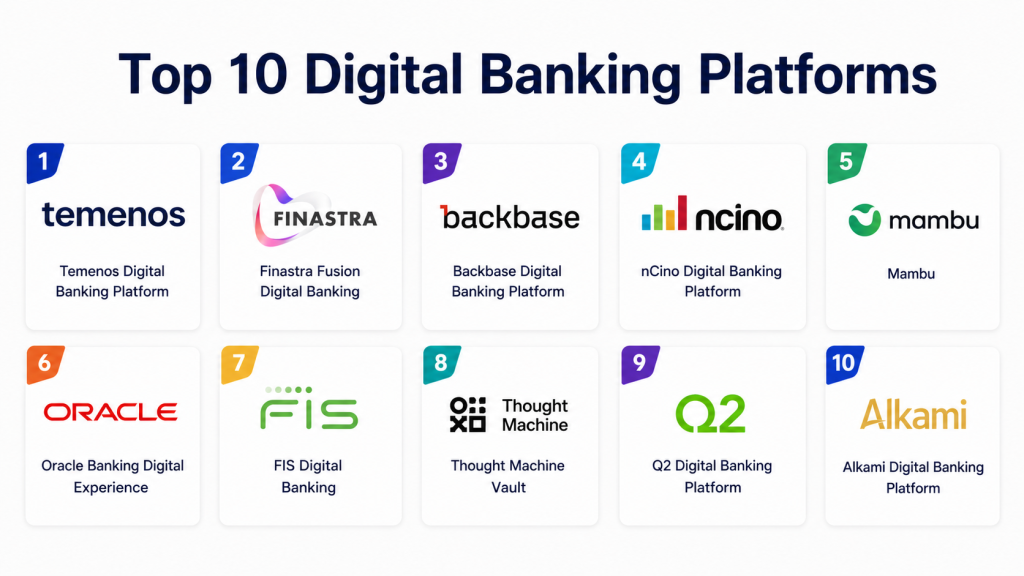
Top 10 Digital Banking Platforms
1 — Temenos Digital Banking Platform
Temenos is a leading digital banking platform designed for large banks and financial institutions. It offers end-to-end digital banking capabilities including payments, lending, and customer engagement. The platform is highly scalable and supports global banking operations. It provides strong integration with core banking systems. Temenos focuses on flexibility and innovation.
Key Features
- Digital banking services
- Payments and transaction management
- Customer engagement tools
- API-based integrations
- Analytics dashboards
- Compliance tracking
- Workflow automation
Pros
- Highly scalable
- Strong global adoption
- Flexible architecture
Cons
- Complex implementation
- High cost
Platforms / Deployment
- Web, Mobile
- Cloud / Hybrid
Security & Compliance
- Role-based access control
- Encryption support
- Not publicly stated certifications
Integrations & Ecosystem
Integrates with banking systems and financial services platforms.
Support & Community
Enterprise-grade global support.
2 — Finastra Fusion Digital Banking
Finastra Fusion Digital Banking is a comprehensive platform designed for retail and corporate banking services. It enables banks to deliver digital experiences across multiple channels. The platform supports payments, lending, and customer engagement. It is widely used by global financial institutions.
Key Features
- Digital banking services
- Customer onboarding tools
- Payment processing
- API integrations
- Analytics and reporting
- Compliance tracking
- Workflow automation
Pros
- Strong banking capabilities
- Good integration ecosystem
- Reliable performance
Cons
- Complex setup
- Requires training
Platforms / Deployment
- Web, Mobile
- Cloud / Hybrid
Security & Compliance
- Enterprise-grade controls
- Not publicly stated certifications
Integrations & Ecosystem
Integrates with financial systems and banking platforms.
Support & Community
Global enterprise support.
3 — Backbase Digital Banking Platform
Backbase is a customer experience-focused digital banking platform designed for modern banks and fintechs. It provides tools for digital onboarding, engagement, and banking services. The platform emphasizes user experience and personalization. It is widely used by banks undergoing digital transformation.
Key Features
- Digital onboarding
- Customer engagement tools
- API-based architecture
- Mobile banking support
- Analytics dashboards
- Workflow automation
- Integration capabilities
Pros
- Excellent user experience
- Strong customization
- Flexible architecture
Cons
- Requires customization effort
- High implementation cost
Platforms / Deployment
- Web, Mobile
- Cloud
Security & Compliance
- Role-based access control
- Not publicly stated certifications
Integrations & Ecosystem
Integrates with banking systems and fintech services.
Support & Community
Strong enterprise support.
4 — nCino Digital Banking
nCino provides a cloud-based digital banking platform built on modern architecture. It enables banks to manage lending, onboarding, and customer engagement digitally. The platform is widely used by financial institutions. It focuses on automation and efficiency.
Key Features
- Digital onboarding
- Lending workflows
- Customer engagement
- Workflow automation
- Analytics dashboards
- Integration capabilities
- Compliance tools
Pros
- Strong cloud platform
- Good scalability
- Integrated banking workflows
Cons
- Requires ecosystem dependency
- Complex setup
Platforms / Deployment
- Web
- Cloud
Security & Compliance
- Enterprise security controls
- Not publicly stated certifications
Integrations & Ecosystem
Integrates with banking and financial systems.
Support & Community
Enterprise support.
5 — Mambu
Mambu is a cloud-native banking platform designed for fintech companies and digital banks. It provides flexible APIs for building banking services. The platform supports lending, payments, and account management. It is widely used for digital-first banking models.
Key Features
- Core banking services
- API-based architecture
- Payment processing
- Customer account management
- Analytics tools
- Integration capabilities
- Workflow automation
Pros
- Modern architecture
- Strong API ecosystem
- Highly scalable
Cons
- Requires technical expertise
- Complex configuration
Platforms / Deployment
- Web
- Cloud
Security & Compliance
- RBAC and encryption
- Not publicly stated certifications
Integrations & Ecosystem
Strong API-driven ecosystem.
Support & Community
Developer-focused support.
6 — Oracle Banking Digital Experience
Oracle Banking Digital Experience is designed for large-scale banks and financial institutions. It provides end-to-end digital banking capabilities with strong analytics and reporting tools. The platform is widely used globally.
Key Features
- Digital banking services
- Customer onboarding
- Payment processing
- Analytics dashboards
- Compliance tools
- Workflow automation
- Integration capabilities
Pros
- Strong enterprise features
- Reliable performance
- Global adoption
Cons
- Complex implementation
- High cost
Platforms / Deployment
- Web, Mobile
- Cloud / Hybrid
Security & Compliance
- Enterprise-grade controls
- Not publicly stated certifications
Integrations & Ecosystem
Integrates with Oracle and financial systems.
Support & Community
Global enterprise support.
7 — FIS Digital Banking
FIS Digital Banking platform enables banks to deliver modern digital experiences to customers. It supports payments, account management, and analytics. The platform is widely used in global banking.
Key Features
- Digital banking services
- Payment processing
- Customer account management
- Analytics dashboards
- Workflow automation
- Integration tools
- Compliance tracking
Pros
- Strong banking capabilities
- Reliable platform
- Good scalability
Cons
- Complex setup
- Requires training
Platforms / Deployment
- Web, Mobile
- Cloud / Hybrid
Security & Compliance
- Enterprise security controls
- Not publicly stated certifications
Integrations & Ecosystem
Integrates with financial and banking systems.
Support & Community
Enterprise support.
8 — Thought Machine Vault
Thought Machine Vault is a cloud-native core banking platform designed for next-generation digital banks. It provides flexibility and scalability using modern architecture. The platform supports real-time banking operations.
Key Features
- Core banking services
- Real-time processing
- API-based architecture
- Payment management
- Analytics dashboards
- Workflow automation
- Integration tools
Pros
- Modern cloud-native design
- High flexibility
- Strong scalability
Cons
- Requires technical expertise
- Newer ecosystem
Platforms / Deployment
- Web
- Cloud
Security & Compliance
- Standard enterprise controls
- Not publicly stated certifications
Integrations & Ecosystem
Strong API-based ecosystem.
Support & Community
Growing enterprise support.
9 — Q2 Digital Banking Platform
Q2 provides digital banking solutions focused on retail and commercial banking. It offers customer engagement tools and digital onboarding capabilities. The platform is widely used by regional banks.
Key Features
- Digital onboarding
- Customer engagement
- Payment processing
- Analytics dashboards
- Workflow automation
- Integration capabilities
- Compliance tracking
Pros
- Strong customer experience
- Easy to use
- Good scalability
Cons
- Limited enterprise depth
- Smaller ecosystem
Platforms / Deployment
- Web, Mobile
- Cloud
Security & Compliance
- Standard controls
- Not publicly stated certifications
Integrations & Ecosystem
Integrates with banking systems.
Support & Community
Good support for mid-market banks.
10 — Alkami Digital Banking Platform
Alkami is a digital banking platform designed for credit unions and community banks. It provides customer engagement tools and digital services. The platform focuses on user experience and scalability.
Key Features
- Digital banking services
- Customer engagement tools
- Payment processing
- Analytics dashboards
- Workflow automation
- Integration tools
- Compliance tracking
Pros
- Strong user experience
- Good for community banks
- Scalable
Cons
- Limited enterprise features
- Smaller ecosystem
Platforms / Deployment
- Web, Mobile
- Cloud
Security & Compliance
- Standard enterprise controls
- Not publicly stated certifications
Integrations & Ecosystem
Integrates with financial systems.
Support & Community
Strong mid-market support.
Comparison Table
| Tool | Best For | Platforms | Deployment | Standout Feature | Rating |
|---|---|---|---|---|---|
| Temenos | Enterprise banks | Web/Mobile | Hybrid | Global scalability | N/A |
| Finastra | Banks | Web/Mobile | Hybrid | Full banking suite | N/A |
| Backbase | UX-focused banks | Web/Mobile | Cloud | Customer experience | N/A |
| nCino | Lending banks | Web | Cloud | Workflow automation | N/A |
| Mambu | Fintech | Web | Cloud | API-first | N/A |
| Oracle | Enterprise | Web/Mobile | Hybrid | Analytics | N/A |
| FIS | Global banks | Web/Mobile | Hybrid | Reliability | N/A |
| Thought Machine | Neobanks | Web | Cloud | Real-time core | N/A |
| Q2 | Regional banks | Web/Mobile | Cloud | Engagement tools | N/A |
| Alkami | Credit unions | Web/Mobile | Cloud | User experience | N/A |
Evaluation & Scoring
| Tool | Core | Ease | Integrations | Security | Performance | Support | Value | Total |
|---|---|---|---|---|---|---|---|---|
| Temenos | 9 | 7 | 9 | 9 | 9 | 9 | 7 | 8.6 |
| Finastra | 9 | 7 | 9 | 9 | 9 | 9 | 7 | 8.6 |
| Backbase | 8 | 9 | 8 | 8 | 8 | 8 | 8 | 8.1 |
| nCino | 8 | 8 | 8 | 8 | 8 | 8 | 8 | 8.0 |
| Mambu | 8 | 7 | 9 | 8 | 8 | 8 | 7 | 8.0 |
| Oracle | 9 | 6 | 9 | 9 | 9 | 9 | 7 | 8.3 |
| FIS | 9 | 7 | 9 | 9 | 9 | 9 | 7 | 8.6 |
| Thought Machine | 8 | 7 | 9 | 8 | 8 | 8 | 7 | 8.0 |
| Q2 | 7 | 9 | 7 | 7 | 8 | 8 | 8 | 7.8 |
| Alkami | 7 | 9 | 7 | 7 | 8 | 8 | 8 | 7.8 |
Which Digital Banking Platform Is Right for You?
SMB / Credit Unions
Alkami, Q2
Mid-Market
Backbase, nCino
Enterprise
Temenos, Finastra, Oracle, FIS
Fintech / Neobanks
Mambu, Thought Machine
FAQs
What is a Digital Banking Platform?
A Digital Banking Platform is software that allows banks to deliver services online and via mobile apps. It handles transactions, accounts, and customer engagement. These platforms improve accessibility and efficiency. They are essential for modern banking. They support digital transformation.
Why are digital banking platforms important?
They enable banks to offer seamless digital experiences to customers. They reduce operational costs and improve efficiency. They also support scalability. These platforms enhance customer satisfaction. They are critical for modern financial services.
Do these platforms support automation?
Yes, most platforms automate workflows and transactions. They reduce manual effort and errors. Automation improves efficiency. It speeds up operations. It enables better service delivery.
Are digital banking platforms secure?
Yes, they include strong security features like encryption and access control. Many integrate with Identity Management systems. This ensures safe transactions. Security is a top priority. It protects sensitive financial data.
Are these platforms cloud-based?
Most modern platforms are cloud-based. Some offer hybrid deployment. Cloud improves scalability and flexibility. It reduces infrastructure costs. It enables faster updates.
Do they integrate with other systems?
Yes, they integrate with core banking systems and financial tools. This ensures seamless operations. Integration improves efficiency. It supports automation. It enables innovation.
Are digital banking platforms expensive?
Enterprise platforms are costly. Smaller solutions are more affordable. Pricing depends on features and scale. Costs vary widely. ROI is usually high.
Which industries use these platforms?
Banks, fintech companies, and financial institutions use them. They are essential in banking. They support digital services. They are widely adopted globally.
What is the biggest challenge?
Implementation and integration complexity. Training may be required. Customization can take time. But benefits are significant. They improve operations.
Can small banks use these platforms?
Yes, smaller banks can use simplified versions. These are easier to deploy. They provide essential features. They are cost-effective. They support growth.
Conclusion
Digital Banking Platforms are essential systems that enable financial institutions to deliver modern, secure, and scalable banking services. They provide automation, customer engagement, and operational efficiency across the banking lifecycle.
These platforms are deeply integrated with CyberSecurity, Identity Management, and Access Control frameworks to ensure secure financial transactions. As banking becomes more digital, these platforms play a central role in transformation.
The best platform depends on organizational size and needs. Temenos, Finastra, and Oracle lead enterprise deployments, while Backbase and nCino serve mid-market banks. Mambu and Thought Machine support fintech innovation.
Ultimately, digital banking requires secure, scalable, and customer-focused platforms that drive efficiency and innovation in financial services.
