Introduction
Synthetic Monitoring Tools help teams test websites, APIs, applications, and digital user flows from scheduled scripts or probes instead of waiting for real users to encounter problems. In simple terms, they simulate user activity to check uptime, latency, page performance, API health, and transaction success before customers notice something is wrong. This makes them especially valuable for modern cloud applications, global websites, mobile backends, and ecommerce systems where availability and speed directly affect revenue and customer trust.
Synthetic monitoring matters more now because digital services are expected to be always available, globally responsive, and release-ready across changing infrastructure. Teams use these tools to validate uptime, verify login or checkout flows, measure API response times, track SSL or DNS issues, and confirm that critical user journeys keep working after deployments. Buyers should evaluate check types, browser-based testing, API support, alerting quality, global probe coverage, private probe support, observability integrations, scripting flexibility, security controls, and pricing based on test frequency or volume.
Best for: DevOps teams, SREs, QA engineers, platform teams, ecommerce teams, and SaaS companies that need proactive visibility into uptime and user flows. Not ideal for: tiny internal apps with low business impact, where basic uptime checks or lightweight monitoring may be sufficient until system complexity or customer exposure grows.
Key Trends in Synthetic Monitoring Tools
- Synthetic monitoring is becoming part of broader observability platforms instead of staying a standalone uptime feature.
- Browser-based journey testing is growing fast because teams want to validate real user flows, not just single URL checks.
- Private probes are becoming more important for monitoring internal apps, VPN-only systems, and compliance-sensitive environments.
- API monitoring is now a standard expectation as more products depend on microservices, partner integrations, and mobile backends.
- Global probe coverage remains a major differentiator for brands with customers across multiple regions.
- Synthetic and real user monitoring are increasingly used together so teams can compare expected performance with actual user experience.
- Observability integration is now critical so teams can move from a failed check to logs, traces, and root-cause analysis faster.
- AI-assisted alerting and incident reduction are emerging in premium platforms to reduce noise and improve signal quality.
- Pricing pressure is increasing because frequent browser checks and multistep transactions can become expensive at scale.
- Script reuse across testing and monitoring workflows is gaining traction as teams want to use similar scripts for QA, performance testing, and production checks.
How We Selected These Tools (Methodology)
- We prioritized tools with strong market adoption and practical mindshare in uptime, API, and transaction monitoring.
- We looked for feature completeness, including HTTP checks, API tests, browser flows, alerting, dashboards, and multistep workflows.
- We gave extra weight to tools with strong global coverage and private probe support.
- We considered reliability and performance signals, especially for products used in production-critical environments.
- We reviewed security posture signals such as RBAC, encryption, enterprise access controls, and private deployment options when confidently known.
- We evaluated integrations and ecosystem strength, including APM, logs, traces, CI/CD, incident tools, and APIs.
- We included a balanced mix of enterprise, SMB, developer-first, managed, and open-source-friendly choices.
- We considered customer fit across segments, because an ecommerce team, a platform team, and a startup often need different strengths.
- We factored in price and long-term value, especially where browser checks, frequency, and test volume can significantly affect cost.
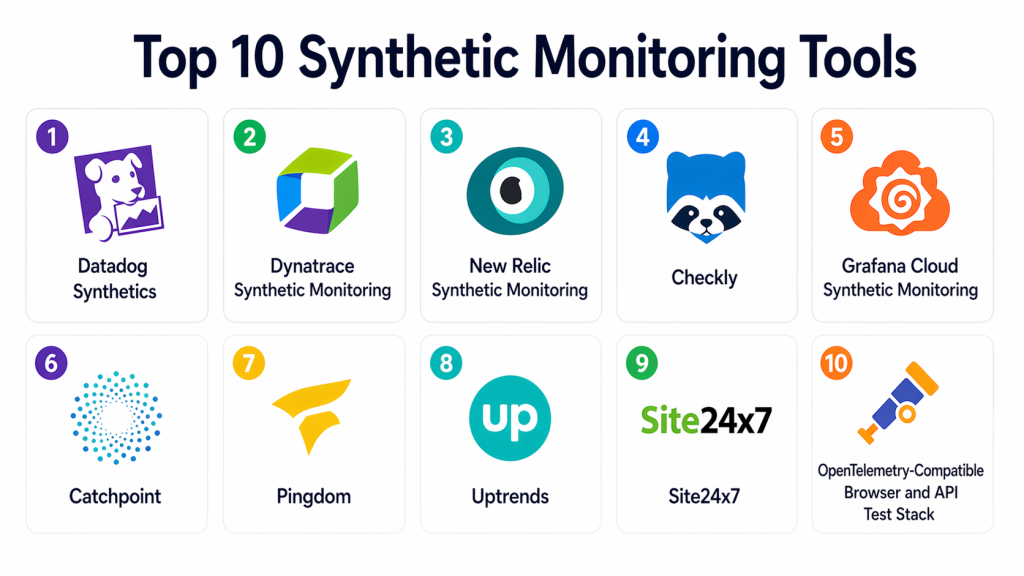
Top 10 Synthetic Monitoring Tools
#1 — Datadog Synthetics
Short description : Datadog Synthetics is one of the strongest all-around synthetic monitoring platforms for teams that want uptime checks, API tests, and browser-based user journey validation in one place. It is especially useful for organizations already using Datadog for APM, logs, and infrastructure monitoring. The platform is well suited to cloud-native environments and modern web applications. It offers strong alerting and integration depth. For many mid-market and enterprise teams, it delivers a complete synthetic monitoring workflow.
Key Features
- API, HTTP, SSL, DNS, TCP, and browser-based checks
- Multistep browser tests for critical user journeys
- Integration with logs, traces, and APM workflows
- Private and public testing locations
- Strong alerting and dashboarding
- CI/CD and deployment validation support
- Flexible scheduling and assertions
Pros
- Excellent fit for full-stack observability workflows
- Strong browser and API monitoring coverage
- Very good for cloud-native teams already using the broader platform
Cons
- Pricing can increase with test volume and frequency
- Broad platform may feel heavy for smaller teams
- Best value often depends on wider Datadog adoption
Platforms / Deployment
- Web
- Cloud / Hybrid
Security & Compliance
- Encryption: Supported
- RBAC: Supported
- SSO/SAML, MFA, audit logs: Not publicly stated
- SOC 2, ISO 27001, GDPR, HIPAA: Varies / N/A
Integrations & Ecosystem
Datadog Synthetics is strongest when used as part of a wider observability strategy. It helps teams connect a failed synthetic check to backend telemetry, traces, and operational workflows quickly.
- APM and distributed tracing
- Cloud platforms
- CI/CD pipelines
- Incident management workflows
- APIs and dashboards
Support & Community
Documentation is strong, onboarding is mature, and enterprise support is well established. Community awareness is high among observability-focused teams.
#2 — Dynatrace Synthetic Monitoring
Short description : Dynatrace Synthetic Monitoring is a strong enterprise-grade choice for teams that need proactive availability checks tied to broader digital experience and observability workflows. It supports browser-based journeys, API monitoring, and location-based validation across production environments. It is particularly attractive to large organizations with strict uptime and user-experience requirements. Dynatrace also emphasizes automation and platform-level correlation. It is best suited to enterprises needing scale, governance, and broad platform depth.
Key Features
- Browser-based synthetic transactions
- API and service monitoring
- Global monitoring locations
- Private synthetic locations
- Integration with real user monitoring and backend observability
- Strong alerting and root-cause workflows
- Enterprise dashboards and reporting
Pros
- Strong fit for large, complex environments
- Good correlation between synthetic failures and platform telemetry
- Strong governance and private location support
Cons
- Premium pricing
- Platform can feel heavy for smaller teams
- Setup may require experienced platform owners
Platforms / Deployment
- Web
- Cloud / Hybrid
Security & Compliance
- RBAC: Supported
- Encryption: Supported
- Audit logs: Supported
- SSO/SAML, MFA: Not publicly stated
- SOC 2, ISO 27001, GDPR, HIPAA: Varies / N/A
Integrations & Ecosystem
Dynatrace is strongest when synthetic monitoring is part of a larger observability and digital experience strategy. It is useful for organizations that want synthetic, real user, and backend visibility tied together.
- APM and observability workflows
- Private monitoring locations
- Cloud platforms
- Incident automation
- APIs
Support & Community
Enterprise support is strong and documentation is broad. It is better suited to structured enterprise teams than lightweight developer-only adoption.
#3 — New Relic Synthetic Monitoring
Short description : New Relic Synthetic Monitoring is a practical choice for teams that want browser tests, scripted API checks, and uptime validation connected to a broader observability platform. It supports key user journeys and helps teams understand when and where failures occur before customers are affected. It is especially attractive for engineering teams that want approachable onboarding. It also works well when synthetic checks need to connect to application telemetry. For SMB and mid-market teams, it offers a balanced feature set.
Key Features
- Simple and scripted browser monitoring
- API and uptime monitoring
- Global monitoring locations
- Alerting and dashboards
- Integration with broader application monitoring
- Flexible scripting and assertions
- Incident workflow support
Pros
- Good balance between usability and platform depth
- Useful for both frontend and backend validation
- Easier onboarding than some enterprise-heavy tools
Cons
- Pricing can become harder to manage with more checks
- Some advanced workflows require tuning
- Product sprawl can confuse new buyers
Platforms / Deployment
- Web
- Cloud
Security & Compliance
- RBAC: Supported
- Encryption: Supported
- SSO/SAML, MFA, audit logs: Not publicly stated
- SOC 2, ISO 27001, GDPR, HIPAA: Varies / N/A
Integrations & Ecosystem
New Relic works well for teams that want synthetic checks in context with broader monitoring, incident workflows, and engineering dashboards instead of a narrow uptime-only tool.
- APM and tracing
- Cloud services
- APIs
- DevOps workflows
- Alerting integrations
Support & Community
Documentation is broad, onboarding is manageable, and the platform has a large installed base. It is usually easier to start with than some more operations-heavy alternatives.
#4 — Checkly
Short description : Checkly is a developer-focused synthetic monitoring platform that combines browser checks, API monitoring, and code-first workflows. It is especially appealing to teams that want modern scripting, CI/CD integration, and synthetic monitoring owned directly by engineers. It fits startups, SaaS teams, and platform teams well. The product is often chosen for its clean developer experience. It is a strong fit for teams that want synthetic checks close to the delivery pipeline.
Key Features
- Browser and API checks
- Code-first monitoring workflows
- Playwright-based browser scripting
- CI/CD integration
- Alerting and failure diagnostics
- Private locations
- Developer-centric automation
Pros
- Excellent developer experience
- Strong fit for engineering-led monitoring workflows
- Good for release validation and modern browser testing
Cons
- Less broad than full enterprise observability platforms
- Some non-technical teams may prefer more visual workflows
- Value depends on engineering ownership model
Platforms / Deployment
- Web
- Cloud / Hybrid
Security & Compliance
- Not publicly stated
- Encryption, RBAC, SSO/SAML, MFA, audit logs: Varies / N/A
Integrations & Ecosystem
Checkly is most compelling for teams that want synthetic monitoring embedded into engineering workflows rather than managed as a separate operations-only function.
- CI/CD pipelines
- Browser automation workflows
- APIs
- Alerting tools
- Private locations
Support & Community
Checkly has strong product clarity and good documentation, especially for developers. It is particularly approachable for code-first teams.
#5 — Grafana Cloud Synthetic Monitoring
Short description : Grafana Cloud Synthetic Monitoring is a strong open-source-friendly option for teams that want uptime checks, API tests, and script-based monitoring inside the Grafana ecosystem. It supports public and private probes, multiple check types, and integration with logs and metrics. It is especially attractive to organizations already using Grafana, Prometheus, Loki, or k6. It offers flexibility and ecosystem openness. It is a strong fit for engineering-led teams that prefer more control.
Key Features
- HTTP, DNS, ping, TCP, traceroute, and multistep checks
- Public and private probes
- k6 scripted checks
- Browser-style and flow validation through k6-based workflows
- Metrics and logs output into Grafana ecosystem
- Alerting and dashboards
- Good fit with broader open observability tooling
Pros
- Strong value for open-source-oriented teams
- Good flexibility and private probe support
- Attractive for teams already using Grafana ecosystem tools
Cons
- Best experience often assumes Grafana familiarity
- Less turnkey than premium enterprise suites
- Some workflows require observability knowledge
Platforms / Deployment
- Web
- Cloud / Hybrid
Security & Compliance
- RBAC: Supported
- Encryption: Supported
- SSO/SAML, MFA, audit logs: Not publicly stated
- SOC 2, ISO 27001, GDPR, HIPAA: Varies / N/A
Integrations & Ecosystem
Grafana Cloud Synthetic Monitoring is strongest when used with the wider Grafana stack. It appeals to teams that want synthetic tests tied to metrics, logs, and observability workflows without relying entirely on proprietary architecture.
- Grafana dashboards
- k6 scripts
- Loki
- Prometheus
- Private probes
- APIs
Support & Community
Grafana has a very strong community and a deep open-source ecosystem. Documentation is solid, and the community is especially strong for engineering-led teams.
#6 — Catchpoint
Short description : Catchpoint is a well-known enterprise synthetic monitoring platform focused on internet performance, digital experience, and global visibility. It is particularly useful for large organizations that care deeply about user journey performance, internet path issues, and global test coverage. It is more enterprise-oriented than many developer-first tools. That focus can be a strength for digital businesses with complex availability and performance requirements. It is best suited to organizations that treat performance as a mission-critical business concern.
Key Features
- Global synthetic monitoring coverage
- Browser and transaction monitoring
- API and availability checks
- Network and internet path visibility
- Detailed performance diagnostics
- Enterprise dashboards and alerting
Pros
- Strong global reach and enterprise maturity
- Excellent for internet performance visibility
- Useful for large-scale digital experience monitoring
Cons
- Typically priced for larger organizations
- More platform-heavy than some developer-first tools
- May be more than smaller teams need
Platforms / Deployment
- Web
- Cloud
Security & Compliance
- Not publicly stated
- Encryption, RBAC, SSO/SAML, MFA, audit logs: Varies / N/A
Integrations & Ecosystem
Catchpoint is most compelling for enterprises that need broad digital performance visibility and proactive testing across many regions and environments.
- Global monitoring locations
- Enterprise alerting workflows
- APIs
- Performance reporting
- Internet path analysis
Support & Community
Catchpoint is enterprise-focused with strong support expectations. It is better known in larger organizations than in smaller developer-first teams.
#7 — Pingdom
Short description : Pingdom is one of the most recognized names in synthetic monitoring and uptime checking. It is widely used for website monitoring, response time tracking, and availability alerting. It is especially attractive to SMBs and teams that want straightforward setup without managing a large observability platform. While it is more focused than enterprise-grade observability suites, that simplicity is often part of its appeal. It works well for web availability and basic synthetic coverage.
Key Features
- Website uptime monitoring
- Response time tracking
- Transaction and page monitoring
- Alerting and notifications
- Global monitoring locations
- Reporting dashboards
Pros
- Easy to understand and deploy
- Strong brand familiarity in uptime monitoring
- Good for focused website monitoring use cases
Cons
- Less broad than full observability suites
- Limited depth compared with premium enterprise tools
- Not ideal for teams needing heavy API or backend correlation
Platforms / Deployment
- Web
- Cloud
Security & Compliance
- Not publicly stated
- Encryption, RBAC, SSO/SAML, MFA, audit logs: Varies / N/A
Integrations & Ecosystem
Pingdom is most useful when uptime, page responsiveness, and fast alerting matter more than building a broad synthetic-plus-observability platform.
- Alerting workflows
- Reporting tools
- APIs
- Website monitoring use cases
Support & Community
Pingdom is approachable and well known. It is especially useful for teams wanting focused synthetic monitoring without major implementation complexity.
#8 — Uptrends
Short description : Uptrends is a synthetic monitoring platform designed for website, transaction, API, and infrastructure checks across global test locations. It is useful for organizations that want broad monitoring coverage without immediately adopting a full observability suite. It offers both simple uptime checks and more advanced transaction monitoring. It is especially practical for web-centric teams and digital businesses. It fits SMB and mid-market organizations particularly well.
Key Features
- Uptime and website monitoring
- Transaction monitoring
- API monitoring
- Global checkpoint locations
- Performance dashboards
- Alerts and reporting
Pros
- Broad check coverage for web-centric teams
- Easier to understand than some enterprise-heavy suites
- Good fit for proactive availability testing
Cons
- Less integrated with deep observability stacks than some rivals
- Not the strongest choice for code-first workflows
- Enterprise platform depth is more limited than top-tier vendors
Platforms / Deployment
- Web
- Cloud
Security & Compliance
- Not publicly stated
- Encryption, RBAC, SSO/SAML, MFA, audit logs: Varies / N/A
Integrations & Ecosystem
Uptrends works well for teams that want broad synthetic coverage, global location testing, and practical alerting without needing a highly technical observability platform.
- APIs
- Alerting tools
- Transaction monitoring workflows
- Reporting tools
Support & Community
The platform is relatively approachable and documentation is practical. It is often easier for operations and web teams than more engineering-centric platforms.
#9 — Site24x7
Short description : Site24x7 is a broad monitoring platform that includes synthetic monitoring for websites, APIs, and user journeys. It is attractive to organizations that want synthetic checks bundled with infrastructure, application, and network monitoring in a single platform. It is especially useful for SMBs and mid-market buyers that want broad coverage at a more approachable level. The platform is more all-in-one than deeply specialized. That can be a strength for general IT monitoring use cases.
Key Features
- Website and application synthetic monitoring
- API and transaction checks
- Global location-based testing
- Alerting and dashboards
- Broader infrastructure and IT monitoring coverage
- Performance and availability reporting
Pros
- Broad all-in-one monitoring coverage
- Useful for teams wanting one platform across multiple layers
- Good practical fit for SMB and mid-market teams
Cons
- Less specialized than best-of-breed synthetic tools
- Can feel broad rather than deep in some workflows
- Developer-first scripting experience is less central than in code-first tools
Platforms / Deployment
- Web
- Cloud
Security & Compliance
- Not publicly stated
- Encryption, RBAC, SSO/SAML, MFA, audit logs: Varies / N/A
Integrations & Ecosystem
Site24x7 is most attractive when buyers want synthetic monitoring included in a larger IT and operations monitoring platform rather than buying multiple point tools.
- Website monitoring
- IT operations workflows
- Alerting tools
- APIs
- Reporting dashboards
Support & Community
Documentation is approachable and product breadth is useful for general IT operations teams. It is especially practical for mixed infrastructure and application monitoring needs.
#10 — OpenTelemetry-Compatible Browser and API Test Stack
Short description : This is not a single product, but a practical category choice for technically strong teams that want vendor-neutral synthetic monitoring workflows tied to standards-driven observability. Teams often combine browser automation, API scripting, scheduled runners, and telemetry export into an observability backend. This approach is best for organizations that want maximum portability and architectural control. It usually requires more implementation effort than turnkey SaaS products. It is powerful, but best suited to mature engineering teams.
Key Features
- Vendor-neutral instrumentation strategies
- Flexible browser and API test architecture
- Portable telemetry export
- Backend-agnostic design
- Strong customization potential
- Good fit for internal platform teams
Pros
- Strongest path to architecture flexibility
- Reduces vendor lock-in risk
- Useful for mature teams with custom requirements
Cons
- Not a turnkey product
- Requires backend selection and engineering ownership
- More implementation effort than managed tools
Platforms / Deployment
- Web / Windows / macOS / Linux
- Cloud / Self-hosted / Hybrid
Security & Compliance
- Varies / Not publicly stated
- Depends on chosen components and backend architecture
Integrations & Ecosystem
This approach is attractive to teams that want standards-driven synthetic monitoring tied to broader observability without depending entirely on one vendor’s pricing and product roadmap.
- Browser automation frameworks
- API scripting tools
- Observability backends
- Open telemetry pipelines
- CI/CD workflows
Support & Community
Community quality depends on the chosen components. For mature platform teams, this can be powerful, but support is less centralized than with a managed SaaS vendor.
Comparison Table (Top 10)
| Tool Name | Best For | Platform(s) Supported | Deployment (Cloud/Self-hosted/Hybrid) | Standout Feature | Public Rating |
|---|---|---|---|---|---|
| Datadog Synthetics | Full-stack cloud observability | Web | Cloud / Hybrid | Strong synthetic-to-observability correlation | N/A |
| Dynatrace Synthetic Monitoring | Large enterprise digital platforms | Web | Cloud / Hybrid | Enterprise-grade synthetic plus observability depth | N/A |
| New Relic Synthetic Monitoring | Balanced app and API monitoring | Web | Cloud | Strong browser and API monitoring in a broader platform | N/A |
| Checkly | Developer-first synthetic monitoring | Web | Cloud / Hybrid | Code-first browser and API checks | N/A |
| Grafana Cloud Synthetic Monitoring | Open-source-friendly synthetic workflows | Web | Cloud / Hybrid | Public and private probes with k6-based flexibility | N/A |
| Catchpoint | Global enterprise digital experience visibility | Web | Cloud | Strong global synthetic reach and internet performance focus | N/A |
| Pingdom | Simple website and uptime monitoring | Web | Cloud | Easy website uptime and response monitoring | N/A |
| Uptrends | Broad web and transaction monitoring | Web | Cloud | Practical transaction and global location checks | N/A |
| Site24x7 | All-in-one IT and synthetic monitoring | Web | Cloud | Synthetic checks bundled with broader monitoring | N/A |
| OpenTelemetry-Compatible Synthetic Stack | Vendor-neutral custom architectures | Web / Windows / macOS / Linux | Cloud / Self-hosted / Hybrid | Portable, standards-friendly architecture flexibility | N/A |
Evaluation & Scoring of Synthetic Monitoring Tools
| Tool Name | Core (25%) | Ease (15%) | Integrations (15%) | Security (10%) | Performance (10%) | Support (10%) | Value (15%) | Weighted Total (0–10) |
|---|---|---|---|---|---|---|---|---|
| Datadog Synthetics | 9.5 | 8.0 | 9.5 | 8.5 | 9.0 | 8.5 | 7.0 | 8.65 |
| Dynatrace Synthetic Monitoring | 9.2 | 7.0 | 9.0 | 9.0 | 9.0 | 8.5 | 6.5 | 8.29 |
| New Relic Synthetic Monitoring | 8.8 | 8.3 | 8.5 | 8.0 | 8.5 | 8.0 | 8.0 | 8.33 |
| Checkly | 8.6 | 8.5 | 8.0 | 7.2 | 8.2 | 7.8 | 8.4 | 8.16 |
| Grafana Cloud Synthetic Monitoring | 8.5 | 7.2 | 9.0 | 7.5 | 8.4 | 8.0 | 8.5 | 8.13 |
| Catchpoint | 9.0 | 6.8 | 8.2 | 8.0 | 9.0 | 8.0 | 6.5 | 7.98 |
| Pingdom | 7.5 | 9.0 | 6.5 | 7.0 | 7.8 | 7.5 | 8.2 | 7.66 |
| Uptrends | 8.0 | 8.4 | 7.0 | 7.2 | 8.0 | 7.5 | 8.0 | 7.85 |
| Site24x7 | 8.0 | 8.2 | 7.5 | 7.2 | 7.8 | 7.6 | 8.2 | 7.90 |
| OpenTelemetry-Compatible Synthetic Stack | 8.2 | 5.5 | 9.2 | 7.5 | 8.3 | 7.2 | 8.8 | 7.82 |
These scores are comparative, not absolute. Higher scores usually reflect stronger feature depth, broader integrations, and better fit for production-scale environments, but they do not automatically make a tool the best choice for every team. Open and architecture-driven options often score lower on ease of use while scoring higher on flexibility and long-term value. Simpler tools may score well on usability but lower on backend correlation or enterprise governance. Use the table as a shortlist guide, not a final answer.
Which Synthetic Monitoring Tools Is Right for You?
Solo / Freelancer
For solo developers or very small teams, Pingdom, Uptrends, or a lightweight custom synthetic setup can be enough. The main priority here is getting clear uptime and availability signals without adopting a heavy platform. If you mostly need website checks and basic alerting, Pingdom is often the easiest choice. If you need a bit more transaction depth, Uptrends can be a better fit. Small teams should avoid paying for more platform than they can realistically use.
SMB
For SMB teams, New Relic Synthetic Monitoring, Checkly, Grafana Cloud Synthetic Monitoring, and Site24x7 are often strong starting points. New Relic offers a balanced mix of usability and broader observability potential. Checkly is great for engineering-led teams that want code-first workflows. Grafana Cloud suits teams that prefer more flexibility and open ecosystems. Site24x7 works well when synthetic checks are part of a wider IT monitoring need.
Mid-Market
Mid-market teams often benefit from Datadog Synthetics, Checkly, Grafana Cloud Synthetic Monitoring, or Catchpoint depending on priorities. Datadog is strong when teams want synthetic tests tied to wider observability workflows. Checkly is a great fit when engineers own monitoring. Grafana Cloud works well for platform-minded teams. Catchpoint is especially useful when global digital experience visibility matters as much as app-level uptime.
Enterprise
Enterprises should usually shortlist Datadog Synthetics, Dynatrace Synthetic Monitoring, Catchpoint, and sometimes New Relic Synthetic Monitoring depending on platform strategy. Datadog is strong for full-stack cloud observability. Dynatrace is powerful where automation, scale, and governance matter most. Catchpoint is strong for internet and global digital experience visibility. New Relic offers a good balance of breadth and usability.
Budget vs Premium
If budget matters most, Grafana Cloud Synthetic Monitoring, Pingdom, Uptrends, and architecture-based custom stacks are often attractive starting points. If premium depth and enterprise workflow maturity matter more, Datadog, Dynatrace, and Catchpoint usually lead the shortlist. The real cost discussion should include browser check frequency, transaction depth, probe count, and operational time. A tool that looks cheaper upfront can still become expensive if it creates fragmented workflows.
Feature Depth vs Ease of Use
For ease of use, Pingdom, Uptrends, and Site24x7 are usually easier for broad teams to adopt. For deeper platform coverage, Datadog, Dynatrace, and Catchpoint go further. For engineering-centric flexibility, Checkly and Grafana Cloud Synthetic Monitoring are stronger. The right answer depends on whether your main problem is getting started quickly or building a long-term synthetic-plus-observability architecture.
Integrations & Scalability
If integrations and scale matter most, Datadog, Dynatrace, New Relic, and Grafana Cloud Synthetic Monitoring are usually the strongest options. Datadog offers breadth, Dynatrace offers enterprise depth, New Relic offers balanced platform coverage, and Grafana offers open ecosystem flexibility. Teams should test not only browser scripting, but also how easily they connect failures to logs, traces, and incident workflows. Scalability means both technical scale and team usability.
Security & Compliance Needs
For stronger enterprise security expectations, Dynatrace, Datadog, and Catchpoint are typically safer shortlists. Grafana Cloud can also work well where buyers want more control through private probes and open observability workflows. Buyers should validate RBAC, encryption, private location support, access boundaries, and auditability before standardizing. Security fit should be tested during rollout planning, not after purchase.
Frequently Asked Questions (FAQs)
1. What is a synthetic monitoring tool?
A synthetic monitoring tool runs scheduled tests against websites, APIs, or application workflows to verify uptime, performance, and transaction success. These tests are not based on real users. Instead, they simulate expected behavior from probes or scripted runners. This makes them ideal for proactive monitoring. Teams use them to detect issues before customers encounter them.
2. How is synthetic monitoring different from real user monitoring?
Synthetic monitoring uses scheduled scripts or probes to test expected behavior, while real user monitoring captures data from actual users in production. Synthetic monitoring is proactive and controlled. Real user monitoring is reactive to real-world traffic conditions. The strongest teams use both together. Synthetic shows what should happen, while real user data shows what actually happened.
3. What should I look for in a synthetic monitoring tool?
Start with check types, browser-based testing, API monitoring, dashboards, and alerting. Then look at private probes, observability integrations, CI/CD fit, scripting flexibility, and pricing based on test volume or frequency. The best tools do more than tell you a test failed. They help teams move quickly from failure to root cause and remediation. That is what separates basic uptime tools from modern synthetic monitoring platforms.
4. Are browser-based synthetic checks necessary?
Not always, but they are increasingly important for customer-facing applications. Simple HTTP or API checks are enough for uptime and endpoint validation. But browser-based checks are much better for validating login flows, checkout journeys, route changes, and JavaScript-heavy pages. If your business depends on multistep user journeys, browser checks are usually worth the extra cost and complexity.
5. Can synthetic monitoring help after deployments?
Yes. This is one of its most practical use cases. Teams often use synthetic checks to validate releases, confirm that key journeys still work, and catch regressions immediately after deployment. Synthetic monitoring is especially useful in CI/CD and release workflows because it provides a repeatable external validation layer. It can reduce mean time to detection when something breaks right after a release.
6. Do synthetic monitoring tools work for internal applications?
Yes, if the product supports private probes or private monitoring locations. This is increasingly important for internal services, VPN-only applications, staging environments, or compliance-sensitive systems that cannot be tested from public networks. Buyers with internal systems should validate this capability early. Public probe coverage alone is not enough if key applications are not internet-facing.
7. What are common mistakes when choosing a synthetic monitoring platform?
A common mistake is choosing based only on uptime checks without thinking about browser tests, APIs, or observability integrations. Teams also underestimate the long-term cost of frequent browser checks and multistep tests. Another problem is selecting a platform that only specialists can script or maintain. Good synthetic monitoring should be operationally useful, not just technically possible. A pilot should test alerting quality, workflow fit, and ease of ownership.
8. Are open-source-friendly synthetic monitoring approaches viable?
Yes, especially for engineering-led teams with strong platform skills. Grafana Cloud Synthetic Monitoring and custom standards-driven stacks are increasingly viable. These options usually require more setup than turnkey SaaS tools, but they can offer strong flexibility and better portability. They are especially attractive for teams already invested in open observability stacks. The trade-off is usually convenience versus control.
9. How do synthetic monitoring tools usually charge?
Pricing varies widely, but common models include check volume, test frequency, browser-run count, private locations, retention, and bundled platform usage. Browser-based tests are often more expensive than simple uptime checks. Some tools become expensive at scale if teams monitor too many flows too frequently. Buyers should always estimate production usage, not just pilot usage. Long-term value matters more than low entry-level pricing.
10. What are alternatives to synthetic monitoring tools?
Alternatives include uptime monitoring tools, API testing tools, load testing tools, real user monitoring, and general observability platforms. But none of these individually replace full synthetic monitoring. Uptime tools are often too basic, and real user monitoring only shows problems after users are affected. Synthetic monitoring fills the proactive gap by testing systems continuously before real traffic fails. In practice, the best setup often combines synthetic monitoring with real user data and backend observability.
Conclusion
Synthetic monitoring tools are now a core part of modern availability, performance, and release validation strategy because they let teams test systems proactively instead of waiting for customers to report failures. The strongest products go beyond simple uptime checks and connect browser flows, API validation, private probes, and broader observability workflows. For some teams, Datadog or Dynatrace will be the right answer because they provide broad platform depth and strong enterprise workflows. For others, Checkly, Grafana Cloud Synthetic Monitoring, or a more focused tool like Pingdom may offer a better mix of usability, flexibility, and value. The best synthetic monitoring tool is not always the one with the biggest feature list. It is the one your teams can deploy quickly, trust during incidents, and afford at production scale. Shortlist 2–3 options, run a pilot on your most important user journeys, and validate alerting quality, integration depth, private probe needs, and real-world cost before making the final decision.
