Introduction
Strategic Planning Tools are software platforms that help organizations define goals, align teams, track execution, and measure performance against long-term business objectives. These tools bring structure to planning processes by connecting strategy with execution through dashboards, KPIs, workflows, and collaboration features.
In today’s environment, where organizations operate across distributed teams and rapidly changing markets, strategic planning tools have evolved into intelligent platforms. They now integrate with identity management, cybersecurity frameworks, zero trust access models, and role-based access control to ensure that sensitive business strategies remain secure while being accessible to the right stakeholders. Many tools also leverage AI for forecasting, scenario planning, and performance insights.
Common use cases include:
- Defining company-wide goals and OKRs
- Aligning departmental strategies with business objectives
- Tracking KPIs and performance metrics
- Managing strategic initiatives and roadmaps
- Conducting scenario planning and forecasting
Key evaluation criteria:
- Goal setting and OKR management
- Reporting and analytics capabilities
- Collaboration and alignment features
- Integration with business tools
- Security and access control
- Ease of use and onboarding
- Scalability and customization
- Pricing and value
Best for: Executives, strategy teams, product leaders, enterprises, and growing companies aligning teams around goals.
Not ideal for: Very small teams with simple task tracking needs or organizations without structured planning processes.
Key Trends in Strategic Planning Tools
- AI-driven forecasting and scenario planning: Predict outcomes and optimize strategies
- OKR and KPI alignment: Strong focus on measurable outcomes
- Real-time dashboards: Live tracking of business performance
- Integration with business ecosystems: CRM, ERP, HR tools
- Zero Trust and role-based access: Secure strategy data sharing
- Cloud-native platforms: Scalable and accessible globally
- Collaboration-first design: Cross-team alignment
- Automation of reporting: Reduced manual effort
- Data-driven decision making: Enhanced analytics capabilities
How We Evaluated Strategic Planning Tools (Methodology)
- Assessed market adoption and product maturity
- Evaluated feature completeness (OKRs, KPIs, planning workflows)
- Reviewed security posture (access control, encryption)
- Measured integration ecosystem strength
- Considered ease of use and onboarding
- Analyzed performance and scalability
- Compared AI and analytics capabilities
- Evaluated pricing flexibility and value
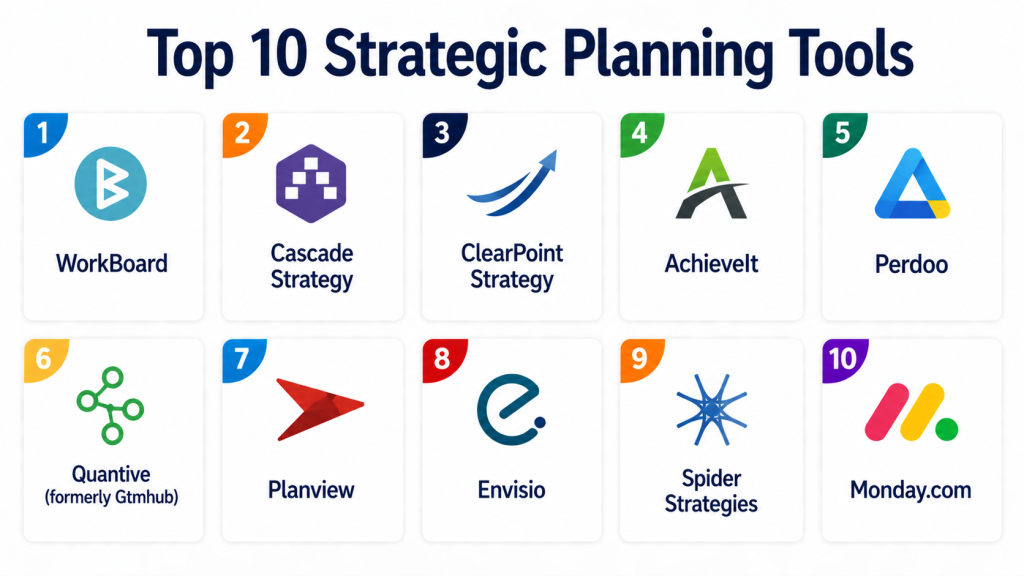
Top 10 Strategic Planning Tools
#1 — WorkBoard
Short description: WorkBoard is a leading enterprise OKR and strategy execution platform. It helps organizations align goals, track execution, and measure outcomes. The platform integrates strategy with operational workflows. It provides dashboards and analytics. It is widely used by enterprises. It supports real-time performance tracking. It is best for organizations focused on OKR-driven execution.
Key Features
- OKR management
- Strategy execution tracking
- Real-time dashboards
- Analytics and reporting
- Workflow automation
- Integration support
Pros
- Strong OKR capabilities
- Enterprise-ready
Cons
- Learning curve
- Premium pricing
Platforms / Deployment
Web
Cloud
Security & Compliance
SSO, MFA, RBAC, encryption
Supports enterprise security standards
Integrations & Ecosystem
Integrates with enterprise tools and workflows.
- CRM systems
- HR platforms
- APIs
Support & Community
Enterprise support, strong documentation.
#2 — Cascade Strategy
Short description: Cascade Strategy is a comprehensive platform designed for strategy planning and execution. It helps organizations define goals, track KPIs, and manage initiatives. It offers visual dashboards and reporting. It is suitable for mid-market and enterprise organizations. It emphasizes alignment and visibility.
Key Features
- Strategic planning
- KPI tracking
- Dashboards
- Reporting
- Collaboration tools
Pros
- Strong visualization
- Easy to align teams
Cons
- Limited advanced AI
- Customization may vary
Platforms / Deployment
Web
Cloud
Security & Compliance
Encryption, access controls
Not publicly stated certifications
Integrations & Ecosystem
Supports integrations with business tools.
- Data platforms
- APIs
Support & Community
Good support and onboarding.
#3 — ClearPoint Strategy
Short description: ClearPoint Strategy is designed for performance management and strategic planning. It helps organizations track KPIs and initiatives. It is widely used in government and enterprises. It supports reporting and dashboards. It is known for structured planning workflows.
Key Features
- KPI tracking
- Performance management
- Dashboards
- Reporting
- Initiative tracking
Pros
- Strong reporting
- Structured workflows
Cons
- UI may feel dated
- Limited flexibility
Platforms / Deployment
Web
Cloud
Security & Compliance
Encryption, RBAC
Supports compliance standards
Integrations & Ecosystem
Integrates with analytics tools.
- APIs
Support & Community
Good support.
#4 — AchieveIt
Short description: AchieveIt is a strategy execution platform that helps organizations track initiatives and goals. It focuses on accountability and progress tracking. It provides reporting and dashboards. It is suitable for enterprises and government organizations. It improves execution visibility.
Key Features
- Goal tracking
- Initiative management
- Reporting
- Dashboards
- Collaboration
Pros
- Strong execution tracking
- Easy reporting
Cons
- Limited customization
- Smaller ecosystem
Platforms / Deployment
Web
Cloud
Security & Compliance
Encryption
Not publicly stated
Integrations & Ecosystem
Basic integrations available.
- APIs
Support & Community
Moderate support.
#5 — Perdoo
Short description: Perdoo is an OKR-focused platform designed for aligning teams and tracking performance. It provides dashboards and insights. It is suitable for SMBs and mid-market organizations. It emphasizes simplicity and usability. It supports KPI tracking.
Key Features
- OKR management
- KPI tracking
- Dashboards
- Alignment tools
- Reporting
Pros
- Easy to use
- Affordable
Cons
- Limited enterprise features
- Basic analytics
Platforms / Deployment
Web
Cloud
Security & Compliance
Encryption
Not publicly stated
Integrations & Ecosystem
Supports integrations.
- APIs
Support & Community
Good support for SMBs.
#6 — Quantive (formerly Gtmhub)
Short description: Quantive is an OKR and strategy execution platform with strong analytics and integrations. It uses data to align strategy with execution. It supports real-time tracking. It is suitable for mid-market and enterprise organizations. It includes automation and reporting.
Key Features
- OKR tracking
- Analytics
- Data integrations
- Dashboards
- Automation
Pros
- Strong analytics
- Data-driven approach
Cons
- Learning curve
- Pricing varies
Platforms / Deployment
Web
Cloud
Security & Compliance
SSO, MFA, encryption
Supports compliance standards
Integrations & Ecosystem
Strong integration ecosystem.
- Data platforms
- CRM tools
- APIs
Support & Community
Enterprise support available.
#7 — Planview
Short description: Planview is a strategic planning and portfolio management platform. It helps organizations align strategy with execution. It supports large enterprises. It includes analytics and reporting. It is scalable and powerful.
Key Features
- Portfolio management
- Strategy alignment
- Reporting
- Analytics
- Workflow automation
Pros
- Enterprise scalability
- Strong portfolio management
Cons
- Complex implementation
- High cost
Platforms / Deployment
Web
Cloud
Security & Compliance
SSO, encryption
Supports enterprise standards
Integrations & Ecosystem
Integrates with enterprise tools.
- ERP
- APIs
Support & Community
Enterprise-level support.
#8 — Envisio
Short description: Envisio is a strategic planning platform focused on public sector and nonprofits. It helps track goals and performance. It provides dashboards and reporting. It is easy to use. It is suitable for structured planning environments.
Key Features
- Goal tracking
- Performance dashboards
- Reporting
- Collaboration
- KPI tracking
Pros
- Simple interface
- Good for structured planning
Cons
- Limited enterprise features
- Smaller ecosystem
Platforms / Deployment
Web
Cloud
Security & Compliance
Encryption
Not publicly stated
Integrations & Ecosystem
Basic integrations available.
- APIs
Support & Community
Moderate support.
#9 — Spider Strategies
Short description: Spider Strategies provides strategic planning and performance management tools. It focuses on dashboards and analytics. It is suitable for enterprises and government organizations. It supports KPI tracking and reporting.
Key Features
- Performance dashboards
- KPI tracking
- Reporting
- Analytics
- Strategy alignment
Pros
- Strong analytics
- Flexible dashboards
Cons
- Complex setup
- Limited integrations
Platforms / Deployment
Web
Cloud
Security & Compliance
Encryption
Not publicly stated
Integrations & Ecosystem
Supports integrations.
- APIs
Support & Community
Moderate support.
#10 — Monday.com (Strategy Use Cases)
Short description: Monday.com is a flexible work management platform that can be used for strategic planning. It offers visual dashboards and workflows. It is suitable for SMBs and mid-market teams. It is easy to customize. It supports collaboration and automation.
Key Features
- Visual dashboards
- Workflow automation
- Collaboration tools
- Custom boards
- Integration support
Pros
- Highly customizable
- Easy to use
Cons
- Limited deep strategy features
- Scaling limitations
Platforms / Deployment
Web / iOS / Android
Cloud
Security & Compliance
MFA, encryption
Supports compliance standards
Integrations & Ecosystem
Strong integration ecosystem.
- CRM tools
- Collaboration tools
- APIs
Support & Community
Active community and support.
Comparison Table
| Tool Name | Best For | Platform(s) Supported | Deployment | Standout Feature | Public Rating |
|---|---|---|---|---|---|
| WorkBoard | Enterprise | Web | Cloud | OKR tracking | N/A |
| Cascade | Mid-market | Web | Cloud | Visualization | N/A |
| ClearPoint | Enterprise | Web | Cloud | Reporting | N/A |
| AchieveIt | Enterprise | Web | Cloud | Execution tracking | N/A |
| Perdoo | SMB | Web | Cloud | Simplicity | N/A |
| Quantive | Enterprise | Web | Cloud | Analytics | N/A |
| Planview | Enterprise | Web | Cloud | Portfolio mgmt | N/A |
| Envisio | Public sector | Web | Cloud | Structured planning | N/A |
| Spider Strategies | Enterprise | Web | Cloud | Dashboards | N/A |
| Monday.com | SMB | Web, Mobile | Cloud | Custom workflows | N/A |
Evaluation & Scoring of Strategic Planning Tools
| Tool | Core | Ease | Integrations | Security | Performance | Support | Value | Total |
|---|---|---|---|---|---|---|---|---|
| WorkBoard | 9 | 7 | 8 | 9 | 9 | 8 | 7 | 8.3 |
| Cascade | 8 | 8 | 7 | 8 | 8 | 8 | 8 | 7.9 |
| ClearPoint | 8 | 7 | 7 | 8 | 8 | 8 | 7 | 7.7 |
| AchieveIt | 7 | 8 | 6 | 7 | 7 | 7 | 7 | 7.2 |
| Perdoo | 7 | 9 | 6 | 7 | 7 | 7 | 9 | 7.5 |
| Quantive | 9 | 7 | 9 | 8 | 8 | 8 | 7 | 8.2 |
| Planview | 9 | 6 | 9 | 9 | 9 | 8 | 6 | 8.3 |
| Envisio | 7 | 8 | 6 | 7 | 7 | 7 | 8 | 7.3 |
| Spider | 8 | 7 | 6 | 7 | 7 | 7 | 7 | 7.2 |
| Monday | 7 | 9 | 8 | 7 | 8 | 7 | 8 | 7.8 |
Scores are comparative and based on weighted evaluation across features, usability, integrations, security, and value.
Which Strategic Planning Tool Is Right for You?
Solo / Freelancer
Use simple tools like Monday.com for basic planning.
SMB
Perdoo and Cascade are great for ease of use and affordability.
Mid-Market
Quantive and Cascade offer balanced capabilities.
Enterprise
WorkBoard and Planview provide deep strategy execution features.
Budget vs Premium
Budget: Perdoo, Monday
Premium: WorkBoard, Planview
Feature Depth vs Ease of Use
Depth: Planview, WorkBoard
Ease: Perdoo, Monday
Integrations & Scalability
Best: Quantive, Planview
Moderate: Cascade, WorkBoard
Security & Compliance Needs
High: WorkBoard, Planview
Basic: Perdoo, Envisio
Frequently Asked Questions (FAQs)
1. What are strategic planning tools?
Strategic planning tools help organizations define goals and track progress. They align teams and improve execution. They provide dashboards and analytics. They support decision-making. They are essential for long-term planning.
2. Why are these tools important?
They improve alignment across teams. They ensure goals are tracked. They enhance visibility. They support better decisions. They reduce manual effort.
3. Are these tools secure?
Most tools include encryption and access controls. Enterprise tools offer advanced security. Security depends on configuration. Organizations must evaluate vendors carefully.
4. How long does implementation take?
Implementation varies by complexity. Simple tools are quick to deploy. Enterprise tools require planning. Training is needed. Setup time depends on requirements.
5. Can these tools integrate with business systems?
Yes, most tools integrate with CRM, ERP, and analytics systems. Integration improves efficiency. APIs are common. It reduces duplication. It enhances workflows.
6. Who uses strategic planning tools?
Executives, strategy teams, and managers use them. They align business goals. They track performance. They support decision-making. They are widely used.
7. What industries use these tools?
Technology, finance, healthcare, and government use them. Any organization with strategic goals can benefit. They improve planning. They enhance execution.
8. What are common mistakes?
Choosing based only on cost is a mistake. Ignoring scalability can cause issues. Lack of training reduces adoption. Overlooking integrations limits value. Security should be considered.
9. Are these tools scalable?
Yes, most tools scale well. Enterprise tools handle large organizations. SMB tools may have limits. Choosing the right tool is important. Scalability ensures growth.
10. How to switch tools?
Switching involves data migration and training. Planning is essential. Testing should be done first. Gradual rollout reduces risks. Vendors often provide support.
Conclusion
Strategic Planning Tools have become essential for organizations aiming to align goals, improve execution, and drive measurable outcomes. As businesses grow more complex and data-driven, these platforms provide the structure needed to connect high-level strategy with day-to-day operations. Enterprise solutions like WorkBoard and Planview deliver deep capabilities for large organizations, while tools like Perdoo and Monday.com offer accessible options for smaller teams seeking simplicity and flexibility.
The right tool depends on your organization’s size, strategic maturity, and integration needs. Instead of focusing solely on features, businesses should evaluate usability, scalability, and security alignment. A practical next step is to shortlist a few platforms, test them in pilot environments, and assess how well they support your workflows. This ensures long-term success and alignment across teams.
