Introduction
Business Plan Software helps entrepreneurs, startups, and organizations create structured, professional business plans with financial projections, strategy outlines, and market analysis. Instead of relying on manual documents, these tools provide guided templates, automation, and collaboration features to streamline planning and decision-making.
In today’s competitive environment, business planning is no longer a one-time activity—it is an ongoing strategic process. Modern platforms integrate with financial systems, analytics tools, and even AI-driven insights to help users validate assumptions and forecast outcomes. Additionally, with growing concerns around data security, many tools now align with Identity Management, CyberSecurity, Zero Trust, and Access Control practices to safeguard sensitive business information.
Real-world use cases:
- Creating startup business plans for investors
- Financial forecasting and scenario modeling
- Strategic planning for growth and expansion
- Preparing pitch decks and funding proposals
- Internal planning and performance tracking
What buyers should evaluate:
- Ease of use and guided templates
- Financial modeling and forecasting tools
- Collaboration and sharing capabilities
- Integration with accounting and analytics tools
- Security and access controls
- Customization and scalability
- Reporting and export options
- Pricing and value
Best for: Entrepreneurs, startups, small businesses, consultants, and corporate teams that need structured planning and financial forecasting.
Not ideal for: Businesses that already have mature financial systems or those that do not require formal planning documentation.
Key Trends in Business Plan Software
- AI-assisted business plan generation and recommendations
- Integrated financial forecasting and scenario modeling
- Cloud-based collaboration and real-time editing
- Investor-ready templates and pitch support
- Integration with accounting and CRM systems
- Data-driven planning with analytics dashboards
- Mobile-friendly platforms for remote work
- Increased focus on security and compliance
- Subscription-based pricing models
- API-driven integrations and extensibility
How We Selected These Business Plan Software (Methodology)
- Market adoption among startups and businesses
- Feature completeness for planning and forecasting
- Ease of use and onboarding experience
- Reliability and performance
- Security and compliance capabilities
- Integration ecosystem and extensibility
- Scalability for growing businesses
- Innovation in AI and automation
- Customer feedback trends
- Balanced mix of beginner-friendly and advanced tools
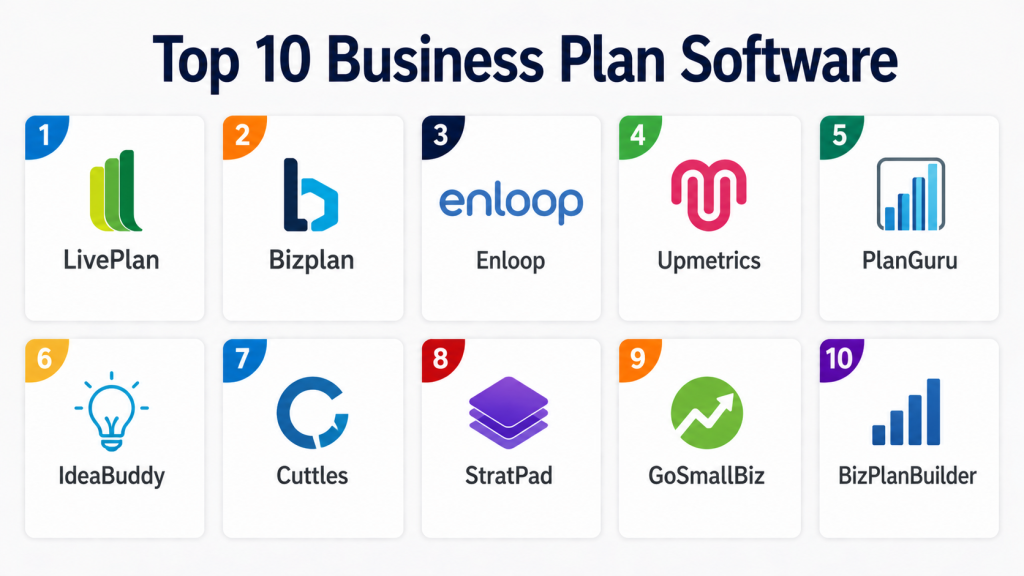
Top 10 Business Plan Software
#1 — LivePlan
Short description:
LivePlan is one of the most popular business plan software platforms, designed for startups and small businesses. It offers step-by-step guidance, financial forecasting tools, and investor-ready templates. The platform is easy to use and integrates with accounting tools. It is ideal for entrepreneurs who want a structured approach to planning. LivePlan also supports performance tracking. It is widely used for funding preparation and strategic planning.
Key Features
- Guided business plan templates
- Financial forecasting
- Performance tracking
- Collaboration tools
- Integration with accounting software
Pros
- Easy to use
- Strong financial planning tools
Cons
- Limited advanced customization
- Subscription-based pricing
Platforms / Deployment
Web
Cloud
Security & Compliance
Encryption, access controls; compliance varies
Integrations & Ecosystem
Integrates with accounting and business tools.
- Accounting platforms
- APIs
Support & Community
Good support and tutorials
#2 — Bizplan
Short description:
Bizplan provides a modern interface for building business plans and financial models. It is designed for startups and entrepreneurs seeking funding. The platform offers drag-and-drop tools and templates. It integrates with funding platforms. Bizplan is easy to use and visually appealing. It is suitable for early-stage companies.
Key Features
- Drag-and-drop plan builder
- Financial modeling
- Templates
- Collaboration tools
- Funding integration
Pros
- User-friendly interface
- Good for startups
Cons
- Limited advanced features
- Smaller ecosystem
Platforms / Deployment
Web
Cloud
Security & Compliance
Encryption, access control; compliance varies
Integrations & Ecosystem
Supports integrations with funding tools.
- APIs
- Financial tools
Support & Community
Basic support available
#3 — Enloop
Short description:
Enloop is a business plan software that automates financial forecasting and performance analysis. It provides scoring and evaluation features. The platform is suitable for startups and small businesses. It offers templates and automation tools. Enloop is known for its simplicity. It is ideal for quick plan creation.
Key Features
- Automated financial forecasting
- Performance scoring
- Templates
- Reporting tools
- Collaboration
Pros
- Quick setup
- Automated analysis
Cons
- Limited customization
- Basic interface
Platforms / Deployment
Web
Cloud
Security & Compliance
Encryption, access control; compliance varies
Integrations & Ecosystem
Basic integrations available.
- APIs
Support & Community
Moderate support
#4 — Upmetrics
Short description:
Upmetrics is a modern business planning tool with strong collaboration and financial modeling features. It provides templates and AI-assisted tools. The platform is suitable for startups and SMBs. It offers forecasting and reporting capabilities. Upmetrics is easy to use and scalable. It is ideal for growing teams.
Key Features
- Business plan templates
- Financial forecasting
- Collaboration tools
- AI assistance
- Reporting
Pros
- Modern interface
- Good collaboration features
Cons
- Limited enterprise features
- Pricing varies
Platforms / Deployment
Web
Cloud
Security & Compliance
Encryption, access control; compliance varies
Integrations & Ecosystem
Integrates with business tools.
- APIs
- Financial tools
Support & Community
Good onboarding support
#5 — PlanGuru
Short description:
PlanGuru focuses on financial planning and budgeting. It provides forecasting and analytics tools. The platform is suitable for small businesses and consultants. It integrates with accounting systems. PlanGuru offers strong financial modeling capabilities. It is ideal for detailed financial planning.
Key Features
- Financial forecasting
- Budgeting tools
- Analytics
- Reporting
- Integration support
Pros
- Strong financial capabilities
- Detailed analysis
Cons
- Less focus on narrative planning
- Learning curve
Platforms / Deployment
Web / Windows
Cloud / On-premise
Security & Compliance
Encryption, access control; compliance varies
Integrations & Ecosystem
Integrates with accounting systems.
- Financial tools
- APIs
Support & Community
Moderate support
#6 — IdeaBuddy
Short description:
IdeaBuddy is designed for entrepreneurs to validate and develop business ideas. It provides step-by-step guidance and financial planning tools. The platform is easy to use and beginner-friendly. It includes collaboration features. IdeaBuddy is suitable for early-stage startups. It focuses on idea validation and planning.
Key Features
- Idea validation tools
- Business planning templates
- Financial projections
- Collaboration
- Reporting
Pros
- Beginner-friendly
- Structured guidance
Cons
- Limited advanced features
- Smaller ecosystem
Platforms / Deployment
Web
Cloud
Security & Compliance
Encryption, access control; compliance varies
Integrations & Ecosystem
Basic integrations available.
- APIs
Support & Community
Good support for beginners
#7 — Cuttles
Short description:
Cuttles is a business planning platform focused on startups and entrepreneurs. It provides templates, financial tools, and collaboration features. The platform is visually appealing and easy to use. It supports forecasting and reporting. Cuttles is suitable for early-stage companies. It emphasizes simplicity and usability.
Key Features
- Business plan templates
- Financial forecasting
- Collaboration tools
- Reporting
- Analytics
Pros
- Simple and intuitive
- Good for startups
Cons
- Limited advanced features
- Smaller ecosystem
Platforms / Deployment
Web
Cloud
Security & Compliance
Encryption, access control; compliance varies
Integrations & Ecosystem
Basic integrations available.
- APIs
Support & Community
Moderate support
#8 — StratPad
Short description:
StratPad is a strategic planning software that combines business planning with execution tracking. It provides templates, financial tools, and reporting features. The platform is suitable for small businesses. It focuses on long-term strategy and execution. StratPad is easy to use and practical.
Key Features
- Strategic planning tools
- Financial forecasting
- Reporting
- Templates
- Execution tracking
Pros
- Focus on strategy
- Easy to use
Cons
- Limited advanced features
- Smaller ecosystem
Platforms / Deployment
Web / Mobile
Cloud
Security & Compliance
Encryption, access control; compliance varies
Integrations & Ecosystem
Basic integrations available.
- APIs
Support & Community
Moderate support
#9 — Tarkenton GoSmallBiz
Short description:
GoSmallBiz offers business planning tools along with advisory services. It provides templates, financial tools, and guidance. The platform is suitable for small businesses. It includes additional resources for entrepreneurs. It is easy to use and practical.
Key Features
- Business plan templates
- Financial tools
- Advisory services
- Reporting
- Collaboration
Pros
- Additional advisory support
- Easy to use
Cons
- Limited advanced features
- Smaller ecosystem
Platforms / Deployment
Web
Cloud
Security & Compliance
Encryption, access control; compliance varies
Integrations & Ecosystem
Basic integrations available.
- APIs
Support & Community
Moderate support
#10 — BizPlanBuilder
Short description:
BizPlanBuilder is a traditional business planning tool with comprehensive templates and financial tools. It is suitable for startups and small businesses. The platform provides structured planning features. It supports reporting and collaboration. It is ideal for users who prefer traditional planning approaches.
Key Features
- Business plan templates
- Financial forecasting
- Reporting tools
- Collaboration
- Export options
Pros
- Comprehensive templates
- Structured approach
Cons
- Interface may feel outdated
- Limited modern features
Platforms / Deployment
Web / Windows
Cloud / On-premise
Security & Compliance
Encryption, access control; compliance varies
Integrations & Ecosystem
Basic integrations available.
- APIs
Support & Community
Moderate support
Comparison Table (Top 10)
| Tool Name | Best For | Platform(s) Supported | Deployment | Standout Feature | Public Rating |
|---|---|---|---|---|---|
| LivePlan | Startups | Web | Cloud | Guided planning | N/A |
| Bizplan | Startups | Web | Cloud | Visual builder | N/A |
| Enloop | SMB | Web | Cloud | Automated scoring | N/A |
| Upmetrics | SMB | Web | Cloud | Collaboration | N/A |
| PlanGuru | SMB/Consultants | Web, Windows | Cloud/On-premise | Financial depth | N/A |
| IdeaBuddy | Startups | Web | Cloud | Idea validation | N/A |
| Cuttles | Startups | Web | Cloud | Simplicity | N/A |
| StratPad | SMB | Web, Mobile | Cloud | Strategy focus | N/A |
| GoSmallBiz | SMB | Web | Cloud | Advisory services | N/A |
| BizPlanBuilder | SMB | Web, Windows | Cloud/On-premise | Traditional planning | N/A |
Evaluation & Scoring of Business Plan Software
| Tool Name | Core | Ease | Integrations | Security | Performance | Support | Value | Weighted Total |
|---|---|---|---|---|---|---|---|---|
| LivePlan | 9 | 9 | 8 | 8 | 9 | 9 | 8 | 8.6 |
| Bizplan | 8 | 9 | 7 | 7 | 8 | 7 | 8 | 7.9 |
| Enloop | 7 | 9 | 6 | 7 | 7 | 7 | 8 | 7.5 |
| Upmetrics | 8 | 9 | 7 | 7 | 8 | 8 | 8 | 8.0 |
| PlanGuru | 9 | 7 | 8 | 8 | 9 | 7 | 7 | 8.0 |
| IdeaBuddy | 7 | 9 | 6 | 7 | 7 | 7 | 8 | 7.5 |
| Cuttles | 7 | 9 | 6 | 7 | 7 | 7 | 8 | 7.5 |
| StratPad | 8 | 8 | 6 | 7 | 8 | 7 | 7 | 7.6 |
| GoSmallBiz | 7 | 8 | 6 | 7 | 7 | 7 | 7 | 7.2 |
| BizPlanBuilder | 8 | 7 | 6 | 7 | 8 | 7 | 7 | 7.5 |
Interpretation:
These scores are comparative and based on weighted criteria such as features, usability, integrations, and value. Higher scores indicate stronger overall capabilities, but the best choice depends on your specific business needs.
Which Business Plan Software Is Right for You?
Solo / Freelancer
IdeaBuddy or Cuttles for simplicity and guided planning.
SMB
LivePlan, Upmetrics, or StratPad for balanced features and usability.
Mid-Market
PlanGuru or Upmetrics for financial depth and scalability.
Enterprise
PlanGuru or advanced custom solutions for detailed financial planning.
Budget vs Premium
Budget: Enloop, IdeaBuddy
Premium: LivePlan, PlanGuru
Feature Depth vs Ease of Use
Depth: PlanGuru
Ease: LivePlan, Cuttles
Integrations & Scalability
Best: LivePlan, PlanGuru
Moderate: Upmetrics, Bizplan
Security & Compliance Needs
Enterprise-grade: PlanGuru
Basic: Startup-focused tools
Frequently Asked Questions (FAQs)
1. What is Business Plan Software?
Business plan software helps users create structured business plans with templates and financial tools. It simplifies planning and forecasting. These tools provide guidance and automation. They are useful for startups and businesses. They improve clarity and organization.
2. Why is business planning important?
Business planning helps define goals and strategies. It provides a roadmap for growth. It is essential for securing funding. Planning also improves decision-making. It helps businesses stay organized and focused.
3. Are these tools suitable for startups?
Yes, most tools are designed for startups. They provide templates and guidance. Startups benefit from financial forecasting features. These tools simplify planning. Choosing the right tool is important.
4. What is the typical pricing model?
Most tools use subscription-based pricing. Costs vary by features and users. Some offer free or trial versions. Enterprise tools may require custom pricing. Pricing depends on complexity and usage.
5. How long does implementation take?
Implementation is usually quick. Most tools are cloud-based and easy to deploy. Users can start within hours or days. Advanced tools may require setup. Training may also be needed.
6. Do these tools integrate with other systems?
Yes, many tools integrate with accounting and CRM systems. APIs allow custom integrations. Integration depth varies by vendor. Strong integrations improve workflows. This is a key factor in selection.
7. What are common mistakes when choosing software?
Choosing overly complex tools is common. Ignoring integration needs can cause issues. Not considering scalability is risky. Poor onboarding leads to low adoption. Proper evaluation helps avoid mistakes.
8. Are these tools secure?
Most platforms offer encryption and access controls. Enterprise tools provide advanced security features. Compliance varies by vendor. Security aligns with Zero Trust models. Verification is essential.
9. Can businesses switch tools later?
Switching is possible but requires effort. Data migration and retraining are needed. Integration changes may also be required. Planning ahead reduces risks. Choosing scalable tools helps.
10. What are alternatives to business plan software?
Alternatives include spreadsheets and document editors. However, they lack automation and guidance. Some businesses use custom tools. Business plan software provides a structured approach. It is ideal for planning and forecasting.
Conclusion
Business Plan Software has become an essential tool for entrepreneurs and organizations aiming to build structured, data-driven strategies. From guided templates to advanced financial forecasting, these platforms simplify the planning process and help transform ideas into actionable business plans. As businesses increasingly rely on data and collaboration, these tools provide the flexibility and insights needed to stay competitive and aligned with evolving market conditions.
The best choice depends on your business stage, complexity, and goals. Startups may prioritize ease of use and affordability, while growing businesses may require deeper financial modeling and integrations. The most effective approach is to shortlist a few tools, test their usability, and evaluate how well they align with your planning workflow. This ensures you select a solution that supports long-term success and strategic growth.
