Introduction
Smart Home Platforms are software ecosystems that enable users to control, automate, and monitor connected devices such as lights, thermostats, cameras, locks, and appliances from a centralized interface. These platforms act as the backbone of a smart home, integrating multiple devices and enabling seamless automation across them.
As homes become increasingly connected, modern smart home platforms now include AI-driven automation, voice control, IoT integration, identity management, cybersecurity layers, Zero Trust access, and role-based permissions, ensuring convenience while maintaining strong security and privacy.
Common use cases:
- Home automation and device control
- Smart lighting and energy management
- Home security and surveillance
- Voice-controlled smart assistants
- Remote monitoring via mobile apps
Key evaluation criteria:
- Device compatibility and ecosystem support
- Automation capabilities and routines
- Ease of use and setup
- Integration with third-party devices
- Security features like encryption, MFA, RBAC
- Mobile and voice assistant support
- Scalability and future-proofing
- Pricing and value
Best for: Homeowners, tech enthusiasts, property managers, and IoT users looking to automate and control connected devices.
Not ideal for: Users with no smart devices or those preferring manual control systems.
Key Trends in Smart Home Platforms
- AI-powered automation and predictive behavior
- Integration with voice assistants and natural language control
- Expansion of IoT ecosystems and device compatibility
- Mobile-first smart home management
- Cloud-based and edge computing hybrid models
- Increased focus on cybersecurity and privacy
- Zero Trust access for smart devices
- Energy efficiency and sustainability monitoring
- Interoperability standards like Matter adoption
- Subscription-based smart services
How We Evaluated Smart Home Platforms (Methodology)
- Market adoption and ecosystem size
- Feature completeness across smart home use cases
- Reliability and performance
- Security posture including access control and encryption
- Integration ecosystem with smart devices
- Ease of use and onboarding
- Scalability across devices and homes
- Support quality and community
- Overall value and long-term usability
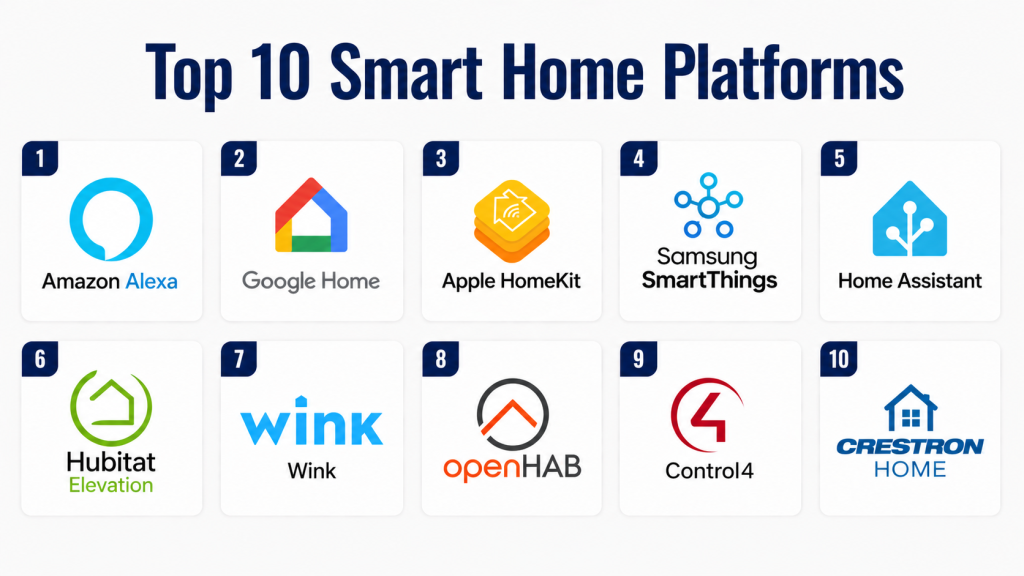
Top 10 Smart Home Platforms
#1 — Amazon Alexa
Short description:
Amazon Alexa is one of the most widely used smart home platforms, offering voice-controlled automation and device integration. It supports a large ecosystem of smart devices across brands. The platform enables routines, automation, and remote control. It integrates with smart speakers and displays. Alexa is suitable for beginners and advanced users. Its ecosystem makes it highly flexible.
Key Features
- Voice control
- Device automation
- Smart routines
- Wide device compatibility
- Mobile app control
- Integration support
Pros
- Large ecosystem
- Easy to use
Cons
- Privacy concerns
- Internet dependency
Platforms / Deployment
Web / Mobile / Cloud
Security & Compliance
Encryption, MFA. Compliance: Not publicly stated
Integrations & Ecosystem
Supports a wide range of smart devices
- Smart lights
- Cameras
- IoT devices
Support & Community
Strong community and documentation
#2 — Google Home
Short description:
Google Home is a smart home platform offering voice control and automation through Google Assistant. It integrates with various smart devices and services. The platform provides automation and remote control features. It is easy to use and widely adopted. Google Home is suitable for modern smart homes. It offers strong AI capabilities.
Key Features
- Voice assistant integration
- Automation routines
- Device control
- Mobile app
- Analytics
Pros
- Strong AI capabilities
- Easy setup
Cons
- Limited offline functionality
- Privacy concerns
Platforms / Deployment
Web / Mobile / Cloud
Security & Compliance
Encryption, MFA. Compliance: Not publicly stated
Integrations & Ecosystem
- Smart devices
- IoT platforms
Support & Community
Good support and documentation
#3 — Apple HomeKit
Short description:
Apple HomeKit is a secure smart home platform designed for Apple users. It provides integration with Apple devices and services. The platform emphasizes privacy and security. It supports automation and remote control. HomeKit is suitable for iOS users. It offers seamless integration within the Apple ecosystem.
Key Features
- Device control
- Automation
- Voice control via Siri
- Secure access
- Integration with Apple devices
Pros
- Strong privacy
- Seamless integration
Cons
- Limited device compatibility
- Apple-only ecosystem
Platforms / Deployment
iOS / macOS / Cloud
Security & Compliance
Encryption, secure access. Compliance: Not publicly stated
Integrations & Ecosystem
- Apple devices
- Smart home accessories
Support & Community
Strong support for Apple users
#4 — Samsung SmartThings
Short description:
Samsung SmartThings is a versatile smart home platform supporting a wide range of devices. It enables automation and control through a central hub. The platform integrates with IoT devices and services. It is suitable for various smart home setups. SmartThings offers flexibility and scalability. It supports both beginners and advanced users.
Key Features
- Device automation
- Smart hub integration
- Mobile app control
- Integration support
- Analytics
Pros
- Flexible ecosystem
- Wide compatibility
Cons
- Setup complexity
- Requires hub
Platforms / Deployment
Web / Mobile / Cloud
Security & Compliance
Encryption. Compliance: Not publicly stated
Integrations & Ecosystem
- IoT devices
- Smart home products
Support & Community
Active community support
#5 — Home Assistant
Short description:
Home Assistant is an open-source smart home platform focused on privacy and customization. It allows users to control and automate devices locally. The platform supports a wide range of integrations. It is suitable for advanced users. Home Assistant provides flexibility and control. It emphasizes data privacy.
Key Features
- Local automation
- Custom integrations
- Device control
- Automation workflows
- Analytics
Pros
- Highly customizable
- Privacy-focused
Cons
- Technical setup required
- Learning curve
Platforms / Deployment
Self-hosted / Cloud / Web
Security & Compliance
User-managed security
Integrations & Ecosystem
- IoT devices
- APIs
Support & Community
Strong open-source community
#6 — Hubitat Elevation
Short description:
Hubitat Elevation is a smart home platform designed for local automation and fast performance. It processes automation locally without relying on the cloud. The platform supports various smart devices. It is suitable for advanced users. Hubitat provides reliability and privacy. It enhances automation speed.
Key Features
- Local automation
- Device control
- Integration support
- Automation workflows
- Reporting
Pros
- Fast performance
- Privacy-focused
Cons
- Complex setup
- Limited UI
Platforms / Deployment
Local hub / Web
Security & Compliance
Local control security
Integrations & Ecosystem
- IoT devices
- APIs
Support & Community
Active community
#7 — Wink
Short description:
Wink is a smart home platform designed for easy device control and automation. It supports multiple device types. The platform offers a simple interface. It is suitable for beginners. Wink enables centralized control. It enhances home automation.
Key Features
- Device control
- Automation
- Mobile app
- Integration support
- Notifications
Pros
- Easy to use
- Beginner-friendly
Cons
- Limited features
- Smaller ecosystem
Platforms / Deployment
Web / Mobile / Cloud
Security & Compliance
Not publicly stated
Integrations & Ecosystem
- Smart devices
Support & Community
Standard support
#8 — OpenHAB
Short description:
OpenHAB is an open-source smart home platform offering flexibility and customization. It supports multiple devices and integrations. The platform enables automation and control. It is suitable for advanced users. OpenHAB emphasizes openness and extensibility. It supports local and cloud deployments.
Key Features
- Automation
- Device control
- Integration support
- Custom workflows
- Analytics
Pros
- Open-source
- Highly flexible
Cons
- Complex setup
- Requires technical knowledge
Platforms / Deployment
Web / Self-hosted / Cloud
Security & Compliance
User-managed security
Integrations & Ecosystem
- IoT devices
- APIs
Support & Community
Strong community support
#9 — Control4
Short description:
Control4 is a premium smart home platform designed for luxury homes. It offers advanced automation and integration capabilities. The platform supports professional installation. It integrates with various devices. Control4 provides high-end features. It is suitable for custom smart homes.
Key Features
- Advanced automation
- Device integration
- Custom control
- Analytics
- Integration support
Pros
- Premium features
- Highly customizable
Cons
- Expensive
- Requires professional setup
Platforms / Deployment
Web / Mobile / Cloud
Security & Compliance
Encryption. Compliance: Not publicly stated
Integrations & Ecosystem
- Smart devices
- Home systems
Support & Community
Professional support
#10 — Crestron Home
Short description:
Crestron Home is an enterprise-grade smart home platform designed for high-end automation. It offers control over lighting, security, and entertainment systems. The platform integrates with various devices. It supports custom installations. Crestron is suitable for luxury homes. It provides advanced automation.
Key Features
- Home automation
- Device control
- Integration support
- Custom workflows
- Analytics
Pros
- Enterprise-grade
- Reliable
Cons
- High cost
- Complex setup
Platforms / Deployment
Web / Mobile / Cloud
Security & Compliance
Encryption. Compliance: Not publicly stated
Integrations & Ecosystem
- Smart devices
- Home systems
Support & Community
Professional support
Comparison Table
| Tool Name | Best For | Platform(s) Supported | Deployment | Standout Feature | Public Rating |
|---|---|---|---|---|---|
| Alexa | General users | Web/Mobile | Cloud | Voice control | N/A |
| Google Home | Smart homes | Web/Mobile | Cloud | AI integration | N/A |
| HomeKit | Apple users | iOS/macOS | Cloud | Privacy | N/A |
| SmartThings | Flexible setups | Web/Mobile | Cloud | Compatibility | N/A |
| Home Assistant | Advanced users | Web | Self-hosted | Customization | N/A |
| Hubitat | Local automation | Web | Local | Performance | N/A |
| Wink | Beginners | Web/Mobile | Cloud | Simplicity | N/A |
| OpenHAB | Developers | Web | Self-hosted | Open-source | N/A |
| Control4 | Luxury homes | Web/Mobile | Cloud | Custom control | N/A |
| Crestron | Enterprise homes | Web/Mobile | Cloud | Advanced automation | N/A |
Evaluation & Scoring of Smart Home Platforms
| Tool Name | Core | Ease | Integrations | Security | Performance | Support | Value | Weighted Total |
|---|---|---|---|---|---|---|---|---|
| Alexa | 9 | 9 | 9 | 7 | 8 | 9 | 8 | 8.6 |
| Google Home | 9 | 9 | 9 | 7 | 8 | 8 | 8 | 8.5 |
| HomeKit | 8 | 8 | 7 | 9 | 8 | 8 | 7 | 7.9 |
| SmartThings | 8 | 8 | 9 | 7 | 8 | 8 | 8 | 8.2 |
| Home Assistant | 9 | 6 | 9 | 8 | 8 | 7 | 8 | 8.0 |
| Hubitat | 8 | 6 | 8 | 8 | 9 | 7 | 7 | 7.8 |
| Wink | 6 | 9 | 6 | 6 | 7 | 7 | 7 | 6.9 |
| OpenHAB | 8 | 6 | 9 | 8 | 8 | 7 | 7 | 7.8 |
| Control4 | 9 | 6 | 8 | 8 | 9 | 9 | 6 | 8.1 |
| Crestron | 9 | 6 | 8 | 8 | 9 | 9 | 6 | 8.1 |
Which Smart Home Platform Is Right for You?
Solo / Freelancer
Basic platforms like Google Home or Alexa are sufficient.
SMB
SmartThings and Home Assistant offer flexibility and control.
Mid-Market
Hubitat and OpenHAB provide customization and scalability.
Enterprise
Control4 and Crestron offer advanced automation.
Budget vs Premium
Budget tools focus on ease of use, premium tools offer customization.
Feature Depth vs Ease of Use
Advanced tools require technical knowledge.
Integrations & Scalability
Choose platforms with wide device compatibility.
Security & Compliance Needs
Look for encryption, MFA, and local control options.
Frequently Asked Questions
1. What is a smart home platform?
A smart home platform is software that connects and controls smart devices. It enables automation and monitoring. It improves convenience. It integrates devices. It enhances home management.
2. How much does it cost?
Costs vary depending on devices and platform. Some are free. Others require subscriptions. Premium setups cost more. Hardware adds cost. Evaluate ROI.
3. Is it secure?
Most platforms offer encryption and access controls. Some support MFA. Security varies. Protecting data is important. Always review features.
4. Can it integrate with devices?
Yes, most platforms support many devices. Compatibility varies. APIs allow integration. Check device support. Choose wisely.
5. How long does setup take?
Setup can take minutes to hours. Simple setups are quick. Complex systems take longer. Planning helps. Follow instructions.
6. Can beginners use it?
Yes, many platforms are beginner-friendly. They offer easy setup. They simplify automation. They improve convenience. They support growth.
7. What are common mistakes?
Choosing incompatible devices is common. Ignoring security is risky. Complex setups can fail. Lack of planning reduces value. Research first.
8. How does AI help?
AI enables automation and predictions. It improves efficiency. It enhances user experience. It reduces manual work. It provides insights.
9. Can it scale?
Yes, most platforms scale. They support more devices. Advanced setups allow expansion. Choose flexible platforms. Scalability matters.
10. Can you switch platforms?
Switching is possible but requires effort. Devices must be compatible. Data migration is limited. Setup must be redone. Plan carefully.
Conclusion
Smart Home Platforms have transformed how individuals interact with their living spaces by enabling seamless automation, centralized control, and real-time monitoring of connected devices. As smart homes become more common, these platforms provide the foundation for integrating lighting, security, energy management, and entertainment systems into a unified ecosystem. With advancements in AI, IoT, and voice control, they continue to evolve into more intelligent and responsive solutions.
Choosing the right platform depends on your ecosystem preference, technical expertise, and desired level of automation. Platforms like Amazon Alexa and Google Home are ideal for general users due to their ease of use and wide compatibility, while Home Assistant and OpenHAB offer deeper customization for advanced users. High-end solutions like Control4 and Crestron cater to premium smart home environments with complex automation needs.
To make the best choice, evaluate your device compatibility, automation goals, and security requirements. Start with a small setup, test integrations, and expand gradually. Prioritize scalability, privacy, and ease of use to ensure a smooth experience. With the right smart home platform, users can create efficient, secure, and highly personalized living environments.
