Introduction
Building Energy Management Systems are software platforms that help organizations monitor, control, and optimize energy usage across buildings. These systems collect data from HVAC, lighting, power systems, and IoT sensors to improve efficiency and reduce operational costs.
With rising energy costs and sustainability goals, BEMS solutions have become critical for modern buildings. They enable real-time monitoring, automation, and predictive insights that help reduce energy waste. Organizations use these systems to meet compliance standards, improve sustainability, and optimize building performance.
Common use cases:
- Monitoring energy consumption across facilities
- Optimizing HVAC and lighting systems
- Reducing operational costs
- Supporting sustainability initiatives
- Automating energy control systems
What buyers should evaluate:
- Real-time monitoring capabilities
- Integration with IoT and building systems
- Automation and control features
- Analytics and reporting
- Scalability across multiple buildings
- Security and data protection
- Ease of use
- Support and onboarding
Best for: Enterprises, facility managers, smart buildings, and organizations focused on energy optimization.
Not ideal for: Small properties with minimal energy monitoring requirements.
Key Trends in Building Energy Management Systems
- AI-driven energy optimization and forecasting
- Integration with smart building IoT devices
- Real-time energy monitoring dashboards
- Automation of HVAC and lighting systems
- Cloud-based deployment for scalability
- Sustainability and ESG reporting features
- Predictive maintenance for energy systems
- Integration with building management systems
How We Evaluate Building Energy Management Systems (Methodology)
- Market adoption and industry relevance
- Feature completeness and innovation
- Ease of use and dashboard quality
- Integration ecosystem
- Performance and reliability
- Security features
- Scalability for enterprise use
- Customer support quality
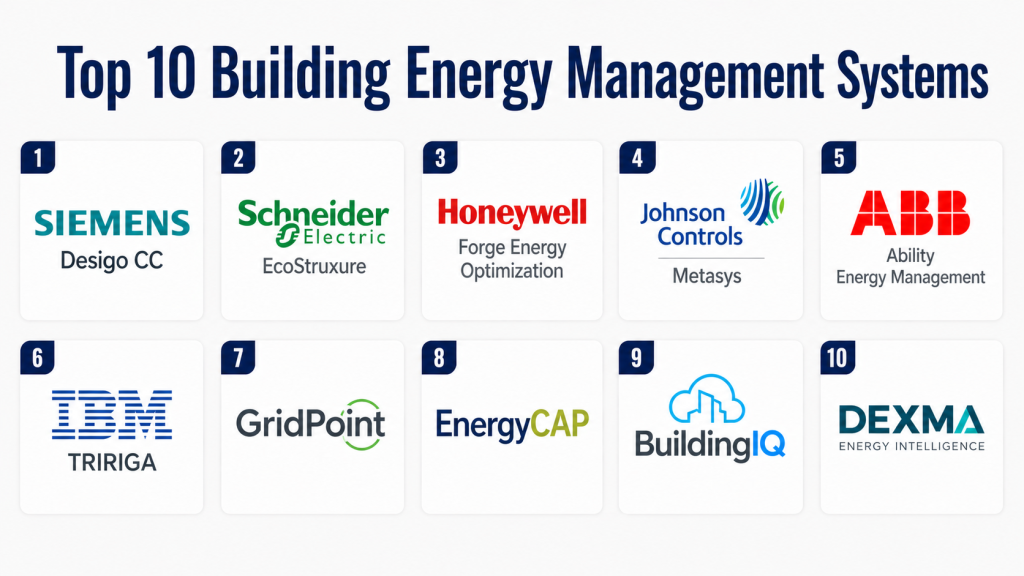
Top 10 Building Energy Management Systems
#1 — Siemens Desigo CC
Short description:
Siemens Desigo CC is an advanced building management and energy optimization platform. It integrates multiple building systems into one interface. The platform provides real-time monitoring and automation. It is ideal for large facilities. It improves efficiency and sustainability.
Key Features
- Energy monitoring
- Automation control
- Real-time dashboards
- Multi-system integration
Pros
- Enterprise-grade solution
- Strong automation
Cons
- Complex setup
- High cost
Platforms / Deployment
Web / Cloud / On-premise
Security & Compliance
Not publicly stated
Integrations & Ecosystem
Integrates with building systems and IoT devices.
- HVAC systems
- IoT sensors
Support & Community
Enterprise support.
#2 — Schneider Electric EcoStruxure
Short description:
EcoStruxure is a comprehensive energy management platform. It helps monitor and optimize energy usage. The platform supports IoT integration. It is suitable for large enterprises. It improves sustainability performance.
Key Features
- Energy monitoring
- IoT integration
- Analytics dashboards
- Automation tools
Pros
- Strong analytics
- Scalable
Cons
- Complex implementation
- Premium pricing
Platforms / Deployment
Web / Cloud
Security & Compliance
Not publicly stated
Integrations & Ecosystem
Supports integration with enterprise systems.
- IoT devices
- Energy systems
Support & Community
Strong support.
#3 — Honeywell Forge Energy Optimization
Short description:
Honeywell Forge provides energy optimization tools for smart buildings. It uses analytics and automation to reduce energy consumption. The platform supports large facilities. It is suitable for enterprises. It enhances operational efficiency.
Key Features
- Energy analytics
- Automation tools
- Real-time monitoring
- Predictive insights
Pros
- Advanced analytics
- Enterprise-ready
Cons
- High cost
- Complex setup
Platforms / Deployment
Web / Cloud
Security & Compliance
Not publicly stated
Integrations & Ecosystem
Integrates with building systems.
- HVAC systems
- IoT tools
Support & Community
Enterprise support.
#4 — Johnson Controls OpenBlue
Short description:
OpenBlue is a smart building platform with energy management capabilities. It provides insights and automation for energy optimization. The platform supports sustainability goals. It is suitable for large buildings. It enhances performance.
Key Features
- Energy monitoring
- Automation
- Analytics dashboards
- Sustainability tools
Pros
- Strong integration
- Scalable
Cons
- Complex implementation
- Higher pricing
Platforms / Deployment
Web / Cloud
Security & Compliance
Not publicly stated
Integrations & Ecosystem
Integrates with building systems.
- IoT devices
- HVAC systems
Support & Community
Enterprise support.
#5 — ABB Ability Energy Manager
Short description:
ABB Ability Energy Manager helps monitor and optimize energy usage. It provides real-time insights and analytics. The platform supports industrial and commercial buildings. It improves efficiency. It is suitable for enterprises.
Key Features
- Energy monitoring
- Analytics tools
- Reporting
- Real-time insights
Pros
- Reliable platform
- Strong analytics
Cons
- Limited customization
- Complex setup
Platforms / Deployment
Web / Cloud
Security & Compliance
Not publicly stated
Integrations & Ecosystem
Supports integration with energy systems.
- Industrial systems
- IoT devices
Support & Community
Good support.
#6 — IBM TRIRIGA
Short description:
IBM TRIRIGA is a facility and energy management platform. It provides analytics and reporting tools. The platform supports large organizations. It helps optimize energy usage. It is suitable for enterprise environments.
Key Features
- Energy analytics
- Facility management
- Reporting
- Automation
Pros
- Comprehensive features
- Enterprise-ready
Cons
- Complex interface
- High cost
Platforms / Deployment
Web / Cloud
Security & Compliance
Not publicly stated
Integrations & Ecosystem
Integrates with enterprise systems.
- Facility tools
- Data platforms
Support & Community
Enterprise support.
#7 — EnergyCAP
Short description:
EnergyCAP is an energy management software focused on utility tracking. It helps organizations monitor and reduce energy costs. The platform provides reporting tools. It is suitable for enterprises. It supports sustainability efforts.
Key Features
- Utility tracking
- Reporting tools
- Analytics
- Cost management
Pros
- Easy to use
- Strong reporting
Cons
- Limited automation
- Basic features
Platforms / Deployment
Web / Cloud
Security & Compliance
Not publicly stated
Integrations & Ecosystem
Supports integrations with data tools.
- Data systems
- Reporting tools
Support & Community
Reliable support.
#8 — eSight Energy
Short description:
eSight Energy provides energy monitoring and analytics solutions. It helps organizations track usage and reduce costs. The platform offers dashboards and reporting. It is suitable for commercial buildings. It improves efficiency.
Key Features
- Energy monitoring
- Analytics dashboards
- Reporting tools
- Alerts
Pros
- Good analytics
- Easy to use
Cons
- Limited automation
- Smaller ecosystem
Platforms / Deployment
Web / Cloud
Security & Compliance
Not publicly stated
Integrations & Ecosystem
Supports integrations with energy systems.
- IoT tools
- Data systems
Support & Community
Good support.
#9 — BuildingIQ
Short description:
BuildingIQ uses AI to optimize energy consumption in buildings. It focuses on HVAC optimization. The platform provides predictive analytics. It is suitable for smart buildings. It improves energy efficiency.
Key Features
- AI optimization
- HVAC control
- Predictive analytics
- Energy insights
Pros
- AI-driven insights
- Energy savings
Cons
- Limited scope
- Requires integration
Platforms / Deployment
Web / Cloud
Security & Compliance
Not publicly stated
Integrations & Ecosystem
Integrates with HVAC systems.
- HVAC tools
- IoT devices
Support & Community
Support available.
#10 — Dexma Energy Intelligence
Short description:
Dexma is an energy intelligence platform that helps track and optimize consumption. It provides analytics and reporting tools. The platform is suitable for businesses and energy consultants. It improves efficiency. It supports sustainability goals.
Key Features
- Energy monitoring
- Analytics dashboards
- Reporting tools
- Alerts
Pros
- Easy to use
- Flexible
Cons
- Limited enterprise features
- Smaller ecosystem
Platforms / Deployment
Web / Cloud
Security & Compliance
Not publicly stated
Integrations & Ecosystem
Supports integrations with IoT and energy systems.
- IoT tools
- Energy platforms
Support & Community
Good support.
Comparison Table
| Tool Name | Best For | Platform(s) | Deployment | Standout Feature | Public Rating |
|---|---|---|---|---|---|
| Siemens Desigo CC | Enterprise | Web | Hybrid | Automation | N/A |
| EcoStruxure | Enterprise | Web | Cloud | IoT integration | N/A |
| Honeywell Forge | Enterprise | Web | Cloud | Analytics | N/A |
| OpenBlue | Large buildings | Web | Cloud | Integration | N/A |
| ABB Ability | Industrial | Web | Cloud | Energy tracking | N/A |
| IBM TRIRIGA | Enterprise | Web | Cloud | Facility mgmt | N/A |
| EnergyCAP | Cost tracking | Web | Cloud | Reporting | N/A |
| eSight Energy | SMB | Web | Cloud | Analytics | N/A |
| BuildingIQ | Smart buildings | Web | Cloud | AI optimization | N/A |
| Dexma | SMB | Web | Cloud | Flexibility | N/A |
Evaluation & Scoring Table
| Tool | Core | Ease | Integrations | Security | Performance | Support | Value | Total |
|---|---|---|---|---|---|---|---|---|
| Siemens Desigo CC | 9 | 6 | 9 | 7 | 9 | 9 | 7 | 8.2 |
| EcoStruxure | 9 | 7 | 9 | 7 | 9 | 8 | 7 | 8.2 |
| Honeywell Forge | 9 | 7 | 8 | 7 | 9 | 8 | 7 | 8.1 |
| OpenBlue | 9 | 7 | 8 | 7 | 9 | 8 | 7 | 8.1 |
| ABB Ability | 8 | 7 | 8 | 7 | 8 | 7 | 7 | 7.7 |
| IBM TRIRIGA | 9 | 6 | 9 | 7 | 9 | 9 | 7 | 8.2 |
| EnergyCAP | 7 | 8 | 7 | 6 | 7 | 7 | 8 | 7.4 |
| eSight Energy | 7 | 8 | 7 | 6 | 7 | 7 | 8 | 7.4 |
| BuildingIQ | 8 | 7 | 7 | 6 | 8 | 7 | 7 | 7.5 |
| Dexma | 7 | 8 | 7 | 6 | 7 | 7 | 8 | 7.4 |
Which Building Energy Management System Is Right for You?
Solo / Small Buildings
If you manage a small building or facility, simple tools like EnergyCAP or eSight Energy are enough. These platforms provide basic energy tracking and reporting without complexity. They are easy to use and affordable. You don’t need advanced automation at this level. Focus on visibility and cost tracking.
SMB
Small to mid-sized organizations should consider tools like Dexma or eSight Energy. These platforms offer a balance of analytics and usability. They help track energy usage, generate reports, and improve efficiency. They are suitable for growing businesses managing multiple energy sources. These tools provide good value without being overly complex.
Mid-Market
Mid-sized organizations can benefit from platforms like ABB Ability or BuildingIQ. These tools provide deeper analytics and some automation capabilities. They help optimize HVAC systems and energy consumption. They also support integration with building systems. This level is ideal for scaling operations and improving efficiency.
Enterprise
Large enterprises should choose platforms like Siemens Desigo CC, Schneider EcoStruxure, or Honeywell Forge. These tools offer advanced automation, AI-driven insights, and full system integration. They support large-scale operations across multiple buildings. They also provide predictive analytics and strong reporting. These are ideal for complex environments.
Budget vs Premium
Budget tools focus on monitoring and reporting, while premium tools provide automation and predictive insights. If your goal is basic energy tracking, budget tools are sufficient. For optimization and sustainability goals, premium tools are better. Choose based on your long-term strategy and budget.
Feature Depth vs Ease of Use
Some platforms offer advanced features but require training and setup. Others are simple but limited in functionality. If your team is non-technical, choose easy-to-use tools. For advanced optimization, go for feature-rich platforms. Balance usability with capability.
Integrations & Scalability
Energy management systems need to connect with HVAC, IoT, and building systems. Choose platforms with strong integration capabilities. Scalability is important if you manage multiple buildings. Make sure the system can grow with your needs. Integration is key to accurate data.
Security & Compliance Needs
These systems handle operational and infrastructure data, so security is critical. Look for platforms with access control and data protection features. Enterprise users should prioritize security and compliance. Protecting system data ensures reliability. Always evaluate security before implementation.
Frequently Asked Questions (FAQs)
1. What is a Building Energy Management System?
A BEMS is software that monitors and controls energy usage in buildings. It collects data from systems like HVAC and lighting. It helps reduce energy consumption and costs. It also provides insights and automation. It is widely used in smart buildings.
2. Do small buildings need BEMS?
Small buildings may not require advanced systems. Basic tools can handle simple monitoring. However, as energy costs increase, even small facilities can benefit. BEMS helps improve efficiency and reduce waste. It depends on your energy usage needs.
3. How do BEMS systems work?
These systems collect data from sensors and building systems. They analyze energy usage patterns. They provide insights and automation. Some use AI for optimization. This helps improve efficiency and reduce costs.
4. Are these systems expensive?
Pricing varies based on features and scale. Basic tools are more affordable. Enterprise solutions are more expensive. Costs also depend on hardware requirements. Choose based on your budget and needs.
5. Can BEMS integrate with existing systems?
Yes, most systems integrate with HVAC, IoT, and building systems. Integration improves data accuracy and automation. It helps streamline operations. Compatibility is important. Always check integration support before choosing.
6. Is BEMS secure?
Security depends on the provider. Some systems offer strong access control and encryption. Others provide basic protection. Enterprise tools usually have better security. It is important to evaluate security features.
7. Can BEMS help reduce energy costs?
Yes, BEMS helps identify inefficiencies and optimize usage. It provides insights and automation. This reduces energy waste. Over time, it lowers operational costs. It supports sustainability goals.
8. What features should I look for?
Look for real-time monitoring, analytics, and automation. Integration with building systems is important. Ease of use also matters. Choose features based on your needs. Scalability is also key.
9. Can BEMS support multiple buildings?
Yes, many systems support multi-building management. Enterprise tools are best for this. They provide centralized control. This improves efficiency across locations. Scalability is important.
10. What are alternatives to BEMS?
Alternatives include manual monitoring or basic tools. These are less efficient and accurate. BEMS provides automation and insights. It improves energy management. It is a better long-term solution.
Conclusion
Building Energy Management Systems play a crucial role in optimizing energy consumption and improving sustainability in modern buildings. These platforms provide real-time insights, automation, and analytics to help organizations reduce costs and improve efficiency.
Choosing the right solution depends on your building size, complexity, and goals. Enterprises should prioritize scalability and advanced analytics, while smaller organizations can focus on ease of use and affordability.
Start by evaluating your requirements, testing a few tools, and selecting the one that aligns with your energy management strategy. The right BEMS solution can significantly improve operational efficiency and sustainability outcomes.
