Introduction
Shopping Cart Software is a type of e-commerce platform that enables businesses to sell products and services online. It handles the entire purchasing process, including product catalog management, shopping cart functionality, checkout, payment processing, and order management. With the rise of digital commerce, efficient and flexible shopping cart solutions are critical for businesses seeking to deliver seamless online experiences.
The demand for advanced shopping cart solutions has accelerated due to shifts in consumer behavior, the rise of mobile commerce, and the expectation of fast, secure, and personalized shopping experiences. Businesses now need software that can integrate with payment gateways, support multiple currencies and languages, and handle complex tax and shipping rules.
Use cases include:
- Small businesses launching their first online store
- Retail chains expanding into omnichannel commerce
- Subscription-based services managing recurring billing
- Marketplaces aggregating multiple vendors
- Developers building custom e-commerce solutions
Key evaluation criteria when selecting shopping cart software:
- Feature completeness (catalog, checkout, promotions, analytics)
- Ease of use for non-technical teams
- Integration capabilities (CRM, ERP, payment gateways)
- Security and compliance standards
- Performance and reliability
- Scalability for growth
- Pricing and value for money
- Support and community resources
- Customization and extensibility options
- Mobile and omnichannel readiness
Best for: E-commerce managers, retail brands, startups, agencies, and developers seeking flexible and scalable platforms.
Not ideal for: Businesses with minimal online sales needs, static websites, or companies fully reliant on marketplaces without custom storefronts.
Key Trends in Shopping Cart Software
- AI-driven product recommendations and personalized marketing
- Headless commerce architectures for omnichannel experiences
- Automated inventory, pricing, and promotion management
- Advanced analytics dashboards for customer behavior insights
- Mobile-first and progressive web app (PWA) optimized platforms
- Integration with subscription and recurring billing models
- Cloud-native deployment for scalability and uptime
- Enhanced security with MFA, SSO, and PCI DSS compliance
- Ecosystem connectivity via APIs for ERP, CRM, and marketing tools
- Flexible pricing models including SaaS subscription, usage-based, and open-source options
How We Evaluated Shopping Cart Software
- Assessed market adoption and brand mindshare across SMB and enterprise segments
- Reviewed feature completeness, including checkout, catalog, promotions, analytics, and reporting
- Evaluated reliability and performance through uptime, load testing, and user feedback
- Analyzed security posture: encryption, compliance certifications, audit trails, and access control
- Examined integration ecosystem: APIs, plug-ins, and third-party marketplace support
- Considered customer fit: suitability across solo entrepreneurs, SMBs, mid-market, and enterprise
- Verified support and community strength for onboarding and troubleshooting
- Checked scalability to accommodate seasonal spikes and growth
- Compared pricing models to balance value with functionality
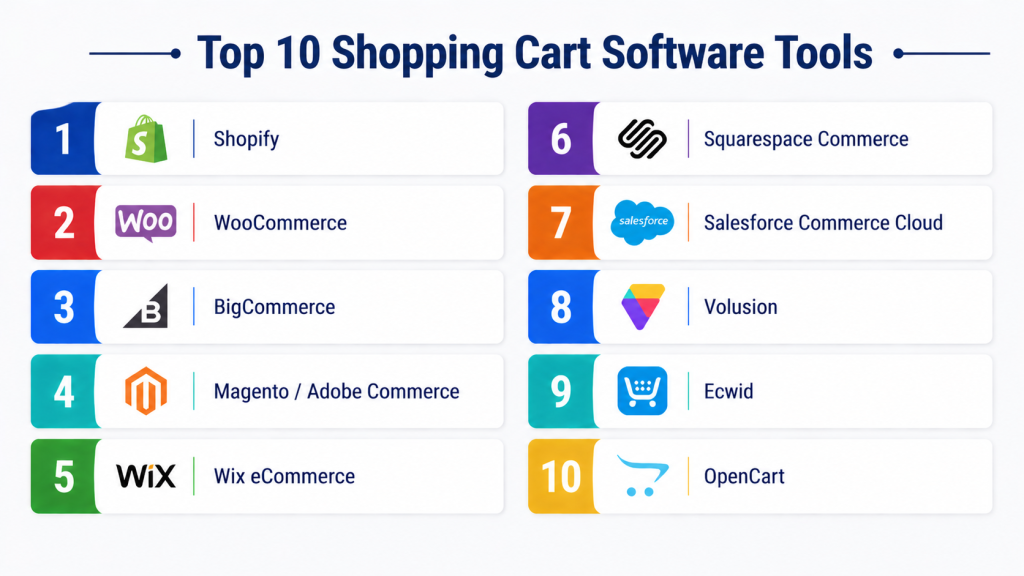
Top 10 Shopping Cart Software Tools
#1 — Shopify
Short description: Shopify is a comprehensive cloud-based e-commerce platform for businesses of all sizes. It enables merchants to build, customize, and manage online stores with minimal technical expertise, offering a full suite of sales, marketing, and analytics tools.
Key Features
- Drag-and-drop store builder
- Payment gateway integration with Shopify Payments
- Extensive app marketplace for extended functionality
- Mobile-optimized checkout and PWA support
- Inventory and order management
- Built-in SEO and marketing tools
- Multi-channel selling (online, social media, marketplaces)
Pros
- Very easy to use for non-technical teams
- Large ecosystem of third-party apps and plugins
Cons
- Transaction fees for non-Shopify payment gateways
- Limited backend customization without developer support
Platforms / Deployment
- Web, iOS, Android
- Cloud
Security & Compliance
- PCI DSS compliant
- SSL encryption
- MFA available
Integrations & Ecosystem
Shopify connects with hundreds of tools across marketing, analytics, and fulfillment.
- ERP systems like NetSuite
- CRM platforms like HubSpot
- Email marketing tools
- Social media sales channels
Support & Community
24/7 support via chat, email, and phone; strong community forums and developer resources.
#2 — WooCommerce
Short description: WooCommerce is an open-source e-commerce plugin for WordPress, ideal for businesses already using WordPress websites. It allows full control over customization and offers extensive extensions for payments, shipping, and marketing.
Key Features
- Seamless WordPress integration
- Highly customizable via themes and plugins
- Supports multiple payment gateways
- Advanced shipping and tax options
- Inventory and order management
- Marketing and SEO tools
- REST API for custom integrations
Pros
- Flexible and fully customizable
- Large developer and community support
Cons
- Requires hosting and WordPress knowledge
- Performance depends on hosting and optimization
Platforms / Deployment
- Web
- Self-hosted
Security & Compliance
- SSL and payment security dependent on hosting
- Plugins available for GDPR compliance
Integrations & Ecosystem
- WordPress ecosystem
- Payment gateways (PayPal, Stripe, Square)
- Marketing platforms and analytics tools
Support & Community
Extensive community forums; official documentation; paid support via WooCommerce extensions.
#3 — BigCommerce
Short description: BigCommerce is a scalable SaaS e-commerce platform for mid-market and enterprise businesses. It focuses on performance, customization, and B2B capabilities, supporting large product catalogs and omnichannel selling.
Key Features
- Advanced product management
- Multi-channel and international selling
- Headless commerce API support
- Built-in SEO and analytics tools
- Payment gateway integrations
- B2B pricing and wholesale features
Pros
- Excellent scalability for growing businesses
- Strong built-in B2B functionality
Cons
- Higher pricing for enterprise features
- Learning curve for advanced configurations
Platforms / Deployment
- Web
- Cloud
Security & Compliance
- PCI DSS certified
- SSL encryption
- SOC 2 Not publicly stated
Integrations & Ecosystem
- CRM, ERP, and accounting integrations
- Marketing automation tools
- Headless commerce extensions
Support & Community
24/7 support; comprehensive documentation and developer community.
#4 — Magento / Adobe Commerce
Short description: Magento is an enterprise-grade e-commerce platform offering high flexibility and control. It supports complex business models and large-scale operations with advanced features and customizations.
Key Features
- Flexible architecture for custom development
- Multi-store and multi-language support
- Advanced SEO and marketing tools
- Extensive inventory management
- B2B and marketplace capabilities
- Headless commerce and API integration
Pros
- Highly customizable and feature-rich
- Strong enterprise B2B support
Cons
- Requires technical expertise and developer resources
- Higher total cost of ownership
Platforms / Deployment
- Web
- Cloud / Self-hosted
Security & Compliance
- PCI DSS certified
- Role-based access control
- SSL encryption
Integrations & Ecosystem
- ERP, CRM, marketing tools
- Payment gateways and shipping platforms
- Extensive developer marketplace
Support & Community
Enterprise support plans; large developer community; comprehensive documentation.
#5 — Wix eCommerce
Short description: Wix eCommerce provides a user-friendly platform for small businesses and entrepreneurs. It combines a drag-and-drop website builder with integrated shopping cart functionality.
Key Features
- Visual website editor
- Payment gateway support
- Mobile-friendly templates
- Inventory and order tracking
- Marketing and SEO tools
- Discount and coupon management
Pros
- Extremely easy for beginners
- Integrated website and e-commerce solution
Cons
- Limited customization compared to open-source platforms
- Not ideal for large-scale stores
Platforms / Deployment
- Web, iOS, Android
- Cloud
Security & Compliance
- SSL encryption
- PCI DSS compliant
Integrations & Ecosystem
- Email marketing tools
- CRM integrations
- Social media sales channels
Support & Community
24/7 support; help center and community forums.
#6 — Squarespace Commerce
Short description: Squarespace Commerce is a SaaS solution designed for creative entrepreneurs and SMBs. It integrates website building, hosting, and e-commerce in a single platform.
Key Features
- Beautiful customizable templates
- Integrated checkout and payment processing
- Inventory and order management
- Marketing and analytics dashboards
- Mobile-responsive design
- Abandoned cart recovery
Pros
- Visually appealing templates
- Simple setup and management
Cons
- Limited advanced e-commerce features
- Less flexible for custom integrations
Platforms / Deployment
- Web, iOS, Android
- Cloud
Security & Compliance
- SSL encryption
- PCI DSS compliant
Integrations & Ecosystem
- Payment gateways
- Email marketing platforms
- Analytics and CRM tools
Support & Community
24/7 email support; live chat; active user community.
#7 — Salesforce Commerce Cloud
Short description: Salesforce Commerce Cloud is a cloud-native enterprise e-commerce solution for large organizations. It provides robust omnichannel capabilities and deep CRM integration.
Key Features
- AI-driven personalization
- Multi-channel and global selling
- Inventory and order management
- Marketing automation and analytics
- API-first architecture
- B2B and B2C support
Pros
- Excellent enterprise-level scalability
- Seamless integration with Salesforce CRM
Cons
- High cost for small businesses
- Complex implementation process
Platforms / Deployment
- Web
- Cloud
Security & Compliance
- SOC 2 Not publicly stated
- PCI DSS compliant
- MFA and SSO support
Integrations & Ecosystem
- Salesforce ecosystem
- Payment and fulfillment integrations
- Marketing and analytics platforms
Support & Community
Enterprise-level support; developer community; training resources.
#8 — Volusion
Short description: Volusion is a cloud-based e-commerce platform aimed at SMBs, offering core online store functionality with analytics and marketing features.
Key Features
- Product catalog and inventory management
- Payment gateway integrations
- Marketing and SEO tools
- Reporting and analytics dashboards
- Coupon and promotion management
- Mobile-optimized stores
Pros
- Easy setup and usability
- Affordable pricing for SMBs
Cons
- Limited advanced features for large stores
- Design flexibility is constrained
Platforms / Deployment
- Web
- Cloud
Security & Compliance
- SSL encryption
- PCI DSS compliant
Integrations & Ecosystem
- Payment gateways
- CRM and email marketing tools
- Shipping and fulfillment platforms
Support & Community
24/7 support via phone and chat; knowledge base.
#9 — Ecwid
Short description: Ecwid is a versatile e-commerce platform designed to add shopping functionality to any existing website or social media channel.
Key Features
- Multi-platform support (website, social, marketplaces)
- Flexible product catalog management
- Payment gateway integration
- Mobile-friendly design
- Tax and shipping automation
- API and app marketplace
Pros
- Quick setup on existing sites
- Integrates with multiple online platforms
Cons
- Limited custom design options
- Advanced features require higher-tier plans
Platforms / Deployment
- Web, iOS, Android
- Cloud
Security & Compliance
- SSL encryption
- PCI DSS compliant
Integrations & Ecosystem
- Payment gateways (Stripe, PayPal, Square)
- Social media selling
- Accounting and CRM tools
Support & Community
Email and chat support; active knowledge base.
#10 — OpenCart
Short description: OpenCart is an open-source e-commerce platform suitable for developers and businesses seeking full control. It supports multiple stores, languages, and currencies.
Key Features
- Multi-store and multi-language support
- Modular extension system
- Payment and shipping gateway support
- Product catalog and inventory management
- SEO-friendly architecture
- Reporting and analytics tools
Pros
- Free and open-source
- Highly customizable for developers
Cons
- Requires technical knowledge
- Reliant on extensions for advanced features
Platforms / Deployment
- Web
- Self-hosted
Security & Compliance
- SSL support
- Security depends on hosting and extensions
Integrations & Ecosystem
- Payment gateways and shipping modules
- Marketing and analytics plugins
- API for custom integrations
Support & Community
Large developer community; official forums; documentation available.
Comparison Table (Top 10)
| Tool Name | Best For | Platform(s) Supported | Deployment | Standout Feature | Public Rating |
|---|---|---|---|---|---|
| Shopify | SMBs & enterprises | Web, iOS, Android | Cloud | Large app marketplace | N/A |
| WooCommerce | WordPress users | Web | Self-hosted | Full WordPress integration | N/A |
| BigCommerce | Mid-market & enterprise | Web | Cloud | B2B functionality | N/A |
| Magento / Adobe Commerce | Enterprise | Web | Cloud/Self-hosted | Headless & customizable | N/A |
| Wix eCommerce | Small businesses | Web, iOS, Android | Cloud | Drag-and-drop builder | N/A |
| Squarespace Commerce | SMBs & creatives | Web, iOS, Android | Cloud | Visually appealing templates | N/A |
| Salesforce Commerce Cloud | Large enterprises | Web | Cloud | AI personalization & CRM integration | N/A |
| Volusion | SMBs | Web | Cloud | Core e-commerce for SMBs | N/A |
| Ecwid | Multi-platform sellers | Web, iOS, Android | Cloud | Integrates with existing sites | N/A |
| OpenCart | Developers & tech-savvy | Web | Self-hosted | Open-source and modular | N/A |
Evaluation & Scoring of Shopping Cart Software
| Tool Name | Core (25%) | Ease (15%) | Integrations (15%) | Security (10%) | Performance (10%) | Support (10%) | Value (15%) | Weighted Total (0–10) |
|---|---|---|---|---|---|---|---|---|
| Shopify | 9 | 10 | 9 | 9 | 9 | 9 | 8 | 9.1 |
| WooCommerce | 8 | 7 | 9 | 8 | 8 | 8 | 9 | 8.2 |
| BigCommerce | 9 | 8 | 9 | 9 | 9 | 8 | 7 | 8.7 |
| Magento / Adobe Commerce | 10 | 7 | 10 | 9 | 9 | 8 | 6 | 8.6 |
| Wix eCommerce | 7 | 10 | 7 | 8 | 8 | 8 | 8 | 8.0 |
| Squarespace Commerce | 7 | 9 | 7 | 8 | 8 | 8 | 8 | 7.9 |
| Salesforce Commerce Cloud | 10 | 8 | 10 | 9 | 9 | 9 | 6 | 8.7 |
| Volusion | 7 | 8 | 7 | 8 | 8 | 7 | 8 | 7.6 |
| Ecwid | 7 | 9 | 8 | 8 | 8 | 8 | 7 | 7.9 |
| OpenCart | 9 | 6 | 8 | 7 | 8 | 7 | 9 | 7.8 |
Scores are comparative and relative to the set of top 10 tools. Weighted totals highlight overall strength across core features, ease of use, integrations, security, performance, support, and value.
Which Shopping Cart Software Is Right for You?
Solo / Freelancer
Wix eCommerce or Squarespace are ideal for easy setup and minimal technical complexity. Low upfront cost and templates simplify store creation.
SMB
Shopify or Ecwid provide balanced features, ease of use, and integration options for growing businesses.
Mid-Market
BigCommerce or WooCommerce (self-hosted) can handle larger catalogs and more complex workflows. Customization and multi-channel selling are key.
Enterprise
Magento / Adobe Commerce or Salesforce Commerce Cloud suit large, global operations requiring headless architecture, deep integrations, and advanced B2B support.
Budget vs Premium
Budget-conscious users can opt for Wix, Squarespace, or WooCommerce. Premium offerings like Magento and Salesforce provide scalability and flexibility at higher cost.
Feature Depth vs Ease of Use
Platforms like Shopify and BigCommerce strike a balance. Magento prioritizes feature depth but has a steeper learning curve.
Integrations & Scalability
Choose platforms with strong API ecosystems (Shopify, BigCommerce, Salesforce) for long-term scalability and multi-system connectivity.
Security & Compliance Needs
Enterprise stores handling sensitive data should prioritize PCI DSS compliance, SSO/MFA, and SOC 2 certifications (Shopify, Salesforce, Magento).
Frequently Asked Questions (FAQs)
What are the typical pricing models for shopping cart software?
Most platforms offer SaaS subscriptions with monthly or annual fees. Open-source platforms like WooCommerce or OpenCart require hosting and may incur extension costs. Some charge transaction fees on sales, while others bundle features into higher-tier plans.
How long does it take to set up a new store?
Setup time depends on the platform and customization needs. SaaS platforms like Shopify or Wix can launch in a few hours to days, whereas Magento or WooCommerce may require weeks due to development and integration.
Can I migrate from one platform to another?
Yes, most platforms support migration, but it often requires data export/import and possibly custom scripts. Proper planning ensures minimal downtime and preserves product, customer, and order data.
How secure are shopping cart platforms?
Security varies. Look for PCI DSS compliance, SSL encryption, MFA, and SSO. SaaS platforms handle updates and security patches automatically, while self-hosted solutions require manual management.
Are shopping carts suitable for mobile commerce?
Yes, all top platforms support mobile-optimized websites and progressive web apps. Some include mobile apps for store management and sales tracking.
How do integrations work?
Most platforms offer app marketplaces or APIs to integrate with CRM, ERP, payment gateways, email marketing, and analytics tools. Evaluate ecosystem compatibility before selection.
What are common mistakes when selecting a shopping cart?
Common errors include ignoring scalability, underestimating customization needs, neglecting integration requirements, and choosing based solely on price.
How do I handle international sales?
Platforms like Shopify, BigCommerce, and Magento support multi-currency, multi-language, tax rules, and localized payment methods, essential for global commerce.
Can I manage subscriptions and recurring billing?
Yes, many platforms offer built-in or third-party subscription solutions, supporting recurring payments, automated invoicing, and renewal notifications.
Which platform is best for marketplaces?
Magento, Shopify Plus, and BigCommerce are suitable for multi-vendor setups, offering catalog segregation, vendor management, and flexible commission structures.
Conclusion
Magento, Shopify Plus, and BigCommerce are suitable for multi-vendor setups, offering catalog segregation, vendor management, and flexible commission structures.
Selecting the right Shopping Cart Software is a strategic decision that directly impacts a business’s online sales, customer experience, and operational efficiency. The ideal platform should align with company size, technical expertise, and business goals while providing reliable performance, strong security, and seamless integrations. Evaluating core features, ease of use, and scalability ensures that the solution can grow alongside the business.
For small businesses and freelancers, platforms like Wix, Squarespace, or Ecwid offer simplicity and quick setup, while mid-market and enterprise companies benefit from robust platforms like Shopify, BigCommerce, Magento, or Salesforce Commerce Cloud. Each option balances usability, customization, and ecosystem support differently, making it important to consider specific operational needs, B2B or B2C focus, and multi-channel selling requirements.
Ultimately, no single platform fits every scenario. Businesses should shortlist a few candidates, test key features through pilots or trials, and validate integrations and security requirements. Taking this measured approach helps ensure the selected shopping cart software drives growth, supports seamless customer experiences, and provides a flexible foundation for future expansion.
