Introduction
Marketplace platforms are software solutions that enable businesses to build and manage online marketplaces connecting buyers and sellers. They support a variety of business models, including B2C, B2B, and peer-to-peer commerce, and offer functionalities like product catalog management, payments, vendor onboarding, analytics, and logistics. In marketplace platforms are becoming more crucial as e-commerce expands globally, AI-driven personalization improves buyer experiences, and integrated payment systems streamline transactions.
Real-world use cases include:
- Launching a niche e-commerce marketplace for products or services.
- Supporting peer-to-peer service platforms such as rentals or freelance services.
- Managing multi-vendor B2B marketplaces for wholesale distribution.
- Aggregating digital services like software, subscriptions, or creative content.
- Creating on-demand service marketplaces for logistics or delivery services.
When evaluating marketplace platforms, buyers should consider:
- Core feature set and flexibility
- Ease of use for vendors and administrators
- Integration options with payments, shipping, and marketing tools
- Security and compliance capabilities
- Performance, reliability, and uptime
- Support and community resources
- Pricing structure and total cost of ownership
- Customization and branding options
- Analytics and reporting capabilities
- Multi-currency and multi-language support
Best for: Marketplace entrepreneurs, e-commerce managers, SMBs to enterprises, digital service providers, and companies looking to scale vendor networks.
Not ideal for: Single-product retailers, small businesses with simple storefront needs, or businesses seeking a marketplace solution without vendor management or multi-seller support.
Key Trends in Marketplace Platforms Tools
- AI-powered product recommendations and personalized shopping experiences.
- Built-in payment processing with multi-currency support for global transactions.
- Strong emphasis on privacy and compliance, including GDPR and SOC 2 readiness.
- Headless architecture and API-first platforms for flexibility and integrations.
- Support for subscription-based and recurring revenue marketplaces.
- Low-code or no-code marketplace builders for faster time-to-market.
- Advanced analytics and reporting dashboards for vendor and buyer insights.
- Omnichannel capabilities across web, mobile, and social commerce.
- Automated fraud detection and risk management tools.
- Flexible pricing models, including subscription, commission, or hybrid approaches.
How We Evaluated Marketplace Platforms (Methodology)
- Market adoption and brand recognition across SMB, mid-market, and enterprise segments.
- Core feature completeness, including vendor management, payments, and fulfillment tools.
- Reliability and performance signals, such as uptime and transaction handling.
- Security posture evaluation, including encryption, SSO, and audit capabilities.
- Integration capabilities with ERP, CRM, payment gateways, and marketing tools.
- Customer fit across different industries and business sizes.
- Scalability for large vendor networks, multi-currency operations, and high transaction volumes.
- Support, documentation, and active community participation.
- Pricing models, value for money, and total cost of ownership.
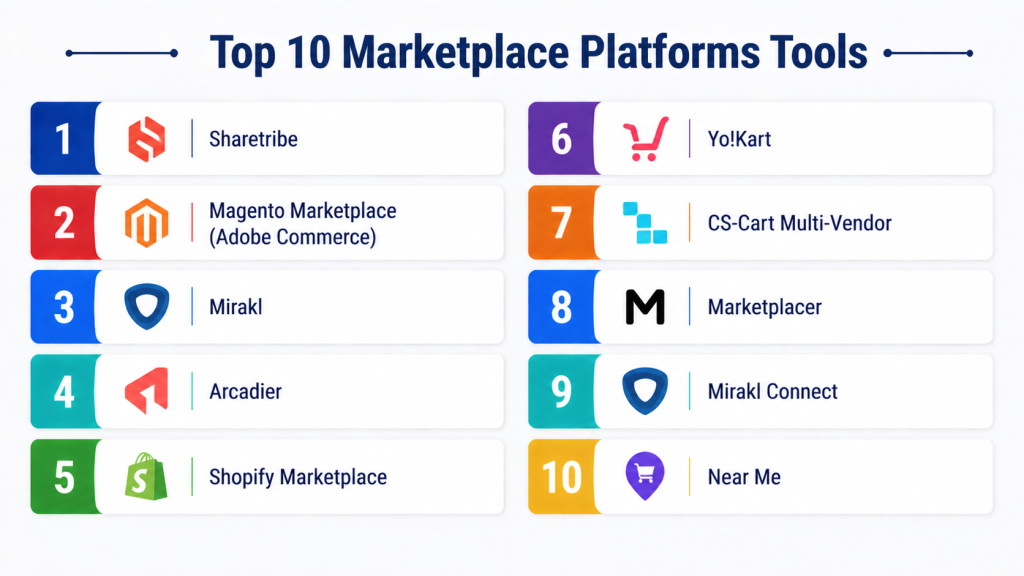
Top 10 Marketplace Platforms Tools
#1 — Sharetribe
Short description: Sharetribe is a cloud-based marketplace platform designed for small businesses and entrepreneurs who want to launch peer-to-peer or B2C marketplaces quickly. It provides a simple and intuitive interface for managing vendors, products, and transactions. Users can start their marketplace without any coding experience, making it ideal for rapid deployments. It also includes built-in payment processing and reporting dashboards to manage day-to-day operations efficiently.
Key Features
- Multi-vendor management with commission tracking
- Payment processing and payout automation
- Customizable branding and themes
- Rental, product, and service marketplace support
- Built-in analytics and reporting dashboards
Pros
- Fast setup with minimal technical expertise
- No coding required for core functionality
Cons
- Limited advanced customization options
- Scalability may be constrained for very large marketplaces
Platforms / Deployment
- Web / iOS / Android
- Cloud
Security & Compliance
- SSL encryption and GDPR compliance
- Not publicly stated on SOC 2 or ISO certifications
Integrations & Ecosystem
- Zapier integrations for CRM, email, and analytics
- Payment gateways like Stripe and PayPal
- API access for custom integrations
Support & Community
- Email support, documentation, and active user forum
#2 — Magento Marketplace (Adobe Commerce)
Short description: Magento Marketplace by Adobe Commerce is a powerful platform for mid-market and enterprise businesses. It supports highly customizable B2C and B2B marketplaces, offering flexibility to manage multi-vendor stores. Magento Marketplace is ideal for companies with technical resources who want to scale operations and integrate advanced features like AI-driven personalization, complex product catalogs, and multiple store fronts. It provides extensive analytics and reporting to help optimize sales and vendor performance.
Key Features
- Multi-vendor and multi-store management
- Advanced product catalog and inventory tools
- Payment, shipping, and tax flexibility
- AI-powered search and personalization
- Comprehensive analytics and reporting
Pros
- Highly customizable and extensible
- Strong third-party ecosystem and extensions
Cons
- Requires technical expertise to deploy and maintain
- Higher total cost compared to cloud-native solutions
Platforms / Deployment
- Web
- Cloud / Self-hosted
Security & Compliance
- Supports SSO/SAML, MFA, encryption
- PCI DSS compliance
Integrations & Ecosystem
- Adobe Experience Cloud, ERP, CRM, marketing tools
- APIs for custom extensions
- Payment and shipping integrations
Support & Community
- Extensive documentation, developer community, and enterprise support tiers
#3 — Mirakl
Short description: Mirakl is an enterprise-grade platform designed for retailers, wholesalers, and B2B organizations. It excels in vendor management, large-scale operations, and workflow automation. Mirakl allows companies to expand catalogs quickly, manage complex transactions, and integrate with existing ERP and CRM systems. Its API-first architecture enables headless deployment, giving enterprises flexibility in user experience design.
Key Features
- Multi-vendor catalog and order management
- Vendor onboarding workflows
- Commission management and financial reconciliation
- Advanced reporting and business intelligence
- API-first, headless deployment options
Pros
- Enterprise-ready with high scalability
- Comprehensive vendor management tools
Cons
- Implementation complexity
- Premium pricing may not suit SMBs
Platforms / Deployment
- Web
- Cloud / Hybrid
Security & Compliance
- SOC 2, GDPR, SSO/SAML, audit logging
Integrations & Ecosystem
- ERP, CRM, payment gateways, shipping systems
- API access for custom workflows
Support & Community
- Dedicated enterprise support and professional services
#4 — Arcadier
Short description: Arcadier is a flexible marketplace platform that supports both service and product marketplaces. It targets SMBs and entrepreneurs needing a fast launch. Arcadier provides multi-language and multi-currency support, pre-built templates, and intuitive vendor management. It is especially suitable for marketplaces that want to go live quickly with minimal technical involvement, while still offering integration options through APIs.
Key Features
- Multi-language and multi-currency support
- Customizable themes and templates
- Payment and commission management
- Analytics and reporting dashboards
- API access for integrations
Pros
- Quick setup and minimal technical effort
- Supports multiple marketplace models
Cons
- Limited enterprise-level customization
- Advanced features may require higher-tier plans
Platforms / Deployment
- Web
- Cloud
Security & Compliance
- SSL encryption and GDPR compliance
Integrations & Ecosystem
- Stripe, PayPal, and other payment gateways
- Basic API and webhooks for notifications
Support & Community
- Email support, documentation, and knowledge base
#5 — Shopify Marketplace (via Multi-Vendor Apps)
Short description: Shopify Marketplace apps allow SMBs to convert Shopify stores into multi-vendor marketplaces. These apps are ideal for small retailers or niche markets, offering vendor management, order processing, and commission tracking. Shopify Marketplace leverages the broader Shopify ecosystem, making it simple for businesses already on Shopify to expand into multi-vendor operations quickly.
Key Features
- Vendor onboarding and management
- Order and commission tracking
- Mobile-optimized storefronts
- Integration with Shopify payments and shipping
- Analytics and reporting tools
Pros
- Easy integration within Shopify ecosystem
- Rapid deployment for small retailers
Cons
- Dependent on Shopify limitations
- Multiple apps may be required for full functionality
Platforms / Deployment
- Web / iOS / Android
- Cloud
Security & Compliance
- PCI DSS, SSL encryption
Integrations & Ecosystem
- Shopify apps, payment gateways, shipping providers
- APIs for custom integrations
Support & Community
- Shopify support channels, forums, and documentation
#6 — Yo!Kart
Short description: Yo!Kart is a multi-vendor marketplace solution aimed at startups and SMBs. It provides ready-to-use templates, easy vendor management, and built-in payment gateways. The platform supports mobile-friendly storefronts and SEO optimization, making it a cost-effective option for businesses that want to establish an online marketplace quickly.
Key Features
- Multi-vendor catalog and commission management
- SEO-friendly and mobile-responsive
- Payment gateways and automated payouts
- Analytics dashboards
- API access for third-party integrations
Pros
- Cost-effective for small businesses
- Fast deployment with templates
Cons
- Limited scalability for large enterprises
- Some advanced features require technical assistance
Platforms / Deployment
- Web
- Cloud / Self-hosted
Security & Compliance
- SSL encryption and GDPR compliance
Integrations & Ecosystem
- Payment processors, shipping APIs, analytics tools
- Plugin ecosystem for extensions
Support & Community
- Email support, live chat, and documentation
#7 — CS-Cart Multi-Vendor
Short description: CS-Cart Multi-Vendor is a self-hosted platform suitable for SMBs and mid-market companies. It provides complete control over the marketplace, including vendor panels, shipping options, and payment configurations. This platform is ideal for businesses that want to manage all technical aspects internally while offering robust multi-vendor features.
Key Features
- Vendor management and dashboards
- Flexible shipping and payment options
- Product management and SEO tools
- Marketplace analytics
- Mobile-friendly storefront
Pros
- Full deployment control
- Rich customization options
Cons
- Self-hosting requires server management
- Steeper learning curve for non-technical users
Platforms / Deployment
- Web
- Cloud / Self-hosted
Security & Compliance
- SSL encryption and GDPR compliance
Integrations & Ecosystem
- Payment gateways, shipping providers, CRM systems
- API access for extensions
Support & Community
- Documentation, forums, and support tiers
#8 — Marketplacer
Short description: Marketplacer is a cloud-based platform designed for enterprise marketplaces. It supports retail, services, and subscription-based models. With features like multi-vendor management, commission handling, and headless commerce support, Marketplacer is ideal for businesses needing scalable marketplaces and robust integrations.
Key Features
- Multi-vendor management
- Subscription and commission handling
- Payments, logistics, and fulfillment integrations
- Analytics dashboards
- API and headless commerce support
Pros
- Enterprise-ready and scalable
- Flexible business model support
Cons
- High cost for SMBs
- Complex implementation
Platforms / Deployment
- Web
- Cloud
Security & Compliance
- SOC 2, GDPR, SSO/SAML, encryption
Integrations & Ecosystem
- ERP, CRM, payment, and shipping systems
- API and headless commerce support
Support & Community
- Professional services, dedicated support, and documentation
#9 — Mirakl Connect
Short description: Mirakl Connect focuses on large B2B marketplaces. It provides strong vendor onboarding, ERP and CRM integrations, and advanced reporting capabilities. Mirakl Connect is best for enterprises managing high volumes of vendors and requiring detailed operational insights.
Key Features
- B2B-specific vendor management
- Integration with ERP, CRM, and logistics
- Advanced reporting and analytics
- Flexible commission structures
- API-first architecture
Pros
- Highly scalable for enterprise B2B
- Extensive integration ecosystem
Cons
- Premium pricing
- Professional services often required for implementation
Platforms / Deployment
- Web
- Cloud
Security & Compliance
- SOC 2, GDPR, SSO/SAML, audit logs
Integrations & Ecosystem
- ERP, CRM, payment providers
- API and webhooks for custom workflows
Support & Community
- Enterprise-grade support, documentation
#10 — Near Me
Short description: Near Me is a SaaS marketplace builder suitable for service and product marketplaces. It enables startups and SMBs to deploy multi-vendor marketplaces quickly, offering payment management, analytics, and API integration. Its mobile-friendly design and flexible setup make it ideal for businesses needing a fast, user-friendly launch.
Key Features
- Multi-vendor support
- Payment and commission management
- Mobile-friendly interface
- Analytics dashboards
- API and webhooks for integrations
Pros
- Rapid deployment and easy to use
- Supports various marketplace types
Cons
- Limited scalability for enterprise
- Fewer advanced customization options
Platforms / Deployment
- Web
- Cloud
Security & Compliance
- SSL encryption, GDPR compliance
Integrations & Ecosystem
- Payment processors, analytics tools, CRM integrations
- API and webhooks for extensibility
Support & Community
- Email support, documentation, knowledge base
Comparison Table (Top 10)
| Tool Name | Best For | Platform(s) Supported | Deployment | Standout Feature | Public Rating |
|---|---|---|---|---|---|
| Sharetribe | SMB / Freelancers | Web / iOS / Android | Cloud | Quick launch, easy setup | N/A |
| Magento Marketplace | Mid-market / Enterprise | Web | Cloud / Self-hosted | Customizable & scalable | N/A |
| Mirakl | Enterprise | Web | Cloud / Hybrid | Vendor onboarding & BI | N/A |
| Arcadier | SMB / Entrepreneurs | Web | Cloud | Multi-model marketplace templates | N/A |
| Shopify Marketplace | SMB retail | Web / iOS / Android | Cloud | Shopify ecosystem integration | N/A |
| Yo!Kart | SMB startups | Web | Cloud / Self-hosted | Cost-effective multi-vendor | N/A |
| CS-Cart Multi-Vendor | SMB / Mid-market | Web | Cloud / Self-hosted | Self-hosted flexibility | N/A |
| Marketplacer | Enterprise | Web | Cloud | Enterprise scalability & subscriptions | N/A |
| Mirakl Connect | Enterprise B2B | Web | Cloud | B2B marketplace focus | N/A |
| Near Me | SMB / Service marketplaces | Web | Cloud | Rapid deployment & flexible models | N/A |
Evaluation & Scoring of Marketplace Platforms
| Tool Name | Core (25%) | Ease (15%) | Integrations (15%) | Security (10%) | Performance (10%) | Support (10%) | Value (15%) | Weighted Total (0–10) |
|---|---|---|---|---|---|---|---|---|
| Sharetribe | 7 | 9 | 6 | 6 | 7 | 7 | 8 | 7.3 |
| Magento Marketplace | 9 | 6 | 9 | 8 | 9 | 8 | 6 | 7.9 |
| Mirakl | 9 | 6 | 9 | 9 | 9 | 9 | 7 | 8.1 |
| Arcadier | 7 | 8 | 6 | 6 | 7 | 7 | 7 | 7.1 |
| Shopify Marketplace | 6 | 9 | 7 | 8 | 7 | 8 | 7 | 7.5 |
| Yo!Kart | 7 | 8 | 6 | 6 | 7 | 7 | 7 | 7.1 |
| CS-Cart Multi-Vendor | 8 | 6 | 7 | 7 | 8 | 7 | 6 | 7.2 |
| Marketplacer | 9 | 6 | 9 | 9 | 9 | 8 | 6 | 8.0 |
| Mirakl Connect | 9 | 6 | 9 | 9 | 9 | 9 | 6 | 8.0 |
| Near Me | 7 | 8 | 6 | 6 | 7 | 7 | 7 | 7.1 |
Interpretation: Weighted scores highlight relative strengths in features, usability, integrations, and security. Businesses should align platform scores with specific marketplace objectives.
Which Marketplace Platforms Is Right for You?
Solo / Freelancer
Platforms like Sharetribe and Near Me provide fast setup, low cost, and intuitive interfaces. Focus on simplicity and basic vendor management.
SMB
Arcadier, Shopify Marketplace, and Yo!Kart balance ease of use and flexibility. Ideal for small businesses seeking multi-vendor functionality and quick launch.
Mid-Market
Magento Marketplace and CS-Cart Multi-Vendor offer customization and performance for growing marketplaces. Suitable for companies with technical resources to manage integrations.
Enterprise
Mirakl, Marketplacer, and Mirakl Connect support large-scale, high-volume marketplaces. Prioritize security, compliance, and vendor management capabilities.
Budget vs Premium
- Budget: Sharetribe, Arcadier, Yo!Kart, Near Me
- Premium: Magento, Mirakl, Marketplacer
Feature Depth vs Ease of Use
- Feature depth: Mirakl, Magento, Marketplacer
- Ease of use: Sharetribe, Arcadier, Near Me
Integrations & Scalability
- Enterprise buyers need API-driven ERP, CRM, payment, and shipping integrations.
- SMBs can leverage pre-built integrations for faster deployment.
Security & Compliance Needs
- Enterprise marketplaces require SOC 2, GDPR, SSO/SAML, and audit logging.
- SMBs can rely on platform-level encryption and basic compliance features.
Frequently Asked Questions (FAQs) - 1. What pricing models do marketplace platforms use?
- Marketplace platforms typically use subscription fees, transaction commissions, or a combination of both. SMB-focused solutions often have flat monthly pricing for simplicity, while enterprise platforms usually negotiate custom contracts based on usage, vendor count, or transaction volume. Choosing the right model depends on the scale of your marketplace and projected revenue.
- 2. How long does it take to launch a marketplace?
- Launch timelines vary by platform and complexity. Platforms like Sharetribe or Arcadier can go live within days or weeks, whereas enterprise solutions such as Mirakl or Magento Marketplace may take several months due to customization, integrations, and vendor onboarding processes. Planning is essential to meet market deadlines.
- 3. Can I switch marketplace platforms if needed?
- Switching platforms is possible but can be complex. It involves migrating product data, re-onboarding vendors, and reconfiguring integrations with payment gateways and analytics tools. Proper planning and testing are essential to minimize downtime and ensure a smooth transition for both vendors and customers.
- 4. Are payments secure on these platforms?
- Most marketplace platforms integrate with PCI DSS-compliant payment gateways to protect financial transactions. Enterprise-grade solutions often include SSL encryption, audit logs, and advanced security features like SSO and multi-factor authentication, ensuring both vendors and buyers have secure payment experiences.
- 5. Do marketplace platforms support multiple currencies and languages?
- Many platforms, especially enterprise-grade, support multiple currencies and languages to facilitate global operations. SMB-focused solutions may offer limited multi-currency or localization features. Businesses planning cross-border sales should confirm the platform’s global capabilities before adoption.
- 6. What integrations are typically available with marketplace platforms?
- Marketplace platforms commonly integrate with ERP, CRM, payment gateways, shipping providers, and marketing automation tools. API access allows for custom integrations, enabling seamless connections with other business systems and workflows to improve efficiency and data synchronization.
- 7. Can I customize the marketplace branding?
- Yes, most platforms provide customization options including themes, templates, and branding elements. Enterprise platforms may offer headless architecture, giving full control over the user interface and front-end design. Custom branding is crucial for creating a consistent marketplace experience for buyers and vendors.
- 8. How do analytics and reporting features differ across platforms?
- Enterprise platforms offer comprehensive dashboards with detailed insights into sales, vendor performance, and customer behavior, often integrating with business intelligence tools. SMB-focused solutions provide simpler reporting and analytics suitable for small marketplaces but may lack advanced metrics or predictive insights.
- 9. What common mistakes should businesses avoid when selecting a platform?
- Common mistakes include choosing a platform based solely on price, underestimating integration complexity, neglecting security and compliance requirements, or failing to consider scalability. It’s important to align platform capabilities with business goals and projected growth to avoid costly re-platforming later.
- 10. Are there alternatives to using marketplace platforms?
- Yes, businesses with simpler needs can consider multi-vendor extensions for e-commerce platforms like Shopify or WooCommerce. Alternatively, custom-built solutions can be developed for unique business models. However, full-featured marketplace platforms typically provide faster deployment, vendor management tools, and integrated payments, reducing operational complexity.
Conclusion - Marketplace platforms in offer a wide range of options tailored to different business sizes and needs. SMBs and freelancers benefit from rapid-deployment platforms like Sharetribe, Arcadier, and Near Me, which allow marketplaces to go live quickly with minimal technical effort. These solutions are ideal for testing ideas, entering niche markets, or managing small vendor networks without significant upfront investment.
- Mid-market businesses and growing enterprises may prefer platforms such as Magento Marketplace and CS-Cart Multi-Vendor, which provide deeper customization, scalability, and integration capabilities. These platforms are suited for companies that require complex workflows, multi-store management, and advanced analytics while balancing usability for vendors and admins.
- Large enterprises and B2B marketplaces can leverage Mirakl, Marketplacer, and Mirakl Connect for full-scale operations. These platforms support high transaction volumes, extensive vendor networks, and rigorous security and compliance standards. When selecting a platform, businesses should consider deployment models, integration needs, budget, and feature depth, then shortlist 2–3 tools for a pilot to validate functionality, performance, and vendor experience before committing fully.
