Introduction
Service discovery tools automate detecting, registering, and managing services in dynamic IT environments. They ensure services can communicate efficiently without manual configuration, which is critical in microservices, containerized applications, and cloud-native infrastructures.
These tools are increasingly vital as distributed architectures grow more complex. They help IT teams maintain uptime, reduce errors, and optimize service routing, providing both reliability and performance.
Real-world use cases
- Automatic registration of microservices in Kubernetes clusters
- Health checks and failover for distributed systems
- Dynamic load balancing based on service availability
- Integration with API gateways and service meshes
- Observability and monitoring of service interactions
Evaluation criteria for buyers
- Dynamic environment support for containers and serverless
- Integration with orchestration platforms
- Health checking and failover
- Performance and low-latency service resolution
- Ease of deployment and maintenance
- Security features including authentication, encryption, and access control
- API and SDK support for custom integrations
- Community adoption and enterprise support
- Licensing and cost considerations
Best for: DevOps engineers, SREs, cloud architects, enterprises running microservices, and teams managing dynamic infrastructure
Not ideal for: Small-scale applications with static services where manual management suffices
Key Trends in Service Discovery Tools
- Integration with service meshes and API gateways for microservices
- AI-assisted routing and predictive service scaling
- Cloud-native design with multi-cloud and hybrid support
- Zero-trust security models with automatic encryption and authentication
- Enhanced monitoring and observability with built-in metrics and logging
- Support for advanced protocols like HTTP/3 and gRPC
- Automated configuration and self-healing service registration
- Container-native deployments with seamless orchestration
- Open-source innovation combined with enterprise-grade support
- Flexible pricing models including SaaS subscriptions and hybrid licensing
How We Selected These Tools
- Reviewed market adoption and mindshare among enterprises and SMBs
- Assessed feature completeness including registration, discovery, and health checks
- Evaluated reliability and performance under dynamic environments
- Analyzed security posture and compliance readiness
- Examined integrations with Kubernetes, Docker, cloud providers, and service meshes
- Measured customer fit across industries and team sizes
- Balanced open-source tools with enterprise-grade solutions
- Reviewed documentation quality, support tiers, and community activity
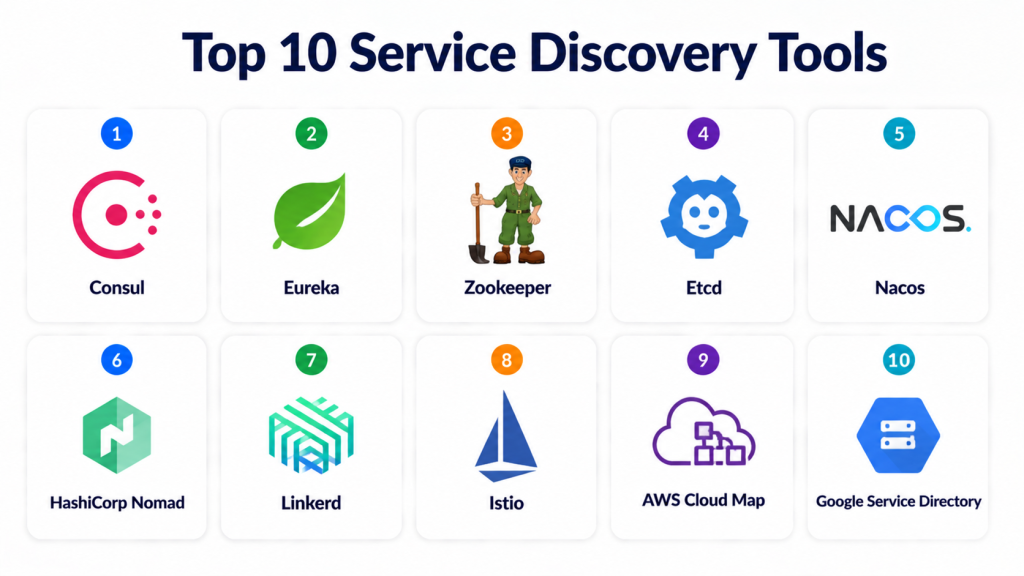
Top 10 Service Discovery Tools
#1 — Consul
Short description: Service discovery and configuration tool for microservices and dynamic cloud environments
Key Features
- Automatic service registration
- Health checking for services
- Key/value configuration store
- Multi-datacenter support
- API and DNS-based discovery
- Service mesh integration
- ACL-based security
Pros
- Strong community and enterprise support
- Robust security and multi-cloud support
- Mature ecosystem with integrations
Cons
- Complex configuration for advanced setups
- Performance requires proper tuning
Platforms / Deployment
Linux / macOS / Windows
Cloud / Self-hosted / Hybrid
Security & Compliance
SSO/SAML, ACLs, encryption
Not publicly stated
Integrations & Ecosystem
- Kubernetes integration
- Envoy and Istio service mesh
- REST API and SDKs for automation
Support & Community
Active open-source community
Enterprise support available
Extensive documentation
#2 — Eureka
Short description: REST-based service discovery server for Java ecosystems and Spring Boot applications
Key Features
- Service registration and heartbeat
- Client-side load balancing
- Dashboard for service monitoring
- Spring Cloud integration
- Configurable service expiration
- Peer replication for high availability
Pros
- Well-integrated with Java and Spring frameworks
- Easy to deploy in microservices
- Simple REST API interface
Cons
- Limited to JVM environments
- Some features need Spring Cloud components
Platforms / Deployment
Linux / Windows
Self-hosted / Hybrid
Security & Compliance
SSL/TLS support
Not publicly stated
Integrations & Ecosystem
- Spring Boot and Spring Cloud apps
- API gateways and load balancers
- Monitoring via Prometheus or Grafana
Support & Community
Strong Java community
Documentation and tutorials
#3 — Zookeeper
Short description: Centralized service for configuration, naming, and synchronization of distributed systems
Key Features
- Hierarchical namespace for service registration
- Watches for real-time updates
- Leader election and distributed locks
- Fault-tolerant cluster management
- Strong consistency
- Integration with Hadoop and Kafka
Pros
- Reliable for large-scale distributed systems
- Proven consistency and coordination mechanisms
- Active open-source development
Cons
- Complex to operate and scale
- Steep learning curve
Platforms / Deployment
Linux / macOS / Windows
Self-hosted
Security & Compliance
SASL authentication, SSL/TLS
Not publicly stated
Integrations & Ecosystem
- Apache Kafka, Hadoop, HBase
- REST API and client libraries
- Cluster coordination and monitoring tools
Support & Community
Community support
Extensive documentation
#4 — Etcd
Short description: Distributed key-value store with strong consistency, used for service discovery and configuration
Key Features
- Strong consistency via Raft protocol
- Service registration and discovery
- Key/value configuration storage
- Watch APIs for updates
- Kubernetes integration
- Cluster snapshots and management
Pros
- Reliable and consistent
- Native Kubernetes integration
- Lightweight and performant
Cons
- Cluster management requires expertise
- Scaling needs careful planning
Platforms / Deployment
Linux / macOS / Windows
Cloud / Self-hosted / Hybrid
Security & Compliance
SSL/TLS, authentication
Not publicly stated
Integrations & Ecosystem
- Kubernetes API server
- Service meshes
- Client libraries for multiple languages
Support & Community
Open-source community
Documentation and guides
#5 — Nacos
Short description: Platform for service discovery, configuration, and dynamic DNS in microservices
Key Features
- Service registration and discovery
- Configuration management
- Health checks and failover
- DNS, HTTP, and gRPC support
- Cluster management
- Console dashboard
Pros
- Simplifies microservices management
- Multi-protocol support
- Active open-source development
Cons
- Mostly Java ecosystem oriented
- Requires proper deployment for HA
Platforms / Deployment
Linux / macOS / Windows
Cloud / Self-hosted / Hybrid
Security & Compliance
SSL/TLS, RBAC
Not publicly stated
Integrations & Ecosystem
- Spring Cloud and microservices
- Service mesh integration
- REST API for automation
Support & Community
Active contributors
Comprehensive documentation
#6 — HashiCorp Nomad
Short description: Workload orchestrator with built-in service discovery for containers and legacy workloads
Key Features
- Service discovery via Consul
- Container and non-container workload support
- Health checking and failover
- Multi-region scheduling
- Job templating and automation
- High scalability
Pros
- Supports hybrid workloads
- Integrated discovery via Consul
- Lightweight orchestration
Cons
- Less mature than Kubernetes
- Requires HashiCorp ecosystem knowledge
Platforms / Deployment
Linux / macOS / Windows
Cloud / Self-hosted / Hybrid
Security & Compliance
TLS encryption, ACLs
Not publicly stated
Integrations & Ecosystem
- Consul for service discovery
- Vault for secrets
- Terraform for infrastructure automation
Support & Community
HashiCorp community support
Documentation available
#7 — Linkerd
Short description: Lightweight service mesh providing service discovery and observability for Kubernetes
Key Features
- Automatic Kubernetes pod discovery
- Load balancing and routing
- Metrics, tracing, and logging
- Mutual TLS encryption
- Failover and retries
- Policy enforcement
Pros
- Easy installation in Kubernetes
- Strong security defaults
- Observability by default
Cons
- Kubernetes-only
- Limited non-container support
Platforms / Deployment
Linux / macOS
Cloud / Self-hosted / Hybrid
Security & Compliance
mTLS, TLS, RBAC
Not publicly stated
Integrations & Ecosystem
- Kubernetes native
- Prometheus and Grafana integration
- API for service routing
Support & Community
Active community
Comprehensive documentation
#8 — Istio
Short description: Full-featured service mesh with advanced discovery, routing, and security
Key Features
- Automatic service registration
- Traffic management
- mTLS and policy enforcement
- Observability with telemetry
- Kubernetes and Envoy integration
- Fault injection and resiliency testing
Pros
- Enterprise-grade features
- Strong security
- Advanced traffic management
Cons
- Steep learning curve
- Operational complexity
Platforms / Deployment
Linux / macOS
Cloud / Self-hosted / Hybrid
Security & Compliance
mTLS, TLS, RBAC
Not publicly stated
Integrations & Ecosystem
- Kubernetes and Envoy
- Prometheus, Grafana, Jaeger
- CI/CD pipelines
Support & Community
Large open-source community
Professional vendor support
#9 — AWS Cloud Map
Short description: Managed service discovery for cloud-native applications on AWS
Key Features
- Automatic service registration
- DNS and API discovery
- Health checks and failover
- AWS integration
- Multi-region support
Pros
- Fully managed, reduces operational overhead
- Tight AWS integration
- Automatic scaling
Cons
- AWS-only
- Limited outside AWS
Platforms / Deployment
Web / Cloud
Cloud
Security & Compliance
IAM access control
SOC 2 / ISO 27001 / Not publicly stated
Integrations & Ecosystem
- AWS ECS, Lambda, EKS
- CloudWatch monitoring
- API integration
Support & Community
AWS support tiers
Documentation and community forums
#10 — Google Service Directory
Short description: Managed service discovery for GCP with centralized registration and lookup
Key Features
- DNS and API lookup
- Health checking
- Multi-project support
- GCP networking integration
- API-driven configuration
Pros
- Fully managed and scalable
- Tight GCP integration
- Simplifies cloud-native development
Cons
- Google Cloud-only
- Less flexible for multi-cloud
Platforms / Deployment
Web / Cloud
Cloud
Security & Compliance
IAM-based access control, TLS
Not publicly stated
Integrations & Ecosystem
- GCP Compute, GKE, Cloud Functions
- Cloud monitoring
- API-driven configuration
Support & Community
Google Cloud support
Documentation and tutorials
Comparison Table
| Tool Name | Best For | Platform(s) Supported | Deployment | Standout Feature | Public Rating |
|---|---|---|---|---|---|
| Consul | Multi-cloud microservices | Linux / macOS / Windows | Cloud / Self-hosted / Hybrid | Health checks + key/value store | N/A |
| Eureka | Java/Spring apps | Linux / Windows | Self-hosted / Hybrid | REST API discovery | N/A |
| Zookeeper | Large-scale distributed systems | Linux / macOS / Windows | Self-hosted | Distributed coordination | N/A |
| Etcd | Kubernetes & cloud-native | Linux / macOS / Windows | Cloud / Self-hosted / Hybrid | Strong consistency | N/A |
| Nacos | Microservices | Linux / macOS / Windows | Cloud / Self-hosted / Hybrid | Multi-protocol support | N/A |
| Nomad | Hybrid workloads | Linux / macOS / Windows | Cloud / Self-hosted / Hybrid | Integrated discovery via Consul | N/A |
| Linkerd | Kubernetes microservices | Linux / macOS | Cloud / Self-hosted / Hybrid | Lightweight service mesh | N/A |
| Istio | Enterprise service mesh | Linux / macOS | Cloud / Self-hosted / Hybrid | Advanced routing + security | N/A |
| AWS Cloud Map | AWS-native apps | Web | Cloud | Fully managed discovery | N/A |
| Google Service Directory | GCP-native apps | Web | Cloud | Centralized registry | N/A |
Evaluation & Scoring
| Tool Name | Core | Ease | Integrations | Security | Performance | Support | Value | Weighted Total |
|---|---|---|---|---|---|---|---|---|
| Consul | 9 | 8 | 9 | 8 | 9 | 8 | 8 | 8.5 |
| Eureka | 8 | 8 | 7 | 7 | 8 | 7 | 8 | 7.7 |
| Zookeeper | 9 | 6 | 7 | 8 | 9 | 7 | 7 | 7.9 |
| Etcd | 9 | 7 | 8 | 8 | 9 | 7 | 7 | 8.0 |
| Nacos | 8 | 8 | 8 | 7 | 8 | 7 | 8 | 7.9 |
| Nomad | 8 | 7 | 7 | 7 | 8 | 7 | 7 | 7.5 |
| Linkerd | 8 | 9 | 7 | 8 | 8 | 7 | 8 | 8.0 |
| Istio | 9 | 6 | 8 | 9 | 9 | 7 | 7 | 8.0 |
| AWS Cloud Map | 7 | 9 | 8 | 8 | 8 | 8 | 8 | 8.0 |
| Google Service Directory | 7 | 9 | 7 | 8 | 8 | 8 | 8 | 7.9 |
Interpretation: Weighted totals indicate comparative strength across features, ease of use, integrations, security, performance, support, and value.
Which Service Discovery Tool Is Right for You?
Solo / Freelancer
- Linkerd or Nacos for simple Kubernetes or microservice deployments
SMB
- Eureka or Etcd for Java/Kubernetes microservices
Mid-Market
- Nomad or Linkerd for hybrid or containerized workloads
Enterprise
- Istio, Consul Enterprise, or AWS Cloud Map for advanced features and compliance
Budget vs Premium
- Budget: Nacos, Linkerd, Etcd
- Premium: Consul Enterprise, Istio, AWS Cloud Map
Feature Depth vs Ease of Use
- Feature-heavy: Istio, Consul Enterprise
- Ease of use: Linkerd, Nacos
Integrations & Scalability
- Nomad, Etcd, Consul for multi-cloud or hybrid setups
Security & Compliance Needs
- Consul, Istio, AWS Cloud Map for encryption, access control, and audit logs
Frequently Asked Questions
1. What pricing models do service discovery tools use?
Open-source tools are free, enterprise editions or managed services use subscription or usage-based pricing.
2. How complex is onboarding for these tools?
Linkerd and Nacos are beginner-friendly; Istio and Consul Enterprise require specialized knowledge.
3. Can service discovery improve reliability?
Yes, automated registration, health checks, and failover improve uptime and reduce errors.
4. Are these tools compatible with cloud platforms?
Most integrate with AWS, GCP, Azure, and container platforms like Kubernetes.
5. Can they handle microservices at scale?
Yes, Consul, Etcd, and Istio are designed for large-scale microservices environments.
6. How do they enhance security?
Through mTLS, RBAC, TLS encryption, and ACL policies for secure service-to-service communication.
7. What are common configuration mistakes?
Incorrect health checks, missing authentication, and poor scaling policies are frequent issues.
8. How easy is switching between tools?
Migration requires careful testing, configuration translation, and service re-registration planning.
9. Do these tools support multi-cloud or hybrid deployments?
Yes, tools like Consul, Nomad, and Etcd support multi-cloud and hybrid setups.
10. Can service discovery integrate with service meshes?
Yes, most integrate with service meshes like Istio, Linkerd, and Consul Connect.
Conclusion
Service discovery tools are essential for microservices and cloud-native environments. The best choice depends on scale, cloud ecosystem, team expertise, and security requirements. Solo developers may prefer lightweight tools like Linkerd, while enterprises may require Istio or Consul Enterprise. Start with 2–3 shortlisted tools, run a pilot, and evaluate integration, observability, and security before full deployment.
