Introduction
Reverse proxy tools act as intermediaries between clients and backend servers, routing incoming requests efficiently while offering security and performance enhancements. These tools are vital for ensuring websites and applications remain fast, secure, and scalable. Organizations use reverse proxies to manage traffic, protect servers from attacks, and improve user experience through caching and load balancing.
Reverse proxies are especially relevant today due to increasing web traffic, complex cloud architectures, and heightened cybersecurity risks. They help businesses maintain uptime, optimize traffic flow, and implement security policies effectively.
Real-world use cases:
- Load balancing across multiple servers to ensure high availability
- Secure exposure of internal services while hiding backend details
- SSL termination and automated certificate management
- Caching static content to reduce server load and accelerate performance
- API routing in microservices environments
- Mitigating malicious traffic and enforcing access policies
Evaluation criteria for buyers:
- Security and compliance capabilities
- Performance and scalability
- Ease of setup and management
- Integration with existing cloud and on-premises systems
- Support for modern protocols like HTTP/2, HTTP/3, and WebSocket
- Automation and monitoring features
- Pricing and licensing flexibility
- Community support and vendor reliability
Best for: IT managers, network administrators, developers, mid-to-large enterprises, cloud-focused companies, and SaaS providers.
Not ideal for: Very small teams with minimal traffic or businesses that do not require load balancing or advanced security features.
Key Trends in Reverse Proxy Tools
- AI-driven traffic optimization for predictive load balancing
- DevOps pipeline integration for automated deployment and configuration
- Enhanced security features including WAF and bot protection
- Support for HTTP/3 and QUIC to improve connection performance
- Cloud-native deployments with multi-cloud support
- API-aware routing for microservices and serverless architectures
- Automated certificate management and zero-touch SSL deployment
- Compliance features for GDPR, SOC 2, and HIPAA
- Observability dashboards with detailed traffic metrics
- Flexible pricing models including SaaS subscriptions and self-hosted licenses
How We Selected These Tools
- Market adoption and mindshare among enterprises and SMBs
- Completeness of features including load balancing, caching, and security
- Reliability and performance under high traffic loads
- Security posture and compliance readiness
- Integration with cloud platforms and developer tools
- Customer fit across different industries and company sizes
- Balance between open-source, enterprise, and hybrid solutions
- Quality of documentation, support, and community engagement
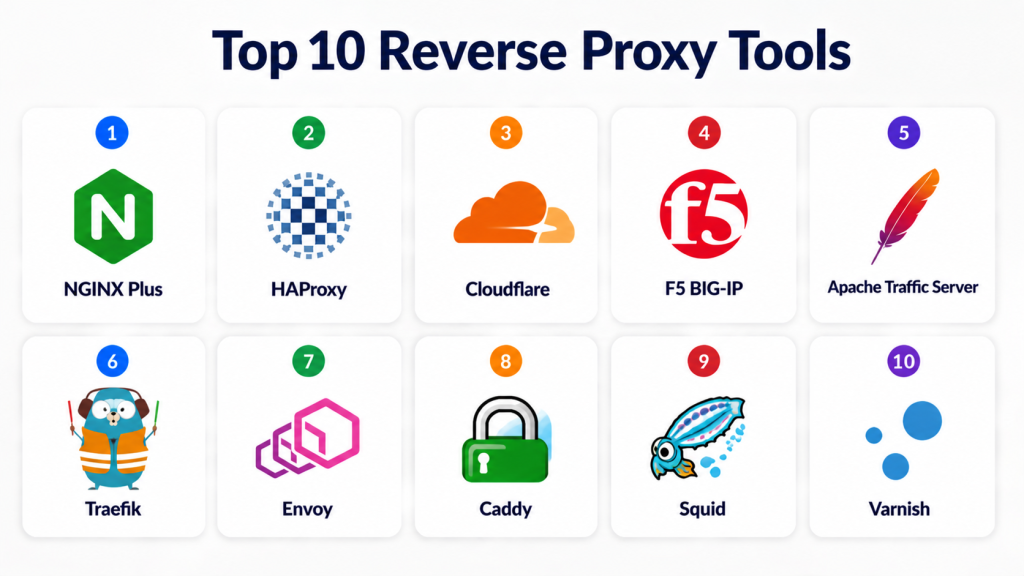
Top 10 Reverse Proxy Tools
#1 — NGINX Plus
Short description: Enterprise-grade reverse proxy and load balancer for high-traffic applications and APIs.
Key Features
- Layer 7 load balancing and caching
- SSL/TLS termination and certificate management
- Web application firewall integration
- Health checks and traffic shaping
- API gateway capabilities
- Monitoring dashboards
- Session persistence
Pros
- High performance under heavy traffic
- Enterprise support and documentation
- Flexible deployment options
Cons
- Paid version can be costly
- Advanced configuration requires expertise
Platforms / Deployment
Linux / Windows / macOS
Cloud / Self-hosted / Hybrid
Security & Compliance
SSL/TLS, RBAC
SOC 2 / ISO 27001 / Not publicly stated
Integrations & Ecosystem
Compatible with DevOps and cloud environments
- Kubernetes ingress controller
- Docker integration
- API and custom module extensions
Support & Community
Strong documentation and enterprise support
Active community forums
#2 — HAProxy
Short description: High-performance open-source proxy and load balancer for TCP/HTTP traffic.
Key Features
- Layer 4 and 7 load balancing
- SSL termination
- Health checks and failover
- TCP and HTTP proxying
- Advanced routing rules
- Metrics via Prometheus or StatsD
Pros
- Open-source with enterprise options
- Excellent stability and performance
- Highly customizable
Cons
- Steep learning curve
- Some features only in enterprise edition
Platforms / Deployment
Linux / Windows / macOS
Cloud / Self-hosted / Hybrid
Security & Compliance
SSL/TLS, basic RBAC
Not publicly stated
Integrations & Ecosystem
- Kubernetes ingress support
- Prometheus/Grafana monitoring
- Automation APIs
Support & Community
Active open-source community
Enterprise support via HAProxy Technologies
#3 — Cloudflare
Short description: Cloud-based reverse proxy providing DDoS protection, CDN, and web security.
Key Features
- Global CDN
- DDoS mitigation and WAF
- SSL/TLS termination
- Rate limiting and bot management
- DNS management
- Page rules and caching
Pros
- Simplifies global traffic management
- Built-in security and compliance
- Zero infrastructure maintenance
Cons
- Limited backend control
- Some features require higher-tier plans
Platforms / Deployment
Web
Cloud
Security & Compliance
TLS encryption, WAF, RBAC
SOC 2 / GDPR / Not publicly stated
Integrations & Ecosystem
- APIs for firewall and DNS management
- Cloud platform integrations
- Supports serverless functions
Support & Community
Tiered support plans
Large knowledge base and community forums
#4 — F5 BIG-IP
Short description: Enterprise reverse proxy, load balancer, and application delivery controller.
Key Features
- Advanced L4–7 traffic management
- SSL offloading and TLS inspection
- Application firewall integration
- Global server load balancing
- Analytics and monitoring
- Automation via iControl API
Pros
- Enterprise-grade security and reliability
- Scales for high-volume traffic
- Extensive customization
Cons
- High cost for smaller deployments
- Complex setup
Platforms / Deployment
Linux / Virtual appliances
Cloud / Self-hosted / Hybrid
Security & Compliance
SSL/TLS, RBAC, MFA
SOC 2 / ISO 27001 / HIPAA
Integrations & Ecosystem
- DevOps CI/CD pipeline integration
- REST APIs
- Multi-cloud compatible
Support & Community
Enterprise support
Documentation and professional training
#5 — Apache Traffic Server
Short description: Open-source reverse proxy and caching server for high-performance HTTP.
Key Features
- Caching and content acceleration
- HTTP/2 support and SSL termination
- Traffic routing and load balancing
- Plugin system
- Logging and monitoring
Pros
- Free and open-source
- Scales for high traffic
- Customizable via plugins
Cons
- Advanced setup required
- Smaller community than NGINX/HAProxy
Platforms / Deployment
Linux / macOS
Self-hosted
Security & Compliance
SSL/TLS
Not publicly stated
Integrations & Ecosystem
- Monitoring integrations
- Custom plugin support
- Cloud load balancer compatibility
Support & Community
Community-based support
Online documentation
#6 — Traefik
Short description: Modern reverse proxy for containerized applications with service discovery.
Key Features
- Automatic discovery of containers
- Dynamic configuration via APIs
- SSL automation (Let’s Encrypt)
- HTTP/2 and WebSocket support
- Load balancing and routing
Pros
- Ideal for containerized environments
- Kubernetes/Docker integration
- Dynamic configuration
Cons
- Limited enterprise support
- Requires monitoring setup
Platforms / Deployment
Linux / macOS / Windows
Cloud / Self-hosted / Hybrid
Security & Compliance
SSL/TLS, RBAC
Not publicly stated
Integrations & Ecosystem
- Kubernetes ingress
- Docker Compose integration
- API-driven configuration
Support & Community
Active community
Documentation and examples online
#7 — Envoy
Short description: High-performance edge and service proxy for cloud-native applications.
Key Features
- Layer 7 proxy for HTTP/gRPC
- Service discovery
- Observability with metrics/tracing
- Load balancing and rate limiting
- SSL termination and mTLS
Pros
- Highly performant and scalable
- Cloud-native friendly
- Strong observability
Cons
- Complex configuration
- Steep learning curve
Platforms / Deployment
Linux / macOS
Cloud / Self-hosted / Hybrid
Security & Compliance
SSL/TLS, RBAC, mTLS
Not publicly stated
Integrations & Ecosystem
- Kubernetes ingress
- Istio and service mesh integration
- API configuration
Support & Community
Large open-source community
Active forums and GitHub
#8 — Caddy
Short description: Lightweight, automated reverse proxy with built-in HTTPS.
Key Features
- Automatic HTTPS
- Simple configuration
- HTTP/2 and QUIC support
- Load balancing and routing
- Plugin extensibility
Pros
- Easy setup for small/medium projects
- Automatic certificate management
- Low maintenance
Cons
- Limited enterprise features
- Basic security options
Platforms / Deployment
Linux / macOS / Windows
Self-hosted / Cloud
Security & Compliance
SSL/TLS
Not publicly stated
Integrations & Ecosystem
- Plugin system
- Container compatibility
- Basic API integration
Support & Community
Active community support
Documentation online
#9 — Squid
Short description: Caching proxy that can act as a reverse proxy for web acceleration.
Key Features
- HTTP caching and acceleration
- Reverse proxy mode
- Access control and filtering
- Logging and monitoring
- Authentication and ACLs
Pros
- Open-source and free
- Effective caching
- Flexible access control
Cons
- Complex modern configuration
- Limited TLS/HTTP/2 features
Platforms / Deployment
Linux / Windows / macOS
Self-hosted
Security & Compliance
Basic ACLs
Not publicly stated
Integrations & Ecosystem
- Monitoring system support
- Custom scripting
- LDAP/Active Directory integration
Support & Community
Community-driven support
Extensive online resources
#10 — Varnish
Short description: High-performance caching reverse proxy for HTTP traffic.
Key Features
- HTTP caching and acceleration
- Custom VCL configuration
- Load balancing and routing
- Logging and stats
- Edge caching for content-heavy sites
Pros
- Excellent for high-traffic websites
- Reduces backend load
- Flexible configuration
Cons
- Limited SSL support
- Not ideal for dynamic routing
Platforms / Deployment
Linux / macOS
Self-hosted / Cloud
Security & Compliance
Basic SSL via add-ons
Not publicly stated
Integrations & Ecosystem
- NGINX/Apache frontends
- Monitoring tools
- API and scripting for automation
Support & Community
Active open-source community
Documentation available
Comparison Table
| Tool Name | Best For | Platform(s) Supported | Deployment | Standout Feature | Public Rating |
|---|---|---|---|---|---|
| NGINX Plus | Enterprise apps | Linux / Windows / macOS | Cloud / Self-hosted / Hybrid | Layer 7 load balancing | N/A |
| HAProxy | Performance/open-source | Linux / Windows / macOS | Cloud / Self-hosted / Hybrid | High-performance proxy | N/A |
| Cloudflare | Cloud security | Web | Cloud | DDoS + CDN | N/A |
| F5 BIG-IP | Enterprise | Linux / Virtual appliances | Cloud / Self-hosted / Hybrid | Advanced L4–7 traffic | N/A |
| Apache Traffic Server | High-performance caching | Linux / macOS | Self-hosted | HTTP caching | N/A |
| Traefik | Containers | Linux / macOS / Windows | Cloud / Self-hosted / Hybrid | Automatic service discovery | N/A |
| Envoy | Microservices | Linux / macOS | Cloud / Self-hosted / Hybrid | Observability + proxy | N/A |
| Caddy | Small-medium sites | Linux / macOS / Windows | Self-hosted / Cloud | Automatic HTTPS | N/A |
| Squid | Web acceleration | Linux / Windows / macOS | Self-hosted | HTTP caching/filtering | N/A |
| Varnish | Content-heavy sites | Linux / macOS | Self-hosted / Cloud | High-performance caching | N/A |
Evaluation & Scoring
| Tool Name | Core | Ease | Integrations | Security | Performance | Support | Value | Weighted Total |
|---|---|---|---|---|---|---|---|---|
| NGINX Plus | 9 | 8 | 8 | 9 | 9 | 9 | 7 | 8.7 |
| HAProxy | 8 | 7 | 7 | 8 | 9 | 7 | 9 | 8.0 |
| Cloudflare | 7 | 9 | 8 | 9 | 8 | 8 | 8 | 8.3 |
| F5 BIG-IP | 9 | 6 | 8 | 9 | 9 | 8 | 6 | 8.1 |
| Apache Traffic Server | 7 | 6 | 6 | 7 | 8 | 6 | 9 | 7.2 |
| Traefik | 8 | 8 | 8 | 7 | 8 | 7 | 8 | 7.9 |
| Envoy | 9 | 7 | 8 | 8 | 9 | 7 | 7 | 8.0 |
| Caddy | 6 | 9 | 7 | 6 | 7 | 6 | 8 | 7.1 |
| Squid | 7 | 6 | 6 | 6 | 7 | 6 | 9 | 7.0 |
| Varnish | 8 | 7 | 7 | 6 | 9 | 6 | 8 | 7.6 |
Interpretation: Weighted totals indicate overall tool strength. Scores are comparative to help prioritize based on organizational requirements.
Which Reverse Proxy Tool Is Right for You?
Solo / Freelancer
- Caddy or Traefik for simplicity and automatic HTTPS
- Minimal setup and maintenance
SMB
- HAProxy or NGINX Plus
- Balance of performance, security, and cost
Mid-Market
- Envoy or Traefik
- Microservices-friendly, dynamic configuration
Enterprise
- F5 BIG-IP, Cloudflare, or NGINX Plus
- Enterprise-grade features and compliance
Budget vs Premium
- Budget: HAProxy, Caddy, Squid, Varnish
- Premium: NGINX Plus, F5 BIG-IP, Cloudflare Enterprise
Feature Depth vs Ease of Use
- Feature-heavy: Envoy, F5 BIG-IP
- Ease of use: Caddy, Cloudflare
Integrations & Scalability
- Envoy, Traefik, Cloudflare for cloud and container integration
Security & Compliance Needs
- F5 BIG-IP, Cloudflare, NGINX Plus for advanced WAF, SSL, and compliance
Frequently Asked Questions
1. What pricing models do reverse proxy tools use?
Some are open-source and free, while others have subscription or perpetual licenses with enterprise support tiers.
2. How difficult is onboarding for these tools?
Tools like Caddy and Cloudflare are beginner-friendly. Envoy and F5 BIG-IP require specialized knowledge.
3. Can these tools improve website performance?
Yes, through caching, load balancing, and SSL termination, they reduce latency and server load.
4. How do reverse proxies enhance security?
They hide backend servers, terminate SSL, block malicious traffic, and integrate with WAFs.
5. Are these tools compatible with cloud platforms?
Most modern tools support cloud-native deployment and container orchestration.
6. Can they handle microservices architectures?
Yes, especially Envoy, Traefik, and NGINX Plus with service discovery and dynamic routing.
7. What are common configuration mistakes?
Overcomplicating rules, neglecting SSL, and uneven load balancing are frequent issues.
8. How easy is it to switch between tools?
Switching requires careful planning, testing, and possible migration of configuration and certificates.
9. Do reverse proxies support API traffic management?
Many tools provide API routing, rate limiting, and authentication features to manage APIs efficiently.
10. Can these tools help with compliance requirements?
Yes, enterprise-grade solutions offer features to support GDPR, SOC 2, HIPAA, and audit logs.
Conclusion
Reverse proxy tools provide critical performance, security, and scalability benefits. The “best” tool depends on your organization’s size, traffic volume, security needs, and deployment preferences. Solo users may prioritize simplicity and automation, while enterprises need advanced features and compliance capabilities. Start by shortlisting 2–3 tools, run a pilot, and evaluate integration and security fit for your environment to make an informed choice.
