Introduction
Restaurant Management Systems (RMS) are software solutions that streamline operations, improve efficiency, and enhance customer experience for restaurants, cafes, and foodservice businesses. They integrate key functions such as point-of-sale (POS), table management, inventory tracking, kitchen display, and reporting, providing a unified platform to run daily operations efficiently.
In 2026, the restaurant industry faces increasing pressure from digital ordering, delivery platforms, and consumer expectations for fast, accurate service. An effective RMS can reduce errors, optimize staff productivity, and improve profitability while supporting omnichannel ordering across in-store, online, and mobile platforms.
Use cases include:
- Full-service restaurants managing dine-in and takeout orders
- Quick-service restaurants (QSRs) optimizing drive-thru and online orders
- Cafes and bakeries handling inventory and employee scheduling
- Multi-location chains needing centralized reporting and analytics
- Cloud kitchens managing high-volume delivery operations
Key evaluation criteria:
- POS integration and ease of use
- Online ordering and delivery management
- Inventory and supplier management
- Employee scheduling and labor management
- Kitchen display system (KDS) integration
- Reporting and analytics
- Customer loyalty and CRM functionality
- Multi-location support and scalability
- Security and compliance features
- Pricing and total cost of ownership
Best for: Restaurant operators, franchise managers, cloud kitchen owners, and hospitality managers looking for operational efficiency and enhanced customer experience.
Not ideal for: Very small cafes or independent restaurants that rely on manual processes or third-party delivery platforms without in-house POS needs.
Key Trends in Restaurant Management Systems
- AI-driven inventory forecasting and demand prediction
- Integrated online ordering and delivery management
- Mobile and tablet POS systems for flexible service
- Cloud-based RMS for multi-location and remote access
- Kitchen display systems (KDS) replacing paper tickets
- Loyalty and CRM integration for customer retention
- Contactless ordering and payments
- Data-driven reporting for sales and operational decisions
- Automated employee scheduling and labor optimization
- Third-party delivery platform integration for omnichannel fulfillment
How We Selected These Tools (Methodology)
- Market adoption and brand presence among restaurants
- Feature completeness: POS, inventory, ordering, KDS, reporting
- Reliability and performance signals from customer feedback
- Security posture: encryption, access control, compliance
- Integration ecosystem with online ordering, POS, and loyalty platforms
- Customer fit across small, mid-market, and enterprise restaurants
- Scalability and cloud deployment
- Ease of use and training requirements
- Pricing and total value delivered
- Innovation and forward-looking capabilities (AI, automation, mobile support)
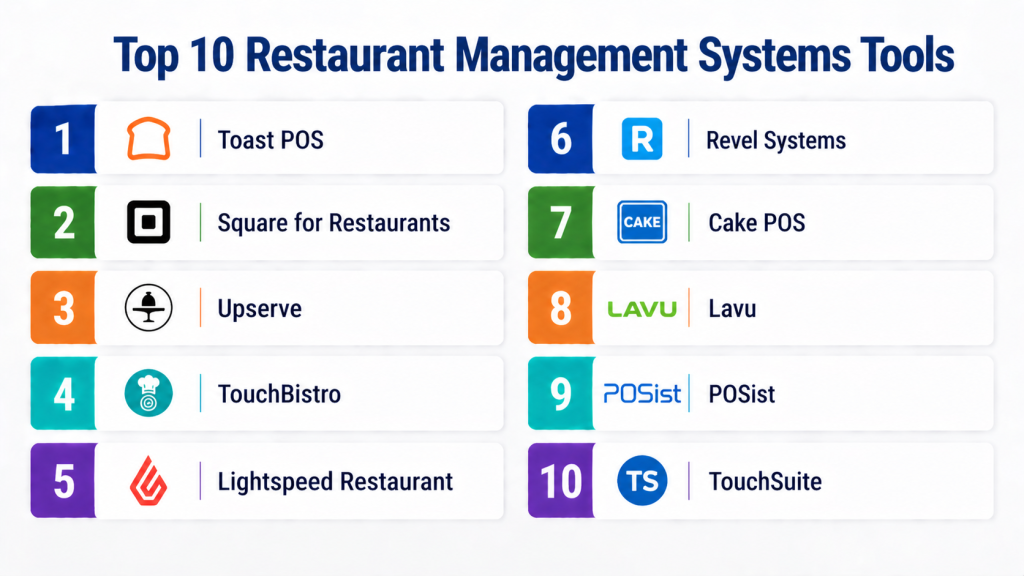
Top 10 Restaurant Management Systems Tools
#1 — Toast POS
Short description: Toast POS is a cloud-based restaurant management platform that integrates POS, online ordering, delivery, and employee management. Ideal for full-service and QSR restaurants.
Key Features
- Cloud-based POS with tableside ordering
- Online ordering and delivery integration
- Employee scheduling and labor reporting
- Inventory and menu management
- Customer loyalty and gift card programs
- Analytics and reporting dashboards
Pros
- Easy to deploy and use
- Comprehensive feature set covering POS, online orders, and management
Cons
- Monthly subscription cost can be high for small restaurants
- Some advanced features require add-on modules
Platforms / Deployment
- Web, iOS, Android / Cloud
Security & Compliance
- PCI DSS compliant
- SSL encryption
Integrations & Ecosystem
- Online ordering platforms
- Payment processors
- Third-party delivery integrations
- APIs for custom integrations
Support & Community
24/7 support, online documentation, and community forums.
#2 — Square for Restaurants
Short description: Square for Restaurants offers a flexible RMS with integrated POS, payments, and analytics, suitable for small to medium-sized restaurants and cafes.
Key Features
- POS with table management and modifiers
- Mobile and tablet support for flexible ordering
- Online ordering integration
- Inventory tracking and reporting
- Employee management
- Loyalty and marketing tools
Pros
- Easy to use and affordable for SMBs
- Integrated payments simplify operations
Cons
- Limited advanced reporting for multi-location chains
- Less suitable for high-volume enterprise operations
Platforms / Deployment
- Web, iOS, Android / Cloud
Security & Compliance
- PCI DSS compliant
- SSL encryption
Integrations & Ecosystem
- Online ordering and delivery apps
- Accounting systems
- CRM platforms
- API for custom integrations
Support & Community
Email, phone, and chat support; knowledge base available.
#3 — Upserve by Lightspeed
Short description: Upserve provides an all-in-one RMS focusing on POS, analytics, and marketing insights, ideal for full-service and casual dining restaurants.
Key Features
- Cloud POS system
- Inventory and menu management
- Employee and shift scheduling
- Customer loyalty and CRM
- Analytics dashboards
- Online ordering support
Pros
- Strong analytics and reporting
- Integrates POS with loyalty and marketing
Cons
- Pricing can be higher for smaller restaurants
- Some features require add-ons
Platforms / Deployment
- Web, iOS, Android / Cloud
Security & Compliance
- PCI DSS compliant
- SSL encryption
Integrations & Ecosystem
- Payment processors
- Online ordering platforms
- Accounting and ERP systems
- APIs for custom workflows
Support & Community
Dedicated account managers, online documentation, and support channels.
#4 — TouchBistr
Short description: TouchBistro offers an iPad-based RMS designed for restaurants of all sizes, combining POS, tableside ordering, and inventory management.
Key Features
- iPad POS system
- Table and floor management
- Menu and inventory tracking
- Employee scheduling
- Reporting and analytics
- Offline mode support
Pros
- Intuitive interface and mobile POS
- Offline functionality ensures continuity
Cons
- Limited online ordering support
- May require separate integration for loyalty programs
Platforms / Deployment
- iOS, Web / Cloud
Security & Compliance
- PCI DSS compliant
- SSL encryption
Integrations & Ecosystem
- Payment processors
- Accounting platforms
- Loyalty and marketing tools
Support & Community
Phone, chat, and email support; user forums.
#5 — Lightspeed Restaurant
Short description: Lightspeed Restaurant offers a cloud-based RMS with POS, inventory, and reporting for multi-location restaurants and bars.
Key Features
- POS with tableside and bar support
- Inventory and recipe management
- Employee scheduling and labor reports
- Reporting and analytics dashboards
- Online ordering and delivery integration
- Customer management and loyalty programs
Pros
- Scales well for multi-location operations
- Strong reporting and analytics
Cons
- More complex setup for small restaurants
- Subscription cost can be high
Platforms / Deployment
- Web, iOS, Android / Cloud
Security & Compliance
- PCI DSS compliant
- SSL encryption
Integrations & Ecosystem
- Payment gateways
- Online ordering platforms
- Accounting systems
- API for custom integrations
Support & Community
24/7 support; online resources and forums.
#6 — Revel Systems
Short description: Revel Systems provides a robust RMS with POS, inventory, and CRM for QSRs, full-service restaurants, and enterprise operations.
Key Features
- Cloud POS system
- Inventory tracking and menu management
- Employee scheduling and labor analytics
- Customer loyalty and CRM
- Multi-location management
- Reporting and analytics
Pros
- Strong enterprise capabilities
- Flexible POS and inventory features
Cons
- Costly for smaller establishments
- Requires onboarding support
Platforms / Deployment
- Web, iOS / Cloud
Security & Compliance
- PCI DSS compliant
- SSL encryption
Integrations & Ecosystem
- Payment processors
- Accounting software
- Loyalty and marketing tools
Support & Community
Enterprise support teams; online documentation and training.
#7 — Cake POS
Short description: Cake POS provides a cloud-based RMS designed for small to medium-sized restaurants and bakeries with POS, online ordering, and loyalty features.
Key Features
- POS with order management
- Inventory tracking
- Online ordering
- Customer loyalty programs
- Reporting and analytics
Pros
- Easy to set up and use
- Affordable for SMBs
Cons
- Limited advanced analytics
- Smaller integration ecosystem
Platforms / Deployment
- Web, iOS / Cloud
Security & Compliance
- PCI DSS compliant
- SSL encryption
Integrations & Ecosystem
- Payment processors
- Online ordering platforms
- Loyalty systems
Support & Community
Email and chat support; documentation available.
#8 — Lavu
Short description: Lavu is an iPad-based RMS with POS, inventory, and reporting for small to mid-sized restaurants.
Key Features
- POS with tableside ordering
- Inventory and recipe tracking
- Employee management
- Reporting dashboards
- Loyalty program support
Pros
- Intuitive iPad interface
- Affordable for SMBs
Cons
- Limited enterprise features
- Integration options are narrower
Platforms / Deployment
- iOS, Web / Cloud
Security & Compliance
- PCI DSS compliant
- SSL encryption
Integrations & Ecosystem
- Payment gateways
- Accounting software
- Loyalty and marketing tools
Support & Community
Email, chat, and phone support; online resources.
#9 — POSist
Short description: POSist provides cloud-based restaurant management software for multi-location operations, integrating POS, inventory, and analytics.
Key Features
- POS system with offline support
- Multi-location inventory management
- Employee scheduling
- Online ordering and delivery
- Reporting and analytics
Pros
- Ideal for chain restaurants
- Scalable cloud platform
Cons
- Implementation requires support
- Advanced features may increase cost
Platforms / Deployment
- Web, iOS, Android / Cloud
Security & Compliance
- PCI DSS compliant
- SSL encryption
Integrations & Ecosystem
- Payment processors
- Accounting and CRM platforms
- Online ordering systems
Support & Community
Dedicated support and documentation.
#10 — TouchSuite
Short description: TouchSuite offers a POS and restaurant management platform combining order management, payment processing, and customer analytics.
Key Features
- POS with order and payment management
- Inventory tracking
- Reporting dashboards
- Customer loyalty and CRM
- Employee management
Pros
- All-in-one RMS solution
- Flexible POS options
Cons
- Limited international support
- Smaller ecosystem compared to enterprise tools
Platforms / Deployment
- Web, iOS / Cloud
Security & Compliance
- PCI DSS compliant
- SSL encryption
Integrations & Ecosystem
- Payment gateways
- Loyalty programs
- Accounting software
Support & Community
Support via phone, email, and chat; documentation provided.
Comparison Table (Top 10)
| Tool Name | Best For | Platform(s) Supported | Deployment | Standout Feature | Public Rating |
|---|---|---|---|---|---|
| Toast POS | Full-service & QSR | Web, iOS, Android | Cloud | POS + online orders | N/A |
| Square for Restaurants | SMB restaurants | Web, iOS, Android | Cloud | Integrated POS & payments | N/A |
| Upserve | Full-service restaurants | Web, iOS | Cloud | POS + analytics | N/A |
| TouchBistro | Restaurants of all sizes | iOS, Web | Cloud | iPad POS & floor management | N/A |
| Lightspeed Restaurant | Multi-location restaurants | Web, iOS, Android | Cloud | Inventory + analytics | N/A |
| Revel Systems | QSR & enterprise | Web, iOS | Cloud | Multi-location POS | N/A |
| Cake POS | SMB restaurants | Web, iOS | Cloud | Affordable POS + loyalty | N/A |
| Lavu | Small to mid-sized restaurants | iOS, Web | Cloud | iPad-based POS | N/A |
| POSist | Multi-location chains | Web, iOS, Android | Cloud | Scalable cloud RMS | N/A |
| TouchSuite | Restaurants needing all-in-one | Web, iOS | Cloud | POS + CRM | N/A |
Evaluation & Scoring of Restaurant Management Systems
| Tool Name | Core (25%) | Ease (15%) | Integrations (15%) | Security (10%) | Performance (10%) | Support (10%) | Value (15%) | Weighted Total (0–10) |
|---|---|---|---|---|---|---|---|---|
| Toast POS | 9 | 8 | 8 | 8 | 9 | 8 | 7 | 8.3 |
| Square | 8 | 9 | 7 | 8 | 8 | 8 | 8 | 8.0 |
| Upserve | 9 | 8 | 8 | 8 | 8 | 8 | 7 | 8.1 |
| TouchBistro | 8 | 9 | 7 | 8 | 8 | 8 | 7 | 7.9 |
| Lightspeed | 9 | 7 | 8 | 8 | 9 | 8 | 7 | 8.1 |
| Revel Systems | 9 | 7 | 8 | 8 | 9 | 8 | 7 | 8.1 |
| Cake POS | 7 | 9 | 7 | 7 | 7 | 7 | 7 | 7.3 |
| Lavu | 7 | 8 | 7 | 7 | 7 | 7 | 7 | 7.3 |
| POSist | 8 | 8 | 8 | 8 | 8 | 8 | 7 | 7.9 |
| TouchSuite | 7 | 8 | 7 | 7 | 7 | 7 | 7 | 7.3 |
Which Restaurant Management System Is Right for You?
Solo / Freelancer
Cake POS or Lavu provide affordable, simple setups for small restaurants, cafes, or bakeries.
SMB
Square for Restaurants or TouchBistro deliver ease of use, mobile POS, and online ordering features.
Mid-Market
Toast POS, Upserve, or Lightspeed offer robust analytics, inventory, and multi-channel support.
Enterprise
Revel Systems and POSist provide scalable, multi-location RMS with advanced reporting and POS functionalities.
Budget vs Premium
Cake POS and Lavu are budget-friendly; Toast POS and Revel offer enterprise-grade features at higher pricing.
Feature Depth vs Ease of Use
Toast POS and Upserve provide deep functionality; TouchBistro and Square prioritize usability.
Integrations & Scalability
Enterprise systems like Revel, Lightspeed, and POSist excel in multi-location scaling and integrations with ERP, CRM, and online ordering platforms.
Security & Compliance Needs
All systems are PCI DSS compliant with SSL encryption. Enterprises should verify user access controls, audit trails, and compliance with local regulations.
Frequently Asked Questions (FAQs)
1. What features are essential in a Restaurant Management System?
Essential features include POS, inventory management, table management, kitchen display, reporting, online ordering, employee scheduling, and loyalty programs. A complete RMS helps streamline operations, improve service, and reduce errors. Modern solutions often integrate these features in a unified dashboard for efficiency.
2. Can these systems support multi-location restaurants?
Yes. Enterprise and mid-market RMS platforms like Revel, Lightspeed, and POSist allow management of multiple restaurant locations from a single dashboard. They centralize reporting, inventory, and employee scheduling across branches. This simplifies operations and provides consistent service standards.
3. How long does implementation take?
Implementation time varies depending on system complexity and business size. Cloud-based RMS solutions can be set up in a few days, while enterprise systems with multiple integrations may take several weeks. Proper onboarding and staff training are recommended to ensure smooth adoption.
4. Do these systems integrate with online ordering platforms?
Yes. Most modern RMS integrate with online ordering, delivery apps, and marketplaces. This allows restaurants to manage in-store, takeout, and delivery orders from one system. Integration reduces manual entry and ensures accurate inventory and reporting.
5. Can small restaurants afford these systems?
Yes. Budget-friendly options like Cake POS, Lavu, and TouchBistro are designed for small and mid-sized restaurants. They provide essential POS and management features at a lower cost. Cloud-based pricing models help reduce upfront investment.
6. Do they provide reporting and analytics?
Yes. Reporting includes sales analysis, inventory tracking, labor costs, and customer behavior insights. Dashboards help managers make informed decisions about staffing, menu planning, and promotions. Data-driven insights improve operational efficiency.
7. Are these systems mobile-friendly?
Many RMS offer iPad or tablet-based POS systems and mobile apps. Staff can take orders, update tables, and manage inventory on the go. Mobile functionality enhances service speed and flexibility in both front-of-house and back-of-house operations.
8. Can RMS handle delivery and takeout orders?
Yes. RMS platforms typically include features for online ordering, delivery management, and takeout operations. Orders can be automatically routed to the kitchen display system, reducing errors. Integration with delivery apps ensures seamless fulfillment.
9. Do they support loyalty programs?
Yes. Most RMS platforms include loyalty and CRM features to reward repeat customers. Points, discounts, and promotions can be tracked automatically. Loyalty integration encourages customer retention and boosts repeat sales.
10. Is training required for staff?
Yes. While many RMS platforms are intuitive, staff training ensures full utilization of features. Training covers POS operation, inventory updates, order management, and reporting. Proper onboarding minimizes errors and maximizes system benefits.
Conclusion
Restaurant Management Systems streamline operations, enhance customer experience, and improve profitability by integrating POS, inventory, and employee management. Modern RMS solutions also support online ordering, delivery, and analytics, helping restaurants adapt to evolving market demands.
Different business sizes require different RMS solutions. Small restaurants benefit from simple, affordable options like Cake POS or Lavu, while mid-market and enterprise restaurants require robust systems such as Toast POS, Revel, or Lightspeed with multi-location and analytics capabilities.
Restaurants should shortlist 2–3 RMS options, test key features through pilot programs, and ensure integration with payment, online ordering, and loyalty systems. This ensures operational efficiency, better customer service, and scalability for future growth.
