Introduction
Research Data Management Platforms are specialized systems designed to organize, store, share, and preserve research data throughout its lifecycle. These platforms help researchers, universities, and enterprises manage datasets efficiently while ensuring compliance with data governance, privacy regulations, and reproducibility standards.
With the exponential growth of data in scientific research, healthcare, AI, and enterprise analytics, managing research data has become increasingly complex. Modern platforms provide centralized storage, metadata management, collaboration tools, and automation to streamline workflows. They also support FAIR principles—making data Findable, Accessible, Interoperable, and Reusable.
Real-world use cases:
- Managing academic research datasets
- Collaborating across research teams and institutions
- Ensuring compliance with funding and regulatory requirements
- Publishing datasets for reuse and transparency
- Managing AI and machine learning training data
What buyers should evaluate:
- Data storage and scalability
- Metadata management and search capabilities
- Collaboration and sharing features
- Compliance and governance support
- Integration with research tools and workflows
- Security and access controls
- Versioning and audit trails
- Ease of use and onboarding
- API and automation capabilities
Best for: Universities, research labs, healthcare organizations, AI teams, and enterprises managing structured and unstructured research data.
Not ideal for: Small teams with minimal data management needs or organizations using basic file storage systems.
Key Trends in Research Data Management Platforms
- Cloud-based data management replacing local storage systems
- Adoption of FAIR data principles for better data sharing
- Integration with AI and machine learning workflows
- Automated metadata tagging and classification
- Increased focus on data governance and compliance
- Collaboration tools for distributed research teams
- Data versioning and reproducibility becoming critical
- API-driven platforms enabling automation
- Growth in open data and research transparency
How We Selected Research Data Management Platforms (Methodology)
- Evaluated adoption in research institutions and enterprises
- Assessed data storage and scalability capabilities
- Reviewed metadata and data organization features
- Analyzed collaboration and sharing functionality
- Considered integration with research and analytics tools
- Evaluated security and compliance support
- Reviewed performance and reliability
- Assessed ease of use and onboarding
- Considered pricing and overall value
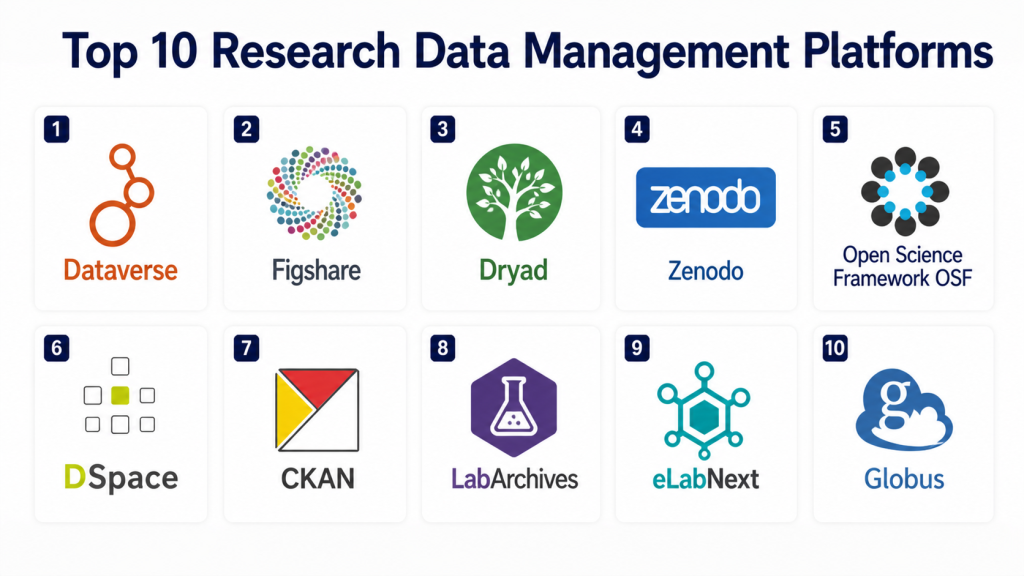
Top 10 Research Data Management Platforms
#1 — Dataverse
Short description: Dataverse is an open-source research data repository platform widely used by academic institutions. It enables researchers to store, share, and publish datasets with ease. The platform supports metadata standards and ensures data reproducibility. It is designed for collaboration and long-term data preservation. Dataverse is ideal for universities and research organizations. It aligns well with open science initiatives.
Key Features
- Open-source data repository
- Metadata management
- Dataset publishing
- Version control
- Collaboration tools
- FAIR data support
Pros
- Free and open-source
- Strong academic adoption
Cons
- Requires technical setup
- Limited enterprise features
Platforms / Deployment
Web / Cloud / Self-hosted
Security & Compliance
Access controls, encryption
Integrations & Ecosystem
Dataverse integrates with academic research tools and supports open data ecosystems.
- APIs
- Research tools
- Data repositories
Support & Community
Active academic community with documentation
#2 — Figshare
Short description: Figshare is a cloud-based research data management platform that allows users to store, share, and publish research outputs. It supports datasets, figures, and media files. It provides DOI assignment for datasets. It is widely used by researchers and institutions. It promotes open research and collaboration.
Key Features
- Data publishing and sharing
- DOI assignment
- Cloud storage
- Metadata support
- Collaboration tools
Pros
- Easy to use
- Strong sharing capabilities
Cons
- Limited customization
- Paid plans for institutions
Platforms / Deployment
Cloud
Security & Compliance
Encryption, access controls
Integrations & Ecosystem
Figshare integrates with research publishing and institutional systems.
- APIs
- Institutional repositories
- Publishing tools
Support & Community
Strong support with global user base
#3 — Dryad
Short description: Dryad is a curated data repository focused on research data publication. It ensures datasets are accessible and reusable. It supports open science initiatives. It is widely used in academic publishing. It provides structured data submission workflows. It is ideal for researchers sharing datasets publicly.
Key Features
- Data publishing
- Curated datasets
- Metadata standards
- Open access support
- DOI assignment
Pros
- Strong open data focus
- High-quality curation
Cons
- Limited private data management
- Not ideal for enterprise use
Platforms / Deployment
Cloud
Security & Compliance
Not publicly stated
Integrations & Ecosystem
Dryad integrates with publishing workflows and academic systems.
- Journals
- Research platforms
Support & Community
Academic-focused support
#4 — Zenodo
Short description: Zenodo is a research data repository developed to support open science. It allows researchers to upload datasets, publications, and software. It supports long-term preservation and accessibility. It is widely used globally. It is suitable for individuals and institutions.
Key Features
- Data and publication storage
- DOI assignment
- Long-term preservation
- Open access
- Versioning
Pros
- Free to use
- Supports multiple data types
Cons
- Limited enterprise features
- Basic collaboration tools
Platforms / Deployment
Cloud
Security & Compliance
Not publicly stated
Integrations & Ecosystem
Zenodo supports integrations with research tools and repositories.
- APIs
- Research platforms
Support & Community
Strong open science community
#5 — Open Science Framework (OSF)
Short description: OSF is a collaborative platform for managing research projects and data. It supports data storage, sharing, and versioning. It is widely used in academic research. It provides transparency and reproducibility features. It is ideal for collaborative research environments.
Key Features
- Project management
- Data storage
- Version control
- Collaboration tools
- Transparency support
Pros
- Strong collaboration features
- Free usage options
Cons
- Interface can be complex
- Limited enterprise features
Platforms / Deployment
Web / Cloud
Security & Compliance
Access controls
Integrations & Ecosystem
OSF integrates with various research and collaboration tools.
- GitHub
- Storage services
- APIs
Support & Community
Active research community
#6 — DSpace
Short description: DSpace is an open-source repository software used for managing institutional research data. It supports digital asset management and archiving. It is widely used by universities. It provides flexible customization. It supports metadata standards.
Key Features
- Digital repository
- Metadata support
- Open-source architecture
- Data archiving
- Customization
Pros
- Flexible and scalable
- Widely adopted
Cons
- Requires technical expertise
- Setup complexity
Platforms / Deployment
Web / Self-hosted
Security & Compliance
Access controls
Integrations & Ecosystem
DSpace integrates with institutional and research systems.
- APIs
- Institutional systems
Support & Community
Large open-source community
#7 — CKAN
Short description: CKAN is an open-source data management system used for publishing and sharing datasets. It is widely used by governments and research institutions. It supports data catalogs and metadata. It is highly customizable. It is suitable for large-scale data management.
Key Features
- Data cataloging
- Open data publishing
- Metadata management
- API access
- Customizable
Pros
- Highly flexible
- Strong open data support
Cons
- Requires development resources
- Complex setup
Platforms / Deployment
Cloud / Self-hosted
Security & Compliance
Access controls
Integrations & Ecosystem
CKAN integrates with data portals and analytics tools.
- APIs
- Data portals
Support & Community
Active open-source community
#8 — LabArchives
Short description: LabArchives is an electronic lab notebook and research data management platform. It helps researchers store and manage experimental data. It supports collaboration and compliance. It is widely used in laboratories. It is ideal for scientific research workflows.
Key Features
- Electronic lab notebook
- Data storage
- Collaboration tools
- Compliance support
- Workflow management
Pros
- Good for lab environments
- Easy collaboration
Cons
- Limited general data management features
- Subscription-based pricing
Platforms / Deployment
Cloud
Security & Compliance
Encryption, access controls
Integrations & Ecosystem
LabArchives integrates with lab tools and research systems.
- APIs
- Lab systems
Support & Community
Strong support for researchers
#9 — eLabNext
Short description: eLabNext provides an integrated platform for managing research data and laboratory workflows. It includes electronic lab notebook features and data storage. It supports compliance and collaboration. It is widely used in research labs. It is suitable for regulated environments.
Key Features
- ELN and data management
- Workflow automation
- Compliance support
- Collaboration tools
- Data storage
Pros
- Strong compliance features
- Integrated workflows
Cons
- Complex setup
- Premium pricing
Platforms / Deployment
Cloud
Security & Compliance
Encryption, access controls
Integrations & Ecosystem
eLabNext integrates with lab systems and enterprise tools.
- APIs
- Lab tools
Support & Community
Professional support
#10 — Globus
Short description: Globus is a data management platform designed for large-scale research data transfer and sharing. It is widely used in scientific computing environments. It supports secure data movement and collaboration. It is ideal for high-performance computing workflows.
Key Features
- Secure data transfer
- Collaboration tools
- Data sharing
- Automation
- High-performance support
Pros
- Excellent for large datasets
- High performance
Cons
- Technical complexity
- Not beginner-friendly
Platforms / Deployment
Cloud / Hybrid
Security & Compliance
Encryption, access controls
Integrations & Ecosystem
Globus integrates with research computing environments and storage systems.
- HPC systems
- Cloud storage
- APIs
Support & Community
Strong research community support
Comparison Table (Top 10)
| Tool Name | Best For | Platform(s) Supported | Deployment | Standout Feature | Public Rating |
|---|---|---|---|---|---|
| Dataverse | Academia | Web | Cloud/Self-hosted | Open-source repository | N/A |
| Figshare | Researchers | Web | Cloud | Data publishing | N/A |
| Dryad | Open science | Web | Cloud | Curated datasets | N/A |
| Zenodo | Individuals | Web | Cloud | Free repository | N/A |
| OSF | Collaboration | Web | Cloud | Project management | N/A |
| DSpace | Institutions | Web | Self-hosted | Digital archiving | N/A |
| CKAN | Governments | Web | Cloud/Self-hosted | Data cataloging | N/A |
| LabArchives | Labs | Web | Cloud | ELN features | N/A |
| eLabNext | Research labs | Web | Cloud | Workflow automation | N/A |
| Globus | HPC data | Web | Cloud/Hybrid | Data transfer | N/A |
Evaluation & Scoring of Research Data Management Platforms
| Tool Name | Core (25%) | Ease (15%) | Integrations (15%) | Security (10%) | Performance (10%) | Support (10%) | Value (15%) | Weighted Total |
|---|---|---|---|---|---|---|---|---|
| Dataverse | 9 | 7 | 8 | 8 | 8 | 8 | 9 | 8.3 |
| Figshare | 8 | 9 | 8 | 8 | 8 | 8 | 8 | 8.2 |
| Dryad | 7 | 8 | 6 | 7 | 7 | 7 | 8 | 7.3 |
| Zenodo | 8 | 9 | 6 | 7 | 7 | 8 | 9 | 8.0 |
| OSF | 8 | 7 | 7 | 7 | 7 | 8 | 8 | 7.6 |
| DSpace | 9 | 6 | 8 | 8 | 8 | 7 | 9 | 8.0 |
| CKAN | 9 | 6 | 9 | 8 | 8 | 7 | 8 | 8.1 |
| LabArchives | 8 | 8 | 7 | 8 | 7 | 8 | 7 | 7.7 |
| eLabNext | 8 | 7 | 8 | 8 | 8 | 8 | 7 | 7.8 |
| Globus | 9 | 6 | 8 | 8 | 9 | 8 | 7 | 8.0 |
Interpretation: These scores are comparative and help evaluate strengths across features, usability, and value. Higher scores indicate better overall performance, but the best platform depends on your specific research needs, scale, and technical expertise.
Which Research Data Management Platform Is Right for You?
Solo / Freelancer
Individual researchers should consider Zenodo or OSF. These platforms are free, easy to use, and support open research practices. They are ideal for managing small datasets and collaborating with peers.
SMB
Small research teams and labs benefit from Figshare or LabArchives. These tools provide better collaboration features and structured data management while remaining easy to use.
Mid-Market
Mid-sized institutions should consider eLabNext or DSpace. These platforms offer scalability, integration capabilities, and support for more complex workflows.
Enterprise
Large organizations and research institutions should choose Dataverse, CKAN, or Globus. These platforms provide enterprise-grade scalability, performance, and integration with large data ecosystems.
Budget vs Premium
Free tools like Zenodo and OSF are suitable for basic needs. Premium platforms offer better scalability and advanced features. Choose based on long-term requirements.
Feature Depth vs Ease of Use
Simple tools are easier to adopt but may lack advanced features. Enterprise tools offer deeper capabilities but require technical expertise.
Integrations & Scalability
Platforms with API support and integration capabilities are essential for growing research environments. Scalability ensures long-term usability.
Security & Compliance Needs
Organizations handling sensitive data should prioritize platforms with strong security and compliance features. Data protection is critical in research environments.
Frequently Asked Questions (FAQs)
1. What is a research data management platform?
A research data management platform is a system used to store, organize, and manage research data throughout its lifecycle. It helps researchers maintain structured datasets and ensures easy access. These platforms support collaboration and data sharing. They are essential for modern research workflows. They also help maintain data integrity and reproducibility.
2. Why is research data management important?
Research data management ensures data is organized, secure, and accessible. It helps researchers comply with regulations and funding requirements. Proper management improves collaboration and efficiency. It also supports data reuse and transparency. It is critical for maintaining research quality and credibility.
3. Are these platforms suitable for small teams?
Yes, many platforms are designed for small teams and individual researchers. Tools like Zenodo and OSF are easy to use and affordable. They provide essential features without complexity. Small teams can start simple and scale later. Choosing the right tool depends on data size and workflow needs.
4. What are FAIR data principles?
FAIR stands for Findable, Accessible, Interoperable, and Reusable. These principles ensure that research data can be easily discovered and used by others. Many platforms support FAIR compliance. It improves collaboration and data sharing. It is widely adopted in research communities.
5. How secure are research data platforms?
Most platforms offer encryption and access controls to protect data. Security depends on the platform and deployment model. Cloud-based systems often provide strong security features. Organizations should verify compliance and data protection measures. Security is essential for sensitive research data.
6. Can these platforms integrate with research tools?
Yes, most platforms support integrations with research tools, analytics systems, and storage solutions. APIs enable automation and data exchange. Integration improves workflow efficiency. It allows seamless collaboration across systems. Always check compatibility before choosing a platform.
7. Do these platforms support collaboration?
Yes, collaboration is a key feature of research data platforms. They allow multiple users to access and work on data simultaneously. Version control ensures changes are tracked. Collaboration tools improve teamwork and productivity. They are essential for modern research environments.
8. Are these platforms expensive?
Pricing varies widely depending on features and scale. Some platforms are free, while others require subscriptions. Enterprise solutions are more expensive. Cost depends on storage, users, and customization. Organizations should evaluate value based on their needs.
9. How difficult is implementation?
Implementation depends on the platform. Open-source tools may require technical expertise. Cloud-based tools are easier to set up. Training may be required for advanced features. Planning is important for successful deployment.
10. Can data be migrated from existing systems?
Yes, most platforms support data migration through import tools and APIs. This allows researchers to transfer existing datasets. Migration may require preparation and validation. Proper planning ensures smooth transition. It helps maintain data continuity.
Conclusion
Research Data Management Platforms have become essential for handling the growing complexity of modern research data. From open-source solutions like Dataverse and CKAN to specialized tools like LabArchives and Globus, these platforms provide the infrastructure needed to store, manage, and share data effectively. They enable compliance with regulations, improve collaboration, and support reproducibility, which is critical for scientific progress.
Choosing the right platform depends on your research environment, data volume, and technical capabilities. While smaller teams may benefit from simple, cost-effective tools, large institutions should focus on scalability, integration, and security. The best approach is to shortlist a few platforms, test them with real datasets, and evaluate their usability and performance before making a final decision.
