Introduction
Prompt Engineering Tools are platforms designed to help users create, optimize, test, and manage prompts used in AI systems, especially large language models. These tools enable developers, marketers, and AI teams to refine how they interact with AI models, ensuring more accurate, relevant, and consistent outputs.
In the modern generative AI ecosystem, prompt engineering has become a critical skill. Whether building chatbots, AI copilots, automation workflows, or content generation systems, the quality of prompts directly impacts results. Prompt engineering tools also integrate with Identity Management, Cybersecurity frameworks, Zero Trust architectures, and Access Control systems, ensuring secure and controlled AI interactions at scale.
Real-world use cases include:
- Designing prompts for chatbots and virtual assistants
- Optimizing AI-generated content
- Testing and evaluating prompt performance
- Managing prompt libraries and workflows
- Automating AI-driven business processes
What buyers should evaluate:
- Prompt testing and optimization features
- Version control and prompt management
- Integration with LLMs and APIs
- Performance analytics and evaluation tools
- Collaboration and team workflows
- Security and governance capabilities
- Ease of use and interface
- Scalability and deployment flexibility
Best for: AI developers, data scientists, product teams, marketers, and enterprises building AI-powered applications.
Not ideal for: Simple AI usage where basic prompts are sufficient without optimization.
Key Trends in Prompt Engineering Tools
- AI-assisted prompt optimization and auto-generation
- Prompt versioning and lifecycle management becoming standard
- Integration with LLM orchestration frameworks
- Evaluation and benchmarking tools for prompt performance
- Collaboration features for teams working on AI workflows
- Low-code interfaces for non-technical users
- Security and governance for enterprise AI usage
- Multi-model support for testing across LLM providers
- Real-time prompt tuning and feedback loops
- Growing adoption in marketing and product development
How We Prompt Engineering Tools (Methodology)
We evaluated tools based on:
- Feature completeness (testing, optimization, management)
- Integration with LLMs and APIs
- Ease of use and user interface
- Performance and scalability
- Security and compliance readiness
- Collaboration capabilities
- Community and ecosystem strength
- Market adoption and reliability
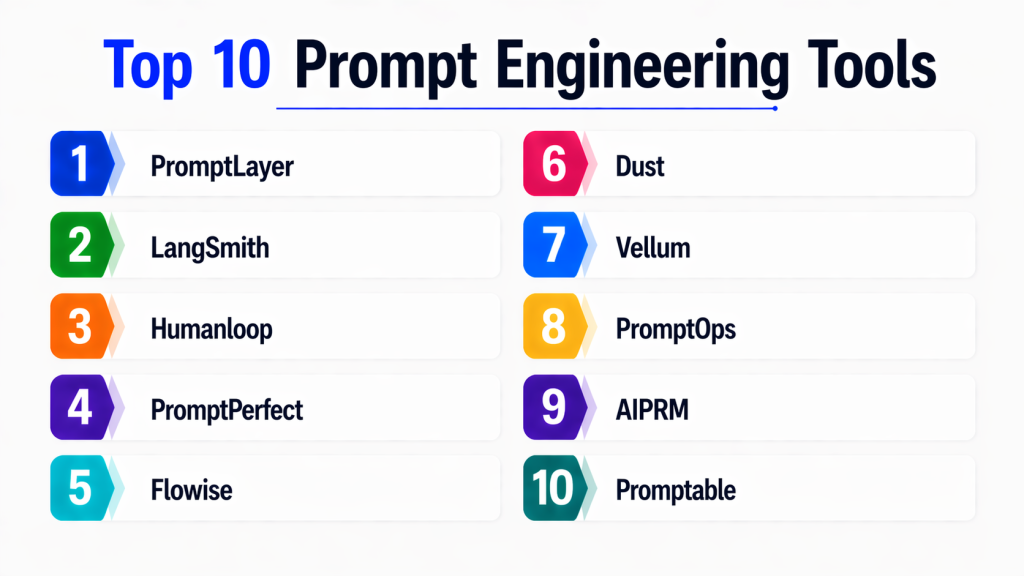
Top 10 Prompt Engineering Tools
#1 — PromptLayer
Short description :
PromptLayer is a platform designed for managing and tracking prompts used in AI applications. It allows developers to monitor prompt performance and versioning. Ideal for teams building production AI systems. Provides analytics and debugging tools. Helps improve prompt quality over time.
Key Features
- Prompt tracking
- Version control
- Analytics dashboard
- API integration
- Debugging tools
Pros
- Strong observability
- Easy integration
Cons
- Limited UI features
- Developer-focused
Platforms / Deployment
Web
Cloud
Security & Compliance
Not publicly stated
Integrations & Ecosystem
- LLM APIs
- Dev tools
Support & Community
Growing developer community.
#2 — LangSmith
Short description :
LangSmith is an observability and evaluation platform for LLM applications. It helps test, debug, and optimize prompts. Designed for developers using LangChain. Provides deep insights into prompt performance.
Key Features
- Prompt evaluation
- Debugging tools
- Performance tracking
- Integration with LangChain
Pros
- Strong analytics
- Developer-friendly
Cons
- Best with LangChain
- Learning curve
Platforms / Deployment
Cloud
Security & Compliance
Varies
Integrations & Ecosystem
- LangChain
- APIs
Support & Community
Active ecosystem.
#3 — Humanloop
Short description :
Humanloop is a prompt engineering and evaluation platform for AI teams. It provides tools for testing and optimizing prompts. Ideal for enterprise AI applications. Focuses on collaboration and governance.
Key Features
- Prompt testing
- Evaluation tools
- Collaboration features
- Version control
Pros
- Enterprise-ready
- Strong collaboration
Cons
- Premium pricing
- Limited open-source
Platforms / Deployment
Cloud
Security & Compliance
Enterprise controls
Compliance: Varies
Integrations & Ecosystem
- APIs
- AI tools
Support & Community
Enterprise support.
#4 — PromptPerfect
Short description :
PromptPerfect is a tool designed to automatically optimize prompts for better AI outputs. It helps improve prompt efficiency and accuracy. Ideal for users looking for quick optimization.
Key Features
- Prompt optimization
- AI-assisted tuning
- Multi-model support
Pros
- Easy to use
- Fast optimization
Cons
- Limited customization
- Not enterprise-focused
Platforms / Deployment
Web
Security & Compliance
Not publicly stated
Integrations & Ecosystem
- LLM APIs
Support & Community
Growing community.
#5 — Flowise
Short description :
Flowise is a low-code tool for building AI workflows and prompt pipelines. It allows visual creation of prompt chains. Ideal for developers and non-technical users.
Key Features
- Visual workflow builder
- Prompt chaining
- Integration tools
Pros
- Easy to use
- Flexible
Cons
- Limited enterprise features
- Requires setup
Platforms / Deployment
Cloud / Self-hosted
Security & Compliance
Depends on deployment
Integrations & Ecosystem
- APIs
- LLM tools
Support & Community
Active open-source community.
#6 — Dust
Short description :
Dust is a prompt engineering platform focused on building AI assistants. It enables teams to create and manage prompts. Ideal for internal AI tools and workflows.
Key Features
- Prompt management
- AI assistant building
- Workflow automation
Pros
- Flexible
- Good UI
Cons
- Smaller ecosystem
- Limited documentation
Platforms / Deployment
Cloud
Security & Compliance
Not publicly stated
Integrations & Ecosystem
- APIs
Support & Community
Emerging community.
#7 — Vellum
Short description :
Vellum is a prompt management and orchestration tool. It helps teams test and deploy prompts. Ideal for production AI systems. Focuses on collaboration.
Key Features
- Prompt versioning
- Testing tools
- Deployment workflows
Pros
- Strong workflow management
- Team collaboration
Cons
- Premium pricing
- Learning curve
Platforms / Deployment
Cloud
Security & Compliance
Enterprise controls
Compliance: Varies
Integrations & Ecosystem
- APIs
Support & Community
Enterprise support.
#8 — PromptOps
Short description :
PromptOps focuses on managing prompt lifecycles similar to DevOps practices. It enables versioning, testing, and deployment of prompts. Ideal for enterprise teams.
Key Features
- Prompt lifecycle management
- Version control
- Testing tools
Pros
- DevOps-style workflows
- Scalable
Cons
- Complex
- Limited adoption
Platforms / Deployment
Cloud
Security & Compliance
Not publicly stated
Integrations & Ecosystem
- Dev tools
Support & Community
Emerging support.
#9 — AIPRM
Short description :
AIPRM is a prompt library and management tool for AI platforms. It provides pre-built prompts for various use cases. Ideal for marketers and beginners.
Key Features
- Prompt templates
- Library management
- Easy access
Pros
- Beginner-friendly
- Large prompt library
Cons
- Limited customization
- Basic features
Platforms / Deployment
Web
Security & Compliance
Not publicly stated
Integrations & Ecosystem
- AI platforms
Support & Community
Large user base.
#10 — Promptable
Short description :
Promptable is a tool for managing and evaluating prompts. It provides testing and monitoring features. Suitable for developers building AI applications.
Key Features
- Prompt testing
- Monitoring tools
- Version control
Pros
- Developer-focused
- Simple
Cons
- Limited advanced features
- Smaller ecosystem
Platforms / Deployment
Cloud
Security & Compliance
Not publicly stated
Integrations & Ecosystem
- APIs
Support & Community
Growing community.
Comparison Table (Top 10)
| Tool Name | Best For | Platform(s) | Deployment | Standout Feature | Public Rating |
|---|---|---|---|---|---|
| PromptLayer | Devs | Web | Cloud | Tracking | N/A |
| LangSmith | LangChain users | Cloud | Cloud | Analytics | N/A |
| Humanloop | Enterprise | Cloud | Cloud | Collaboration | N/A |
| PromptPerfect | Beginners | Web | Cloud | Optimization | N/A |
| Flowise | Low-code | Multi | Hybrid | Visual builder | N/A |
| Dust | Teams | Cloud | Cloud | Assistants | N/A |
| Vellum | Enterprise | Cloud | Cloud | Workflow | N/A |
| PromptOps | DevOps | Cloud | Cloud | Lifecycle | N/A |
| AIPRM | Beginners | Web | Cloud | Templates | N/A |
| Promptable | Devs | Cloud | Cloud | Testing | N/A |
Evaluation & Scoring of Prompt Engineering Tools
| Tool | Core | Ease | Integration | Security | Performance | Support | Value | Total |
|---|---|---|---|---|---|---|---|---|
| PromptLayer | 9 | 8 | 9 | 7 | 8 | 8 | 9 | 8.5 |
| LangSmith | 10 | 8 | 10 | 8 | 9 | 9 | 8 | 9.0 |
| Humanloop | 9 | 8 | 9 | 9 | 8 | 9 | 7 | 8.6 |
| PromptPerfect | 8 | 9 | 7 | 6 | 8 | 7 | 9 | 8.0 |
| Flowise | 9 | 9 | 8 | 7 | 8 | 8 | 9 | 8.5 |
| Dust | 8 | 8 | 7 | 7 | 8 | 7 | 8 | 7.8 |
| Vellum | 9 | 7 | 9 | 9 | 8 | 9 | 7 | 8.5 |
| PromptOps | 8 | 6 | 8 | 7 | 8 | 7 | 7 | 7.3 |
| AIPRM | 7 | 10 | 6 | 6 | 7 | 8 | 9 | 7.8 |
| Promptable | 8 | 8 | 7 | 7 | 8 | 7 | 8 | 7.9 |
Which Prompt Engineering Tool Is Right for You?
Solo / Freelancer
Use AIPRM, PromptPerfect
SMB
Use Flowise, PromptLayer
Mid-Market
Use LangSmith, Dust
Enterprise
Use Humanloop, Vellum
Budget vs Premium
Budget: AIPRM
Premium: Humanloop
Feature Depth vs Ease
Depth: LangSmith
Ease: PromptPerfect
Security & Compliance
Best: Humanloop, Vellum
Frequently Asked Questions (FAQs)
1. What are prompt engineering tools?
Prompt engineering tools help users design, test, and optimize prompts used in AI systems. They improve the quality of AI outputs. These tools provide analytics and version control. They are essential for building reliable AI applications. They support workflow automation.
2. Why are prompt engineering tools important?
They ensure better AI performance by optimizing prompts. Without proper prompts, AI outputs may be inconsistent. These tools help standardize workflows. They improve efficiency and scalability. They are critical for enterprise AI systems.
3. Can I use AI without prompt tools?
Yes, basic AI usage does not require prompt tools. However, advanced workflows benefit from them. They provide structure and optimization. They reduce manual effort. They are recommended for production systems.
4. Are these tools secure?
Security depends on the platform and deployment. Enterprise tools offer better security features. Proper configuration is important. Sensitive data must be handled carefully. Compliance varies.
5. Which tool is best for beginners?
AIPRM and PromptPerfect are easy to use for beginners. They provide templates and simple interfaces. Advanced tools may require learning. Beginners should start simple. Gradual learning is recommended.
6. Do these tools support multiple models?
Yes, most tools support multiple AI models. This allows flexibility in choosing providers. It helps optimize performance and cost. Multi-model support is common. It enables advanced use cases.
7. Are prompt engineering tools expensive?
Some tools are free or open-source. Others offer premium plans. Costs depend on features and usage. Enterprise tools are more expensive. Evaluate based on needs.
8. Can prompt tools integrate with other systems?
Yes, they provide APIs and integrations. They connect with AI platforms and workflows. Integration improves efficiency. Compatibility varies by tool. Choose based on ecosystem.
9. What are common mistakes when using prompt tools?
Common mistakes include poor prompt design and lack of testing. Ignoring analytics can reduce effectiveness. Overcomplicating workflows is also common. Proper planning is important. Testing improves results.
10. How do I choose the right tool?
Choose based on your use case and complexity. Evaluate features, integrations, and cost. Test multiple tools. Consider scalability and security. Select the best fit for your workflow.
Conclusion
Prompt engineering tools have become a critical layer in modern AI development, enabling teams to create more accurate, consistent, and scalable interactions with large language models. As AI adoption continues to grow across industries, the importance of structured prompt management, testing, and optimization is increasing rapidly. These tools not only improve output quality but also help standardize workflows, reduce errors, and enhance collaboration across teams working on AI-driven applications.
Choosing the right prompt engineering tool depends on your specific requirements, including ease of use, integration capabilities, scalability, and security needs. While beginner-friendly tools like AIPRM and PromptPerfect are great for quick adoption, enterprise-grade platforms like Humanloop and Vellum offer advanced governance and collaboration features. The best approach is to shortlist a few tools, experiment with real use cases, and select the one that aligns with your workflow and long-term AI strategy.
