Introduction
Payment Orchestration Platforms are software solutions that help businesses manage multiple payment gateways, processors, and methods from a single platform. In simple terms, they simplify payment operations, optimize authorization routing, and enhance transaction efficiency across channels.
In today’s digital economy, merchants face complex payment landscapes, increasing global transactions, and rising customer expectations for seamless checkout experiences. Modern payment orchestration platforms provide intelligent routing, analytics, and integrations to reduce failures and improve conversion rates.
Real-world use cases include:
- Consolidating multiple payment gateways
- Optimizing transaction routing for approval and cost
- Fraud detection and risk management
- Multi-currency and global payments support
- Payment reporting and analytics
What buyers should evaluate:
- Gateway and processor coverage
- Intelligent routing and optimization
- Fraud detection and compliance features
- Integration with commerce platforms and APIs
- Multi-currency and multi-region support
- Scalability and performance
- Reporting and analytics
- Ease of use
- Security and compliance
- Pricing and ROI
Best for: E-commerce merchants, marketplaces, fintechs, and enterprises with high transaction volumes.
Not ideal for: Small merchants with a single payment gateway or low transaction volumes.
Key Trends in Payment Orchestration Platforms
- AI-driven routing and payment optimization
- Multi-acquirer and multi-gateway integration
- Cloud-native and API-first platforms
- Fraud detection and compliance automation
- Support for multi-currency and cross-border transactions
- Real-time transaction monitoring and reporting
- Integration with e-commerce and ERP systems
- Dynamic routing to maximize approvals
- Omnichannel payment support
- Enhanced security and PCI compliance
How We Evaluate Payment Orchestration Platforms (Methodology)
- Market adoption and vendor credibility
- Breadth of gateway and processor coverage
- Automation and routing capabilities
- Integration with e-commerce, ERP, and APIs
- Security and compliance features
- Analytics and reporting functionality
- Scalability and performance
- Vendor support and onboarding
- Flexibility and customization
- Cost-effectiveness
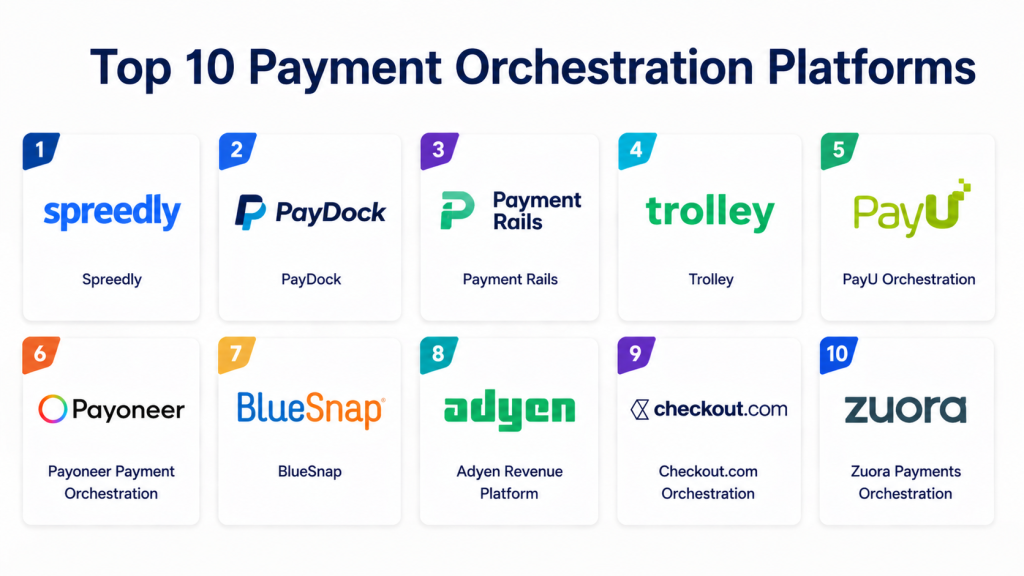
Top 10 Payment Orchestration Platforms
#1 — Spreedly
Short description :
Spreedly is a cloud-based payment orchestration platform that allows merchants to connect with multiple gateways and processors. It offers secure storage of payment credentials, intelligent routing, and analytics. Known for flexibility and reliability. Suitable for enterprises and fintechs. Provides reporting and monitoring tools. Helps optimize global payment operations.
Key Features
- Multi-gateway connectivity
- Intelligent routing
- Secure payment storage
- Analytics and reporting
- API-first architecture
Pros
- High flexibility
- Enterprise scalability
Cons
- Complex setup for small merchants
- Premium pricing
Platforms / Deployment
Cloud
Security & Compliance
PCI DSS compliant, encryption, access controls
Integrations & Ecosystem
- Payment gateways
- ERP systems
- APIs
Support & Community
Enterprise-level support.
#2 — PayDock
Short description :
PayDock is a payment orchestration platform that centralizes multiple payment providers. It supports automated routing, fraud detection, and analytics. Known for ease of integration. Suitable for e-commerce merchants. Provides dashboards and reporting. Helps improve transaction success and reduce failures.
Key Features
- Multi-gateway support
- Payment routing
- Fraud monitoring
- Reporting dashboards
- API integrations
Pros
- Easy to integrate
- Scalable platform
Cons
- Limited advanced features
- Pricing varies
Platforms / Deployment
Cloud
Security & Compliance
PCI DSS compliant, encryption
Integrations & Ecosystem
- Payment gateways
- APIs
Support & Community
Good support available.
#3 — Payment Rails
Short description :
Payment Rails is a global payment orchestration platform for businesses and marketplaces. It supports multi-currency, multi-gateway routing, and reporting. Known for automation and international payments. Suitable for SMBs and enterprises. Provides analytics and dashboards. Helps streamline payment operations.
Key Features
- Global payment routing
- Multi-currency support
- Workflow automation
- Reporting and analytics
- Fraud detection
Pros
- Supports global payments
- Automation features
Cons
- Complexity for small merchants
- Pricing
Platforms / Deployment
Cloud
Security & Compliance
PCI DSS compliant, encryption
Integrations & Ecosystem
- Payment gateways
- Accounting systems
Support & Community
Moderate support.
#4 — Trolley
Short description :
Trolley provides payment orchestration and disbursement services for marketplaces and businesses. It supports multi-gateway routing, analytics, and compliance. Known for simplicity and scalability. Suitable for mid-market and enterprise merchants. Provides dashboards and reporting tools. Helps optimize global payouts.
Key Features
- Multi-gateway orchestration
- International payouts
- Reporting
- Analytics
- Compliance management
Pros
- User-friendly
- Scalable for enterprises
Cons
- Limited payment methods
- Pricing
Platforms / Deployment
Cloud
Security & Compliance
PCI DSS compliant, encryption
Integrations & Ecosystem
- Payment gateways
- APIs
Support & Community
Good SMB and enterprise support.
#5 — PayU Orchestration
Short description :
PayU Orchestration is a payment management platform designed for merchants in emerging markets. It provides multi-gateway connectivity, routing, and reporting. Known for reliability and local payment support. Suitable for e-commerce and digital businesses. Provides dashboards and analytics. Helps optimize payment success rates.
Key Features
- Multi-gateway connectivity
- Payment routing
- Analytics and reporting
- Fraud detection
- API-first design
Pros
- Local payment support
- Reliable platform
Cons
- Limited enterprise features
- Pricing varies
Platforms / Deployment
Cloud
Security & Compliance
PCI DSS compliant, encryption
Integrations & Ecosystem
- Payment gateways
- APIs
Support & Community
Good support available.
#6 — Payoneer Payment Orchestration
Short description :
Payoneer offers orchestration and disbursement tools for cross-border payments. It supports multi-gateway routing and reporting. Known for international payment expertise. Suitable for enterprises and marketplaces. Provides analytics and dashboards. Helps streamline global payment operations.
Key Features
- Global payment routing
- Multi-currency support
- Reporting
- Analytics
- Compliance tools
Pros
- Strong global payments
- Automated routing
Cons
- Limited customization
- Pricing
Platforms / Deployment
Cloud
Security & Compliance
PCI DSS compliant, encryption
Integrations & Ecosystem
- Payment gateways
- APIs
Support & Community
Enterprise support available.
#7 — BlueSnap
Short description :
BlueSnap is a payment orchestration platform that consolidates multiple payment methods and gateways. It provides intelligent routing, analytics, and reporting. Known for ease of use and international coverage. Suitable for SMBs and enterprises. Helps improve transaction approval rates and customer experience.
Key Features
- Multi-gateway support
- Intelligent routing
- Reporting dashboards
- Analytics
- Fraud detection
Pros
- International coverage
- User-friendly
Cons
- Advanced features may require custom setup
- Pricing
Platforms / Deployment
Cloud
Security & Compliance
PCI DSS compliant, encryption
Integrations & Ecosystem
- Payment gateways
- APIs
Support & Community
Good support.
#8 — Spreedly Payments
Short description :
Spreedly Payments allows businesses to manage multiple gateways and store card data securely. It supports routing, reporting, and analytics. Known for flexibility and API-first approach. Suitable for enterprises and fintechs. Provides dashboards and monitoring tools. Helps optimize payment operations.
Key Features
- Multi-gateway orchestration
- Payment storage
- Reporting
- Analytics
- API-first design
Pros
- Highly flexible
- Secure payment storage
Cons
- Complex for small merchants
- Pricing
Platforms / Deployment
Cloud
Security & Compliance
PCI DSS compliant, encryption
Integrations & Ecosystem
- Payment gateways
- APIs
Support & Community
Enterprise-level support.
#9 — Adyen Revenue Platform
Short description :
Adyen provides payment orchestration and unified commerce solutions. It supports global gateways, routing, and reporting. Known for scalability and international payments. Suitable for large enterprises. Provides analytics and dashboards. Helps streamline omnichannel payment operations.
Key Features
- Multi-gateway connectivity
- Global payment routing
- Analytics and reporting
- Omnichannel support
- Compliance management
Pros
- Scalable enterprise platform
- International coverage
Cons
- Costly for small merchants
- Advanced configuration needed
Platforms / Deployment
Cloud
Security & Compliance
PCI DSS compliant, encryption
Integrations & Ecosystem
- Payment gateways
- ERP systems
Support & Community
Enterprise support.
#10 — Checkout.com Orchestration
Short description :
Checkout.com Orchestration is a platform for managing payments, gateways, and transactions. It supports global payments, routing, and analytics. Known for real-time processing and API-first design. Suitable for enterprises and digital-first merchants. Provides dashboards and reporting tools. Helps optimize payment flows.
Key Features
- Multi-gateway orchestration
- Global payment support
- Real-time processing
- Reporting
- Analytics
Pros
- Fast real-time payments
- API-first design
Cons
- Pricing
- Integration complexity
Platforms / Deployment
Cloud
Security & Compliance
PCI DSS compliant, encryption
Integrations & Ecosystem
- Payment gateways
- ERP and commerce systems
Support & Community
Enterprise-level support.
Comparison Table (Top 10)
| Tool Name | Best For | Platform(s) Supported | Deployment | Standout Feature | Public Rating |
|---|---|---|---|---|---|
| Spreedly | Enterprise | Web | Cloud | Flexible orchestration | N/A |
| PayDock | SMB | Web | Cloud | Multi-gateway integration | N/A |
| Payment Rails | SMB/Enterprise | Web | Cloud | Global payouts | N/A |
| Trolley | Mid-market | Web | Cloud | Disbursement | N/A |
| PayU Orchestration | SMB/Mid | Web | Cloud | Local payment support | N/A |
| Payoneer | Enterprise | Web | Cloud | Cross-border payments | N/A |
| BlueSnap | SMB/Enterprise | Web | Cloud | Intelligent routing | N/A |
| Spreedly Payments | Enterprise | Web | Cloud | Secure storage | N/A |
| Adyen | Enterprise | Web | Cloud | Unified commerce | N/A |
| Checkout.com | Enterprise | Web | Cloud | Real-time processing | N/A |
Evaluation & Scoring of Payment Orchestration Platforms
| Tool Name | Core | Ease | Integrations | Security | Performance | Support | Value | Weighted Total |
|---|---|---|---|---|---|---|---|---|
| Spreedly | 9 | 7 | 9 | 9 | 9 | 9 | 7 | 8.4 |
| PayDock | 8 | 8 | 8 | 8 | 8 | 7 | 8 | 7.9 |
| Payment Rails | 8 | 7 | 8 | 8 | 8 | 7 | 7 | 7.7 |
| Trolley | 7 | 8 | 7 | 7 | 7 | 7 | 7 | 7.2 |
| PayU | 7 | 7 | 7 | 7 | 7 | 7 | 7 | 7.0 |
| Payoneer | 8 | 7 | 8 | 8 | 8 | 7 | 7 | 7.7 |
| BlueSnap | 8 | 8 | 8 | 8 | 8 | 7 | 7 | 7.8 |
| Spreedly Payments | 9 | 7 | 9 | 9 | 9 | 9 | 7 | 8.4 |
| Adyen | 9 | 7 | 9 | 9 | 9 | 9 | 7 | 8.4 |
| Checkout.com | 9 | 7 | 9 | 9 | 9 | 9 | 7 | 8.4 |
Which Payment Orchestration Platform Is Right for You?
Solo / Freelancer
- Not required
SMB
- PayDock, Payment Rails
- Focus on ease of integration and cost
Mid-Market
- Trolley, PayU
- Balanced features and global support
Enterprise
- Spreedly, Adyen, Checkout.com
- Full enterprise capabilities
Budget vs Premium
- Budget: Payment Rails
- Premium: Adyen, Checkout.com
Feature Depth vs Ease of Use
- Deep features: Spreedly, Adyen
- Easy to use: PayDock
Integrations & Scalability
- Strong: Enterprise platforms
- Moderate: SMB platforms
Security & Compliance Needs
- High: Enterprise solutions
- Moderate: SMB platforms
Frequently Asked Questions (FAQs)
1. What is a payment orchestration platform?
It is a platform that manages multiple payment gateways and processors. It optimizes routing, improves approvals, and provides analytics. Essential for merchants with high transaction volumes.
2. How much does it cost?
Pricing depends on transaction volume, integrations, and features. SMB platforms are subscription-based, while enterprise tools use custom pricing.
3. How long does implementation take?
SMB tools deploy quickly. Enterprise solutions may take weeks to months. Integration planning is essential.
4. Is it secure?
Most platforms are PCI DSS compliant and provide encryption and access control. Enterprise platforms offer advanced security.
5. Can it integrate with e-commerce and ERP systems?
Yes, most platforms provide APIs for seamless integration with commerce, ERP, and banking systems.
6. What industries use these platforms?
E-commerce, marketplaces, fintechs, and enterprises managing payments use them. They improve transaction efficiency and reduce failure rates.
7. What are common mistakes when choosing?
Choosing based only on cost, ignoring integration capabilities, and underestimating transaction volumes.
8. Can small businesses benefit?
Yes, SMB platforms like PayDock and Payment Rails are designed for smaller merchants.
9. How effective are these platforms?
They improve approval rates, reduce transaction failures, and provide insights through analytics.
10. Is switching platforms easy?
Switching requires careful planning, particularly for gateway and API integrations.
Conclusion
Payment Orchestration Platforms are crucial for businesses seeking to optimize payment processing across multiple gateways, reduce failures, and improve operational efficiency. They enable seamless cross-border and multi-currency payments, along with detailed analytics and reporting to improve decision-making.
The right platform depends on transaction volume, business size, and operational complexity. Enterprises benefit from advanced platforms like Spreedly, Adyen, or Checkout.com, while SMBs may prefer simpler platforms like PayDock or Payment Rails. Evaluating integrations, scalability, and cost is essential.
As a next step, shortlist platforms that align with your payment ecosystem, run pilot tests, and evaluate routing efficiency and integration capabilities to maximize transaction success.
