Introduction
Merchant Acquiring Platforms are software and service solutions that help businesses accept card payments and manage merchant accounts. In simple terms, they connect merchants with banks and payment networks, enabling the processing of credit and debit card transactions securely and efficiently.
In today’s digital economy, businesses face a wide range of payment methods, cross-border transactions, and compliance requirements. Modern merchant acquiring platforms now offer integrated fraud detection, multi-currency support, and analytics to improve payment acceptance rates and operational efficiency.
Real-world use cases include:
- Accepting credit, debit, and alternative payments
- Managing merchant accounts and settlements
- Fraud detection and risk management
- Multi-currency processing and cross-border payments
- Payment reporting and analytics
What buyers should evaluate:
- Supported payment types and networks
- Integration with POS, e-commerce, and ERP systems
- Multi-currency and global support
- Fraud prevention and compliance features
- Settlement and reporting capabilities
- Scalability for transaction volumes
- Security and PCI compliance
- Analytics and dashboards
- Ease of use
- Cost and fees
Best for: Retailers, e-commerce merchants, marketplaces, and enterprises handling high-volume card transactions.
Not ideal for: Small merchants who only process a limited number of local transactions.
Key Trends in Merchant Acquiring Platforms
- Support for multi-currency and cross-border transactions
- AI-driven fraud detection and risk scoring
- Integration with e-commerce, POS, and ERP systems
- Cloud-native and API-first platforms
- Omnichannel payment support
- Real-time transaction monitoring and reconciliation
- Dynamic routing to optimize acceptance rates
- Enhanced PCI DSS compliance and security
- Analytics and reporting for business insights
- Partnership with fintech ecosystems
How We Evaluate Merchant Acquiring Platforms (Methodology)
- Market adoption and vendor credibility
- Breadth of payment network and card coverage
- Automation and fraud prevention capabilities
- Integration with POS, e-commerce, and ERP systems
- Security and PCI compliance features
- Reporting and analytics functionality
- Scalability for transaction volume
- Vendor support and onboarding
- Flexibility and customization
- Cost-effectiveness and fees
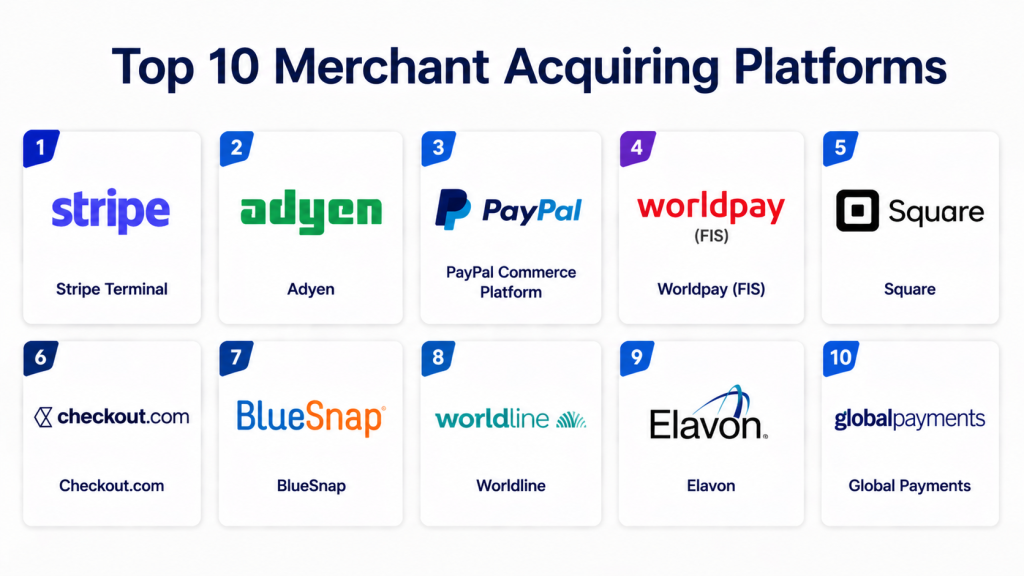
Top 10 Merchant Acquiring Platforms
#1 — Stripe Terminal
Short description :
Stripe Terminal provides an integrated merchant acquiring solution for in-person and online payments. It supports multiple card networks and currencies. Known for flexibility and developer-friendly APIs. Suitable for e-commerce and retail merchants. Provides analytics and reporting tools. Helps optimize payment acceptance.
Key Features
- Multi-network card acceptance
- POS integration
- API-first architecture
- Reporting dashboards
- Analytics tools
Pros
- Developer-friendly
- Flexible and scalable
Cons
- Advanced features require technical expertise
- Transaction fees
Platforms / Deployment
Cloud
Security & Compliance
PCI DSS compliant, encryption
Integrations & Ecosystem
- POS systems
- E-commerce platforms
- APIs
Support & Community
Strong documentation and support.
#2 — Adyen
Short description :
Adyen is a global merchant acquiring platform supporting online, in-store, and mobile payments. Known for global reach and fraud prevention tools. Suitable for large enterprises and marketplaces. Provides real-time analytics and reporting. Helps improve transaction success rates.
Key Features
- Global card acceptance
- Fraud prevention
- Omnichannel support
- Reporting
- Analytics
Pros
- Enterprise-ready
- International coverage
Cons
- Premium pricing
- Complex setup
Platforms / Deployment
Cloud
Security & Compliance
PCI DSS compliant, encryption
Integrations & Ecosystem
- POS and e-commerce systems
- ERP integrations
- APIs
Support & Community
Enterprise support.
#3 — PayPal Commerce Platform
Short description :
PayPal Commerce Platform provides merchant acquiring and payment processing for online businesses. It supports multiple currencies and alternative payment methods. Known for ease of use. Suitable for SMBs and enterprises. Offers reporting and analytics. Helps improve checkout conversion.
Key Features
- Card and alternative payments
- Multi-currency support
- Fraud detection
- Reporting dashboards
- Analytics
Pros
- Easy integration
- Popular with consumers
Cons
- Higher fees for small merchants
- Limited customization
Platforms / Deployment
Cloud
Security & Compliance
PCI DSS compliant, encryption
Integrations & Ecosystem
- E-commerce platforms
- APIs
Support & Community
Strong community support.
#4 — Worldpay (FIS)
Short description :
Worldpay provides merchant acquiring solutions for global transactions, supporting online and in-store payments. Known for reliability and global coverage. Suitable for enterprises and retailers. Offers reporting dashboards and fraud prevention tools. Helps optimize payment acceptance.
Key Features
- Card acceptance globally
- Fraud detection
- POS and online support
- Reporting
- Analytics
Pros
- Reliable platform
- Strong global coverage
Cons
- Premium pricing
- Complex for SMBs
Platforms / Deployment
Cloud
Security & Compliance
PCI DSS compliant, encryption
Integrations & Ecosystem
- POS and e-commerce
- APIs
Support & Community
Enterprise support.
#5 — Square
Short description :
Square provides merchant acquiring and payment processing for small to mid-sized merchants. Supports card and mobile payments. Known for simplicity and user-friendly POS. Suitable for SMBs and retailers. Offers reporting and analytics. Helps improve transaction efficiency.
Key Features
- POS integration
- Card and mobile payments
- Reporting dashboards
- Analytics
- Payment routing
Pros
- Easy to use
- Affordable for SMBs
Cons
- Limited enterprise features
- Higher fees for cross-border
Platforms / Deployment
Cloud
Security & Compliance
PCI DSS compliant, encryption
Integrations & Ecosystem
- POS systems
- E-commerce platforms
- APIs
Support & Community
Good SMB support.
#6 — Checkout.com
Short description :
Checkout.com provides a global merchant acquiring solution with multi-currency support and API-first architecture. Known for real-time processing and analytics. Suitable for enterprises and marketplaces. Offers reporting dashboards. Helps optimize transaction approval rates.
Key Features
- Multi-currency acceptance
- Global card networks
- API-first design
- Reporting
- Analytics
Pros
- Global coverage
- Developer-friendly
Cons
- Pricing
- Integration complexity
Platforms / Deployment
Cloud
Security & Compliance
PCI DSS compliant, encryption
Integrations & Ecosystem
- POS and e-commerce
- APIs
Support & Community
Enterprise-level support.
#7 — BlueSnap
Short description :
BlueSnap offers merchant acquiring for e-commerce, marketplaces, and SaaS platforms. It supports multi-currency, fraud prevention, and intelligent routing. Known for international coverage. Suitable for SMBs and enterprises. Provides reporting and analytics dashboards. Helps optimize checkout success.
Key Features
- Multi-currency processing
- Fraud detection
- Intelligent routing
- Reporting dashboards
- Analytics
Pros
- International support
- Easy setup
Cons
- Limited enterprise features
- Pricing
Platforms / Deployment
Cloud
Security & Compliance
PCI DSS compliant, encryption
Integrations & Ecosystem
- E-commerce and POS
- APIs
Support & Community
Good SMB support.
#8 — Worldline
Short description :
Worldline provides merchant acquiring services across online and in-store channels. It supports multiple currencies and payment types. Known for reliability and security. Suitable for enterprises and retailers. Provides analytics and reporting. Helps optimize payment operations globally.
Key Features
- Multi-channel payment processing
- Multi-currency support
- Fraud detection
- Reporting
- Analytics
Pros
- Reliable platform
- Secure transactions
Cons
- Premium pricing
- Complexity for SMBs
Platforms / Deployment
Cloud
Security & Compliance
PCI DSS compliant, encryption
Integrations & Ecosystem
- POS and e-commerce
- APIs
Support & Community
Enterprise support.
#9 — Adyen Revenue Platform
Short description :
Adyen Revenue Platform consolidates payment processing and merchant acquiring globally. Supports multiple payment methods and intelligent routing. Known for real-time analytics. Suitable for large enterprises. Provides dashboards and reporting. Helps improve transaction approval and efficiency.
Key Features
- Multi-gateway orchestration
- Real-time analytics
- Global payments
- Reporting
- Fraud detection
Pros
- Scalable enterprise solution
- Global coverage
Cons
- Pricing
- Advanced configuration needed
Platforms / Deployment
Cloud
Security & Compliance
PCI DSS compliant, encryption
Integrations & Ecosystem
- E-commerce platforms
- APIs
Support & Community
Enterprise support.
#10 — Wirecard (legacy systems)
Short description :
Wirecard provides merchant acquiring solutions for online and in-store payments. Supports global card networks and multi-currency processing. Known for integration flexibility. Suitable for SMBs and mid-market enterprises. Provides reporting and analytics. Helps streamline payment operations.
Key Features
- Multi-currency card acceptance
- Global payment networks
- Reporting dashboards
- Analytics
- API integrations
Pros
- Flexible integration
- Global coverage
Cons
- Legacy platform
- Market restructuring
Platforms / Deployment
Cloud
Security & Compliance
PCI DSS compliant, encryption
Integrations & Ecosystem
- E-commerce and POS
- APIs
Support & Community
Moderate support.
Comparison Table
| Tool Name | Best For | Platform(s) Supported | Deployment | Standout Feature | Public Rating |
|---|---|---|---|---|---|
| Stripe Terminal | SMB/Enterprise | Web | Cloud | Developer-friendly | N/A |
| Adyen | Enterprise | Web | Cloud | Global coverage | N/A |
| PayPal Commerce | SMB | Web | Cloud | Ease of use | N/A |
| Worldpay | Enterprise | Web | Cloud | Global payments | N/A |
| Square | SMB | Web | Cloud | User-friendly POS | N/A |
| Checkout.com | Enterprise | Web | Cloud | Real-time processing | N/A |
| BlueSnap | SMB/Enterprise | Web | Cloud | Multi-currency support | N/A |
| Worldline | Enterprise | Web | Cloud | Security & reliability | N/A |
| Adyen Revenue | Enterprise | Web | Cloud | Analytics | N/A |
| Wirecard | SMB/Mid | Web | Cloud | Global coverage | N/A |
Which Merchant Acquiring Platform Is Right for You?
Solo / Freelancer
Small-scale sellers or freelancers usually do not require full-scale enterprise acquiring solutions. Platforms like Stripe Terminal or Square are ideal due to their simplicity, low setup costs, and quick deployment. They provide easy integration with online stores or POS systems, allowing fast acceptance of payments without complex onboarding.
SMB
For small to medium-sized businesses, platforms such as PayPal Commerce Platform, BlueSnap, or PayDock are suitable. They offer multi-gateway connectivity, fraud monitoring, and reporting tools while remaining affordable and user-friendly. These platforms balance functionality and cost, making them ideal for businesses scaling their online and in-store operations.
Mid-Market
Mid-market merchants with higher transaction volumes or cross-border operations should consider Checkout.com, Trolley, or PayU Orchestration. These platforms provide advanced routing, analytics, and compliance features to optimize authorization rates. They also integrate with ERP and e-commerce systems for operational efficiency.
Enterprise
Large enterprises with global operations benefit from Adyen, Worldpay (FIS), Worldline, Elavon, or Global Payments. These solutions support multi-currency payments, fraud detection, global settlement, and reporting at scale. They are best for organizations with complex payment ecosystems and high-volume transaction processing.
Budget vs Premium
- Budget-friendly: Stripe, Square, PayDock – suitable for SMBs with moderate transaction volume.
- Premium / Enterprise: Adyen, Worldpay, Checkout.com – ideal for high-volume merchants with global reach.
Feature Depth vs Ease of Use
- Feature depth: Adyen, Worldpay – comprehensive tools and analytics.
- Ease of use: Stripe, Square – simple setup, user-friendly interfaces.
Integrations & Scalability
- High integration: Enterprise platforms like Adyen and Checkout.com support multiple APIs and POS/e-commerce integrations.
- Moderate integration: SMB solutions like PayDock and BlueSnap provide standard integrations with popular commerce tools.
Security & Compliance Needs
- Enterprise: Platforms provide PCI DSS compliance, encryption, SSO, and multi-layer fraud monitoring.
- SMB / Mid-market: Security is robust but simpler, covering PCI DSS and basic fraud protection.
Frequently Asked Questions (FAQs)
1. What is a merchant acquiring platform?
A merchant acquiring platform is a system that enables businesses to process card and digital payments. It connects merchants to banks and payment networks. The platform ensures transactions are authorized, settled, and secure. It supports multiple currencies and channels. Merchants gain insights through analytics dashboards.
2. How much does it cost?
Costs vary by platform, transaction volume, and features. SMB platforms often use subscription or per-transaction pricing. Enterprise platforms typically have custom pricing models. Additional fees may apply for cross-border transactions. Evaluate the total cost including setup and transaction fees.
3. How long does setup take?
Setup can range from a few hours for SMB platforms like Stripe to several weeks for enterprise solutions like Adyen. Integration with POS or e-commerce systems may extend timelines. Cloud-based platforms are faster to deploy. Planning for compliance and training is recommended.
4. Is it secure?
Most merchant acquiring platforms are PCI DSS compliant. Enterprise solutions often include encryption, SSO, MFA, and fraud monitoring. Security is essential to protect customer payment data and reduce liability. Ensure the platform meets local and global regulatory requirements.
5. Can it handle international payments?
Yes, many platforms like Adyen, Worldpay, and Payoneer support multi-currency transactions and global settlements. SMB platforms may handle fewer currencies. For cross-border sales, choose a platform with strong international capabilities and currency conversion support.
6. What payment methods are supported?
Modern platforms support credit and debit cards, digital wallets, bank transfers, and alternative payment methods. Enterprise solutions typically support more channels, including local payment methods. Check the platform’s compatibility with your target markets.
7. Can it integrate with my e-commerce or POS system?
Yes, most platforms provide API or plugin-based integrations. Enterprise platforms offer extensive API options and ERP connectivity. SMB solutions integrate with popular online stores and POS systems. Integration ensures seamless checkout and transaction reporting.
8. How effective is fraud detection?
Enterprise platforms provide AI-driven risk scoring, transaction monitoring, and advanced fraud tools. SMB platforms offer basic fraud detection and monitoring. The platform should help reduce chargebacks and increase successful transactions while maintaining compliance.
9. Can I switch platforms easily?
Switching can be complex due to merchant accounts, payment gateways, and transaction history. Data migration requires careful planning. SMB platforms typically allow simpler migration. Enterprise migrations require technical support and phased implementations.
10. Which platform is best for high-volume merchants?
High-volume merchants should consider enterprise platforms like Adyen, Worldpay, Checkout.com, or Global Payments. These solutions offer robust fraud protection, global coverage, advanced analytics, and high scalability.
Conclusion
Merchant Acquiring Platforms play a crucial role in enabling businesses to accept payments efficiently, securely, and globally. They reduce operational complexity, optimize payment routing, and provide insights through analytics and reporting. Choosing the right platform ensures smooth transactions, improved approval rates, and better customer experiences.
The ideal platform depends on your business size, transaction volume, and global reach. Small merchants may benefit from solutions like Stripe or Square, while mid-market and enterprise businesses require feature-rich platforms such as Adyen, Checkout.com, or Worldpay. Each platform offers a balance of scalability, security, and integration capabilities.
As a next step, merchants should shortlist 2–3 platforms that align with their operational needs, evaluate integration possibilities, and run pilot transactions. This approach helps determine the most suitable platform to optimize payments and maximize business efficiency.
