Introduction
Model Registry Tools are platforms that help teams manage, version, store, and govern machine learning models throughout their lifecycle. They act as a centralized system where models can be tracked, approved, deployed, and monitored across environments, ensuring consistency and reliability in production AI systems.
In modern AI and MLOps workflows, model registries are critical for bridging the gap between experimentation and deployment. As organizations scale machine learning initiatives, they need robust systems to handle model versioning, governance, compliance, and collaboration. These tools also integrate closely with Identity Management, Cybersecurity, Zero Trust architectures, and Access Control systems, making them enterprise-ready.
Real-world use cases include:
- Versioning and tracking ML models across experiments
- Managing model approvals and deployment pipelines
- Monitoring model performance and lifecycle
- Enabling collaboration across data science teams
- Ensuring compliance and auditability in regulated industries
What buyers should evaluate:
- Model versioning and lineage tracking
- Integration with MLOps and data platforms
- Deployment and rollback capabilities
- Security features (RBAC, SSO, audit logs)
- Scalability and performance
- Ease of use and UI/UX
- Governance and compliance support
- Cost and deployment flexibility
Best for: ML engineers, data scientists, DevOps teams, enterprises scaling AI, and organizations requiring governance and compliance.
Not ideal for: Small projects with minimal model lifecycle needs or teams not deploying models to production.
Key Trends in Model Registry Tools
- Tight integration with MLOps pipelines for automation
- Zero Trust security models for model governance
- Built-in model monitoring and drift detection
- Multi-cloud and hybrid deployment support
- AI governance and compliance tracking becoming mandatory
- Integration with feature stores and data platforms
- Low-code model management interfaces emerging
- Versioning and lineage tracking improvements
- Real-time deployment and rollback capabilities
- Growing adoption of open standards like model packaging formats
How We Model Registry Tools (Methodology)
We evaluated model registry tools based on:
- Market adoption and ecosystem presence
- Feature completeness (versioning, governance, deployment)
- Performance and scalability
- Security posture and compliance readiness
- Integration capabilities with ML and data tools
- Ease of use and onboarding
- Deployment flexibility (cloud/on-premise)
- Support and community strength
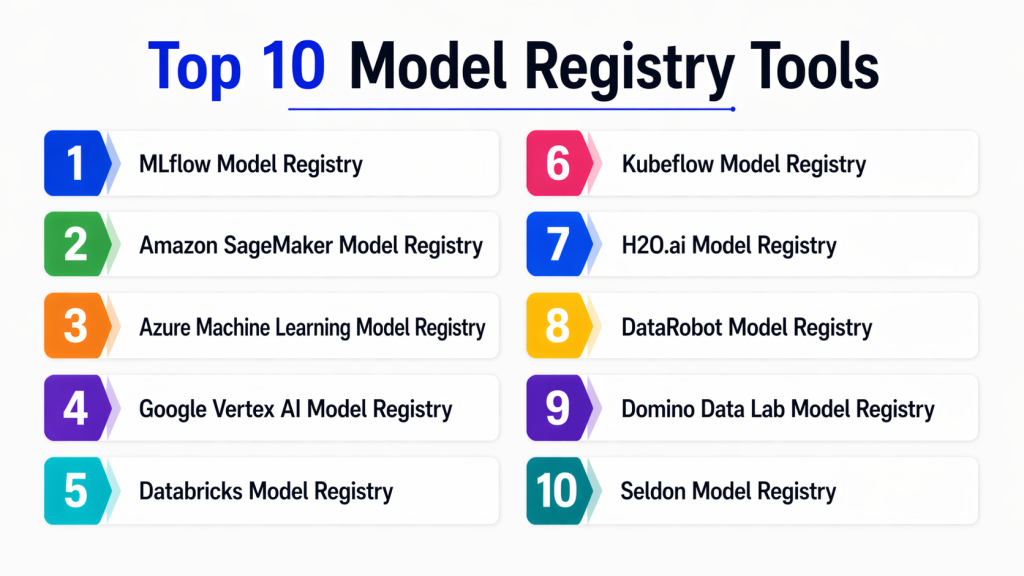
Top 10 Model Registry Tools
#1 — MLflow Model Registry
Short description :
MLflow Model Registry is one of the most widely used tools for managing ML models. It provides centralized versioning, lifecycle management, and deployment tracking. Designed to work across multiple ML frameworks, it is highly flexible. Ideal for teams building scalable ML pipelines. It is widely adopted in both startups and enterprises.
Key Features
- Model versioning and lifecycle management
- Experiment tracking integration
- Model deployment tools
- Framework-agnostic support
- API-based access
- Model staging and transitions
Pros
- Open-source and flexible
- Strong ecosystem support
Cons
- Requires setup and infrastructure
- Limited UI compared to enterprise tools
Platforms / Deployment
Web / Linux / Windows
Cloud / Self-hosted
Security & Compliance
Basic access control, role-based permissions
Compliance: Not publicly stated
Integrations & Ecosystem
MLflow integrates with most ML frameworks and cloud services, making it highly adaptable.
- TensorFlow, PyTorch
- Kubernetes
- Data pipelines
Support & Community
Large open-source community with extensive documentation.
#2 — Amazon SageMaker Model Registry
Short description :
SageMaker Model Registry is part of AWS’s managed ML ecosystem. It enables centralized model tracking, approval workflows, and deployment management. Designed for enterprise use, it integrates deeply with AWS services. Ideal for organizations operating within AWS. Provides scalability and automation.
Key Features
- Model versioning
- Approval workflows
- Deployment tracking
- Integration with SageMaker pipelines
- Automated lifecycle management
Pros
- Fully managed
- Scalable infrastructure
Cons
- Vendor lock-in
- Pricing complexity
Platforms / Deployment
Web
Cloud
Security & Compliance
IAM, encryption, audit logs
Compliance: Varies
Integrations & Ecosystem
- AWS services
- Data lakes
- APIs
Support & Community
Enterprise-level support.
#3 — Azure Machine Learning Model Registry
Short description :
Azure ML Model Registry provides centralized model management within Microsoft ecosystem. It supports versioning, deployment, and monitoring. Designed for enterprise AI workflows. Offers strong governance and security features. Best for organizations using Azure.
Key Features
- Model versioning
- Deployment pipelines
- Monitoring tools
- Integration with Azure ML
- Governance features
Pros
- Strong enterprise security
- Seamless Azure integration
Cons
- Requires Azure ecosystem
- Learning curve
Platforms / Deployment
Web
Cloud
Security & Compliance
Azure AD, RBAC, MFA
Compliance: Varies
Integrations & Ecosystem
- Azure services
- Power BI
- APIs
Support & Community
Enterprise support.
#4 — Google Vertex AI Model Registry
Short description :
Vertex AI Model Registry is part of Google Cloud’s AI platform. It enables model tracking, versioning, and deployment. Integrated with Google Cloud services. Ideal for scalable AI applications. Supports automated ML workflows.
Key Features
- Model versioning
- Deployment management
- Integration with Vertex AI
- Pipeline automation
- Monitoring tools
Pros
- Scalable
- Strong cloud integration
Cons
- Cloud dependency
- Pricing complexity
Platforms / Deployment
Web
Cloud
Security & Compliance
IAM, encryption
Compliance: Varies
Integrations & Ecosystem
- BigQuery
- Google Cloud services
Support & Community
Strong enterprise support.
#5 — Databricks Model Registr
Short description :
Databricks Model Registry is part of the Databricks Lakehouse platform. It enables centralized model tracking and deployment. Ideal for data-driven organizations. Supports collaborative workflows. Designed for large-scale ML operations.
Key Features
- Model lifecycle management
- Integration with MLflow
- Collaboration tools
- Deployment tracking
- Version control
Pros
- Strong integration with data workflows
- Scalable
Cons
- Requires Databricks ecosystem
- Costly
Platforms / Deployment
Cloud
Security & Compliance
RBAC, encryption
Compliance: Varies
Integrations & Ecosystem
- Databricks
- Spark
- Data pipelines
Support & Community
Enterprise-grade support.
#6 — Kubeflow Model Registry
Short description :
Kubeflow provides model management capabilities within Kubernetes-based ML pipelines. It supports versioning and deployment tracking. Ideal for engineering teams using Kubernetes. Highly flexible and scalable. Best for custom ML workflows.
Key Features
- Kubernetes-native architecture
- Pipeline integration
- Model versioning
- Deployment tools
Pros
- Highly customizable
- Scalable
Cons
- Complex setup
- Requires Kubernetes expertise
Platforms / Deployment
Linux
Self-hosted / Cloud
Security & Compliance
Kubernetes RBAC
Compliance: Not publicly stated
Integrations & Ecosystem
- Kubernetes
- ML tools
Support & Community
Active open-source community.
#7 — ClearML
Short description :
ClearML offers experiment tracking and model registry capabilities. It supports model versioning and pipeline automation. Open-source and flexible. Suitable for teams of all sizes. Focuses on ease of use.
Key Features
- Model tracking
- Pipeline automation
- Open-source
- Version control
Pros
- Cost-effective
- Flexible
Cons
- Smaller ecosystem
- Limited enterprise features
Platforms / Deployment
Cloud / Self-hosted
Security & Compliance
Basic access control
Compliance: Not publicly stated
Integrations & Ecosystem
- ML frameworks
- APIs
Support & Community
Growing open-source community.
#8 — Weights & Biases Model Registry
Short description :
Weights & Biases provides model tracking and registry capabilities. It helps teams manage experiments and deployments. Strong visualization features. Ideal for research teams and startups.
Key Features
- Model versioning
- Experiment tracking
- Visualization tools
- Collaboration
Pros
- Easy to use
- Strong UI
Cons
- Not full lifecycle tool
- Requires integration
Platforms / Deployment
Web
Cloud
Security & Compliance
Basic controls
Compliance: Not publicly stated
Integrations & Ecosystem
- PyTorch
- TensorFlow
Support & Community
Strong community.
#9 — Neptune.ai
Short description :
Neptune.ai is a metadata store and model tracking platform. It enables model versioning and experiment tracking. Designed for ML teams. Focuses on collaboration and observability.
Key Features
- Model tracking
- Experiment logging
- Collaboration tools
- Metadata management
Pros
- Strong tracking capabilities
- Easy integration
Cons
- Limited deployment features
- Requires integration
Platforms / Deployment
Cloud
Security & Compliance
Basic controls
Compliance: Not publicly stated
Integrations & Ecosystem
- ML tools
- APIs
Support & Community
Growing support.
#10 — DVC (Data Version Control)
Short description :
DVC is a version control tool for data and models. It integrates with Git workflows. Provides model tracking and reproducibility. Ideal for developers and data scientists.
Key Features
- Version control for models
- Git integration
- Reproducibility
- Pipeline management
Pros
- Developer-friendly
- Open-source
Cons
- Limited UI
- Requires setup
Platforms / Deployment
Multi-platform
Self-hosted
Security & Compliance
Depends on Git system
Compliance: Not publicly stated
Integrations & Ecosystem
- Git
- CI/CD tools
Support & Community
Active community.
Comparison Table (Top 10)
| Tool Name | Best For | Platform(s) | Deployment | Standout Feature | Public Rating |
|---|---|---|---|---|---|
| MLflow | Teams | Multi | Hybrid | Open-source registry | N/A |
| SageMaker | Enterprise | Web | Cloud | Managed workflows | N/A |
| Azure ML | Enterprise | Web | Cloud | Microsoft ecosystem | N/A |
| Vertex AI | Cloud AI | Web | Cloud | Automation | N/A |
| Databricks | Data teams | Cloud | Cloud | Lakehouse integration | N/A |
| Kubeflow | Engineers | Linux | Hybrid | Kubernetes-native | N/A |
| ClearML | Open-source | Multi | Hybrid | Flexibility | N/A |
| W&B | Research | Web | Cloud | Visualization | N/A |
| Neptune | Tracking | Cloud | Cloud | Metadata store | N/A |
| DVC | Developers | Multi | Self-hosted | Git-based versioning | N/A |
Evaluation & Scoring of Model Registry Tools
| Tool | Core | Ease | Integration | Security | Performance | Support | Value | Total |
|---|---|---|---|---|---|---|---|---|
| MLflow | 9 | 8 | 9 | 7 | 8 | 9 | 9 | 8.5 |
| SageMaker | 10 | 7 | 10 | 9 | 9 | 9 | 7 | 8.9 |
| Azure ML | 10 | 7 | 10 | 9 | 9 | 9 | 7 | 8.9 |
| Vertex AI | 10 | 7 | 10 | 9 | 9 | 9 | 7 | 8.9 |
| Databricks | 9 | 7 | 9 | 9 | 9 | 9 | 7 | 8.6 |
| Kubeflow | 9 | 6 | 9 | 8 | 9 | 7 | 8 | 8.2 |
| ClearML | 8 | 8 | 8 | 7 | 8 | 7 | 9 | 8.1 |
| W&B | 8 | 9 | 8 | 7 | 8 | 8 | 8 | 8.2 |
| Neptune | 8 | 8 | 8 | 7 | 8 | 7 | 8 | 8.0 |
| DVC | 7 | 7 | 8 | 6 | 7 | 7 | 9 | 7.6 |
Interpretation:
Enterprise tools score higher in scalability and governance. Open-source tools excel in flexibility and cost efficiency. Choose based on your workflow and infrastructure.
Which Model Registry Tool Is Right for You?
Solo / Freelancer
Use DVC, ClearML
SMB
Use MLflow, Neptune
Mid-Market
Use Databricks, Kubeflow
Enterprise
Use SageMaker, Azure ML, Vertex AI
Budget vs Premium
Budget: DVC, MLflow
Premium: SageMaker, Databricks
Feature Depth vs Ease
Depth: Kubeflow
Ease: W&B
Integrations & Scalability
Best: Databricks, Vertex
Security & Compliance
Best: Azure ML, SageMaker
Frequently Asked Questions (FAQs)
1. What is a model registry?
A model registry is a centralized repository for managing machine learning models. It helps track versions, manage lifecycle stages, and store metadata, ensuring models are organized and reproducible across environments.
2. Why is a model registry important?
It ensures consistency, governance, and traceability in ML workflows. Without a registry, managing multiple model versions and deployments becomes complex and error-prone.
3. Who should use model registry tools?
ML engineers, data scientists, and MLOps teams benefit the most, especially those managing production ML systems and multiple model versions.
4. Can model registries integrate with CI/CD pipelines?
Yes, most modern tools integrate with CI/CD pipelines, enabling automated model deployment and lifecycle management.
5. Are model registries secure?
Security varies by platform. Enterprise tools provide encryption, RBAC, and compliance features, while open-source tools may require additional configuration.
6. What is model versioning?
Model versioning tracks changes in models over time, allowing teams to compare, rollback, and manage different versions effectively.
7. Do these tools support collaboration?
Yes, many tools include collaboration features like shared dashboards, approval workflows, and access control.
8. Are open-source registries reliable?
Yes, tools like MLflow and Kubeflow are widely used and reliable, but may require additional setup and maintenance.
9. What industries use model registry tools?
Industries like finance, healthcare, retail, and technology rely on these tools to manage AI systems and ensure compliance.
10. How do I choose the right tool?
Evaluate based on scalability, integration, ease of use, and cost. Testing tools in real-world scenarios is recommended.
Conclusion
Model registry tools are a critical part of modern machine learning operations, enabling teams to manage models efficiently across their lifecycle. As organizations scale their AI initiatives, these tools ensure consistency, governance, and reproducibility. From open-source solutions like MLflow to enterprise platforms like DataRobot and SageMaker, the ecosystem offers a wide range of options for different needs.
Choosing the right model registry depends on your infrastructure, team expertise, and business requirements. Instead of selecting based on popularity, focus on how well the tool integrates with your workflows and supports your MLOps strategy. A practical approach is to shortlist a few tools, test them in your environment, and validate their scalability and governance capabilities before making a final decision.
