Introduction
Mind mapping tools are digital applications that help individuals and teams visually organize ideas, concepts, and information. By structuring thoughts into nodes and branches, these tools make it easier to brainstorm, plan, and connect ideas in a non-linear way.
In today’s fast-paced, information-heavy work environment, mind mapping tools have become essential for improving clarity, creativity, and productivity. Whether you’re planning a project, studying complex topics, or outlining business strategies, visual thinking tools help simplify complexity and enhance collaboration.
Common use cases include:
- Brainstorming ideas and capturing thoughts
- Project planning and task breakdown
- Studying and note-taking
- Business strategy and decision-making
- Content planning and outlining
What buyers should evaluate:
- Ease of use and learning curve
- Collaboration capabilities
- Template availability
- Integration with other tools
- Export and sharing options
- Performance with large maps
- Mobile and offline support
- Customization and flexibility
- Pricing structure
Best for: Students, professionals, project managers, writers, educators, and teams that rely on visual thinking.
Not ideal for: Teams needing strict workflow automation, structured databases, or heavy documentation—project management or note-taking tools may be more suitable.
Key Trends in Mind Mapping Tools for the Future
- AI-powered mind mapping: Tools now generate maps automatically from prompts or notes
- Hybrid work support: Real-time and async collaboration features
- Integration-first design: Seamless sync with productivity and knowledge tools
- Visual knowledge management: Mind maps as part of larger knowledge systems
- Cross-device optimization: Smooth experience across desktop, tablet, and mobile
- Automation features: Auto-organizing nodes and linking related ideas
- Cloud-first platforms: Easier sharing and collaboration
- Template ecosystems: Pre-built maps for faster workflows
How We Selected These Tools (Methodology)
- Considered market popularity and adoption
- Evaluated feature depth and usability
- Assessed collaboration and sharing capabilities
- Reviewed integration ecosystem strength
- Checked performance with large maps
- Considered pricing flexibility and accessibility
- Included tools for different user segments (solo to enterprise)
- Prioritized modern, actively maintained platforms
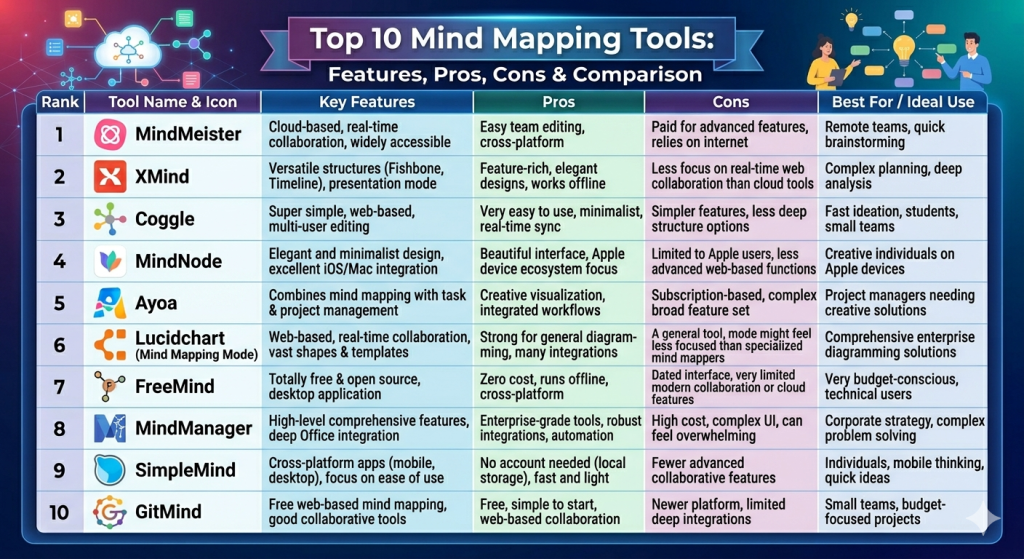
Top 10 Mind Mapping Tools Tools
#1 — MindMeister
Short description: A popular cloud-based mind mapping tool designed for collaboration and ease of use.
Key Features
- Real-time collaboration
- Intuitive drag-and-drop interface
- Presentation mode
- Task management integration
- Templates for various use cases
- Cloud syncing
Pros
- Easy to use for beginners
- Strong collaboration features
Cons
- Limited offline capabilities
- Advanced features require paid plans
Platforms / Deployment
Web / iOS / Android
Cloud
Security & Compliance
Encryption, SSO (varies by plan)
Integrations & Ecosystem
Integrates with productivity tools and task managers.
- Google Workspace
- Microsoft Teams
- MeisterTask
Support & Community
Good documentation and onboarding; active user base.
#2 — XMind
Short description: A feature-rich desktop-first mind mapping tool known for its design and flexibility.
Key Features
- Multiple map structures (logic chart, tree, etc.)
- Zen mode for focus
- Presentation tools
- Offline support
- Export options
Pros
- Works offline
- Visually appealing maps
Cons
- Limited collaboration features
- Some features locked behind premium
Platforms / Deployment
Windows / macOS / Linux / iOS / Android
Cloud / Offline
Security & Compliance
Not publicly stated
Integrations & Ecosystem
Limited integrations compared to cloud tools.
Support & Community
Strong documentation; long-standing user base.
#3 — Coggle
Short description: A simple, browser-based mind mapping tool focused on ease of use and sharing.
Key Features
- Real-time collaboration
- Automatic saving
- Unlimited image uploads
- Version history
- Simple interface
Pros
- Extremely easy to use
- Fast setup
Cons
- Limited advanced features
- Basic customization
Platforms / Deployment
Web
Cloud
Security & Compliance
Not publicly stated
Integrations & Ecosystem
Minimal integrations.
Support & Community
Basic support; small but active community.
#4 — MindNode
Short description: A beautifully designed mind mapping tool optimized for Apple users.
Key Features
- Clean UI
- Focus mode
- Task tracking
- iCloud sync
- Visual styling
Pros
- Excellent design
- Smooth Apple ecosystem integration
Cons
- Limited to Apple devices
- Not ideal for teams
Platforms / Deployment
macOS / iOS
Cloud
Security & Compliance
Apple ecosystem security
Integrations & Ecosystem
- Apple ecosystem apps
Support & Community
Good documentation; smaller community.
#5 — Ayoa
Short description: A mind mapping and task management hybrid tool designed for productivity.
Key Features
- Mind maps + task boards
- Collaboration tools
- Templates
- Idea capture tools
- Visual workflows
Pros
- Combines planning and execution
- Good for teams
Cons
- UI can feel cluttered
- Learning curve
Platforms / Deployment
Web / Desktop / Mobile
Cloud
Security & Compliance
Not publicly stated
Integrations & Ecosystem
- Google Drive
- Slack
Support & Community
Good onboarding; moderate community.
#6 — Lucidchart (Mind Mapping Mode)
Short description: A diagramming tool with mind mapping capabilities for teams.
Key Features
- Diagram + mind map hybrid
- Real-time collaboration
- Templates
- Integration with Lucidspark
- Data linking
Pros
- Strong for business workflows
- Integration ecosystem
Cons
- Not a dedicated mind mapping tool
- Pricing tiers can be complex
Platforms / Deployment
Web / Desktop
Cloud
Security & Compliance
SSO, SOC 2
Integrations & Ecosystem
- Slack
- Microsoft Teams
- Google Workspace
Support & Community
Strong enterprise support.
#7 — FreeMind
Short description: A free, open-source mind mapping tool with a simple interface.
Key Features
- Lightweight
- Offline use
- Basic map creation
- Open-source
Pros
- Free to use
- Fast performance
Cons
- Outdated interface
- No collaboration
Platforms / Deployment
Windows / macOS / Linux
Offline
Security & Compliance
N/A
Integrations & Ecosystem
Minimal.
Support & Community
Open-source community support.
#8 — MindManager
Short description: An enterprise-grade mind mapping tool with advanced project planning features.
Key Features
- Advanced mapping tools
- Gantt charts
- Task management
- Data visualization
- Templates
Pros
- Powerful features
- Enterprise-ready
Cons
- Expensive
- Steeper learning curve
Platforms / Deployment
Windows / macOS
Cloud / Desktop
Security & Compliance
Varies / enterprise-grade
Integrations & Ecosystem
- Microsoft Office
- SharePoint
Support & Community
Strong enterprise support.
#9 — SimpleMind
Short description: A cross-platform mind mapping tool focused on simplicity and flexibility.
Key Features
- Free-form layout
- Cross-platform sync
- Offline support
- Custom styling
Pros
- Flexible layout
- Works offline
Cons
- Limited collaboration
- Basic integrations
Platforms / Deployment
Windows / macOS / iOS / Android
Cloud / Offline
Security & Compliance
Not publicly stated
Integrations & Ecosystem
Limited.
Support & Community
Moderate documentation and support.
#10 — GitMind
Short description: A cloud-based mind mapping tool with AI features and templates.
Key Features
- AI-generated mind maps
- Templates
- Collaboration tools
- Cloud storage
- Export options
Pros
- AI features
- Easy to use
Cons
- Limited advanced customization
- Smaller ecosystem
Platforms / Deployment
Web
Cloud
Security & Compliance
Not publicly stated
Integrations & Ecosystem
Limited integrations.
Support & Community
Growing community; basic support.
Comparison Table (Top 10)
| Tool Name | Best For | Platform(s) Supported | Deployment | Standout Feature | Public Rating |
|---|---|---|---|---|---|
| MindMeister | Teams | Web, Mobile | Cloud | Collaboration | N/A |
| XMind | Individuals | Desktop, Mobile | Cloud/Offline | Visual design | N/A |
| Coggle | Beginners | Web | Cloud | Simplicity | N/A |
| MindNode | Apple users | macOS, iOS | Cloud | UI/UX | N/A |
| Ayoa | Teams | Web, Mobile | Cloud | Tasks + maps | N/A |
| Lucidchart | Businesses | Web | Cloud | Diagram integration | N/A |
| FreeMind | Free users | Desktop | Offline | Open-source | N/A |
| MindManager | Enterprise | Desktop | Cloud/Desktop | Advanced planning | N/A |
| SimpleMind | Flexible users | Desktop, Mobile | Cloud/Offline | Free-form layout | N/A |
| GitMind | AI users | Web | Cloud | AI maps | N/A |
Evaluation & Scoring of Mind Mapping Tools
| Tool Name | Core | Ease | Integrations | Security | Performance | Support | Value | Weighted Total |
|---|---|---|---|---|---|---|---|---|
| MindMeister | 9 | 9 | 8 | 8 | 8 | 8 | 7 | 8.4 |
| XMind | 8 | 8 | 6 | 6 | 9 | 7 | 8 | 7.7 |
| Coggle | 6 | 10 | 5 | 5 | 8 | 6 | 9 | 7.4 |
| MindNode | 7 | 9 | 5 | 7 | 8 | 7 | 7 | 7.3 |
| Ayoa | 8 | 7 | 7 | 6 | 7 | 7 | 7 | 7.3 |
| Lucidchart | 8 | 8 | 9 | 9 | 8 | 8 | 6 | 8.1 |
| FreeMind | 5 | 7 | 3 | 5 | 8 | 5 | 10 | 6.8 |
| MindManager | 9 | 6 | 8 | 9 | 8 | 8 | 6 | 7.9 |
| SimpleMind | 7 | 8 | 5 | 6 | 8 | 6 | 8 | 7.3 |
| GitMind | 7 | 8 | 5 | 5 | 7 | 6 | 8 | 7.0 |
How to interpret scores:
- Scores compare tools within this list
- Higher scores = better overall balance
- Some tools excel in simplicity, others in power
- Choose based on your workflow needs
Which Mind Mapping Tools Tool Is Right for You?
Solo / Freelancer
- Best: XMind, SimpleMind
SMB
- Best: MindMeister, Ayoa
Mid-Market
- Best: Lucidchart, MindMeister
Enterprise
- Best: MindManager, Lucidchart
Budget vs Premium
- Budget: FreeMind, Coggle
- Premium: MindManager
Feature Depth vs Ease of Use
- Deep: MindManager
- Easy: Coggle
Integrations & Scalability
- Strong: Lucidchart
Security & Compliance Needs
- Best: Lucidchart, MindManager
Frequently Asked Questions (FAQs)
What is a mind mapping tool?
A tool that visually organizes ideas into connected nodes.
Are mind mapping tools free?
Many offer free versions; premium plans unlock more features.
Can teams collaborate?
Yes, most modern tools support real-time collaboration.
Are they good for studying?
Yes, they help simplify complex topics.
Do they support AI?
Some tools now include AI features for idea generation.
Can I export mind maps?
Yes, usually as PDF, image, or document formats.
Are they mobile-friendly?
Most tools offer mobile apps.
What’s the best for beginners?
Coggle and MindMeister.
Can I use them offline?
Some tools like XMind support offline use.
Are open-source tools available?
Yes, like FreeMind.
Conclusion
Mind mapping tools are powerful solutions for organizing ideas, improving clarity, and enhancing productivity. From simple tools for quick brainstorming to advanced platforms for enterprise planning, the options vary widely. The best choice depends on your workflow, collaboration needs, and budget. Start by identifying your primary use case, shortlist a few tools, and test them in real scenarios to find the best fit.
