Introduction
Kanban Tools are visual work management platforms that help teams organize tasks using boards, columns, and cards. Work typically moves through stages such as To Do, In Progress, and Done, making it easier to track progress, reduce bottlenecks, and improve workflow efficiency.
In the business environment, Kanban tools are more important than ever because teams need faster execution, clearer priorities, and better collaboration across remote and hybrid work models. Modern Kanban platforms now include AI automation, dashboards, workload balancing, reporting, and integrations with business apps.
Common Real-World Use Cases
- Software development workflows
- Marketing campaign pipelines
- Sales lead tracking
- HR hiring pipelines
- Content production management
- Client project delivery
- Operations workflow tracking
What Buyers Should Evaluate
- Ease of board setup and usability
- Card customization and workflows
- Automation capabilities
- Reporting and analytics
- Integrations with existing tools
- Mobile experience
- Security and permissions
- Scalability for larger teams
- Collaboration tools
- Pricing flexibility
Best for: Startups, agile teams, operations teams, marketing teams, remote teams, freelancers, and enterprises wanting visual workflow management.
Not ideal for: Teams needing complex financial planning, deep portfolio management, or businesses requiring ERP systems rather than workflow boards.
Key Trends in Kanban Tools
- AI-generated task cards and summaries
- Smart automation rules for repetitive work
- Predictive flow analytics for bottlenecks
- Hybrid project views (Kanban + Gantt + Timeline)
- Integrated docs and chat in one platform
- Mobile-first board management
- Advanced workload balancing across teams
- Enterprise-grade security controls
- Cross-functional operating systems beyond project management
- Template marketplaces for instant workflows
How We Selected These Tools (Methodology)
We selected these top Kanban tools using:
- Market popularity and trust
- Strength of Kanban board functionality
- Ease of use and onboarding speed
- Reporting and analytics depth
- Automation features
- Integration ecosystem quality
- Reliability and performance reputation
- Security posture signals
- Fit for SMB to enterprise teams
- Future readiness for AI-driven work management
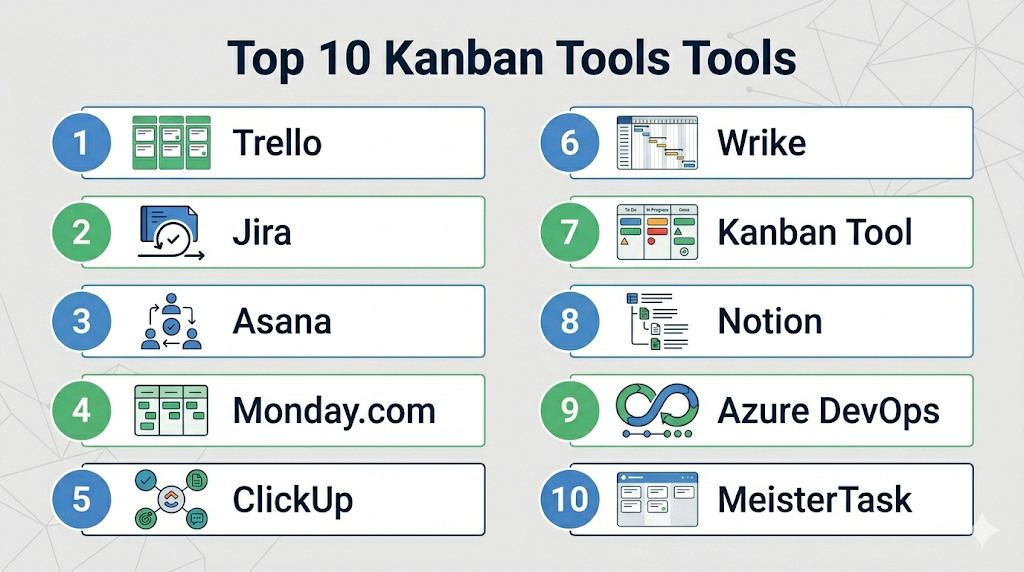
Top 10 Kanban Tools Tools
Standalone Top 10 Tool Names
- Trello
- Jira
- Asana
- Monday.com
- ClickUp
- Wrike
- Kanban Tool
- Notion
- Azure DevOps
- MeisterTask
#1 — Trello
Short description (2–3 lines): Trello is one of the most recognized Kanban platforms, known for drag-and-drop simplicity and fast adoption. It is ideal for individuals, startups, and lightweight teams.
Key Features
- Visual Kanban boards
- Cards and checklists
- Butler automation
- Calendar and timeline views
- Templates
- Comments and attachments
- Power-Ups ecosystem
Pros
- Extremely easy to use
- Fast onboarding
- Strong free plan
Cons
- Limited advanced reporting
- Less suited for complex PMOs
Platforms / Deployment
Web / Windows / macOS / iOS / Android
Security & Compliance
SSO on enterprise tiers, MFA, permissions.
Integrations & Ecosystem
- Slack
- Jira
- Google Drive
- Confluence
- Automation apps
Support & Community
Massive user community and extensive tutorials.
#2 — Jira
Short description (2–3 lines): Jira is a powerful Agile and Kanban platform for engineering teams that need advanced workflow controls and development integrations.
Key Features
- Kanban boards
- Scrum boards
- Backlogs
- Sprint planning
- Roadmaps
- Workflow automation
- DevOps integrations
Pros
- Excellent for software teams
- Deep customization
- Strong ecosystem
Cons
- Learning curve for non-technical users
- Can be complex initially
Platforms / Deployment
Web / Windows / macOS / iOS / Android
Security & Compliance
SSO/SAML, RBAC, audit controls.
Integrations & Ecosystem
- GitHub
- Bitbucket
- Confluence
- Slack
- CI/CD tools
Support & Community
Strong documentation and global adoption.
#3 — Asana
Short description (2–3 lines): Asana offers polished Kanban boards plus broader project management tools for cross-functional teams.
Key Features
- Board view
- Timelines
- Goals tracking
- Dashboards
- Automation
- Dependencies
- Templates
Pros
- Great UI and usability
- Strong team collaboration
- Scales well
Cons
- Premium tiers unlock more value
- Less engineering-focused than Jira
Platforms / Deployment
Web / Windows / macOS / iOS / Android
Security & Compliance
SSO, MFA, enterprise controls.
Integrations & Ecosystem
- Slack
- Google Workspace
- Microsoft 365
- Salesforce
Support & Community
Large business user base and strong resources.
#4 — Monday.com
Short description (2–3 lines): Monday.com provides visual Kanban workflows with customizable boards and operational dashboards.
Key Features
- Boards
- Automations
- Dashboards
- Workload views
- Forms
- Templates
- Time tracking options
Pros
- Highly flexible
- Strong dashboards
- Good cross-department fit
Cons
- Pricing rises with scale
- Setup takes planning
Platforms / Deployment
Web / Windows / macOS / iOS / Android
Security & Compliance
SSO, admin controls, enterprise permissions.
Integrations & Ecosystem
- Slack
- Teams
- Zoom
- Gmail
- APIs
Support & Community
Strong commercial support presence.
#5 — ClickUp
Short description (2–3 lines): ClickUp is an all-in-one productivity suite with Kanban boards, docs, chat, dashboards, and automation.
Key Features
- Board view
- Docs
- Goals
- Whiteboards
- Dashboards
- Automations
- Multiple project views
Pros
- Huge feature set
- Strong value pricing
- Can replace multiple tools
Cons
- Initial complexity possible
- Requires setup discipline
Platforms / Deployment
Web / Windows / macOS / iOS / Android
Security & Compliance
Permissions, SSO on higher plans.
Integrations & Ecosystem
- Slack
- GitHub
- Google Drive
- Zoom
- Zapier
Support & Community
Strong templates and growing community.
#6 — Wrike
Short description (2–3 lines): Wrike blends Kanban boards with enterprise project planning, reporting, and resource management.
Key Features
- Kanban boards
- Gantt charts
- Dashboards
- Proofing
- Request forms
- Reporting
- Automation
Pros
- Great for enterprise workflows
- Strong reporting depth
Cons
- More complex than lightweight tools
- Premium tiers often preferred
Platforms / Deployment
Web / Windows / macOS / iOS / Android
Security & Compliance
SSO, admin controls, enterprise governance.
Integrations & Ecosystem
- Adobe
- Salesforce
- Slack
- Microsoft apps
Support & Community
Strong enterprise support options.
#7 — Kanban Tool
Short description (2–3 lines): Kanban Tool is a dedicated Kanban-focused platform built to improve workflow visibility and efficiency.
Key Features
- Swimlanes
- Time tracking
- Analytics
- WIP limits
- Card templates
- Recurring tasks
- AI assistant tools
Pros
- Strong pure Kanban focus
- Useful analytics
Cons
- Smaller ecosystem than large suites
- Less broad PM functionality
Platforms / Deployment
Web / iOS / Android
Security & Compliance
Varies / Not publicly stated.
Integrations & Ecosystem
- APIs
- Calendar tools
- Business apps
Support & Community
Focused niche community.
#8 — Notion
Short description (2–3 lines): Notion combines Kanban boards, docs, databases, and internal knowledge management in one workspace.
Key Features
- Board databases
- Docs + tasks
- Templates
- Wikis
- AI writing tools
- Collaboration
- Custom databases
Pros
- Very flexible workspace
- Great docs + Kanban combo
Cons
- Requires customization
- Less structured PM depth
Platforms / Deployment
Web / Windows / macOS / iOS / Android
Security & Compliance
Permissions vary by plan.
Integrations & Ecosystem
- Slack
- GitHub
- Google Drive
- APIs
Support & Community
Huge template and creator ecosystem.
#9 — Azure DevOps
Short description (2–3 lines): Azure DevOps includes Kanban boards alongside repos, pipelines, and testing for technical teams.
Key Features
- Kanban boards
- Backlogs
- Pipelines
- Repos
- Dashboards
- Test plans
- Enterprise controls
Pros
- Excellent Microsoft ecosystem fit
- Great for engineering teams
Cons
- More technical than business tools
- Less ideal for marketing teams
Platforms / Deployment
Web / Windows / macOS
Security & Compliance
Microsoft enterprise identity and security controls.
Integrations & Ecosystem
- GitHub
- Azure
- Teams
- Microsoft tools
Support & Community
Strong enterprise ecosystem.
#10 — MeisterTask
Short description (2–3 lines): MeisterTask is a polished Kanban platform focused on ease of use, automation, and team collaboration.
Key Features
- Boards
- Automation
- Timelines
- Recurring tasks
- Time tracking options
- Comments
- Templates
Pros
- Clean interface
- Good for SMB teams
Cons
- Less enterprise depth
- Smaller ecosystem than giants
Platforms / Deployment
Web / Windows / macOS / iOS / Android
Security & Compliance
Permissions and admin controls vary.
Integrations & Ecosystem
- Slack
- Google Workspace
- Zapier
Support & Community
Good SMB support reputation.
Comparison Table (Top 10)
| Tool Name | Best For | Platform(s) Supported | Deployment | Standout Feature | Public Rating |
|---|---|---|---|---|---|
| Trello | Simplicity | All major platforms | Cloud | Easy Kanban boards | N/A |
| Jira | Engineering teams | All major platforms | Cloud | Advanced workflows | N/A |
| Asana | Cross-functional teams | All major platforms | Cloud | Polished collaboration | N/A |
| Monday.com | Flexible teams | All major platforms | Cloud | Custom boards | N/A |
| ClickUp | All-in-one work | All major platforms | Cloud | Feature depth | N/A |
| Wrike | Enterprises | All major platforms | Cloud | Reporting + boards | N/A |
| Kanban Tool | Pure Kanban users | Web/Mobile | Cloud | Workflow analytics | N/A |
| Notion | Docs + boards | All major platforms | Cloud | Unified workspace | N/A |
| Azure DevOps | Dev teams | Web/Desktop | Cloud | Code + Kanban | N/A |
| MeisterTask | SMB teams | All major platforms | Cloud | Easy collaboration | N/A |
Evaluation & Scoring of Kanban Tools
| Tool Name | Core (25%) | Ease (15%) | Integrations (15%) | Security (10%) | Performance (10%) | Support (10%) | Value (15%) | Weighted Total |
|---|---|---|---|---|---|---|---|---|
| Trello | 8 | 10 | 8 | 7 | 9 | 8 | 9 | 8.45 |
| Jira | 10 | 6 | 9 | 9 | 8 | 9 | 8 | 8.45 |
| Asana | 8 | 9 | 9 | 8 | 8 | 9 | 8 | 8.40 |
| Monday.com | 8 | 8 | 8 | 8 | 8 | 8 | 7 | 7.95 |
| ClickUp | 9 | 7 | 8 | 8 | 8 | 8 | 9 | 8.20 |
| Wrike | 8 | 7 | 8 | 8 | 8 | 8 | 7 | 7.75 |
| Kanban Tool | 8 | 8 | 6 | 7 | 8 | 7 | 8 | 7.55 |
| Notion | 7 | 8 | 7 | 7 | 8 | 8 | 9 | 7.75 |
| Azure DevOps | 9 | 6 | 9 | 9 | 8 | 8 | 8 | 8.10 |
| MeisterTask | 7 | 9 | 7 | 7 | 8 | 7 | 8 | 7.70 |
These scores are comparative. Engineering teams may prefer Jira or Azure DevOps, while business teams may choose Trello, Asana, or Monday.com. Adoption and usability often matter as much as feature depth.
Which Kanban Tools Is Right for You?
Solo / Freelancer
Choose Trello, Notion, or MeisterTask.
SMB
Choose ClickUp, Trello, or Monday.com.
Mid-Market
Choose Asana, ClickUp, or Wrike.
Enterprise
Choose Jira, Wrike, Azure DevOps, or Monday.com.
Budget vs Premium
- Budget-friendly: Trello, Notion, ClickUp
- Premium: Jira enterprise, Wrike, Monday.com
Feature Depth vs Ease of Use
- Deep features: Jira, Azure DevOps, ClickUp
- Easy adoption: Trello, MeisterTask, Asana
Integrations & Scalability
Choose Jira, Asana, Monday.com, ClickUp.
Security & Compliance Needs
Choose enterprise plans from Jira, Azure DevOps, Wrike, Asana.
Frequently Asked Questions (FAQs)
1. What is a Kanban tool?
It is software that manages work visually through boards, columns, and task cards.
2. Is Trello still good for Kanban?
Yes, Trello remains a popular and simple Kanban choice.
3. Which Kanban tool is best for developers?
Jira and Azure DevOps are strong options.
4. Are Kanban tools only for Agile teams?
No. Marketing, HR, sales, and operations teams use them too.
5. Can Kanban tools automate tasks?
Yes, many offer rules, triggers, and workflow automations.
6. Are mobile apps available?
Most leading Kanban tools support iOS and Android.
7. Can I use Kanban for personal productivity?
Yes, Trello, Notion, and MeisterTask work well personally.
8. What are WIP limits?
They cap tasks in progress to improve focus and flow.
9. Is free pricing available?
Many vendors offer free tiers with limits.
10. How should I choose one?
Pick based on team size, complexity, integrations, and usability.
Conclusion
Kanban tools have evolved from simple boards into powerful work management systems for modern teams. The best option depends on whether you prioritize simplicity, enterprise controls, engineering workflows, or all-in-one collaboration. Trello remains excellent for lightweight use, Jira dominates technical teams, and Asana, ClickUp, and Monday.com serve broader business needs. There is no universal winner—adoption and fit matter most. Shortlist two or three options, run a real workflow pilot, and choose the tool your team uses consistently.
