Introduction
Issue Tracking Tools help teams capture, manage, prioritize, and resolve bugs, tasks, and operational issues across software development and business workflows. These platforms provide structured tracking systems that ensure nothing falls through the cracks, improving team efficiency and product quality.
In today’s fast-paced development environment, issue tracking is tightly integrated with DevOps, Agile, and product management practices. Modern tools go beyond basic ticketing by offering automation, AI-driven insights, and integrations with CI/CD pipelines. They also incorporate Identity Management, CyberSecurity, Zero Trust, and Access Control mechanisms to ensure that sensitive project data and workflows remain secure.
Real-world use cases:
- Bug tracking and resolution
- Task and project management
- Agile sprint planning and backlog management
- Incident tracking and operational workflows
- Collaboration between development and support teams
What buyers should evaluate:
- Issue tracking and workflow customization
- Integration with development and DevOps tools
- Automation and notification features
- Reporting and analytics capabilities
- Ease of use and onboarding
- Security and access control features
- Scalability for team size
- Pricing and value
Best for: Developers, product managers, IT teams, DevOps engineers, and organizations managing complex workflows or software projects.
Not ideal for: Very small teams with simple task management needs or organizations that do not require structured issue tracking.
Key Trends in Issue Tracking Tools
- AI-assisted issue categorization and prioritization
- Integration with CI/CD pipelines and DevOps tools
- Real-time collaboration and notifications
- Cloud-native platforms with remote accessibility
- Automation of workflows and ticket routing
- API-first architecture for integrations
- Enhanced security with Zero Trust models
- Mobile-first applications for distributed teams
- Integration with customer support and help desk tools
- Advanced analytics and reporting dashboards
How We Selected These Issue Tracking Tools (Methodology)
- Market adoption and developer community usage
- Feature completeness for issue tracking and workflows
- Reliability and performance in production environments
- Security and compliance capabilities
- Integration ecosystem and API support
- Ease of use for technical and non-technical users
- Scalability across team sizes
- Innovation in automation and analytics
- Customer feedback trends
- Balanced mix of enterprise and SMB tools
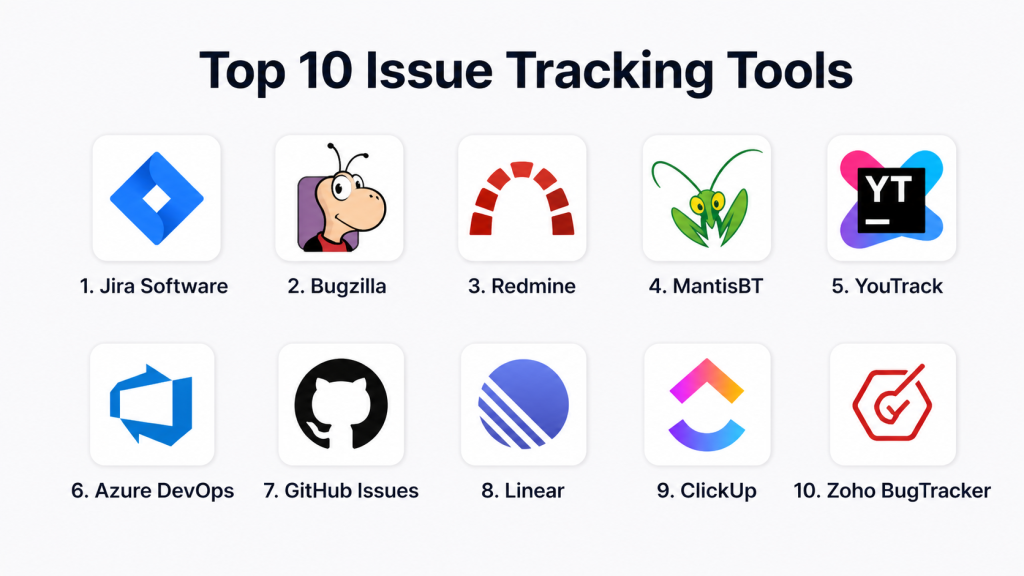
- Top 10 Issue Tracking Tools
#1 — Jira
Short description:
Jira is one of the most widely used issue tracking tools, especially in software development. It provides powerful features for bug tracking, Agile project management, and workflow customization. The platform integrates with a wide range of development tools. Jira is suitable for teams of all sizes. It is known for its flexibility and scalability. It is ideal for organizations following Agile methodologies.
Key Features
- Issue tracking and workflows
- Agile boards
- Reporting and analytics
- Automation
- Integration support
Pros
- Highly customizable
- Strong ecosystem
Cons
- Complex setup
- Learning curve
Platforms / Deployment
Web / Mobile
Cloud / On-premise
Security & Compliance
SSO, encryption, RBAC; compliance varies
Integrations & Ecosystem
Extensive integrations with development tools.
- CI/CD tools
- APIs
Support & Community
Large community and documentation
#2 — GitHub Issues
Short description:
GitHub Issues is a lightweight issue tracking system integrated with GitHub repositories. It allows developers to track bugs and tasks directly within their codebase. The platform is simple and easy to use. It is suitable for developers and small teams. GitHub Issues integrates seamlessly with GitHub workflows.
Key Features
- Issue tracking
- Labels and milestones
- Integration with code
- Collaboration tools
- Notifications
Pros
- Easy to use
- Seamless GitHub integration
Cons
- Limited advanced features
- Not ideal for large teams
Platforms / Deployment
Web / Mobile
Cloud
Security & Compliance
Encryption, access control; compliance varies
Integrations & Ecosystem
Integrates with GitHub ecosystem.
- APIs
Support & Community
Strong developer community
#3 — GitLab Issues
Short description:
GitLab Issues is part of the GitLab platform, offering issue tracking integrated with DevOps workflows. It supports Agile planning and CI/CD integration. The platform is suitable for development teams. It provides automation and analytics features. GitLab is ideal for organizations using GitLab ecosystem.
Key Features
- Issue tracking
- Agile planning
- CI/CD integration
- Automation
- Reporting
Pros
- Integrated DevOps platform
- Strong automation
Cons
- Requires GitLab ecosystem
- Learning curve
Platforms / Deployment
Web / Mobile
Cloud / Self-hosted
Security & Compliance
Encryption, access control; compliance varies
Integrations & Ecosystem
Integrates with GitLab tools.
- APIs
Support & Community
Strong community
#4 — Azure DevOps Boards
Short description:
Azure DevOps Boards provides issue tracking and project management tools integrated with Microsoft ecosystem. It supports Agile workflows and reporting. The platform is suitable for enterprises. It integrates with development and cloud tools. It is ideal for Microsoft-based environments.
Key Features
- Issue tracking
- Agile boards
- Reporting
- Integration with Azure
- Automation
Pros
- Strong Microsoft integration
- Enterprise-ready
Cons
- Requires Microsoft ecosystem
- Complex setup
Platforms / Deployment
Web
Cloud
Security & Compliance
Enterprise-grade security; compliance varies
Integrations & Ecosystem
Integrates with Microsoft tools.
- Azure
- APIs
Support & Community
Enterprise support
#5 — ClickUp
Short description:
ClickUp is a productivity platform that includes issue tracking capabilities. It provides task management, collaboration, and reporting tools. The platform is suitable for teams of all sizes. It offers customization and scalability. ClickUp integrates with various tools.
Key Features
- Task and issue tracking
- Workflow automation
- Reporting
- Collaboration
- Integration support
Pros
- Highly customizable
- All-in-one platform
Cons
- Interface complexity
- Learning curve
Platforms / Deployment
Web / Desktop / Mobile
Cloud
Security & Compliance
Encryption, access control; compliance varies
Integrations & Ecosystem
Integrates with productivity tools.
- APIs
Support & Community
Strong support
#6 — Asana
Short description:
Asana is a project management tool that includes issue tracking features. It provides task management, collaboration, and reporting tools. The platform is easy to use and scalable. It is suitable for SMBs and enterprises. Asana integrates with various tools.
Key Features
- Task and issue tracking
- Workflow automation
- Reporting
- Collaboration
- Integration support
Pros
- Easy to use
- Good collaboration
Cons
- Limited advanced issue tracking
- Not developer-focused
Platforms / Deployment
Web / Mobile
Cloud
Security & Compliance
Encryption, access control; compliance varies
Integrations & Ecosystem
Integrates with business tools.
- APIs
Support & Community
Strong community
#7 — Trello
Short description:
Trello is a simple and visual task management tool that can be used for issue tracking. It uses boards and cards for organization. The platform is easy to use and flexible. It is suitable for small teams. Trello integrates with various tools.
Key Features
- Boards and cards
- Workflow visualization
- Collaboration
- Integration support
- Automation
Pros
- Simple and intuitive
- Flexible
Cons
- Limited advanced features
- Not ideal for complex workflows
Platforms / Deployment
Web / Mobile
Cloud
Security & Compliance
Encryption, access control; compliance varies
Integrations & Ecosystem
Extensive integrations available.
- APIs
Support & Community
Large community
#8 — Bugzilla
Short description:
Bugzilla is an open-source issue tracking tool designed for bug tracking. It provides detailed tracking and reporting features. The platform is suitable for development teams. It is highly customizable. Bugzilla is ideal for organizations needing open-source solutions.
Key Features
- Bug tracking
- Reporting
- Custom workflows
- Search capabilities
- Integration support
Pros
- Open-source
- Highly customizable
Cons
- Outdated interface
- Requires setup
Platforms / Deployment
Web
Self-hosted
Security & Compliance
Varies / Not publicly stated
Integrations & Ecosystem
Supports integrations with development tools.
- APIs
Support & Community
Open-source community
#9 — Redmine
Short description:
Redmine is an open-source project management and issue tracking tool. It supports multiple projects and workflows. The platform is flexible and customizable. It is suitable for development teams. Redmine integrates with various tools.
Key Features
- Issue tracking
- Project management
- Reporting
- Workflow customization
- Integration support
Pros
- Open-source
- Flexible
Cons
- Requires setup
- Interface can be complex
Platforms / Deployment
Web
Self-hosted
Security & Compliance
Varies / Not publicly stated
Integrations & Ecosystem
Supports integrations with development tools.
- APIs
Support & Community
Open-source community
#10 — Zoho BugTracker
Short description:
Zoho BugTracker is a simple issue tracking tool designed for SMBs. It provides bug tracking and reporting features. The platform is easy to use and deploy. It integrates with Zoho ecosystem. It is suitable for small teams.
Key Features
- Bug tracking
- Reporting
- Workflow automation
- Integration support
- Collaboration
Pros
- Easy to use
- Affordable
Cons
- Limited advanced features
- Smaller ecosystem
Platforms / Deployment
Web / Mobile
Cloud
Security & Compliance
Encryption, access control; compliance varies
Integrations & Ecosystem
Integrates with Zoho tools.
- APIs
Support & Community
Good support
Comparison Table (Top 10)
| Tool Name | Best For | Platform(s) Supported | Deployment | Standout Feature | Public Rating |
|---|---|---|---|---|---|
| Jira | All sizes | Web, Mobile | Cloud/On-premise | Custom workflows | N/A |
| GitHub Issues | Developers | Web, Mobile | Cloud | Code integration | N/A |
| GitLab Issues | DevOps | Web, Mobile | Cloud/Self-hosted | DevOps integration | N/A |
| Azure Boards | Enterprise | Web | Cloud | Microsoft integration | N/A |
| ClickUp | All teams | Web, Desktop, Mobile | Cloud | Customization | N/A |
| Asana | SMB/Enterprise | Web, Mobile | Cloud | Collaboration | N/A |
| Trello | Small teams | Web, Mobile | Cloud | Simplicity | N/A |
| Bugzilla | Developers | Web | Self-hosted | Open-source | N/A |
| Redmine | Developers | Web | Self-hosted | Flexibility | N/A |
| Zoho BugTracker | SMB | Web, Mobile | Cloud | Affordability | N/A |
Evaluation & Scoring of Issue Tracking Tools
| Tool Name | Core | Ease | Integrations | Security | Performance | Support | Value | Weighted Total |
|---|---|---|---|---|---|---|---|---|
| Jira | 9 | 7 | 9 | 9 | 9 | 9 | 7 | 8.6 |
| GitHub Issues | 7 | 9 | 8 | 8 | 8 | 8 | 9 | 8.1 |
| GitLab Issues | 8 | 7 | 9 | 8 | 8 | 8 | 8 | 8.1 |
| Azure Boards | 9 | 6 | 9 | 9 | 9 | 8 | 6 | 8.2 |
| ClickUp | 8 | 7 | 9 | 8 | 8 | 8 | 8 | 8.1 |
| Asana | 7 | 9 | 8 | 8 | 8 | 8 | 8 | 8.0 |
| Trello | 7 | 9 | 7 | 7 | 7 | 8 | 9 | 7.8 |
| Bugzilla | 8 | 6 | 7 | 7 | 8 | 7 | 8 | 7.6 |
| Redmine | 8 | 6 | 7 | 7 | 8 | 7 | 8 | 7.6 |
| Zoho BugTracker | 7 | 9 | 7 | 7 | 7 | 7 | 9 | 7.8 |
Interpretation:
Scores are comparative and reflect strengths across weighted criteria. Higher scores indicate stronger capabilities, but the best tool depends on your team’s workflow and scale.
Which Issue Tracking Tool Is Right for You?
Solo / Freelancer
Trello or GitHub Issues for simplicity and quick setup.
SMB
Zoho BugTracker, ClickUp, or Asana for affordability and usability.
Mid-Market
GitLab Issues or ClickUp for flexibility and integrations.
Enterprise
Jira or Azure DevOps Boards for scalability and advanced features.
Budget vs Premium
Budget: Trello, Zoho
Premium: Jira, Azure DevOps
Feature Depth vs Ease of Use
Depth: Jira, Azure
Ease: Trello, GitHub Issues
Integrations & Scalability
Best: Jira, GitLab
Moderate: ClickUp, Asana
Security & Compliance Needs
Enterprise-grade: Jira, Azure
Basic: SMB-focused tools
Frequently Asked Questions (FAQs)
1. What are Issue Tracking Tools?
Issue tracking tools help teams manage bugs, tasks, and workflows. They provide structured tracking systems. These tools improve collaboration and efficiency. They are used by development and IT teams. They support project management.
2. Why are these tools important?
They ensure issues are tracked and resolved efficiently. They improve team productivity. They provide visibility into workflows. They support Agile practices. They enhance product quality.
3. Are these tools suitable for small businesses?
Yes, many tools are designed for SMBs. They offer simple and affordable features. Small businesses benefit from organization and tracking. However, advanced tools may not be necessary. Choosing the right tool is important.
4. What is the typical pricing model?
Most tools use subscription pricing. Costs vary by features and users. Some tools offer free tiers. Enterprise tools require custom pricing. Pricing depends on scale.
5. How long does implementation take?
Implementation can be quick for simple tools. Advanced tools require setup and configuration. Training may also be needed. Proper planning ensures success. Deployment time varies by complexity.
6. Do these tools integrate with other systems?
Yes, they integrate with development, CRM, and analytics tools. APIs allow custom integrations. Integration depth varies. Strong integrations improve workflows. This is a key factor in selection.
7. What are common mistakes when choosing tools?
Choosing overly complex tools is common. Ignoring integration needs can cause issues. Not considering scalability is risky. Poor onboarding leads to low adoption. Proper evaluation helps avoid mistakes.
8. Are these tools secure?
Most platforms offer encryption and access controls. Enterprise tools provide advanced security. Compliance varies by vendor. Security aligns with Zero Trust models. Verification is essential.
9. Can businesses switch tools later?
Switching is possible but requires effort. Data migration and retraining are needed. Integration changes may be required. Planning ahead reduces risks. Choosing scalable tools helps.
10. What are alternatives to issue tracking tools?
Alternatives include spreadsheets and basic task management tools. However, they lack structured workflows. Some teams use custom solutions. Dedicated tools provide better tracking. They are ideal for complex workflows.
Conclusion
Issue Tracking Tools are a critical component of modern development and operational workflows, enabling teams to manage tasks, bugs, and processes efficiently. As organizations adopt Agile and DevOps practices, these tools have evolved into powerful platforms that combine automation, analytics, and collaboration. They help ensure that issues are resolved quickly, workflows remain organized, and product quality continues to improve over time.
The right tool depends on your team’s size, technical requirements, and workflow complexity. While enterprise platforms offer advanced customization and scalability, simpler tools provide ease of use and faster adoption for smaller teams. The best approach is to shortlist a few tools, test them in real scenarios, and evaluate how well they integrate with your existing systems. This ensures long-term success in managing issues and improving productivity.
