Introduction
Industrial Automation SCADA Systems (Supervisory Control and Data Acquisition) are platforms used to monitor, control, and automate industrial processes in real time. These systems collect data from sensors, machines, and field devices, enabling operators to visualize operations, detect issues, and make informed decisions.
In modern industries like manufacturing, energy, utilities, and oil & gas, SCADA systems are critical for efficiency, safety, and reliability. With the rise of Industry 4.0, SCADA platforms are evolving with cloud integration, AI analytics, and cybersecurity enhancements, making them more intelligent and scalable than ever.
Common use cases include:
- Industrial process monitoring
- Power grid and energy management
- Water and wastewater control
- Manufacturing automation
- Remote asset monitoring
Key evaluation criteria buyers should consider:
- Real-time monitoring capabilities
- Scalability and performance
- Integration with PLCs and IoT devices
- Security and access control
- Visualization and dashboards
- Alarm and event management
- Data analytics and reporting
- Deployment flexibility
Best for: Industrial engineers, plant managers, automation teams, and enterprises managing large-scale operations
Not ideal for: Small applications without real-time monitoring or automation needs
Key Trends in Industrial Automation SCADA Systems
- Cloud-based SCADA platforms
- AI-driven predictive maintenance
- IoT integration and edge computing
- Cybersecurity-focused SCADA systems
- Digital twin integration
- Remote monitoring capabilities
- Real-time analytics and dashboards
- Industry 4.0 adoption
Methodology
- Market adoption and enterprise usage
- Feature completeness
- Integration capabilities
- Performance and scalability
- Security and compliance
- Ease of use
- Vendor support
- Value for industrial applications
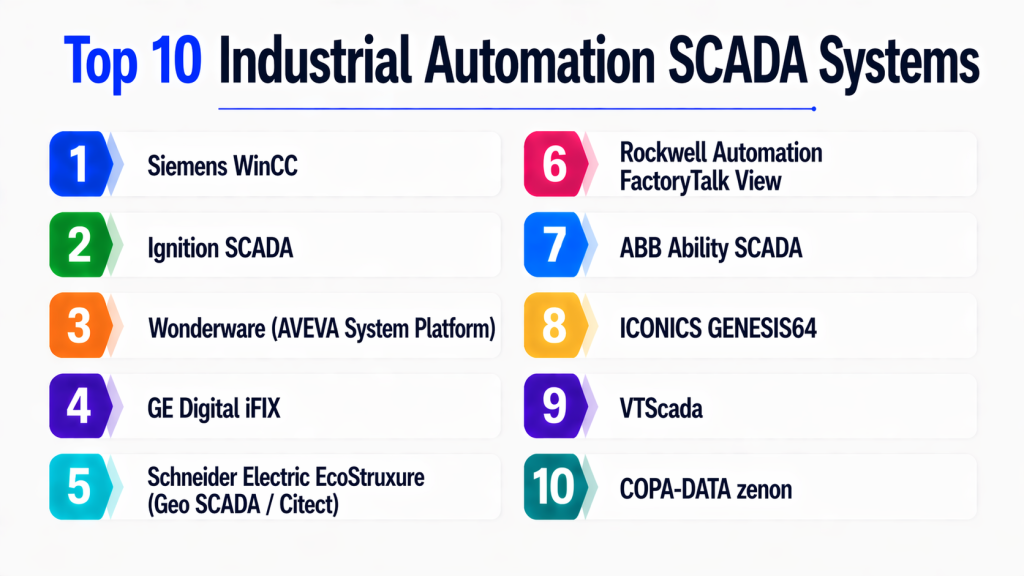
Top 10 Industrial Automation SCADA Systems
#1 — Siemens WinCC
Short description:
Siemens WinCC is a comprehensive SCADA platform designed for industrial automation and process control. It provides real-time monitoring, visualization, and data management capabilities. The platform integrates seamlessly with Siemens hardware and software. It supports large-scale industrial deployments. It is ideal for manufacturing and process industries.
Key Features
- Real-time monitoring
- Visualization dashboards
- Data logging
- Integration with PLCs
- Alarm management
Pros
- Enterprise-grade
- Strong integration
Cons
- Expensive
- Complex setup
Platforms / Deployment
- Windows / Cloud
#2 — Ignition (Inductive Automation)
Short description:
Ignition is a modern SCADA platform focused on flexibility and scalability. It provides web-based visualization and unlimited licensing. The platform supports industrial automation and IoT integration. It is widely used across industries. It is ideal for scalable SCADA deployments.
Key Features
- Web-based SCADA
- Unlimited licensing
- Real-time data
- IoT integration
- Visualization
Pros
- Flexible
- Cost-effective
Cons
- Learning curve
- Requires setup
Platforms / Deployment
- Cross-platform / Cloud
#3 — Wonderware (AVEVA System Platform)
Short description:
Wonderware is a leading SCADA solution for industrial automation. It provides powerful visualization and data management tools. The platform supports real-time monitoring and analytics. It is widely used in large enterprises. It is ideal for process industries.
Key Features
- Visualization
- Real-time monitoring
- Data analytics
- Integration
- Alarm management
Pros
- Industry leader
- Scalable
Cons
- Cost
- Complexity
Platforms / Deployment
- Windows / Cloud
#4 — GE Digital iFIX
Short description:
GE Digital iFIX is a SCADA platform designed for industrial process control and monitoring. It provides high-performance visualization and data acquisition. The platform supports integration with industrial systems. It is widely used in energy and manufacturing sectors. It is ideal for mission-critical applications.
Key Features
- Data acquisition
- Visualization
- Alarms
- Integration
- Analytics
Pros
- Reliable
- High performance
Cons
- Legacy UI
- Cost
Platforms / Deployment
- Windows
#5 — Schneider Electric EcoStruxure
Short description:
EcoStruxure is an industrial automation platform offering SCADA capabilities with IoT integration. It provides real-time monitoring and analytics. The platform supports energy management and automation. It is scalable and flexible. It is ideal for smart industries.
Key Features
- IoT integration
- Monitoring
- Analytics
- Automation
- Energy management
Pros
- Modern platform
- Scalable
Cons
- Complex setup
- Cost
Platforms / Deployment
- Cloud / Hybrid
#6 — Rockwell Automation FactoryTalk
Short description:
FactoryTalk is a SCADA platform designed for industrial automation and manufacturing. It provides real-time monitoring and analytics. The platform integrates with Rockwell systems. It supports large-scale operations. It is ideal for manufacturing environments.
Key Features
- Monitoring
- Analytics
- Integration
- Visualization
- Data management
Pros
- Strong integration
- Reliable
Cons
- Expensive
- Vendor lock-in
Platforms / Deployment
- Windows
#7 — ABB Ability SCADA
Short description:
ABB Ability SCADA provides tools for monitoring and controlling industrial processes. It supports energy and utility management. The platform integrates with ABB systems. It is scalable and reliable. It is ideal for utilities and infrastructure.
Key Features
- Monitoring
- Control
- Analytics
- Integration
- Data management
Pros
- Reliable
- Industry focus
Cons
- Complex
- Cost
Platforms / Deployment
- Cloud / Hybrid
#8 — ICONICS GENESIS64
Short description:
ICONICS GENESIS64 is a SCADA platform focused on visualization and IoT integration. It provides real-time dashboards and analytics. The platform supports cloud and edge deployments. It is widely used in smart industries. It is ideal for modern automation.
Key Features
- Visualization
- IoT integration
- Analytics
- Dashboards
- Real-time data
Pros
- Modern UI
- Flexible
Cons
- Learning curve
- Setup
Platforms / Deployment
- Windows / Cloud
#9 — VTScada
Short description:
VTScada is a SCADA platform designed for industrial monitoring and control. It provides real-time data and visualization. The platform supports remote monitoring. It is widely used in utilities. It is ideal for water and energy systems.
Key Features
- Monitoring
- Visualization
- Alarms
- Remote access
- Data logging
Pros
- Reliable
- Easy to use
Cons
- Limited customization
- Smaller ecosystem
Platforms / Deployment
- Windows
#10 — Trihedral VTScada
Short description:
Trihedral VTScada is a robust SCADA system focused on reliability and real-time monitoring. It supports industrial automation and control. The platform is easy to deploy and maintain. It is widely used in utilities and infrastructure. It is ideal for mission-critical systems.
Key Features
- Monitoring
- Control
- Data logging
- Alarms
- Visualization
Pros
- Stable
- Easy deployment
Cons
- Limited advanced features
- Smaller community
Platforms / Deployment
- Windows
Comparison Table (Top 10 SCADA Systems)
| Tool Name | Best For | Platform(s) Supported | Deployment | Standout Feature | Public Rating |
|---|---|---|---|---|---|
| Siemens WinCC | Enterprise | Windows | Hybrid | Integration | N/A |
| Ignition | Scalable systems | Cross | Hybrid | Unlimited licensing | N/A |
| Wonderware | Process industry | Windows | Hybrid | Visualization | N/A |
| GE iFIX | Energy sector | Windows | Local | Reliability | N/A |
| EcoStruxure | Smart industry | Multi | Hybrid | IoT integration | N/A |
| FactoryTalk | Manufacturing | Windows | Local | Integration | N/A |
| ABB Ability | Utilities | Multi | Hybrid | Energy mgmt | N/A |
| GENESIS64 | IoT systems | Windows | Cloud | Visualization | N/A |
| VTScada | Utilities | Windows | Local | Remote monitoring | N/A |
| Trihedral | Infrastructure | Windows | Local | Stability | N/A |
Evaluation & Scoring of SCADA Systems
| Tool Name | Core (25%) | Ease (15%) | Integrations (15%) | Security (10%) | Performance (10%) | Support (10%) | Value (15%) | Weighted Total |
|---|---|---|---|---|---|---|---|---|
| Siemens WinCC | 9 | 6 | 9 | 9 | 9 | 9 | 7 | 8.5 |
| Ignition | 8 | 8 | 9 | 8 | 8 | 8 | 8 | 8.2 |
| Wonderware | 9 | 7 | 9 | 9 | 8 | 8 | 7 | 8.3 |
| GE iFIX | 8 | 7 | 8 | 8 | 8 | 8 | 7 | 7.9 |
| EcoStruxure | 8 | 7 | 9 | 9 | 8 | 8 | 7 | 8.1 |
| FactoryTalk | 9 | 6 | 9 | 9 | 8 | 8 | 6 | 8.0 |
| ABB Ability | 8 | 7 | 8 | 9 | 8 | 8 | 7 | 8.0 |
| GENESIS64 | 8 | 7 | 8 | 8 | 8 | 7 | 7 | 7.8 |
| VTScada | 7 | 8 | 7 | 8 | 7 | 7 | 8 | 7.6 |
| Trihedral | 7 | 8 | 7 | 8 | 7 | 7 | 8 | 7.6 |
Which SCADA System Is Right for You?
Solo / Small Setup
- VTScada
SMB
- Ignition, GENESIS64
Mid-Market
- EcoStruxure, ABB Ability
Enterprise
- Siemens WinCC, Wonderware, FactoryTalk
Frequently Asked Questions (FAQs)
1. What is a SCADA system?
A SCADA system is used to monitor and control industrial processes in real time. It collects data from sensors, PLCs, and field devices. Operators can visualize operations through dashboards. It helps in decision-making and automation. SCADA is essential for modern industrial environments.
2. Why are SCADA systems important in industrial automation?
SCADA systems improve efficiency by providing real-time visibility into operations. They help reduce downtime and detect issues early. These systems enhance safety and operational reliability. They also enable better control of processes. Overall, they are critical for optimized industrial performance.
3. Who should use SCADA systems?
SCADA systems are used by industrial engineers, plant managers, and automation teams. Industries like manufacturing, energy, water, and oil & gas rely heavily on them. Organizations managing large-scale operations benefit the most. They are also useful for infrastructure monitoring. Adoption is widespread across sectors.
4. Are SCADA systems secure?
Modern SCADA systems include security features like access control, encryption, and monitoring. However, security depends on proper implementation and configuration. Industrial environments require strong cybersecurity practices. Regular updates and monitoring are essential. Security is a critical factor in SCADA deployment.
5. Are SCADA systems expensive?
SCADA systems vary in cost depending on features, scale, and vendor. Enterprise-grade platforms can be expensive. Smaller systems are more affordable. Costs also depend on licensing and infrastructure. Organizations should evaluate ROI before investing.
6. Can SCADA systems scale for large operations?
Yes, SCADA systems are designed to scale for large industrial environments. Cloud-based SCADA platforms offer even greater scalability. They can handle large volumes of data and multiple locations. Performance depends on architecture. Scalability is essential for growing operations.
7. Do SCADA systems support IoT integration?
Yes, modern SCADA systems support IoT integration for real-time monitoring and data collection. They can connect with smart sensors and devices. IoT enhances visibility and automation capabilities. It enables predictive maintenance. Integration is a key advantage of modern SCADA systems.
8. How do I choose the right SCADA system?
Start by identifying your operational needs and scale. Evaluate features like monitoring, integration, and analytics. Consider ease of use and deployment options. Test systems before final selection. Choose the one that aligns with your automation strategy.
9. What industries use SCADA systems?
SCADA systems are widely used in manufacturing, energy, utilities, water management, and oil & gas industries. They are also used in transportation and infrastructure. Any industry requiring real-time monitoring benefits from SCADA. Adoption is increasing globally. They are essential for automation.
10. Are SCADA systems easy to use?
Ease of use depends on the platform. Some SCADA systems provide user-friendly interfaces, while others require technical expertise. Training and documentation help improve usability. Modern platforms focus on better UI and dashboards. Choose based on team capability.
Conclusion
Industrial Automation SCADA systems are the backbone of modern industrial operations, enabling real-time monitoring, control, and optimization of complex processes. They help organizations improve efficiency, reduce downtime, and ensure safety across critical infrastructure. With advancements in cloud computing, IoT, and AI, SCADA platforms are becoming more intelligent, scalable, and adaptable to evolving industrial needs.
Choosing the right SCADA system depends on your operational requirements, scale, and integration needs. While enterprise platforms offer advanced features and high scalability, smaller solutions provide flexibility and ease of deployment. A practical approach is to shortlist a few tools, test them in real environments, and select the one that best aligns with your long-term automation strategy and business goals.
