Introduction
Human-in-the-Loop (HITL) Labeling Tools are platforms that combine human expertise with machine learning to accurately annotate, label, and validate datasets. These tools are essential for training supervised AI and ML models, improving data quality, and creating high-fidelity labeled datasets for computer vision, natural language processing, and other AI applications.
In AI adoption accelerates, HITL labeling platforms have become critical for organizations needing high-accuracy data annotation. They enable scalable labeling while integrating human judgment to handle ambiguous or complex cases, reducing model bias and improving prediction accuracy.
Real-world use cases include: image and video annotation for computer vision, text labeling for NLP models, audio and speech dataset labeling, autonomous vehicle sensor annotation, medical imaging annotation, and AI model validation pipelines.
Buyers evaluating Human-in-the-Loop Labeling Tools should consider:
- Support for various data types (images, text, audio, video)
- Scalability and task management
- Integration with AI/ML pipelines
- Quality control mechanisms and consensus labeling
- Annotation tools and UI ease-of-use
- Task automation and AI-assisted pre-labeling
- Collaboration and workflow management
- Security and compliance for sensitive datasets
- Reporting, analytics, and monitoring
- Cost and pricing model
Best for: AI/ML teams, data annotation teams, autonomous vehicle developers, healthcare AI researchers, NLP and computer vision projects, and enterprises handling large labeled datasets.
Not ideal for: Small datasets or projects that do not require supervised ML or high-accuracy labeling.
Key Trends in Human-in-the-Loop Labeling Tools
- AI-assisted pre-labeling to accelerate annotation
- Real-time collaboration and workflow management
- Multi-modal data labeling support (text, images, video, audio)
- Integration with cloud ML pipelines
- Consensus-based quality control and review
- Scalable workforce management for distributed labeling
- Security, encryption, and compliance for sensitive data
- Annotation analytics and reporting dashboards
- Automated task assignment and prioritization
- Low-code/no-code labeling interfaces for non-technical users
How We Selected These Tools (Methodology)
- Ability to handle large-scale datasets
- Multi-modal annotation support (images, text, audio, video)
- AI-assisted labeling capabilities
- Integration with AI/ML pipelines and cloud platforms
- Quality control mechanisms and validation workflows
- Security, compliance, and governance features
- Collaboration and workflow management
- Ease of use and onboarding
- Reporting, analytics, and observability
- Vendor support and community engagement
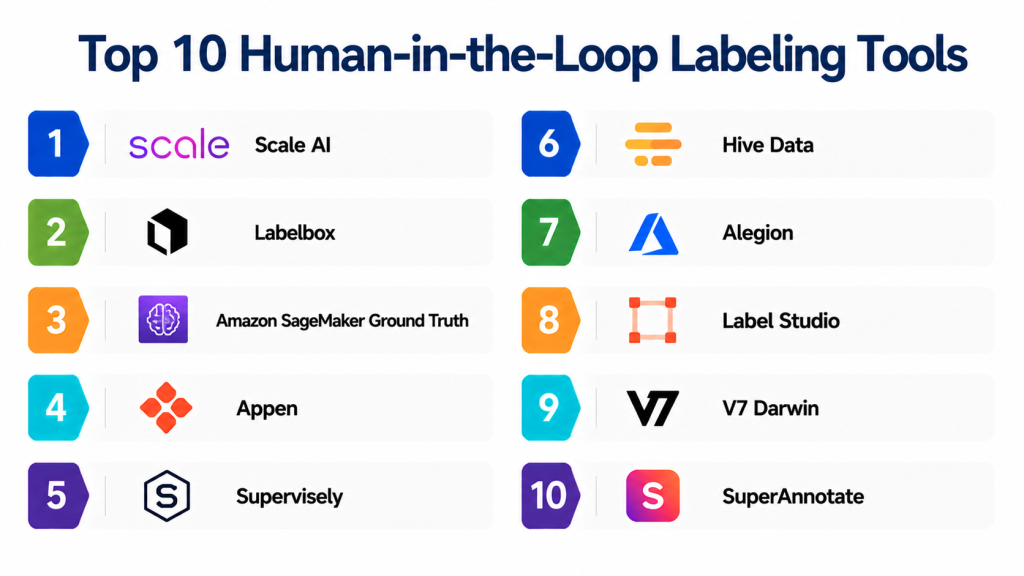
Top 10 Human-in-the-Loop Labeling Tools
1- Scale AI
Short description:
Scale AI is a leading HITL labeling platform offering high-quality annotation services for computer vision, NLP, and autonomous systems.
Key Features
- Image, video, text, and sensor data annotation
- AI-assisted pre-labeling
- Consensus-based quality control
- Task management and workforce assignment
- Real-time monitoring and analytics
- API integrations for ML pipelines
- Cloud-based deployment
Pros
- High-quality enterprise-grade annotations
- Scalable workforce and automation
- Integrates with multiple ML frameworks
Cons
- Enterprise pricing
- Complex onboarding for small teams
- Cloud-only platform
Platforms / Deployment
Cloud / SaaS
Security & Compliance
Encryption, RBAC, audit logging, GDPR, HIPAA (for healthcare datasets)
Integrations & Ecosystem
- TensorFlow, PyTorch, and ML frameworks
- Cloud storage (AWS, GCP, Azure)
- Workflow and ML pipeline integrations
Support & Community
Enterprise support and extensive documentation
2- Labelbox
Short description:
Labelbox is a collaborative platform for human-in-the-loop labeling supporting multiple data types and AI-assisted annotation workflows.
Key Features
- Image, video, and text labeling
- AI-assisted pre-labeling and model-in-the-loop
- Consensus-based quality control
- Workflow management and collaboration
- Visualization and annotation tools
- Integration APIs
- Analytics dashboards
Pros
- Flexible annotation for multiple modalities
- Collaboration and workflow management
- AI-assisted labeling improves efficiency
Cons
- Enterprise pricing for advanced features
- Limited offline capabilities
- Learning curve for complex workflows
Platforms / Deployment
Cloud / SaaS
Security & Compliance
RBAC, encryption, SSO, HIPAA/GDPR compliance
Integrations & Ecosystem
- ML frameworks (TensorFlow, PyTorch)
- Cloud storage and pipelines
- Data versioning and experiment tracking tools
Support & Community
Enterprise support and active documentation
3- Amazon SageMaker Ground Truth
Short description:
SageMaker Ground Truth provides HITL labeling integrated into the AWS ecosystem, supporting scalable AI/ML dataset creation.
Key Features
- Multi-modal labeling (images, text, audio)
- Built-in workflow automation
- Active learning for AI-assisted labeling
- Human review and consensus
- Integration with SageMaker ML pipelines
- Quality control and auditing
- Cloud-native deployment
Pros
- Tight AWS integration
- Scalable labeling workforce
- AI-assisted pre-labeling
Cons
- AWS ecosystem lock-in
- Cloud-only
- Pricing scales with usage
Platforms / Deployment
Cloud / AWS
Security & Compliance
IAM integration, encryption, audit logs, GDPR, HIPAA
Integrations & Ecosystem
- AWS S3, SageMaker ML pipelines
- AI/ML model training
- Analytics and monitoring tools
Support & Community
AWS enterprise support and documentation
4- Appen
Short description:
Appen offers HITL labeling with global workforce support for NLP, computer vision, and speech datasets.
Key Features
- Multi-modal annotation (text, image, video, audio)
- Global workforce for distributed labeling
- Quality control with consensus workflows
- Task assignment and workforce management
- Reporting and analytics
- API access for ML integration
- Cloud deployment
Pros
- Large global workforce
- Scalable for enterprise datasets
- Strong quality control mechanisms
Cons
- Enterprise-focused pricing
- Limited on-prem options
- Workflow customization can be complex
Platforms / Deployment
Cloud / SaaS
Security & Compliance
Encryption, RBAC, audit logging, GDPR, HIPAA
Integrations & Ecosystem
- ML pipelines
- Cloud storage
- AI/ML frameworks
- Data versioning tools
Support & Community
Enterprise support and professional services
5- Supervisely
Short description:
Supervisely provides a collaborative AI-assisted labeling platform for computer vision and image/video annotation.
Key Features
- Image and video annotation
- AI-assisted pre-labeling
- Team collaboration and workflow management
- Dataset versioning
- Quality control and consensus
- API access and ML integration
- Cloud and on-prem deployment
Pros
- Strong computer vision focus
- Collaborative workflows
- AI-assisted labeling increases efficiency
Cons
- Enterprise pricing for advanced features
- Less suited for NLP/audio datasets
- Learning curve for large teams
Platforms / Deployment
Cloud / On-prem / Hybrid
Security & Compliance
RBAC, encryption, audit logs
Integrations & Ecosystem
- TensorFlow, PyTorch
- Cloud storage
- Computer vision ML pipelines
- Analytics tools
Support & Community
Enterprise support and documentation
6- Hive Data
Short description:
Hive Data provides HITL labeling for computer vision and NLP with AI-assisted tools and real-time workforce management.
Key Features
- Multi-modal data annotation
- AI-assisted labeling
- Real-time task management
- Quality control workflows
- API integration
- Cloud-native platform
- Monitoring and reporting
Pros
- Fast annotation with AI assistance
- Cloud-native and scalable
- Workforce management tools
Cons
- Commercial pricing
- Cloud-only deployment
- Limited offline support
Platforms / Deployment
Cloud / SaaS
Security & Compliance
Encryption, RBAC, GDPR compliance
Integrations & Ecosystem
- ML frameworks
- Cloud storage
- AI pipelines
- Analytics dashboards
Support & Community
Vendor enterprise support
7- Alegion
Short description:
Alegion is an enterprise HITL labeling platform specializing in computer vision and AI training datasets.
Key Features
- Image, video, text labeling
- AI-assisted pre-labeling
- Workforce and task management
- Quality control and consensus labeling
- Integration with ML pipelines
- Analytics dashboards
- Cloud deployment
Pros
- Enterprise-ready platform
- Scalable and accurate labeling
- Supports AI/ML pipelines
Cons
- Enterprise pricing
- Cloud-only
- Requires onboarding for teams
Platforms / Deployment
Cloud / SaaS
Security & Compliance
RBAC, encryption, audit logging, GDPR
Integrations & Ecosystem
- TensorFlow, PyTorch
- Cloud storage
- AI pipelines
- Data analytics tools
Support & Community
Enterprise vendor support
8- Label Studio
Short description:
Label Studio is an open-source HITL labeling platform supporting multi-modal data annotation and custom workflows.
Key Features
- Image, video, audio, text annotation
- AI-assisted pre-labeling
- Customizable workflows
- Real-time collaboration
- Data versioning
- API access
- On-prem and cloud deployment
Pros
- Open-source and flexible
- Multi-modal support
- Highly customizable
Cons
- Requires technical setup
- Enterprise features need additional configuration
- Smaller enterprise support compared to commercial platforms
Platforms / Deployment
Cloud / On-prem / Hybrid
Security & Compliance
RBAC, encryption, audit logs
Integrations & Ecosystem
- ML frameworks
- Cloud storage
- AI pipelines
- Analytics tools
Support & Community
Open-source community and enterprise support options
9- V7 Darwin
Short description:
V7 Darwin is a collaborative platform for computer vision labeling with AI-assisted annotation tools.
Key Features
- Image and video annotation
- AI-assisted pre-labeling
- Team collaboration
- Quality control and consensus
- Workflow management
- API access
- Cloud-native deployment
Pros
- Strong computer vision focus
- Easy-to-use interface
- Scalable for enterprise teams
Cons
- Cloud-only deployment
- Commercial pricing
- Limited NLP/audio support
Platforms / Deployment
Cloud / SaaS
Security & Compliance
RBAC, encryption, audit logging
Integrations & Ecosystem
- ML frameworks
- Cloud storage
- AI pipelines
- Analytics dashboards
Support & Community
Vendor enterprise support
10- SuperAnnotate
Short description:
SuperAnnotate provides HITL labeling for images, video, and AI training datasets with scalable annotation workflows.
Key Features
- Image and video annotation
- AI-assisted pre-labeling
- Collaborative workflows
- Quality control and consensus
- Project management dashboards
- API integration
- Cloud-native deployment
Pros
- Enterprise-grade computer vision labeling
- Scalable and collaborative
- AI-assisted tools improve efficiency
Cons
- Cloud-only platform
- Commercial pricing
- Requires onboarding for teams
Platforms / Deployment
Cloud / SaaS
Security & Compliance
RBAC, encryption, audit logging, GDPR
Integrations & Ecosystem
- ML frameworks
- Cloud storage
- AI pipelines
- Analytics tools
Support & Community
Enterprise support and documentation
Comparison Table
| Tool Name | Best For | Platform(s) Supported | Deployment | Standout Feature | Public Rating |
|---|---|---|---|---|---|
| Scale AI | Enterprise ML datasets | Cloud | Cloud | Scalable HITL labeling | N/A |
| Labelbox | Multi-modal annotation | Cloud | Cloud | Collaboration & AI-assisted | N/A |
| SageMaker Ground Truth | AWS ML pipelines | Cloud | AWS | Integrated with SageMaker | N/A |
| Appen | Global workforce labeling | Cloud | Cloud | Large workforce | N/A |
| Supervisely | Computer vision datasets | Cloud/On-prem | Hybrid | Collaborative CV labeling | N/A |
| Hive Data | Multi-modal enterprise | Cloud | Cloud | Real-time task management | N/A |
| Alegion | Enterprise AI datasets | Cloud | Cloud | Accurate HITL labeling | N/A |
| Label Studio | Open-source multi-modal | Cloud/On-prem | Hybrid | Customizable workflows | N/A |
| V7 Darwin | Computer vision focus | Cloud | Cloud | AI-assisted CV labeling | N/A |
| SuperAnnotate | Enterprise CV datasets | Cloud | Cloud | Scalable annotation workflows | N/A |
Evaluation & Scoring
| Tool | Core (25%) | Ease (15%) | Integrations (15%) | Security (10%) | Performance (10%) | Support (10%) | Value (15%) | Weighted Total |
|---|---|---|---|---|---|---|---|---|
| Scale AI | 9.5 | 8.5 | 9.0 | 8.8 | 9.2 | 8.8 | 8.5 | 8.97 |
| Labelbox | 9.0 | 8.3 | 8.8 | 8.5 | 8.9 | 8.7 | 8.4 | 8.72 |
| Ground Truth | 9.2 | 8.4 | 8.9 | 8.7 | 9.0 | 8.8 | 8.5 | 8.83 |
| Appen | 8.8 | 8.2 | 8.5 | 8.5 | 8.8 | 8.6 | 8.4 | 8.53 |
| Supervisely | 9.0 | 8.3 | 8.7 | 8.6 | 8.9 | 8.5 | 8.4 | 8.67 |
| Hive Data | 8.7 | 8.2 | 8.6 | 8.5 | 8.8 | 8.5 | 8.3 | 8.51 |
| Alegion | 8.9 | 8.2 | 8.7 | 8.6 | 8.9 | 8.5 | 8.4 | 8.63 |
| Label Studio | 8.5 | 8.0 | 8.3 | 8.3 | 8.4 | 8.2 | 8.2 | 8.28 |
| V7 Darwin | 8.7 | 8.3 | 8.5 | 8.4 | 8.6 | 8.4 | 8.3 | 8.44 |
| SuperAnnotate | 8.8 | 8.3 | 8.6 | 8.5 | 8.7 | 8.4 | 8.4 | 8.51 |
Which Human-in-the-Loop Labeling Tool Is Right for You?
Solo / Freelancer
Label Studio or Supervisely for small-scale labeling projects and experimentation
SMB
Labelbox or Supervisely for team-based collaboration and moderate-scale datasets
Mid-Market
Scale AI, Ground Truth, or Appen for larger ML datasets and multi-modal annotation
Enterprise
Supervisely, Alegion, Hive Data, or SuperAnnotate for scalable, accurate enterprise HITL workflows
Budget vs Premium
Open-source Label Studio for budget-conscious teams; Scale AI, Appen, and Labelbox for premium enterprise pipelines
Feature Depth vs Ease of Use
Scale AI, Alegion, and Appen provide depth; Labelbox and Supervisely balance usability with features
Integrations & Scalability
Scale AI, Ground Truth, and Supervisely lead in pipeline integration and workforce scalability
Security & Compliance Needs
Enterprise platforms provide RBAC, SSO/SAML, encryption, audit logs, and GDPR/HIPAA compliance
Frequently Asked Questions
1- What is a Human-in-the-Loop labeling tool?
A platform combining human expertise with AI to annotate, label, and validate datasets for ML model training.
2- Which data types do these platforms support?
Images, video, audio, text, and sensor datasets across computer vision, NLP, and other AI domains.
3- Can HITL labeling platforms integrate with ML pipelines?
Yes, most provide APIs and connectors for TensorFlow, PyTorch, and cloud ML pipelines.
4- Do these tools provide AI-assisted labeling?
Many platforms use pre-labeling and active learning to accelerate human annotation.
5- Are open-source options available?
Yes, Label Studio is an open-source HITL labeling platform.
6- Can these platforms handle large-scale enterprise datasets?
Yes, Scale AI, Appen, Supervisely, and Alegion are designed for enterprise-scale labeling.
7- Is cloud deployment required?
Most modern tools are cloud-native, though some support on-premises or hybrid deployment.
8- How is data quality ensured?
Through consensus labeling, multi-reviewer workflows, and validation rules.
9- Which industries use HITL labeling?
Autonomous vehicles, healthcare AI, NLP, computer vision, e-commerce, and AI research.
10- What should guide tool selection?
Dataset size, annotation complexity, modality support, AI-assisted features, security, and budget.
Conclusion
Human-in-the-Loop Labeling Tools are essential for high-quality dataset preparation in modern AI and ML workflows. Open-source options like Label Studio provide flexibility for small teams, while enterprise platforms like Scale AI, Appen, Supervisely, and Alegion deliver scalable, accurate, and secure labeling pipelines. Organizations should assess dataset volume, annotation complexity, team size, integration needs, and compliance requirements before selecting a platform. Piloting helps validate efficiency, accuracy, and integration with ML workflows prior to full-scale adoption.
