Introduction
Data Annotation Platforms are solutions that label and tag datasets to train machine learning and AI models. They provide tools and workflows for annotating images, text, audio, video, and other data types, ensuring high-quality, structured datasets for supervised learning.
With the increasing reliance on AI and machine learning across industries, accurate annotation is critical for model accuracy, reliability, and performance. Modern data annotation platforms also offer collaboration, quality control, and integration with ML pipelines to streamline AI development.
Real-world use cases include
- Image annotation for computer vision models
- Text labeling for NLP tasks like sentiment analysis and entity recognition
- Audio transcription and tagging for speech recognition
- Video annotation for object tracking and action recognition
- Dataset labeling for recommendation systems and autonomous systems
What buyers should evaluate
- Supported data types (text, image, audio, video)
- Annotation tools and interface usability
- Quality assurance and review workflows
- Scalability and collaboration features
- Integration with ML pipelines and MLOps platforms
- Automation and AI-assisted labeling features
- Security, access control, and compliance
- Real-time annotation and dataset updates
- Analytics and reporting on annotation progress
- Pricing and licensing structure
Best for: Data scientists, ML engineers, AI teams, enterprises building supervised learning models, and organizations needing large-scale high-quality labeled datasets
Not ideal for: Small projects with minimal data or unsupervised learning models
Key Trends in Data Annotation Platforms
- AI-assisted and semi-automated labeling to speed up annotation
- Real-time collaboration for distributed teams
- Multi-modal annotation across images, text, audio, and video
- Integration with MLOps pipelines for continuous model training
- Quality control and review workflows using consensus scoring
- Cloud-native platforms for scalable annotation projects
- Low-code/no-code annotation tools for business users
- Dataset versioning and lineage tracking
- Support for synthetic data generation
- Security and compliance enhancements for enterprise use
How We Selected These Tools
- Support for multiple data types and annotation formats
- Integration with ML pipelines and AI frameworks
- Scalability for large datasets
- Quality assurance, review, and workflow features
- Collaboration and project management capabilities
- AI-assisted or automated labeling features
- Security, compliance, and access controls
- Usability and user interface experience
- Vendor support and community engagement
- Relevance for enterprise AI development and ML operations
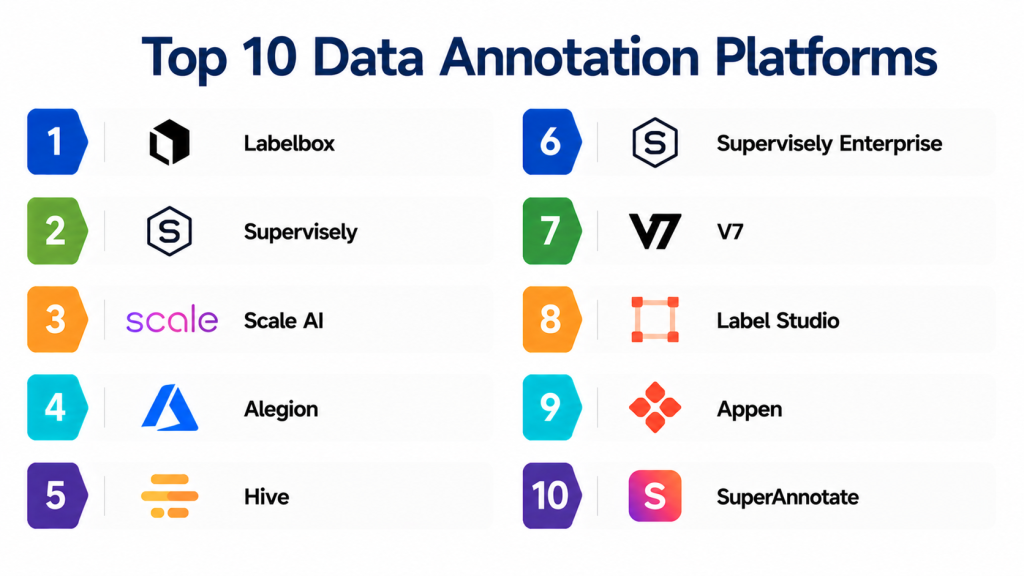
Top 10 Data Annotation Platforms
1- Labelbox
Short description: Labelbox is a cloud-based data annotation platform providing tools for labeling, quality control, and dataset management for AI and ML teams.
Key Features
- Annotation for images, video, text, and audio
- Collaboration and workflow management
- AI-assisted labeling tools
- Quality review and consensus scoring
- Dataset management and versioning
- API and SDK integration
- Analytics and reporting dashboards
Pros
- Intuitive interface for teams
- Scalable for large datasets
- AI-assisted labeling improves efficiency
Cons
- Cloud-only deployment
- Enterprise features require paid plans
Platforms / Deployment
- Cloud
Security & Compliance
- SSO, encryption at rest/in-transit
- Not publicly stated
Integrations & Ecosystem
- Python SDK, REST APIs
- Integration with TensorFlow, PyTorch
- Cloud storage connectors
Support & Community
Enterprise support and active developer resources
2- Supervisely
Short description: Supervisely is a multi-modal data annotation platform for computer vision and AI, offering collaborative labeling and project management.
Key Features
- Image, video, and 3D annotation
- AI-assisted labeling
- Team collaboration and workflow management
- Versioning and dataset tracking
- Project analytics
- API and SDK support
- Integration with ML pipelines
Pros
- Strong computer vision focus
- Collaborative features for distributed teams
- Flexible deployment options
Cons
- Steeper learning curve for beginners
- Limited text/audio support
Platforms / Deployment
- Cloud / Self-hosted
Security & Compliance
- Not publicly stated
Integrations & Ecosystem
- Python, REST APIs
- PyTorch, TensorFlow
- Cloud storage connectors
Support & Community
Active community and enterprise support
3- Scale AI
Short description: Scale AI provides a platform for high-quality data annotation and labeling across multiple data types, focusing on enterprise AI applications.
Key Features
- Image, video, text, and LiDAR annotation
- Human-in-the-loop and AI-assisted labeling
- Quality control workflows
- Dataset management and versioning
- API integration for ML pipelines
- Analytics and reporting
- Collaboration tools for annotation teams
Pros
- Enterprise-grade annotation
- High-quality labeling
- Scalable workforce management
Cons
- Expensive for small teams
- Limited on-premises options
Platforms / Deployment
- Cloud
Security & Compliance
- SSO, encryption
- Not publicly stated
Integrations & Ecosystem
- REST APIs, Python SDKs
- Integration with ML frameworks
- Cloud storage connectors
Support & Community
Vendor support with technical documentation
4- Alegion
Short description: Alegion is a data annotation platform for AI and ML offering human-in-the-loop labeling with workflow management and quality control.
Key Features
- Multi-modal data labeling (image, video, text)
- Human-in-the-loop and AI-assisted workflows
- Quality control with consensus scoring
- Collaboration and task assignment
- Dataset versioning
- API and SDK integration
- Analytics and reporting
Pros
- Strong quality control mechanisms
- Scalable workforce management
- Enterprise-ready
Cons
- Cloud-only deployment
- Costs scale with annotation volume
Platforms / Deployment
- Cloud
Security & Compliance
- Not publicly stated
Integrations & Ecosystem
- Python, REST APIs
- ML framework integration
- Cloud storage connectors
Support & Community
Vendor support with training resources
5- Hive
Short description: Hive offers a platform for AI-driven data annotation, providing tools for labeling, quality assurance, and large-scale dataset management.
Key Features
- Image, video, and text annotation
- AI-assisted and semi-automated labeling
- Quality control workflows
- Dataset management and versioning
- Real-time collaboration
- API and SDK support
- Analytics dashboards
Pros
- Fast annotation with AI-assistance
- Scalable for enterprise datasets
- Real-time collaboration
Cons
- Cloud-only deployment
- Enterprise pricing
Platforms / Deployment
- Cloud
Security & Compliance
- Not publicly stated
Integrations & Ecosystem
- Python, REST APIs
- ML pipelines and frameworks
- Cloud storage connectors
Support & Community
Vendor support and active technical documentation
6- Supervisely Enterprise
Short description: Enterprise edition of Supervisely designed for large-scale, secure, and multi-team annotation projects.
Key Features
- Advanced collaboration and project management
- AI-assisted labeling
- Multi-modal support (image, video, 3D)
- Dataset versioning and governance
- Analytics dashboards
- API and SDK integration
- Security and compliance features
Pros
- Designed for large enterprise teams
- Scalable multi-team workflows
- Strong project management
Cons
- Higher cost for enterprise edition
- Requires trained operators
Platforms / Deployment
- Cloud / Self-hosted / Hybrid
Security & Compliance
- Not publicly stated
Integrations & Ecosystem
- ML frameworks, Python SDKs
- REST APIs
- Cloud storage integration
Support & Community
Vendor enterprise support and community resources
7- V7
Short description: V7 provides a platform for computer vision data annotation with AI-assisted labeling and workflow management.
Key Features
- Image and video annotation
- AI-assisted labeling tools
- Collaboration and task assignment
- Dataset versioning and quality review
- Real-time analytics
- API and SDK support
- Integration with ML pipelines
Pros
- Excellent computer vision focus
- AI-assisted workflow speeds annotation
- Collaboration features
Cons
- Limited support for text/audio data
- Cloud-only deployment
Platforms / Deployment
- Cloud
Security & Compliance
- Not publicly stated
Integrations & Ecosystem
- Python SDKs, REST APIs
- ML frameworks integration
- Cloud storage
Support & Community
Vendor support and documentation
8- Label Studio
Short description: Label Studio is an open-source data labeling platform supporting multiple data types and custom annotation workflows.
Key Features
- Text, image, audio, video annotation
- Customizable labeling interfaces
- Human-in-the-loop workflows
- API and SDK support
- Dataset versioning
- Quality control tools
- Cloud and on-prem deployment
Pros
- Open-source flexibility
- Multi-modal support
- Customizable for complex projects
Cons
- Requires self-hosting for full control
- Enterprise features limited without custom setup
Platforms / Deployment
- Cloud / Self-hosted
Security & Compliance
- Not publicly stated
Integrations & Ecosystem
- Python SDK, REST APIs
- Integration with ML pipelines
- Cloud storage connectors
Support & Community
Active open-source community and technical guides
9- Appen
Short description: Appen offers a human-in-the-loop annotation platform with large-scale workforce management for AI and ML datasets.
Key Features
- Image, text, audio, video annotation
- Human-in-the-loop labeling
- Quality control and review workflows
- Dataset management
- Multi-team collaboration
- API and SDK support
- Analytics dashboards
Pros
- Large scalable workforce
- High-quality annotations
- Enterprise-ready
Cons
- Costly for small projects
- Limited automation features
Platforms / Deployment
- Cloud
Security & Compliance
- Not publicly stated
Integrations & Ecosystem
- ML pipelines, REST APIs
- Python SDKs
- Cloud storage
Support & Community
Vendor enterprise support and training resources
10- SuperAnnotate
Short description: SuperAnnotate is a platform for collaborative image and video annotation, offering AI-assisted labeling and workflow management.
Key Features
- Image and video annotation
- AI-assisted labeling
- Team collaboration and project management
- Dataset versioning
- Quality review and consensus scoring
- API integration
- Analytics dashboards
Pros
- Strong collaboration tools
- AI-assisted annotation speeds up workflow
- Scalable for large datasets
Cons
- Limited support for text/audio
- Cloud-only deployment
Platforms / Deployment
- Cloud
Security & Compliance
- Not publicly stated
Integrations & Ecosystem
- Python SDK, REST APIs
- ML pipelines and frameworks
- Cloud storage connectors
Support & Community
Vendor support and documentation
Comparison Table
| Tool | Best For | Platform(s) | Deployment | Standout Feature | Public Rating |
|---|---|---|---|---|---|
| Labelbox | Multi-modal labeling | Cloud | Cloud | AI-assisted annotation | N/A |
| Supervisely | Computer vision | Cloud/Self-hosted | Hybrid | Team collaboration & 3D support | N/A |
| Scale AI | Enterprise AI datasets | Cloud | Cloud | Human-in-the-loop | N/A |
| Alegion | Multi-modal enterprise | Cloud | Cloud | Quality control workflows | N/A |
| Hive | AI-assisted labeling | Cloud | Cloud | Fast annotation | N/A |
| Supervisely Enterprise | Large-scale projects | Cloud/Self-hosted | Hybrid | Enterprise-grade workflows | N/A |
| V7 | Computer vision | Cloud | Cloud | AI-assisted labeling | N/A |
| Label Studio | Open-source | Cloud/Self-hosted | Hybrid | Customizable workflows | N/A |
| Appen | Workforce-based labeling | Cloud | Cloud | Large-scale human labeling | N/A |
| SuperAnnotate | Image/video | Cloud | Cloud | Team collaboration | N/A |
Evaluation & Scoring of Data Annotation Platforms
| Tool | Core (25%) | Ease (15%) | Integrations (15%) | Security (10%) | Performance (10%) | Support (10%) | Value (15%) | Weighted Total |
|---|---|---|---|---|---|---|---|---|
| Labelbox | 9 | 9 | 8 | 8 | 9 | 8 | 8 | 8.6 |
| Supervisely | 8 | 8 | 8 | 7 | 8 | 7 | 8 | 7.9 |
| Scale AI | 9 | 8 | 8 | 7 | 8 | 7 | 8 | 8.0 |
| Alegion | 8 | 8 | 7 | 7 | 8 | 7 | 8 | 7.7 |
| Hive | 8 | 8 | 7 | 7 | 8 | 7 | 8 | 7.7 |
| Supervisely Enterprise | 9 | 8 | 8 | 8 | 8 | 8 | 8 | 8.2 |
| V7 | 8 | 8 | 7 | 7 | 8 | 7 | 8 | 7.7 |
| Label Studio | 8 | 8 | 7 | 7 | 8 | 7 | 8 | 7.7 |
| Appen | 8 | 7 | 7 | 7 | 8 | 7 | 7 | 7.4 |
| SuperAnnotate | 8 | 8 | 7 | 7 | 8 | 7 | 8 | 7.7 |
Which Data Annotation Tool Is Right for You?
Solo / Freelancer
- Label Studio, V7
Lightweight or open-source solutions for small projects
SMB
- Labelbox, Supervisely, SuperAnnotate
Balance of usability and collaboration features
Mid-Market
- Scale AI, Hive, Alegion
Enterprise-ready for larger datasets
Enterprise
- Supervisely Enterprise, Appen, Labelbox
High-scale, multi-team workflows with quality control
Budget vs Premium
- Budget: Label Studio, V7
- Premium: Scale AI, Supervisely Enterprise, Appen
Feature Depth vs Ease of Use
- Ease: Labelbox, SuperAnnotate
- Depth: Scale AI, Supervisely Enterprise, Alegion
Integrations & Scalability
- Best: Labelbox, Scale AI, Supervisely Enterprise
Security & Compliance Needs
- Enterprise-ready: Labelbox, Appen, Supervisely Enterprise
Frequently Asked Questions
1- What is a data annotation platform?
It provides tools to label and tag datasets for AI and ML training with structured workflows.
2- Do these platforms support multi-modal data?
Yes, most support images, text, audio, and video annotation.
3- Can AI assist in labeling?
Yes, semi-automated AI-assisted labeling reduces manual effort and improves consistency.
4- Are these tools suitable for small teams?
Open-source or lightweight cloud tools like Label Studio or V7 are suitable for small projects.
5- How do they ensure annotation quality?
Through review workflows, consensus scoring, and human-in-the-loop verification.
6- Can these tools integrate with ML pipelines?
Yes, most platforms provide APIs or SDKs for seamless ML integration.
7- Are there self-hosted options?
Yes, Label Studio and Supervisely offer self-hosted deployments.
8- What industries use data annotation platforms?
Computer vision, NLP, autonomous vehicles, robotics, healthcare, and enterprise AI teams.
9- How scalable are these platforms?
Cloud-native tools like Scale AI and Supervisely Enterprise support enterprise-scale annotation projects.
10- How should I choose the right platform?
Evaluate dataset type, scale, collaboration needs, AI-assisted labeling, and deployment options.
Conclusion
Data Annotation Platforms are essential for creating high-quality labeled datasets required for AI and ML model training. They streamline labeling, enforce quality, and integrate with ML pipelines, accelerating AI development and improving model performance.
Selecting the right platform depends on project size, data modality, team collaboration, and deployment preferences. A practical approach is to shortlist pilot annotation projects, and validate quality, performance, and integration before scaling enterprise-wide.
