Introduction
Feature Store Platforms are specialized systems that help teams manage, store, and serve machine learning features consistently across training and production environments. They act as a central layer for feature engineering, ensuring that data used in model development is reliable, reusable, and production-ready.
In the modern AI ecosystem, feature stores are essential for solving challenges like data inconsistency, feature duplication, and real-time inference needs. As organizations scale machine learning, feature stores enable governance, collaboration, and performance optimization, making them a critical component of MLOps architectures.
Real-world use cases include:
- Real-time fraud detection using streaming features
- Recommendation systems powered by user behavior features
- Customer segmentation and personalization
- Predictive maintenance in industrial systems
- Risk scoring in financial services
What buyers should evaluate:
- Offline and online feature store capabilities
- Real-time data processing support
- Integration with data pipelines and ML tools
- Scalability and performance
- Data governance and lineage
- Security and access control
- Ease of use and developer experience
- Cost and infrastructure requirements
Best for: Data engineers, ML engineers, data scientists, enterprises building scalable ML systems, and organizations with complex data pipelines.
Not ideal for: Small teams with simple ML workflows or projects that don’t require feature reuse and real-time serving.
Key Trends in Feature Store Platforms
- Real-time feature serving becoming standard
- Integration with streaming data platforms
- Built-in governance and lineage tracking
- Support for hybrid and multi-cloud deployments
- Feature reuse across teams and projects
- Automated feature engineering tools emerging
- Strong focus on data consistency and validation
- Integration with MLOps and orchestration tools
- Edge and low-latency feature delivery
- Security-first architectures with access controls
How We Feature Store Platforms (Methodology)
We evaluated feature store platforms based on:
- Adoption and industry usage
- Feature completeness (online + offline stores)
- Performance and scalability
- Security and governance capabilities
- Integration ecosystem
- Ease of use and onboarding
- Deployment flexibility
- Support and community strength
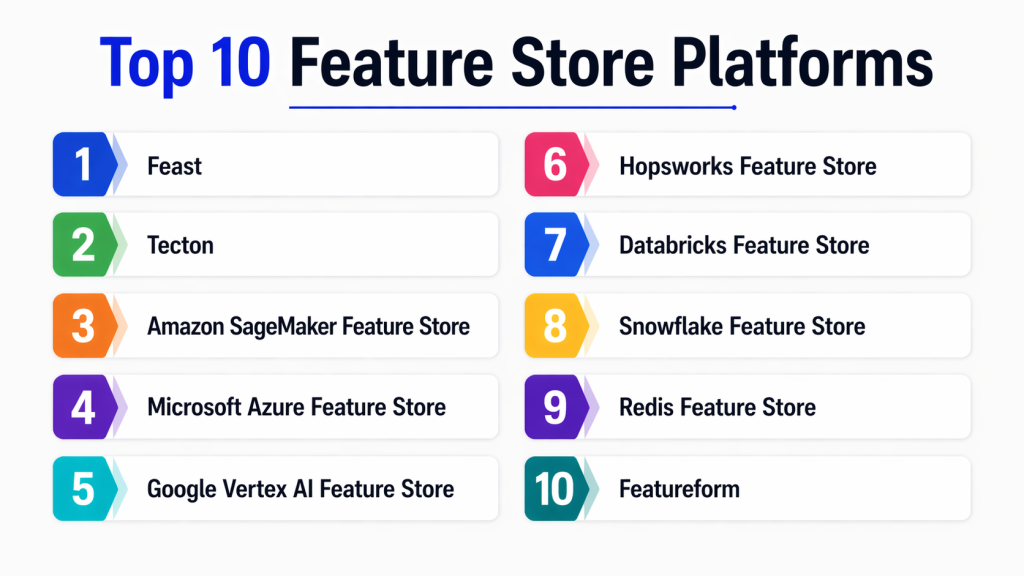
Top 10 Feature Store Platforms
#1 — Feast
Short description :
Feast is a popular open-source feature store designed for managing and serving ML features. It provides both online and offline feature storage capabilities. Widely adopted by ML teams, it integrates easily with data pipelines. Feast is flexible and scalable. Ideal for organizations building production ML systems.
Key Features
- Online and offline feature store
- Feature versioning
- Real-time serving
- Data consistency guarantees
- Open-source architecture
Pros
- Flexible and customizable
- Strong community support
Cons
- Requires setup and maintenance
- Limited UI
Platforms / Deployment
Linux / Windows
Cloud / Self-hosted
Security & Compliance
Basic access control
Compliance: Not publicly stated
Integrations & Ecosystem
- Data pipelines
- ML frameworks
- Cloud services
Support & Community
Active open-source community.
#2 — Tecton
Short description :
Tecton is an enterprise-grade feature platform built for real-time ML applications. It simplifies feature engineering and ensures consistency between training and serving. Designed for large-scale systems, it supports real-time pipelines. Ideal for enterprises with production ML workloads.
Key Features
- Real-time feature pipelines
- Feature registry
- Data transformation tools
- Low-latency serving
- Scalable architecture
Pros
- Enterprise-ready
- Strong real-time capabilities
Cons
- Expensive
- Complex setup
Platforms / Deployment
Cloud
Security & Compliance
RBAC, encryption
Compliance: Varies
Integrations & Ecosystem
- Data warehouses
- Streaming tools
- APIs
Support & Community
Enterprise support.
#3 — AWS SageMaker Feature Store
Short description :
SageMaker Feature Store is a managed feature store within AWS ecosystem. It enables centralized feature management and real-time serving. Fully integrated with AWS services. Ideal for cloud-native ML teams. Provides scalability and automation.
Key Features
- Managed feature store
- Real-time serving
- Data lineage tracking
- Integration with AWS
- Scalable infrastructure
Pros
- Fully managed
- Scalable
Cons
- AWS dependency
- Pricing complexity
Platforms / Deployment
Web
Cloud
Security & Compliance
IAM, encryption
Compliance: Varies
Integrations & Ecosystem
- AWS services
- Data lakes
- APIs
Support & Community
Enterprise support.
#4 — Azure Feature Store
Short description :
Azure Feature Store is part of Azure ML ecosystem. It enables feature management and sharing across teams. Integrated with Microsoft tools. Ideal for enterprise AI workflows. Supports scalable feature pipelines.
Key Features
- Feature sharing
- Integration with Azure ML
- Data pipelines
- Governance tools
Pros
- Enterprise integration
- Strong security
Cons
- Azure dependency
- Learning curve
Platforms / Deployment
Web
Cloud
Security & Compliance
Azure AD, RBAC
Compliance: Varies
Integrations & Ecosystem
- Azure services
- Data tools
Support & Community
Enterprise support.
#5 — Google Vertex AI Feature Store
Short description :
Vertex AI Feature Store provides managed feature storage and serving. Integrated with Google Cloud ecosystem. Supports real-time ML applications. Ideal for cloud-native teams. Offers scalability and automation.
Key Features
- Managed feature store
- Real-time serving
- Data consistency
- Integration with GCP
- Scalable architecture
Pros
- Highly scalable
- Easy integration
Cons
- Cloud dependency
- Pricing complexity
Platforms / Deployment
Web
Cloud
Security & Compliance
IAM, encryption
Compliance: Varies
Integrations & Ecosystem
- BigQuery
- GCP services
Support & Community
Strong support.
#6 — Hopsworks Feature Store
Short description :
Hopsworks is a full-featured feature store platform designed for enterprise ML workflows. It supports both batch and real-time features. Strong focus on governance and scalability. Ideal for large organizations.
Key Features
- Batch and streaming features
- Feature registry
- Data validation
- Governance tools
Pros
- Strong governance
- Scalable
Cons
- Complex setup
- Enterprise-focused
Platforms / Deployment
Cloud / On-premise
Security & Compliance
RBAC, audit logs
Compliance: Varies
Integrations & Ecosystem
- Data pipelines
- ML tools
Support & Community
Enterprise support.
#7 — Databricks Feature Store
Short description :
Databricks Feature Store integrates with the Databricks platform. It enables feature sharing and management within data workflows. Ideal for teams using Databricks ecosystem. Supports large-scale ML.
Key Features
- Feature sharing
- Integration with Spark
- Data pipelines
- Model integration
Pros
- Strong integration
- Scalable
Cons
- Requires Databricks
- Costly
Platforms / Deployment
Cloud
Security & Compliance
RBAC, encryption
Compliance: Varies
Integrations & Ecosystem
- Databricks
- Spark
Support & Community
Enterprise support.
#8 — Snowflake Feature Store
Short description :
Snowflake Feature Store enables feature management within Snowflake ecosystem. It integrates data warehousing with ML workflows. Ideal for analytics-driven teams. Supports scalable feature pipelines.
Key Features
- Data warehouse integration
- Feature pipelines
- Scalable architecture
Pros
- Easy integration
- Scalable
Cons
- Limited standalone features
- Snowflake dependency
Platforms / Deployment
Cloud
Security & Compliance
Encryption, RBAC
Compliance: Varies
Integrations & Ecosystem
- Snowflake
- Data tools
Support & Community
Strong support.
#9 — Redis Feature Store
Short description :
Redis-based feature stores provide ultra-low latency feature serving. Ideal for real-time applications. Focus on speed and performance. Used in production ML systems.
Key Features
- Low-latency serving
- Real-time features
- High performance
Pros
- Fast
- Scalable
Cons
- Limited offline capabilities
- Requires integration
Platforms / Deployment
Cloud / Self-hosted
Security & Compliance
Encryption
Compliance: Not publicly stated
Integrations & Ecosystem
- APIs
- Data pipelines
Support & Community
Strong community.
#10 — Featureform
Short description :
Featureform is an open-source feature store designed for simplicity and flexibility. It enables feature management and reuse. Suitable for small to mid-sized teams. Focuses on developer experience.
Key Features
- Feature registry
- Data pipelines
- Open-source
- Flexible design
Pros
- Easy to use
- Flexible
Cons
- Smaller ecosystem
- Limited enterprise features
Platforms / Deployment
Cloud / Self-hosted
Security & Compliance
Basic controls
Compliance: Not publicly stated
Integrations & Ecosystem
- ML tools
- APIs
Support & Community
Growing community.
Comparison Table (Top 10)
| Tool Name | Best For | Platform(s) | Deployment | Standout Feature | Public Rating |
|---|---|---|---|---|---|
| Feast | Open-source ML | Multi | Hybrid | Flexibility | N/A |
| Tecton | Enterprise | Cloud | Cloud | Real-time pipelines | N/A |
| SageMaker FS | AWS users | Web | Cloud | Managed features | N/A |
| Azure FS | Enterprise | Web | Cloud | Microsoft integration | N/A |
| Vertex FS | Cloud AI | Web | Cloud | Scalability | N/A |
| Hopsworks | Enterprise | Multi | Hybrid | Governance | N/A |
| Databricks FS | Data teams | Cloud | Cloud | Spark integration | N/A |
| Snowflake FS | Analytics | Cloud | Cloud | Warehouse integration | N/A |
| Redis FS | Real-time | Multi | Hybrid | Low latency | N/A |
| Featureform | Developers | Multi | Hybrid | Simplicity | N/A |
Evaluation & Scoring of Feature Store Platforms
| Tool | Core | Ease | Integration | Security | Performance | Support | Value | Total |
|---|---|---|---|---|---|---|---|---|
| Feast | 9 | 8 | 9 | 7 | 8 | 8 | 9 | 8.4 |
| Tecton | 10 | 7 | 9 | 9 | 9 | 9 | 6 | 8.7 |
| SageMaker FS | 9 | 7 | 10 | 9 | 9 | 9 | 7 | 8.7 |
| Azure FS | 9 | 7 | 10 | 9 | 9 | 9 | 7 | 8.7 |
| Vertex FS | 9 | 7 | 10 | 9 | 9 | 9 | 7 | 8.7 |
| Hopsworks | 9 | 7 | 8 | 9 | 9 | 8 | 7 | 8.4 |
| Databricks FS | 9 | 7 | 9 | 9 | 9 | 9 | 7 | 8.6 |
| Snowflake FS | 8 | 8 | 9 | 8 | 8 | 8 | 8 | 8.2 |
| Redis FS | 8 | 7 | 8 | 7 | 10 | 8 | 8 | 8.2 |
| Featureform | 7 | 8 | 7 | 6 | 7 | 7 | 9 | 7.6 |
Interpretation:
Higher scores indicate better enterprise readiness and scalability. Open-source tools offer flexibility, while managed platforms excel in performance and ease of deployment.
Which Feature Store Platform Is Right for You?
Solo / Freelancer
Use Feast, Featureform
SMB
Use Feast, Redis
Mid-Market
Use Hopsworks, Databricks
Enterprise
Use Tecton, SageMaker, Vertex
Budget vs Premium
Budget: Feast
Premium: Tecton
Feature Depth vs Ease
Depth: Tecton
Ease: Featureform
Integrations & Scalability
Best: Databricks, Vertex
Security & Compliance
Best: Azure, SageMaker
Frequently Asked Questions (FAQs)
1. What is a feature store?
A feature store is a system that manages and stores machine learning features in a centralized way. It ensures consistency between training and production environments. Teams can reuse features across multiple models, improving efficiency. It also helps maintain data quality and reliability. Feature stores are essential for scaling ML systems.
2. Why should I use a feature store?
Feature stores help reduce duplication of data transformations and improve collaboration across teams. They ensure that the same feature logic is used in both training and inference. This reduces errors and improves model accuracy. They also enable real-time feature serving. Overall, they streamline the ML workflow.
3. Are feature stores necessary for all ML projects?
Feature stores are not always required for small or simple ML projects. However, they become critical as systems scale and complexity increases. For organizations managing multiple models, they provide consistency and governance. They also help improve performance in production environments. Their value grows with scale.
4. What is the difference between online and offline feature stores?
An offline feature store is used for training models with historical data. An online feature store serves real-time features for predictions. Both are essential for a complete ML pipeline. Feature stores ensure consistency between these two layers. This helps avoid training-serving skew.
5. Are feature store platforms expensive?
The cost depends on the platform and deployment model. Open-source feature stores are free but require infrastructure and maintenance. Managed cloud solutions come with usage-based pricing. Enterprise platforms can be more expensive but offer advanced features. Organizations should evaluate cost vs value.
6. Can feature stores handle real-time data?
Yes, modern feature stores are designed to support real-time data processing. They can ingest streaming data and serve features with low latency. This is important for applications like fraud detection and recommendations. Performance depends on the underlying infrastructure. Real-time capability is a key differentiator.
7. Are feature stores secure?
Enterprise feature stores include security features like encryption, access control, and audit logs. Open-source tools may require additional configuration for security. Security also depends on how the platform is deployed. Organizations must follow best practices. Compliance varies by provider.
8. How long does it take to implement a feature store?
Implementation time depends on the complexity of your ML workflows. Small setups can be completed in a few weeks. Enterprise implementations may take several months. Proper planning and integration are important. The timeline also depends on team expertise.
9. Can feature stores integrate with existing tools?
Yes, most feature stores provide APIs and connectors for integration. They work with data pipelines, ML frameworks, and cloud platforms. Integration helps streamline workflows and improve efficiency. Compatibility varies by platform. Always check ecosystem support before choosing.
10. What are common mistakes when using feature stores?
Common mistakes include poor data governance, lack of feature standardization, and ignoring scalability. Teams may also underestimate integration complexity. Choosing the wrong platform can create long-term issues. Proper planning and evaluation are essential. Avoid rushing implementation decisions.
Conclusion
Feature store platforms have become a foundational component of modern machine learning systems, enabling organizations to manage, share, and serve features efficiently across the ML lifecycle. They solve critical challenges such as data consistency, feature reuse, and real-time inference, making them essential for scaling AI applications.
The right feature store depends on your organization’s size, infrastructure, and ML maturity. While open-source tools like Feast offer flexibility and cost advantages, enterprise platforms like Tecton and cloud-native feature stores provide scalability and governance. Start by evaluating your data workflows, experiment with a few platforms, and choose the one that aligns best with your long-term ML strategy.
