Introduction
Environmental Monitoring Platforms are software solutions designed to collect, process, and analyze data on air quality, water quality, soil conditions, weather, and ecological changes. These platforms allow organizations to track environmental conditions, comply with regulations, and make data-driven decisions for sustainability, risk management, and research.
Organizations in industries such as energy, agriculture, urban planning, and public health rely on environmental monitoring platforms to improve compliance, mitigate risks, and optimize operations. Effective monitoring supports proactive interventions, informs policy decisions, and enables long-term environmental stewardship.
Real-world use cases include:
- Monitoring air quality and pollutant levels in urban areas.
- Tracking water quality in rivers, lakes, and reservoirs.
- Detecting soil contamination and agricultural nutrient levels.
- Measuring weather, climate, and ecological changes.
- Supporting disaster response and environmental risk management.
Evaluation criteria for buyers:
- Sensor and device integration capabilities.
- Real-time data collection and analytics.
- Cloud or on-premise deployment flexibility.
- Alerting and reporting features.
- Regulatory compliance and environmental standards support.
- Scalability for multiple locations or large datasets.
- AI and machine learning analytics capabilities.
- Historical data storage and trend analysis.
- User interface and visualization dashboards.
- Pricing models suitable for research, government, or enterprise use.
Best for: Environmental agencies, research institutions, utility companies, municipalities, and industrial operators monitoring ecological or environmental conditions.
Not ideal for: Organizations without environmental monitoring needs; simple data collection tools may suffice.
Key Trends in Environmental Monitoring Platforms
- AI and machine learning for predictive analytics and anomaly detection.
- Cloud-native platforms with real-time sensor integration.
- Integration with IoT devices for remote monitoring.
- Regulatory compliance automation for environmental standards.
- Multi-location and multi-sensor fleet management.
- Advanced visualization dashboards for trend analysis.
- Mobile-first interfaces for field operators.
- Automated alerting and threshold notifications.
- Subscription-based and pay-per-sensor pricing models.
- Integration with GIS, ERP, and asset management software.
How We Selected These Tools (Methodology)
- Evaluated market adoption across research, government, and enterprise sectors.
- Assessed feature completeness including data collection, analytics, and alerting.
- Reviewed performance, reliability, and uptime for sensor networks.
- Verified security measures and regulatory compliance where publicly stated.
- Examined integration capabilities with sensors, IoT devices, GIS, and analytics tools.
- Considered scalability from single-site monitoring to multi-location deployments.
- Reviewed AI capabilities for predictive insights and automated alerts.
- Assessed user interface accessibility for technical and non-technical users.
- Checked customer support, onboarding, and documentation quality.
- Compared pricing models for flexibility across research, commercial, and enterprise users.
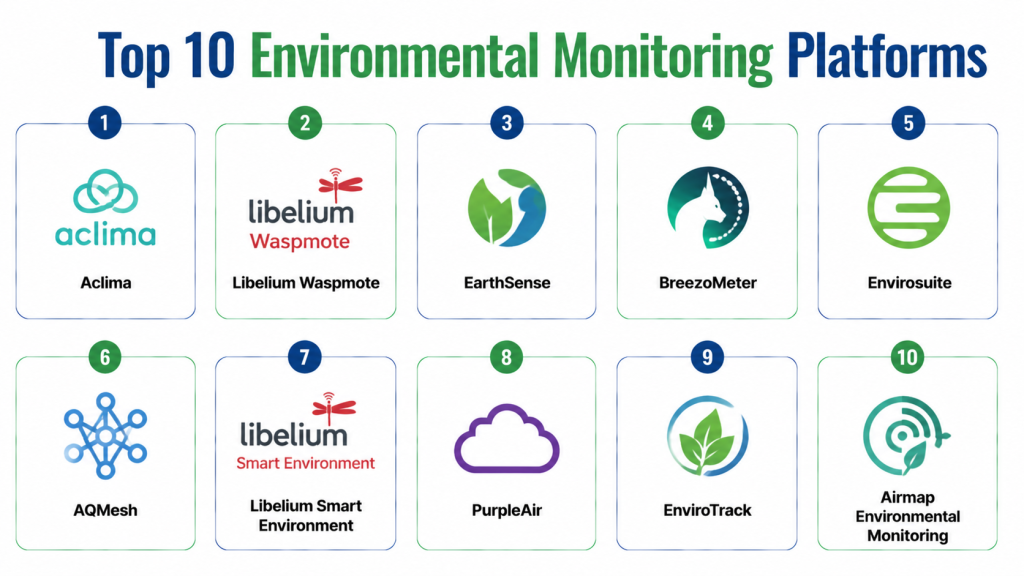
Top 10 Environmental Monitoring Platforms
1- Aclima
Short description: Air quality monitoring platform providing real-time environmental data and analytics for urban planning and public health.
Key Features
- Real-time air quality sensors
- Cloud-based analytics dashboards
- Mobile and web access
- API integrations for data export
- Historical data trend analysis
- Regulatory compliance support
Pros
- High-resolution urban air monitoring
- Strong analytics and visualization
Cons
- Primarily focused on air quality
- Requires sensor deployment
Platforms / Deployment
- Web / iOS / Android
- Cloud
Security & Compliance
- Not publicly stated
Integrations & Ecosystem
- GIS and public health databases
- IoT sensor integration
- API for analytics platforms
Support & Community
- Documentation, training, and support portal
2- Libelium Waspmote
Short description: IoT environmental sensor network platform for monitoring air, water, soil, and weather parameters.
Key Features
- Multi-sensor integration
- Wireless data transmission
- Cloud data analytics
- Real-time alerts
- API and data export
- Battery and energy management
Pros
- Highly versatile sensors
- Scalable network design
Cons
- Requires technical setup
- Data processing may need cloud integration
Platforms / Deployment
- Web / Embedded devices
- Cloud / On-premise
Security & Compliance
- Not publicly stated
Integrations & Ecosystem
- IoT dashboards
- GIS integration
- Cloud analytics APIs
Support & Community
- Documentation, community forums, and technical support
3- EarthSense
Short description: Environmental data platform specializing in air quality, emissions, and ecological monitoring with advanced analytics.
Key Features
- Air and emissions monitoring
- Real-time dashboards
- AI-assisted data analytics
- Multi-location management
- Regulatory reporting
- Historical trend analysis
Pros
- Advanced data analytics
- Multi-sensor deployment support
Cons
- Focused primarily on air quality and emissions
- May require training for complex analytics
Platforms / Deployment
- Web
- Cloud
Security & Compliance
- Not publicly stated
Integrations & Ecosystem
- GIS software
- IoT sensors and devices
- API for data export
Support & Community
- Technical support and documentation
4- BreezoMeter
Short description: Real-time environmental monitoring platform providing air quality, pollen, and pollution analytics for urban areas.
Key Features
- Air quality and pollution monitoring
- Pollen and allergen tracking
- Real-time alerts and notifications
- API for application integration
- Mobile and web dashboards
- Historical trend visualization
Pros
- Accurate and hyperlocal data
- Easy API integration
Cons
- Focused on air and pollen data
- Requires sensor network for best accuracy
Platforms / Deployment
- Web / iOS / Android
- Cloud
Security & Compliance
- Not publicly stated
Integrations & Ecosystem
- GIS and health applications
- API access
- Data visualization tools
Support & Community
- Documentation, tutorials, and support portal
5- Envirosuite
Short description: Industrial and environmental operations platform for air, water, and noise monitoring with predictive analytics.
Key Features
- Multi-environment monitoring
- Predictive AI analytics
- Alerting and notifications
- Data visualization dashboards
- Compliance management
- API access for reporting
Pros
- Supports industrial environmental monitoring
- Predictive capabilities
Cons
- Enterprise focus may not suit small teams
- Complex setup
Platforms / Deployment
- Web
- Cloud
Security & Compliance
- Not publicly stated
Integrations & Ecosystem
- GIS and ERP systems
- Sensor networks
- API for data workflows
Support & Community
- Documentation, training, and technical support
6- AQMesh
Short description: Compact sensor-based platform for air quality monitoring in urban and industrial environments.
Key Features
- Small-footprint air sensors
- Real-time data collection
- Cloud analytics
- Multi-site monitoring
- Regulatory reporting
- Alerts and notifications
Pros
- Easy deployment
- Cost-effective for multiple sites
Cons
- Focused only on air quality
- Limited integration options
Platforms / Deployment
- Web
- Cloud
Security & Compliance
- Not publicly stated
Integrations & Ecosystem
- GIS software
- IoT dashboards
- API access
Support & Community
- Documentation and support portal
7- Libelium Smart Environment
Short description: Comprehensive IoT solution for environmental monitoring including air, water, and soil sensors.
Key Features
- Multi-environment sensors
- Wireless data transmission
- Cloud analytics
- Real-time alerts
- Data export and API
- Energy-efficient sensor management
Pros
- Versatile for multiple environments
- Scalable sensor networks
Cons
- Technical setup required
- Data processing relies on cloud integration
Platforms / Deployment
- Web / Embedded
- Cloud / On-premise
Security & Compliance
- Not publicly stated
Integrations & Ecosystem
- GIS systems
- IoT dashboards
- API for custom workflows
Support & Community
- Documentation, community support
8- PurpleAir
Short description: Real-time air quality monitoring platform using low-cost sensor networks for urban and community applications.
Key Features
- Distributed low-cost sensors
- Real-time air quality maps
- Mobile and web dashboards
- Data sharing and export
- Alerts for threshold exceedance
- Historical data visualization
Pros
- Easy to deploy
- Community-focused data sharing
Cons
- Focused primarily on air monitoring
- Less enterprise features
Platforms / Deployment
- Web / iOS / Android
- Cloud
Security & Compliance
- Not publicly stated
Integrations & Ecosystem
- GIS platforms
- Public dashboards
- API access
Support & Community
- Documentation and forums
9- EnviroTrack
Short description: Platform for water, air, and soil monitoring with multi-location support and compliance reporting.
Key Features
- Water quality sensors
- Air and soil monitoring
- Real-time dashboards
- Alerts and notifications
- Historical trend analytics
- API integration
Pros
- Supports multiple environmental domains
- Multi-site monitoring
Cons
- Less mobile-focused
- Setup can be technical
Platforms / Deployment
- Web
- Cloud
Security & Compliance
- Not publicly stated
Integrations & Ecosystem
- GIS and ERP integration
- Sensor networks
- API access
Support & Community
- Documentation, technical support
10- Airmap Environmental Monitoring
Short description: UAV and sensor-integrated environmental monitoring platform for air, water, and soil analysis.
Key Features
- UAV data integration
- Multi-sensor support
- Real-time monitoring
- Alerts and compliance reporting
- Cloud dashboards
- Data export
Pros
- Integrates drones and ground sensors
- Centralized monitoring
Cons
- Enterprise-focused
- Setup complexity
Platforms / Deployment
- Web / iOS / Android
- Cloud
Security & Compliance
- Not publicly stated
Integrations & Ecosystem
- UAV platforms
- GIS and sensors
- API access
Support & Community
- Documentation and support portal
Comparison Table (Top 10)
| Tool Name | Best For | Platform(s) Supported | Deployment | Standout Feature | Public Rating |
|---|---|---|---|---|---|
| Aclima | Urban air quality | Web / iOS / Android | Cloud | Real-time air monitoring | N/A |
| Libelium Waspmote | Multi-environment IoT | Web / Embedded | Cloud / On-premise | Multi-sensor integration | N/A |
| EarthSense | Air quality & emissions | Web | Cloud | AI-assisted analytics | N/A |
| BreezoMeter | Air quality & pollen | Web / iOS / Android | Cloud | Hyperlocal data | N/A |
| Envirosuite | Industrial monitoring | Web | Cloud | Predictive analytics | N/A |
| AQMesh | Air quality monitoring | Web | Cloud | Compact sensors | N/A |
| Libelium Smart Environment | Multi-domain environmental | Web / Embedded | Cloud / On-premise | IoT sensor network | N/A |
| PurpleAir | Community air monitoring | Web / iOS / Android | Cloud | Distributed low-cost sensors | N/A |
| EnviroTrack | Water, air, soil monitoring | Web | Cloud | Multi-site monitoring | N/A |
| Airmap Environmental Monitoring | UAV & sensor integration | Web / iOS / Android | Cloud | Drone & ground sensor data | N/A |
Evaluation & Scoring of Environmental Monitoring Platforms
| Tool Name | Core | Ease | Integrations | Security | Performance | Support | Value | Weighted Total |
|---|---|---|---|---|---|---|---|---|
| Aclima | 9 | 8 | 8 | 7 | 8 | 8 | 7 | 7.9 |
| Libelium Waspmote | 8 | 7 | 8 | 7 | 8 | 7 | 7 | 7.6 |
| EarthSense | 8 | 7 | 7 | 7 | 8 | 7 | 7 | 7.4 |
| BreezoMeter | 8 | 8 | 7 | 7 | 8 | 7 | 7 | 7.5 |
| Envirosuite | 8 | 7 | 7 | 7 | 8 | 7 | 7 | 7.4 |
| AQMesh | 7 | 8 | 6 | 7 | 7 | 7 | 7 | 7.0 |
| Libelium Smart Environment | 8 | 7 | 7 | 7 | 8 | 7 | 7 | 7.3 |
| PurpleAir | 7 | 8 | 6 | 7 | 7 | 7 | 7 | 6.9 |
| EnviroTrack | 7 | 7 | 7 | 7 | 7 | 7 | 7 | 7.0 |
| Airmap Environmental Monitoring | 8 | 7 | 7 | 7 | 8 | 7 | 7 | 7.3 |
Which Environmental Monitoring Tool Is Right for You?
Solo / Freelancer
- PurpleAir or AQMesh for individual monitoring or small-scale research projects.
SMB
- BreezoMeter or EarthSense for localized monitoring and analytics with sensor integration.
Mid-Market
- Aclima or EnviroTrack for enterprise-level monitoring and multi-location deployments.
Enterprise
- Libelium Smart Environment, Envirosuite, or Airmap for industrial, municipal, or multi-site environmental operations.
Budget vs Premium
- Low-cost, community-driven options for small projects; premium platforms for enterprise-scale monitoring with AI and predictive analytics.
Feature Depth vs Ease of Use
- Aclima and Envirosuite provide advanced analytics; AQMesh and PurpleAir focus on simplicity and quick deployment.
Integrations & Scalability
- Enterprise operations benefit from cloud-native platforms with IoT and GIS integration; smaller setups can leverage compact sensor networks.
Security & Compliance Needs
- Platforms supporting regulatory reporting, alerts, and audit-ready data are best for industrial and municipal clients.
Frequently Asked Questions (FAQs)
1- Can these platforms monitor multiple environments?
Yes, platforms like Libelium Smart Environment and EnviroTrack support air, water, and soil monitoring.
2- Are AI features included?
Some platforms offer AI analytics for trend detection, anomaly identification, and predictive alerts.
3- Do they support real-time alerts?
Yes, most platforms provide automated notifications and thresholds for immediate response.
4- Can UAV or drone data be integrated?
Yes, platforms like Airmap integrate UAV data with ground sensors for comprehensive monitoring.
5- Are these platforms scalable?
Enterprise platforms handle multi-location monitoring; compact sensors are ideal for smaller setups.
6- Can historical data be analyzed?
Yes, most platforms store historical datasets for trend analysis and reporting.
7- Are they mobile-friendly?
Many platforms provide web dashboards and mobile apps for field operators.
8- How secure is the collected data?
Security varies by platform; encryption and secure access are often implemented.
9- Are these platforms suitable for research?
Yes, they are widely used in environmental research, urban planning, and industrial monitoring.
10- What pricing models exist?
Options include subscriptions, per-sensor fees, or enterprise licenses; low-cost options exist for smaller deployments.
Conclusion
Environmental Monitoring Platforms provide actionable insights to manage air, water, and soil quality across industries and municipalities. Solo users may leverage PurpleAir or AQMesh, mid-sized organizations can use BreezoMeter or EarthSense, and enterprise deployments benefit from Aclima, Envirosuite, or Libelium Smart Environment. Next steps: shortlist 2–3 platforms based on environment type, sensor integration, and analytics needs, run pilot monitoring projects, and validate data quality and alert systems.
