Introduction
ELT Orchestration Tools are software platforms that manage, automate, and optimize Extract, Load, and Transform workflows for modern data pipelines. Unlike traditional ETL, ELT orchestrators prioritize loading raw data into data warehouses or data lakes first, then transforming it within the destination, enabling faster analytics and better scalability.
In 2026, with the rise of cloud data platforms, streaming data, and AI-driven insights, ELT orchestration is essential for organizations seeking unified, real-time, and high-performance data pipelines. These tools simplify complex workflows, ensure data quality, and provide visibility into data lineage and pipeline performance.
Real-world use cases include: data consolidation from multiple SaaS systems, real-time analytics in marketing and sales, AI/ML model feeding, financial reporting, IoT data processing, and cross-cloud analytics integration.
Buyers evaluating ELT Orchestration Tools should consider:
- Cloud and on-prem integration support
- Workflow automation and scheduling
- Data pipeline monitoring and observability
- Transformation capabilities within destination systems
- Scalability and multi-region support
- API and third-party integrations
- Error handling and retries
- Security and compliance controls
- Ease of use and onboarding
- Cost structure and licensing model
Best for: Data engineering teams, cloud analytics teams, SaaS-driven companies, enterprises with multiple data sources, AI/ML pipelines, and teams managing large-scale data flows.
Not ideal for: Small businesses with minimal data pipelines or teams that only need simple scheduled data transfers.
Key Trends in ELT Orchestration Tools
- Cloud-native orchestration with multi-cloud support
- Event-driven and real-time pipeline automation
- AI-assisted pipeline optimization and anomaly detection
- Integration with modern data warehouses (Snowflake, BigQuery, Redshift)
- Containerized and Kubernetes-compatible workflows
- Data lineage and observability dashboards
- Automated retries and error handling
- Governance and compliance built into pipelines
- Low-code/no-code workflow building
- Integration with data quality and monitoring platforms
How We Selected These Tools (Methodology)
- Market adoption and customer base
- Scalability for large-scale pipelines
- Cloud and on-prem compatibility
- Workflow automation and scheduling features
- Integration with modern data stacks
- Observability, monitoring, and alerting capabilities
- AI-assisted optimization features
- Security and compliance adherence
- Ease of deployment and administration
- Vendor support and community strength
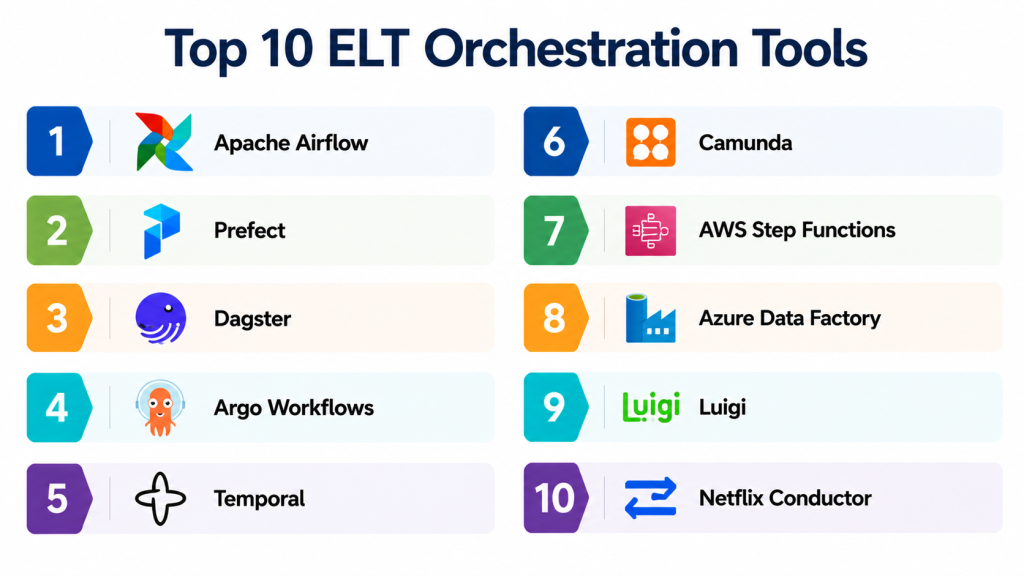
Top 10 ELT Orchestration Tools
1- Apache Airflow
Short description:
Apache Airflow is an open-source workflow orchestration tool widely used for scheduling and managing complex ELT pipelines in both cloud and on-prem environments.
Key Features
- DAG-based workflow design
- Extensive scheduling options
- Python-native task definition
- Multi-tenant support
- Integration with cloud and on-prem systems
- Monitoring and alerting
- Extensible plugin system
Pros
- Open-source with large community
- Highly customizable
- Supports complex dependencies
Cons
- Requires setup and maintenance
- Learning curve for new users
- Can become complex at scale
Platforms / Deployment
Linux / Cloud / On-prem
Security & Compliance
RBAC, LDAP/SSO, audit logging
Integrations & Ecosystem
- Cloud storage systems
- Databases and warehouses
- Messaging systems
- Custom Python operators
Support & Community
Large open-source community, extensive documentation
2- Prefect
Short description:
Prefect is a modern workflow orchestration platform designed to simplify ELT pipeline management with cloud and hybrid deployment support.
Key Features
- Python-native pipeline design
- Cloud and hybrid orchestration
- Observability dashboards
- Dynamic retries and failure handling
- Task scheduling and dependencies
- API-driven automation
- Integration with modern data stacks
Pros
- Simplified orchestration for Python workflows
- Excellent monitoring features
- Flexible deployment options
Cons
- Paid cloud version required for full features
- Learning curve for complex pipelines
- Smaller ecosystem than Airflow
Platforms / Deployment
Cloud / On-prem
Security & Compliance
RBAC, audit logging, encryption
Integrations & Ecosystem
- Data warehouses
- Cloud services
- APIs and event streams
- Python libraries
Support & Community
Active documentation and professional support tiers
3- Dagster
Short description:
Dagster is a data orchestrator focused on development, testing, and production readiness for ELT pipelines.
Key Features
- Type-safe pipeline definitions
- Local development and testing support
- Observability and metrics dashboards
- Cloud and on-prem deployment
- Retry and error handling
- Task-level logging
- Integration with modern data tools
Pros
- Strong developer-focused tooling
- Observability built-in
- Easy testing and debugging
Cons
- Smaller community than Airflow
- Limited enterprise integrations
- Requires Python knowledge
Platforms / Deployment
Cloud / On-prem
Security & Compliance
RBAC, encryption, audit logging
Integrations & Ecosystem
- Warehouses like Snowflake, BigQuery
- Cloud platforms
- Messaging systems
- Python-based transformations
Support & Community
Growing community, professional support available
4- Argo Workflows
Short description:
Argo Workflows is a Kubernetes-native workflow engine for orchestrating container-based ELT pipelines at scale.
Key Features
- Kubernetes-native scheduling
- Container-based tasks
- DAG and step-based workflows
- Cron-based scheduling
- Observability and logs
- Parallel and distributed execution
- Event-driven workflows
Pros
- Cloud-native and container-friendly
- Scales well for modern infrastructure
- Excellent for microservices and Kubernetes environments
Cons
- Requires Kubernetes knowledge
- Complex setup for non-Kubernetes users
- Limited traditional UI
Platforms / Deployment
Cloud / Kubernetes / Hybrid
Security & Compliance
RBAC, namespace isolation, audit logging
Integrations & Ecosystem
- Kubernetes clusters
- Cloud storage and compute
- CI/CD pipelines
- Monitoring and logging tools
Support & Community
Strong open-source support, active community
5- Temporal
Short description:
Temporal is an open-source workflow orchestration platform emphasizing reliability and stateful workflows for ELT pipelines.
Key Features
- Stateful workflow execution
- Retry and failure handling
- Versioned workflow management
- Distributed and scalable
- Language SDKs for Python, Go, Java
- Observability dashboards
- API-driven orchestration
Pros
- Highly reliable and fault-tolerant
- Supports complex stateful workflows
- Cloud-native ready
Cons
- Requires developer setup
- Smaller community compared to Airflow
- Requires coding for workflows
Platforms / Deployment
Cloud / On-prem / Hybrid
Security & Compliance
RBAC, encryption, audit logging
Integrations & Ecosystem
- Databases
- Cloud compute
- Messaging systems
- APIs
Support & Community
Open-source community with enterprise support
6- Camunda
Short description:
Camunda is a workflow automation platform capable of orchestrating ELT pipelines using BPMN standards.
Key Features
- BPMN-based workflow modeling
- Task scheduling and orchestration
- Monitoring dashboards
- Event-driven triggers
- Integration APIs
- Cloud and on-prem deployment
- Observability and alerting
Pros
- Strong business process modeling
- Reliable workflow execution
- Scalable architecture
Cons
- Enterprise pricing for full features
- Requires BPMN knowledge
- Limited Python-native support
Platforms / Deployment
Cloud / On-prem / Hybrid
Security & Compliance
RBAC, audit logs, encryption
Integrations & Ecosystem
- Data warehouses
- APIs
- Cloud services
- Messaging systems
Support & Community
Enterprise support with documentation and training
7- AWS Step Functions
Short description:
AWS Step Functions orchestrates serverless workflows for ELT pipelines, leveraging AWS cloud infrastructure.
Key Features
- Serverless workflow orchestration
- Visual workflow designer
- Integration with AWS services
- Error handling and retries
- Event-driven triggers
- State management
- Logging and monitoring
Pros
- Fully managed and scalable
- Tight AWS ecosystem integration
- Simplifies serverless orchestration
Cons
- AWS dependency
- Pricing can grow with scale
- Less flexible outside AWS
Platforms / Deployment
Cloud
Security & Compliance
AWS-native IAM, encryption, logging
Integrations & Ecosystem
- AWS S3, Lambda, Redshift
- Messaging and event services
- CloudWatch monitoring
- Glue and Athena
Support & Community
AWS enterprise support and documentation
8- Azure Data Factory
Short description:
Azure Data Factory is a cloud-based data integration and orchestration service for ELT pipelines in the Microsoft ecosystem.
Key Features
- Cloud-based ETL/ELT orchestration
- Pipeline design and scheduling
- Data flow transformations
- Integration runtime support
- Monitoring dashboards
- Retry and failure handling
- Event-driven execution
Pros
- Native Azure integration
- Easy drag-and-drop pipelines
- Managed cloud service
Cons
- Microsoft ecosystem lock-in
- Less control over low-level orchestration
- Complex pricing structure
Platforms / Deployment
Cloud
Security & Compliance
RBAC, encryption, auditing
Integrations & Ecosystem
- Azure SQL, Synapse, Blob Storage
- Power BI, Logic Apps
- Event Grid
- Azure Data Lake
Support & Community
Microsoft enterprise support
9- Luigi
Short description:
Luigi is an open-source Python package for building and managing ELT pipelines and dependency-based workflows.
Key Features
- Dependency-based task management
- Workflow visualization
- Task scheduling
- Retry and error handling
- Python-native workflows
- Cloud and local execution
- Observability dashboards
Pros
- Lightweight and flexible
- Open-source with Python ecosystem
- Easy for small to medium workflows
Cons
- Limited advanced orchestration features
- Requires Python coding
- Less enterprise support
Platforms / Deployment
Linux / Cloud / On-prem
Security & Compliance
Varies / Not publicly stated
Integrations & Ecosystem
- Cloud storage
- Databases
- Python libraries
- Scheduling systems
Support & Community
Open-source community support
10- Netflix Conductor
Short description:
Netflix Conductor is an open-source workflow orchestration engine optimized for microservices and ELT pipelines.
Key Features
- Microservices orchestration
- Workflow scheduling
- Event-driven architecture
- Retry and error handling
- Observability and logging
- REST API integration
- Cloud-ready deployment
Pros
- Scales well for complex workflows
- Microservices-oriented
- Open-source flexibility
Cons
- Requires developer setup
- Limited Python-native tooling
- Smaller user community
Platforms / Deployment
Cloud / On-prem / Hybrid
Security & Compliance
Varies / Not publicly stated
Integrations & Ecosystem
- REST APIs
- Cloud services
- Databases
- Microservices platforms
Support & Community
Open-source community, limited enterprise support
Comparison Table (Top 10)
| Tool Name | Best For | Platform(s) Supported | Deployment | Standout Feature | Public Rating |
|---|---|---|---|---|---|
| Apache Airflow | Enterprise ELT | Linux | Cloud/On-prem | DAG-based orchestration | N/A |
| Prefect | Python ELT pipelines | Linux | Cloud/Hybrid | Observability dashboards | N/A |
| Dagster | Developer-friendly ELT | Linux | Cloud/Hybrid | Type-safe pipelines | N/A |
| Argo Workflows | Kubernetes workloads | Cloud | Cloud/Kubernetes | Container-native orchestration | N/A |
| Temporal | Stateful workflows | Linux | Cloud/Hybrid | Fault-tolerant workflows | N/A |
| Camunda | BPMN-based workflows | Linux | Cloud/Hybrid | Business process orchestration | N/A |
| AWS Step Functions | Cloud serverless ELT | Cloud | Cloud | Visual workflow orchestration | N/A |
| Azure Data Factory | Azure ELT | Cloud | Cloud | Drag-and-drop pipelines | N/A |
| Luigi | Python ELT pipelines | Linux | Cloud/On-prem | Dependency-based scheduling | N/A |
| Netflix Conductor | Microservices ELT | Linux | Cloud/Hybrid | Microservices orchestration | N/A |
Evaluation & Scoring of ELT Orchestration Tools
| Tool | Core (25%) | Ease (15%) | Integrations (15%) | Security (10%) | Performance (10%) | Support (10%) | Value (15%) | Weighted Total |
|---|---|---|---|---|---|---|---|---|
| Airflow | 9.5 | 8.0 | 9.0 | 8.5 | 9.2 | 8.8 | 9.0 | 8.97 |
| Prefect | 9.0 | 8.5 | 8.8 | 8.8 | 8.9 | 8.7 | 8.7 | 8.78 |
| Dagster | 8.9 | 8.3 | 8.5 | 8.6 | 8.7 | 8.5 | 8.5 | 8.63 |
| Argo | 9.1 | 8.2 | 8.9 | 8.8 | 8.9 | 8.6 | 8.6 | 8.75 |
| Temporal | 9.2 | 8.3 | 8.8 | 8.7 | 9.0 | 8.5 | 8.5 | 8.79 |
| Camunda | 8.8 | 8.0 | 8.6 | 8.5 | 8.7 | 8.4 | 8.4 | 8.53 |
| Step Functions | 9.0 | 8.5 | 8.9 | 8.8 | 8.9 | 8.7 | 8.6 | 8.80 |
| Azure Data Factory | 8.9 | 8.6 | 8.7 | 8.7 | 8.8 | 8.6 | 8.5 | 8.68 |
| Luigi | 8.5 | 8.3 | 8.4 | 8.3 | 8.5 | 8.2 | 8.4 | 8.41 |
| Netflix Conductor | 8.7 | 8.2 | 8.5 | 8.4 | 8.6 | 8.3 | 8.5 | 8.49 |
Which ELT Orchestration Tool Is Right for You?
Solo / Freelancer
Luigi or Dagster for small Python-based pipelines
SMB
Prefect or Airflow for reliable orchestration with moderate scale
Mid-Market
Argo Workflows, Temporal, or Step Functions for cloud and containerized environments
Enterprise
Airflow, Azure Data Factory, or Camunda for large-scale, multi-source pipelines
Budget vs Premium
Open-source tools like Airflow and Luigi vs enterprise platforms like Azure Data Factory and Step Functions
Feature Depth vs Ease of Use
Airflow and Argo provide depth; Prefect and Azure Data Factory provide ease of use
Integrations & Scalability
Airflow, Step Functions, and Argo lead in cloud and hybrid integrations
Security & Compliance Needs
Enterprise platforms like Camunda and Azure Data Factory provide stronger governance
Frequently Asked Questions
1- What is an ELT orchestration tool?
Software that manages, schedules, and automates data pipelines using Extract, Load, Transform workflows.
2- How is ELT different from ETL?
ELT loads raw data first into a warehouse and transforms it there, improving scalability and analytics speed.
3- Can these tools run on-prem and in the cloud?
Yes, most support hybrid deployment models to meet enterprise requirements.
4- Do ELT orchestration tools support real-time pipelines?
Many platforms offer event-driven and streaming capabilities for near real-time processing.
5- Are these tools suitable for AI/ML pipelines?
Yes, they are widely used to feed ML models with preprocessed or transformed data.
6- Which tools are open-source?
Airflow, Luigi, Dagster, Argo Workflows, Temporal, and Netflix Conductor are open-source.
7- Do these tools support cloud warehouses?
Yes, integrations with Snowflake, BigQuery, Redshift, and Azure Synapse are common.
8- How complex is setup?
Open-source tools require technical setup, whereas managed cloud services are easier to deploy.
9- How do they handle failures?
Most support retries, error handling, notifications, and failure recovery mechanisms.
10- What factors should guide selection?
Scale, cloud vs on-prem deployment, integrations, team expertise, and workflow complexity.
Conclusion
ELT Orchestration Tools have become essential for managing modern data pipelines at scale. Open-source platforms like Apache Airflow, Dagster, and Luigi provide flexibility and cost advantages, while cloud-native services like Azure Data Factory, AWS Step Functions, and Prefect offer ease of deployment and monitoring. Organizations should evaluate their data volume, workflow complexity, cloud adoption, and team expertise before selecting a tool. A practical approach is to shortlist run pilot pipelines, validate integrations and performance, and then scale to production.
