Introduction
Data Pipeline Orchestration Tools enable organizations to automate, schedule, and monitor data workflows across various systems, ensuring reliable and efficient movement of data from source to destination. These platforms manage complex ETL (Extract, Transform, Load) processes, data validation, dependency handling, and workflow monitoring, making them essential for modern data-driven enterprises.
With the increasing volume and complexity of data, organizations require orchestration tools to maintain data quality, enable real-time analytics, and support machine learning pipelines. Orchestration platforms help reduce manual intervention, prevent data pipeline failures, and improve overall operational efficiency.
Real World Use Cases
- ETL automation across multiple databases and cloud sources
- Real-time data ingestion and processing for analytics
- Machine learning model training pipelines
- Data quality checks and validation workflows
- Multi-cloud data synchronization
- Event-driven data processing
- Financial reporting automation
- IoT data aggregation and processing
Evaluation Criteria for Buyers
- Workflow scheduling flexibility
- Scalability across large data volumes
- Multi-cloud and hybrid support
- Integration with databases, data lakes, and data warehouses
- Error handling and alerting mechanisms
- API and developer tool support
- Observability and monitoring capabilities
- Support for streaming and batch data pipelines
- Ease of deployment and management
- Security and compliance features
Best for: Data engineers, MLOps teams, analytics teams, and enterprises managing large-scale ETL, streaming, or machine learning data pipelines.
Not ideal for: Small teams with simple or ad hoc data workflows, or organizations without significant data engineering requirements.
Key Trends in Data Pipeline Orchestration Tools
- Increasing adoption of cloud-native orchestration platforms
- Integration of workflow automation with MLOps pipelines
- Support for hybrid and multi-cloud data environments
- Enhanced observability and lineage tracking
- Streaming and batch workflow support in a unified platform
- Event-driven pipeline orchestration
- Low-code/no-code workflow design capabilities
- AI-assisted anomaly detection in pipelines
- Kubernetes-native orchestration frameworks growing
- Greater focus on data governance and compliance
How We Selected These Tools (Methodology)
- Market adoption and enterprise usage
- Feature completeness for ETL, streaming, and batch workflows
- Scalability and performance under large data loads
- Integration capabilities with databases, warehouses, and cloud providers
- Reliability and fault tolerance of workflow execution
- Observability, monitoring, and logging features
- Security and governance compliance
- Developer experience and API support
- Deployment flexibility across cloud and on-premises
- Community and enterprise support quality
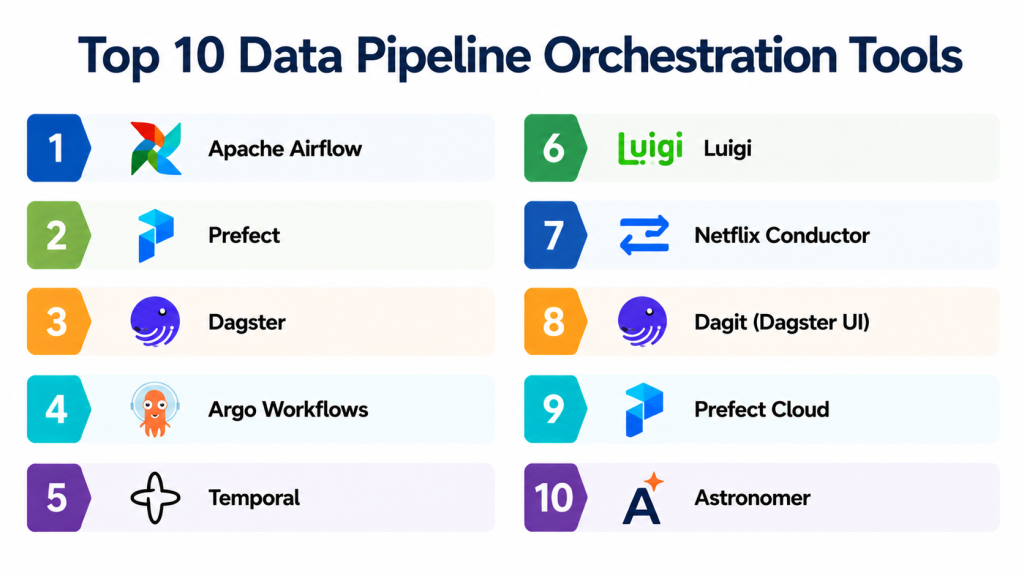
Top 10 Data Pipeline Orchestration Tools
1- Apache Airflow
Short Description:
Apache Airflow is an open-source platform for programmatically authoring, scheduling, and monitoring complex data workflows.
Key Features
- DAG-based workflow design
- Scheduling and retry mechanisms
- Multi-step dependency management
- Task monitoring and logging
- Extensible Python-based framework
- Cloud and on-prem deployment support
- Integration with databases, warehouses, and cloud services
Pros
- Flexible and extensible
- Strong community support
- Supports complex workflows
Cons
- Requires Python knowledge
- Can be complex to set up at scale
Platforms / Deployment
Cloud, On-premise, Hybrid
Security & Compliance
RBAC, encryption, authentication
Integrations & Ecosystem
- AWS, GCP, Azure
- MySQL, PostgreSQL
- BigQuery, Redshift
- Spark, Kubernetes
Support & Community
Large open-source community and documentation
2- Prefect
Short Description:
Prefect is a modern workflow orchestration platform focused on dataflow reliability and ease of deployment.
Key Features
- Cloud and local orchestration
- Dynamic task mapping
- Real-time monitoring
- Failure handling and retries
- API-first design
- Integration with data warehouses and cloud services
- Python-native workflows
Pros
- User-friendly API
- Strong observability
- Handles complex workflows easily
Cons
- Cloud features may require subscription
- Python dependency
Platforms / Deployment
Cloud, On-premise
Security & Compliance
RBAC, encryption, authentication
Integrations & Ecosystem
- Snowflake, BigQuery
- AWS, GCP
- Kubernetes, Docker
Support & Community
Active community and enterprise support
3- Dagster
Short Description:
Dagster is an open-source orchestration platform designed for production-grade data pipelines with strong type and metadata management.
Key Features
- Typed data pipelines
- Schedule and sensor management
- Asset-aware workflow design
- Observability dashboards
- Python-native API
- Cloud and Kubernetes deployment
- Multi-tenant workflow support
Pros
- Strong developer experience
- Data lineage tracking
- Modern workflow design
Cons
- Smaller ecosystem compared to Airflow
- Learning curve for new users
Platforms / Deployment
Cloud, On-premise, Kubernetes
Security & Compliance
Authentication, RBAC, encryption
Integrations & Ecosystem
- Spark, Snowflake, BigQuery
- AWS, GCP, Azure
- Kubernetes
Support & Community
Active open-source community
4- Argo Workflows
Short Description:
Argo Workflows is a Kubernetes-native workflow orchestration engine for running complex parallel workflows in containerized environments.
Key Features
- Kubernetes-native scheduling
- DAG and step-based workflows
- Parallel execution support
- Containerized task execution
- Retry and failure handling
- Event-driven pipelines
- Observability and logging
Pros
- Native Kubernetes integration
- High performance for parallel workloads
- Supports containerized tasks
Cons
- Kubernetes expertise required
- Limited non-Kubernetes support
Platforms / Deployment
Kubernetes, Cloud
Security & Compliance
Kubernetes RBAC, encryption
Integrations & Ecosystem
- Kubernetes cluster
- Helm, Docker
- Cloud storage and services
Support & Community
Strong open-source community
5- Temporal
Short Description:
Temporal is an open-source platform for workflow orchestration with strong reliability guarantees and scalability.
Key Features
- Durable workflow execution
- Multi-step dependency management
- Automatic retries and error handling
- API-driven workflow definition
- Multi-language SDK support
- Scalable distributed execution
- Observability and metrics
Pros
- High reliability
- Scalable across clusters
- Supports long-running workflows
Cons
- Requires learning Temporal SDK
- Smaller community
Platforms / Deployment
Cloud, On-premise
Security & Compliance
Authentication, encryption, auditing
Integrations & Ecosystem
- Databases, Cloud services
- Kubernetes, Docker
- Messaging queues
Support & Community
Growing developer community
6- Luigi
Short Description:
Luigi is an open-source Python framework for building pipelines of batch jobs with dependency resolution and scheduling.
Key Features
- Dependency-aware workflow scheduling
- Python-native pipelines
- Batch job orchestration
- Task failure handling
- Dashboard for monitoring
- Integration with databases and cloud storage
- Lightweight orchestration
Pros
- Simple to use for Python developers
- Lightweight and easy to deploy
- Good for batch processing
Cons
- Limited real-time streaming support
- Smaller ecosystem
Platforms / Deployment
Cloud, On-premise
Security & Compliance
Authentication, RBAC
Integrations & Ecosystem
- AWS, GCP
- MySQL, PostgreSQL
- Hadoop, Spark
Support & Community
Open-source community support
7- Netflix Conductor
Short Description:
Netflix Conductor is a microservices orchestration platform designed for large-scale, complex workflow management.
Key Features
- Distributed workflow engine
- Microservices orchestration
- Event-driven scheduling
- Retry and compensation logic
- REST API-based task execution
- Monitoring dashboards
- Cloud deployment support
Pros
- Scalable for large workflows
- Microservices-oriented
- Event-driven orchestration
Cons
- Requires familiarity with microservices
- Not Python-native
Platforms / Deployment
Cloud, On-premise
Security & Compliance
Authentication, RBAC
Integrations & Ecosystem
- Microservices APIs
- Messaging queues
- Cloud services
Support & Community
Open-source and enterprise support
8- Dagit (Dagster UI)
Short Description:
Dagit is the UI and execution engine for Dagster, providing observability and orchestration tools for data pipelines.
Key Features
- Visual DAG representation
- Pipeline execution monitoring
- Error alerts
- Metadata tracking
- Workflow scheduling
- Cloud and on-prem deployment
- Multi-tenant support
Pros
- Strong UI and observability
- Developer-friendly
- Supports complex workflows
Cons
- Dependent on Dagster
- Smaller ecosystem
Platforms / Deployment
Cloud, On-premise, Kubernetes
Security & Compliance
Authentication, RBAC
Integrations & Ecosystem
- Cloud storage
- Spark, BigQuery
- Kubernetes
Support & Community
Open-source community
9- Prefect Cloud
Short Description:
Prefect Cloud provides a SaaS-based orchestration platform for managing data pipelines with monitoring and observability.
Key Features
- Cloud workflow execution
- Monitoring and alerting
- Task retry and scheduling
- API-driven orchestration
- Multi-tenant management
- Streaming and batch support
- Integration with cloud services
Pros
- SaaS simplicity
- Strong observability
- Developer-friendly API
Cons
- Subscription-based
- Cloud-dependent
Platforms / Deployment
Cloud
Security & Compliance
RBAC, encryption, auditing
Integrations & Ecosystem
- AWS, GCP, Azure
- Databases and warehouses
- Kubernetes
Support & Community
Enterprise-grade support
10- Astronomer
Short Description:
Astronomer is an enterprise-grade managed platform for Apache Airflow with additional monitoring, security, and scaling features.
Key Features
- Managed Airflow orchestration
- Cloud and hybrid deployment
- Scheduling and DAG management
- Observability and monitoring
- Role-based access control
- Multi-environment support
- Enterprise SLA support
Pros
- Fully managed solution
- Enterprise-grade Airflow
- Scalable and monitored
Cons
- Paid enterprise platform
- Airflow knowledge recommended
Platforms / Deployment
Cloud, Hybrid
Security & Compliance
RBAC, encryption, auditing
Integrations & Ecosystem
- AWS, GCP, Azure
- Data warehouses
- ML pipelines
Support & Community
Enterprise support and documentation
Comparison Table
| Tool Name | Best For | Platforms Supported | Deployment | Standout Feature | Public Rating |
|---|---|---|---|---|---|
| Apache Airflow | Flexible workflows | Linux, Cloud | Cloud/On-prem | DAG-based scheduling | N/A |
| Prefect | Python pipelines | Linux, Cloud | Cloud/On-prem | Cloud-native monitoring | N/A |
| Dagster | Typed workflows | Linux, Cloud | Cloud/Kubernetes | Asset-aware orchestration | N/A |
| Argo Workflows | Kubernetes workloads | Kubernetes | Cloud/K8s | Containerized scheduling | N/A |
| Temporal | Long-running workflows | Multi OS | Cloud/On-prem | Durable execution | N/A |
| Luigi | Batch job orchestration | Linux | Cloud/On-prem | Lightweight Python pipelines | N/A |
| Netflix Conductor | Microservices workflows | Linux, Cloud | Cloud/On-prem | Distributed microservices | N/A |
| Dagit | Dagster UI | Linux, Cloud | Cloud/K8s | Observability | N/A |
| Prefect Cloud | SaaS orchestration | Cloud | Cloud | Monitoring & API | N/A |
| Astronomer | Managed Airflow | Linux, Cloud | Cloud/Hybrid | Enterprise-grade Airflow | N/A |
Evaluation & Scoring Table
| Tool Name | Core | Ease | Integrations | Security | Performance | Support | Value | Weighted Total |
|---|---|---|---|---|---|---|---|---|
| Apache Airflow | 9.5 | 8.5 | 9.5 | 9.0 | 9.2 | 9.0 | 8.8 | 9.09 |
| Prefect | 9.2 | 8.8 | 9.1 | 9.0 | 9.1 | 8.9 | 8.7 | 8.97 |
| Dagster | 9.0 | 8.6 | 8.9 | 8.8 | 9.0 | 8.8 | 8.5 | 8.84 |
| Argo Workflows | 9.1 | 8.5 | 8.8 | 8.9 | 9.1 | 8.7 | 8.6 | 8.85 |
| Temporal | 9.2 | 8.3 | 8.9 | 9.0 | 9.2 | 8.8 | 8.7 | 8.90 |
| Luigi | 8.8 | 8.6 | 8.5 | 8.7 | 8.9 | 8.6 | 8.4 | 8.61 |
| Netflix Conductor | 9.0 | 8.3 | 8.7 | 8.9 | 9.0 | 8.5 | 8.5 | 8.70 |
| Dagit | 8.9 | 8.5 | 8.6 | 8.8 | 8.9 | 8.6 | 8.4 | 8.62 |
| Prefect Cloud | 9.1 | 8.8 | 9.0 | 8.9 | 9.1 | 8.8 | 8.7 | 8.96 |
| Astronomer | 9.2 | 8.4 | 9.0 | 9.0 | 9.2 | 8.9 | 8.6 | 9.01 |
Which Data Pipeline Orchestration Tool Is Right for You?
Solo / Freelancer
Luigi and Prefect are ideal for small teams and simple Python pipelines.
SMB
Apache Airflow, Prefect Cloud, and Dagster balance usability and enterprise features.
Mid-Market
Argo Workflows, Temporal, and Netflix Conductor provide scalability and reliability.
Enterprise
Astronomer, Airflow, and Temporal offer managed solutions for enterprise-grade pipelines.
Budget vs Premium
Open-source tools like Airflow, Luigi, and Dagster are cost-efficient, while Astronomer and Prefect Cloud are premium.
Feature Depth vs Ease of Use
Airflow and Temporal provide deep control; Prefect and Dagster offer developer-friendly workflows.
Integrations & Scalability
Airflow, Argo, and Astronomer excel at integrating across data sources and scaling pipelines.
Security & Compliance Needs
Enterprise users should prioritize platforms with RBAC, audit logging, and secure deployment options.
Frequently Asked Questions
1- What is a data pipeline orchestration tool?
It is software that schedules, monitors, and manages complex data workflows across systems.
2- Why is orchestration important?
It ensures reliable, automated, and efficient movement and processing of data.
3- Can these tools handle real-time data?
Yes, many platforms support streaming and event-driven pipelines.
4- Is Apache Airflow still relevant?
Yes, it remains widely used and actively maintained for batch workflows.
5- Are these tools cloud-native?
Many are cloud-native, with hybrid and on-premise support.
6- Do orchestration tools support ML pipelines?
Yes, AI/ML workflows are commonly supported.
7- What is the difference between Airflow and Prefect?
Airflow is DAG-based and mature; Prefect offers modern API-first orchestration and observability.
8- Are these tools secure?
Most provide RBAC, authentication, encryption, and audit logging.
9- Can they integrate with multiple data warehouses?
Yes, they support cloud and on-prem data sources like Snowflake, Redshift, BigQuery, and others.
10- How complex is deployment?
Complexity depends on cluster size, workflow complexity, and integration requirements.
Conclusion
Data Pipeline Orchestration Tools are critical for managing modern data workflows, supporting both batch and real-time pipelines. Airflow, Prefect, and Dagster lead in open-source flexibility, while Astronomer and Prefect Cloud provide managed enterprise capabilities. Argo Workflows and Temporal excel in cloud-native and scalable AI workloads. Organizations should evaluate based on workflow complexity, deployment scale, cloud integration, and operational needs. A pilot across platforms is recommended before full-scale adoption to optimize performance, reliability, and observability.
