Introduction
Edge Device Management Tools help organizations deploy, monitor, secure, update, and manage devices operating at the network edge. These devices can include IoT sensors, industrial gateways, smart cameras, retail kiosks, medical devices, connected vehicles, and edge servers. As organizations increasingly process data closer to where it is generated, managing thousands of distributed devices has become a critical operational requirement.
Edge computing reduces latency, improves application responsiveness, minimizes bandwidth usage, and supports real-time decision-making. However, managing distributed infrastructure introduces challenges related to device onboarding, software updates, security, monitoring, and compliance. Edge Device Management Tools address these challenges through centralized management, automation, and remote control capabilities.
Real World Use Cases
- Managing industrial IoT devices across manufacturing facilities
- Monitoring smart city infrastructure and connected sensors
- Updating retail kiosks and digital signage systems remotely
- Managing healthcare devices across hospitals and clinics
- Operating edge AI systems for video analytics and automation
Evaluation Criteria for Buyers
- Device onboarding and provisioning capabilities
- Remote monitoring and management features
- Security controls and compliance support
- Software and firmware update automation
- Scalability across distributed environments
- Integration with cloud and enterprise platforms
- Edge analytics and reporting capabilities
- Multi-device and multi-vendor support
- API availability and extensibility
- Cost and operational efficiency
Best for: Enterprises, industrial operators, telecom providers, manufacturers, healthcare organizations, retailers, and smart infrastructure operators managing distributed edge environments.
Not ideal for: Small organizations with limited device fleets or businesses that operate entirely within centralized cloud environments.
Key Trends
- Zero-touch device provisioning is becoming a standard requirement.
- AI-powered predictive maintenance is increasingly integrated into management platforms.
- Edge security and Zero Trust architectures are gaining adoption.
- Remote software deployment automation continues to expand.
- Hybrid cloud and edge deployments are becoming the dominant architecture.
- Digital twins are being used for operational visibility.
- Edge AI workload orchestration is growing rapidly.
- Container-based edge deployments are increasing.
- Fleet-wide compliance monitoring is becoming essential.
- Organizations are prioritizing centralized management across heterogeneous device ecosystems.
Methodology
The tools included in this list were evaluated using the following criteria:
- Market adoption and industry reputation
- Feature completeness for edge device lifecycle management
- Security and compliance capabilities
- Scalability for large device fleets
- Monitoring and analytics capabilities
- Integration ecosystem strength
- Deployment flexibility
- Vendor maturity and innovation
- Ease of use and operational efficiency
- Support quality and community engagement
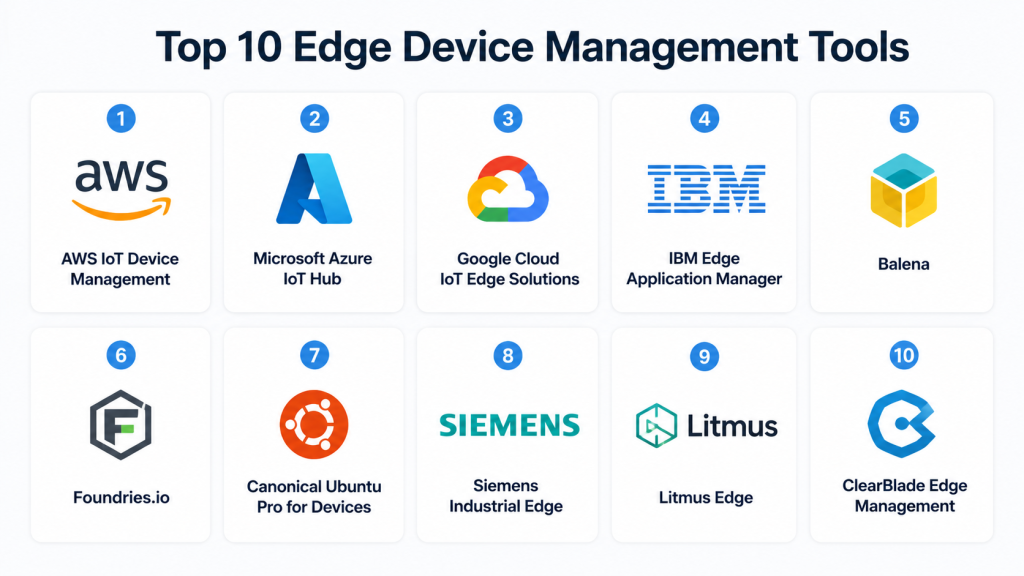
Top 10 Edge Device Management Tools
1- AWS IoT Device Management
Short Description
AWS IoT Device Management enables organizations to securely onboard, organize, monitor, and remotely manage large fleets of IoT and edge devices within the AWS ecosystem.
Key Features
- Device onboarding and provisioning
- Fleet indexing and search
- Remote troubleshooting
- Secure tunneling
- Bulk device management
- Device monitoring
- OTA update management
Pros
- Strong AWS integration
- Excellent scalability
- Mature IoT ecosystem
Cons
- Best suited for AWS users
- Can become complex at scale
Platforms / Deployment
Cloud
Security & Compliance
Encryption, IAM integration, audit logging, RBAC.
Integrations & Ecosystem
Strong integration with AWS services and IoT infrastructure.
- AWS IoT Core
- AWS Lambda
- Amazon CloudWatch
- AWS Security Services
Support & Community
Comprehensive documentation and large developer community.
2- Microsoft Azure IoT Hub
Short Description
Azure IoT Hub provides device connectivity, monitoring, management, and secure communication for enterprise-scale edge and IoT deployments.
Key Features
- Device provisioning
- Device twins
- OTA updates
- Device monitoring
- Secure communication
- Edge deployment support
- Real-time analytics integration
Pros
- Strong Microsoft ecosystem
- Enterprise-grade scalability
- Advanced analytics integration
Cons
- Azure-centric architecture
- Learning curve for new users
Platforms / Deployment
Cloud
Security & Compliance
RBAC, encryption, auditing, Azure Active Directory integration.
Integrations & Ecosystem
- Azure IoT Edge
- Azure Monitor
- Microsoft Defender
- Azure AI Services
Support & Community
Strong enterprise support and extensive learning resources.
3- Google Cloud IoT Edge Solutions
Short Description
Google Cloud offers tools and services that support edge device management, monitoring, and secure deployment within hybrid cloud environments.
Key Features
- Device identity management
- Secure communication
- Monitoring tools
- Cloud connectivity
- Data processing
- API integrations
- Edge analytics support
Pros
- Strong cloud infrastructure
- Scalable architecture
- Developer-friendly tools
Cons
- May require customization
- Less specialized than some competitors
Platforms / Deployment
Cloud
Security & Compliance
Encryption, IAM controls, audit logging.
Integrations & Ecosystem
- Google Cloud Platform
- AI services
- Data analytics tools
- Kubernetes ecosystem
Support & Community
Strong documentation and cloud support options.
4- IBM Edge Application Manager
Short Description
IBM Edge Application Manager focuses on large-scale autonomous management of edge devices and applications.
Key Features
- Autonomous device management
- Policy-based deployment
- Application orchestration
- Security management
- Device monitoring
- Large-scale scalability
- Open-source foundations
Pros
- Excellent scalability
- Strong automation capabilities
- Enterprise-grade management
Cons
- Complex deployment
- Requires technical expertise
Platforms / Deployment
Cloud, Hybrid
Security & Compliance
Encryption, policy controls, RBAC.
Integrations & Ecosystem
- Red Hat OpenShift
- Kubernetes
- Enterprise systems
- Cloud services
Support & Community
Strong enterprise support.
5- Balena
Short Description
Balena is a developer-focused edge device management platform designed for containerized IoT deployments.
Key Features
- Container management
- OTA updates
- Fleet management
- Remote access
- Device monitoring
- Open architecture
- Multi-device support
Pros
- Developer-friendly
- Strong container support
- Easy deployment workflows
Cons
- Enterprise features may require higher plans
- Less suitable for highly regulated environments
Platforms / Deployment
Cloud, Hybrid
Security & Compliance
Encryption and secure device communication.
Integrations & Ecosystem
- Docker
- Raspberry Pi
- Industrial hardware
- Open-source tools
Support & Community
Active community and strong documentation.
6- Foundries.io
Short Description
Foundries.io delivers secure edge device lifecycle management with integrated software updates and security controls.
Key Features
- Secure device onboarding
- OTA updates
- Device lifecycle management
- Linux-based edge deployments
- Security monitoring
- Fleet management
- CI/CD integration
Pros
- Security-focused
- Strong automation
- Modern development workflows
Cons
- Specialized platform
- Requires Linux expertise
Platforms / Deployment
Cloud, Hybrid
Security & Compliance
Secure boot support, encryption, lifecycle security controls.
Integrations & Ecosystem
- Linux ecosystems
- CI/CD tools
- Cloud platforms
- Embedded systems
Support & Community
Strong technical documentation.
7- Canonical Ubuntu Pro for Devices
Short Description
Canonical provides enterprise device management and security capabilities for Ubuntu-based edge deployments.
Key Features
- Device lifecycle management
- Security updates
- OTA deployment
- Fleet management
- Compliance support
- Ubuntu integration
- Long-term maintenance
Pros
- Strong Linux ecosystem
- Enterprise support
- Long-term stability
Cons
- Ubuntu-focused
- Limited non-Linux coverage
Platforms / Deployment
Cloud, Hybrid
Security & Compliance
Encryption, security patching, access controls.
Integrations & Ecosystem
- Ubuntu ecosystem
- Kubernetes
- Open-source platforms
- Edge infrastructure
Support & Community
Large global community and enterprise support.
8- Siemens Industrial Edge
Short Description
Siemens Industrial Edge provides management and orchestration capabilities for industrial edge environments.
Key Features
- Industrial device management
- Application deployment
- Monitoring
- Data processing
- Security management
- Edge analytics
- Factory integration
Pros
- Industrial specialization
- Strong manufacturing support
- Enterprise scalability
Cons
- Industry-focused platform
- Higher implementation complexity
Platforms / Deployment
Hybrid
Security & Compliance
Industrial security controls, encryption, access management.
Integrations & Ecosystem
- Siemens automation systems
- Industrial control systems
- Manufacturing software
- Edge applications
Support & Community
Strong enterprise and industrial support.
9- Litmus Edge
Short Description
Litmus Edge focuses on industrial IoT connectivity, monitoring, and edge device management for manufacturing environments.
Key Features
- Device connectivity
- Data collection
- Edge analytics
- Monitoring
- Industrial protocol support
- Fleet management
- Remote operations
Pros
- Manufacturing focus
- Extensive industrial connectivity
- Easy deployment
Cons
- Less suitable outside industrial sectors
- Specialized use cases
Platforms / Deployment
Cloud, Hybrid
Security & Compliance
Encryption and access controls.
Integrations & Ecosystem
- SCADA systems
- MES platforms
- ERP software
- Industrial protocols
Support & Community
Strong industrial implementation support.
10- ClearBlade Edge Management
Short Description
ClearBlade provides edge computing and device management capabilities for industrial and enterprise IoT deployments.
Key Features
- Device provisioning
- Fleet management
- Real-time monitoring
- OTA updates
- Edge orchestration
- Data processing
- Security controls
Pros
- Flexible deployment
- Strong IoT capabilities
- Real-time operations
Cons
- Smaller ecosystem compared to hyperscalers
- Enterprise adoption varies by region
Platforms / Deployment
Cloud, Hybrid
Security & Compliance
Encryption, identity controls, auditing.
Integrations & Ecosystem
- IoT platforms
- Enterprise systems
- Industrial software
- Cloud services
Support & Community
Professional support and implementation services.
Comparison Table
| Tool Name | Best For | Platforms Supported | Deployment | Standout Feature | Public Rating |
|---|---|---|---|---|---|
| AWS IoT Device Management | Enterprise IoT | Web | Cloud | Fleet Management | N/A |
| Azure IoT Hub | Microsoft Ecosystem | Web | Cloud | Device Twins | N/A |
| Google Cloud IoT Edge Solutions | Cloud Deployments | Web | Cloud | Cloud Integration | N/A |
| IBM Edge Application Manager | Large Enterprises | Web | Hybrid | Autonomous Management | N/A |
| Balena | Developers | Web, Linux | Cloud, Hybrid | Container Management | N/A |
| Foundries.io | Secure Edge Devices | Web, Linux | Cloud, Hybrid | Lifecycle Security | N/A |
| Canonical Ubuntu Pro | Linux Edge Fleets | Linux | Cloud, Hybrid | Long-Term Support | N/A |
| Siemens Industrial Edge | Manufacturing | Web | Hybrid | Industrial Integration | N/A |
| Litmus Edge | Industrial IoT | Web | Cloud, Hybrid | Industrial Connectivity | N/A |
| ClearBlade Edge Management | Enterprise IoT | Web | Cloud, Hybrid | Real-Time Operations | N/A |
Evaluation & Scoring
| Tool | Core | Ease | Integrations | Security | Performance | Support | Value | Weighted Total |
|---|---|---|---|---|---|---|---|---|
| AWS IoT Device Management | 9.5 | 8.8 | 9.5 | 9.2 | 9.4 | 9.0 | 8.5 | 9.08 |
| Azure IoT Hub | 9.4 | 8.7 | 9.4 | 9.2 | 9.3 | 9.0 | 8.6 | 9.03 |
| Google Cloud IoT Edge Solutions | 8.8 | 8.7 | 8.9 | 8.9 | 9.0 | 8.5 | 8.7 | 8.80 |
| IBM Edge Application Manager | 9.3 | 7.8 | 8.9 | 9.3 | 9.2 | 8.8 | 8.0 | 8.82 |
| Balena | 8.8 | 9.0 | 8.5 | 8.4 | 8.8 | 8.6 | 9.0 | 8.74 |
| Foundries.io | 8.9 | 8.2 | 8.4 | 9.2 | 8.8 | 8.5 | 8.6 | 8.68 |
| Canonical Ubuntu Pro | 8.8 | 8.4 | 8.5 | 9.0 | 8.8 | 8.9 | 8.7 | 8.72 |
| Siemens Industrial Edge | 9.2 | 8.0 | 8.7 | 9.1 | 9.2 | 8.8 | 8.1 | 8.77 |
| Litmus Edge | 8.9 | 8.5 | 8.4 | 8.7 | 8.8 | 8.6 | 8.8 | 8.66 |
| ClearBlade Edge Management | 8.8 | 8.4 | 8.5 | 8.8 | 8.8 | 8.5 | 8.7 | 8.65 |
The scores above provide a comparative view of the market. Organizations should focus on the criteria that matter most to their operational requirements. Industrial organizations may prioritize connectivity and scalability, while developers may prioritize deployment simplicity and flexibility.
Which Edge Device Management Tool Is Right for You?
Solo / Freelancer
Balena is often the most approachable option for developers managing smaller fleets and containerized applications.
SMB
Foundries.io and Canonical Ubuntu Pro provide strong security and lifecycle management without the complexity of large enterprise platforms.
Mid-Market
AWS IoT Device Management and Azure IoT Hub offer strong scalability, cloud integration, and operational visibility.
Enterprise
IBM Edge Application Manager, Siemens Industrial Edge, AWS IoT Device Management, and Azure IoT Hub are excellent choices for large-scale deployments.
Budget vs Premium
Budget-conscious teams may prefer Balena and Ubuntu-based solutions, while enterprises requiring advanced automation and governance may benefit from IBM or Siemens offerings.
Feature Depth vs Ease of Use
Balena offers simplicity, while IBM and Siemens provide deeper operational capabilities for complex environments.
Integrations & Scalability
AWS, Azure, and IBM provide some of the broadest integration ecosystems and scalability options.
Security & Compliance Needs
Organizations operating in regulated industries should prioritize platforms with strong lifecycle management, auditing, encryption, and centralized policy controls.
Frequently Asked Questions
1- What is an Edge Device Management Tool?
An Edge Device Management Tool helps organizations deploy, monitor, secure, and maintain devices operating outside traditional data centers, often close to where data is generated.
2- Why is edge device management important?
Without centralized management, organizations may struggle to secure, update, and monitor distributed devices, increasing operational and security risks.
3- Can these tools manage firmware updates?
Yes. Most modern platforms support remote firmware and software updates across large device fleets.
4- Are these tools suitable for industrial environments?
Many platforms such as Siemens Industrial Edge and Litmus Edge are specifically designed for industrial and manufacturing use cases.
5- Do Edge Device Management Tools improve security?
Yes. They help enforce policies, manage identities, automate updates, and monitor devices for security issues.
6- How many devices can these platforms manage?
Enterprise-grade platforms can often manage thousands or even millions of devices depending on deployment architecture.
7- What is zero-touch provisioning?
Zero-touch provisioning allows devices to be automatically configured and enrolled without manual intervention.
8- Can these tools work with multiple cloud providers?
Many modern platforms support hybrid and multi-cloud environments, although integration depth varies.
9- What should organizations evaluate before purchasing?
Key considerations include scalability, security, deployment flexibility, integrations, support quality, and total cost of ownership.
10- What is the biggest implementation mistake?
Many organizations underestimate device lifecycle management and long-term maintenance requirements, leading to operational challenges later.
Conclusion
Edge Device Management Tools are becoming essential for organizations operating distributed digital infrastructure. Whether managing industrial equipment, retail systems, healthcare devices, or smart city deployments, these platforms provide the visibility, security, and automation needed to operate at scale. AWS IoT Device Management and Azure IoT Hub remain strong choices for cloud-centric environments, while IBM Edge Application Manager and Siemens Industrial Edge excel in large enterprise deployments. Balena and Foundries.io appeal to development-focused teams seeking flexibility and automation. The right choice depends on your device fleet size, security requirements, infrastructure strategy, and integration needs. Before making a final decision, shortlist a few platforms, validate their integration capabilities, test management workflows, and assess long-term operational costs.
