Introduction
Device Certificate Provisioning Tools help organizations securely issue, manage, deploy, renew, and revoke digital certificates for devices. These certificates establish trusted identities for IoT devices, endpoints, industrial equipment, embedded systems, and connected infrastructure.
As organizations deploy larger fleets of connected devices, manual certificate management becomes impractical and risky. Automated provisioning platforms help maintain security, reduce operational overhead, and support compliance requirements. These tools are increasingly important in manufacturing, healthcare, automotive, telecommunications, utilities, and enterprise IT environments.
Real-world use cases include:
- Secure onboarding of IoT devices
- Manufacturing-time device identity provisioning
- Zero-touch device enrollment
- Industrial control system authentication
- Connected vehicle certificate management
- Smart city infrastructure security
- Edge device identity management
- Enterprise endpoint certificate deployment
Evaluation Criteria for Buyers
When evaluating Device Certificate Provisioning Tools, consider:
- Certificate lifecycle management
- Scalability for large device fleets
- Automation capabilities
- PKI integration support
- Security controls
- Device onboarding workflows
- API availability
- Cloud and edge support
- Compliance capabilities
- Vendor ecosystem strength
Best for: IoT architects, security teams, PKI administrators, manufacturing organizations, telecom providers, utilities, healthcare organizations, and enterprises managing connected devices.
Not ideal for: Small environments with minimal certificate requirements or organizations that can manage certificates manually using basic PKI tools.
Key Trends
- Zero-touch provisioning is becoming standard.
- Automated certificate rotation is increasingly important.
- Cloud-native certificate management platforms continue growing.
- Hardware-backed device identities are gaining adoption.
- Edge computing deployments require scalable provisioning.
- Certificate lifecycle automation reduces operational costs.
- Integration with device management platforms is expanding.
- Quantum-resistant cryptography preparation is beginning.
- AI-assisted anomaly detection is appearing in security workflows.
- Multi-cloud certificate management is becoming a priority.
Methodology
The tools in this list were evaluated using:
- Industry adoption
- Feature completeness
- Security capabilities
- Certificate lifecycle management
- Device scalability
- Integration ecosystem
- Documentation quality
- Deployment flexibility
- Vendor maturity
- Enterprise readiness
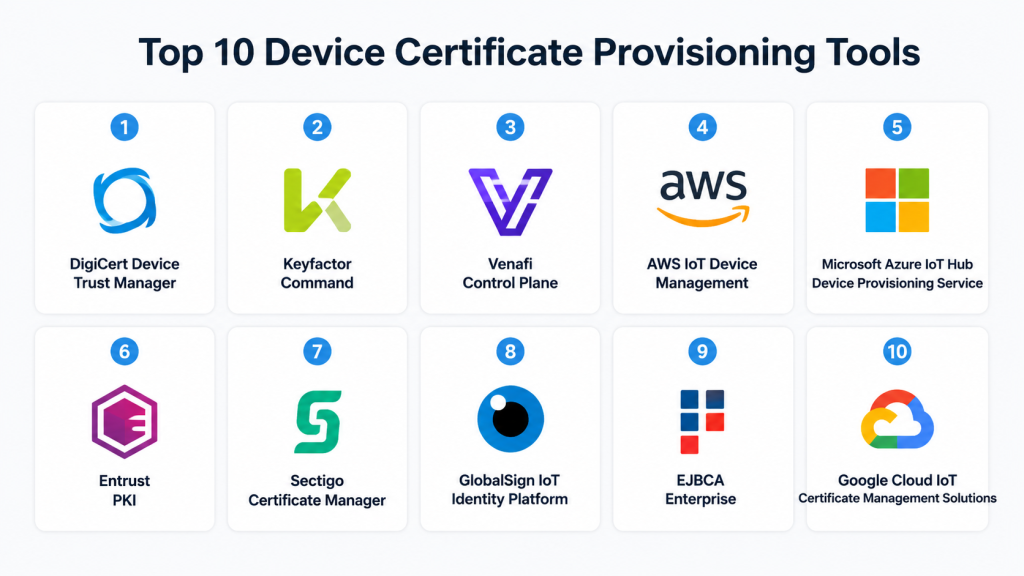
Top 10 Device Certificate Provisioning Tools
1- DigiCert Device Trust Manager
Short Description
DigiCert Device Trust Manager is an enterprise-grade platform designed for provisioning and managing device identities at scale. It is widely used in IoT, manufacturing, and connected infrastructure deployments.
Key Features
- Automated certificate issuance
- Device identity management
- PKI lifecycle automation
- Bulk device onboarding
- Certificate renewal workflows
- Secure manufacturing support
- API-based provisioning
Pros
- Strong enterprise scalability
- Comprehensive certificate automation
- Extensive PKI expertise
Cons
- Can be complex for small teams
- Enterprise pricing may be high
Platforms / Deployment
Cloud, Hybrid
Security & Compliance
RBAC, audit logging, encryption, MFA, SSO support. Additional compliance details vary by deployment.
Integrations & Ecosystem
Integrates with manufacturing systems, IoT platforms, PKI environments, and enterprise security tools.
- REST APIs
- IoT platforms
- Enterprise PKI
- Security monitoring tools
Support & Community
Strong enterprise support, detailed documentation, and extensive implementation resources.
2- Keyfactor Command
Short Description
Keyfactor Command provides certificate lifecycle automation and machine identity management across enterprise environments and connected devices.
Key Features
- Automated certificate issuance
- Lifecycle management
- Discovery capabilities
- Policy enforcement
- Device certificate management
- Certificate monitoring
- Workflow automation
Pros
- Excellent automation
- Strong visibility across environments
- Flexible integrations
Cons
- Advanced setup requirements
- Learning curve for new users
Platforms / Deployment
Cloud, Self-hosted, Hybrid
Security & Compliance
RBAC, audit logs, encryption, SSO integration.
Integrations & Ecosystem
Supports major PKI providers, cloud platforms, and security ecosystems.
- Microsoft environments
- AWS
- Azure
- Google Cloud
- Enterprise PKI
Support & Community
Strong enterprise support with active customer engagement.
3- Venafi Control Plane
Short Description
Venafi focuses on machine identity management and certificate automation for enterprise and IoT environments.
Key Features
- Certificate lifecycle automation
- Machine identity discovery
- Policy management
- Device identity governance
- Risk visibility
- Automated renewal
- Security analytics
Pros
- Mature certificate management platform
- Strong governance features
- Enterprise-grade visibility
Cons
- Premium pricing
- Complex implementation for smaller teams
Platforms / Deployment
Cloud, Hybrid
Security & Compliance
Encryption, audit trails, RBAC, policy enforcement.
Integrations & Ecosystem
Integrates with cloud providers, security platforms, and PKI infrastructure.
Support & Community
Comprehensive enterprise support and extensive documentation.
4- AWS IoT Device Management
Short Description
AWS IoT Device Management includes certificate provisioning capabilities for secure onboarding and lifecycle management of IoT devices.
Key Features
- Fleet provisioning
- Device onboarding
- Certificate management
- Device grouping
- Monitoring
- Secure enrollment
- Cloud-native workflows
Pros
- Strong AWS integration
- Scalable infrastructure
- Simplified IoT deployment
Cons
- Best suited for AWS environments
- Cross-platform flexibility can be limited
Platforms / Deployment
Cloud
Security & Compliance
IAM integration, encryption, access controls, logging.
Integrations & Ecosystem
- AWS IoT Core
- AWS Security Services
- AWS Lambda
- CloudWatch
Support & Community
Large ecosystem and extensive documentation.
5- Microsoft Azure IoT Hub Device Provisioning Service
Short Description
Azure DPS enables secure, automated device enrollment and certificate provisioning for Azure-connected IoT environments.
Key Features
- Automatic device registration
- Certificate attestation
- Enrollment groups
- Device assignment
- Bulk provisioning
- Security controls
- Lifecycle support
Pros
- Deep Azure integration
- Reliable provisioning workflows
- Enterprise scalability
Cons
- Best for Azure-centric environments
- Requires Azure expertise
Platforms / Deployment
Cloud
Security & Compliance
RBAC, encryption, access controls, logging.
Integrations & Ecosystem
- Azure IoT Hub
- Azure Security Center
- Azure Active Directory
- Microsoft ecosystem
Support & Community
Excellent enterprise support and documentation.
6- Entrust PKI
Short Description
Entrust provides enterprise PKI and certificate provisioning solutions for large-scale device identity management.
Key Features
- Device certificates
- Enterprise PKI
- Certificate lifecycle automation
- Identity management
- Policy enforcement
- Secure issuance
- Audit controls
Pros
- Strong security reputation
- Enterprise-grade capabilities
- Flexible deployment options
Cons
- Complex implementation
- Higher operational requirements
Platforms / Deployment
Cloud, Self-hosted, Hybrid
Security & Compliance
Encryption, RBAC, audit logging, identity controls.
Integrations & Ecosystem
Supports enterprise PKI, identity platforms, and security tools.
Support & Community
Strong enterprise-focused support.
7- Sectigo Certificate Manager
Short Description
Sectigo Certificate Manager helps organizations automate certificate issuance, deployment, and lifecycle management.
Key Features
- Automated issuance
- Device certificates
- Lifecycle management
- Renewal automation
- Centralized visibility
- Reporting
- API access
Pros
- Strong automation
- User-friendly management
- Broad certificate support
Cons
- Some advanced features require higher tiers
- Enterprise customization may require expertise
Platforms / Deployment
Cloud, Hybrid
Security & Compliance
Encryption, RBAC, audit logging.
Integrations & Ecosystem
Supports cloud providers, enterprise PKI, and security ecosystems.
Support & Community
Good documentation and enterprise support options.
8- GlobalSign IoT Identity Platform
Short Description
GlobalSign offers device identity and certificate provisioning solutions tailored for IoT ecosystems.
Key Features
- IoT identity management
- Device certificates
- Secure onboarding
- Lifecycle management
- Automated enrollment
- Manufacturing integration
- API provisioning
Pros
- IoT-focused capabilities
- Scalable deployment
- Strong certificate expertise
Cons
- Specialized use cases
- Enterprise-oriented pricing
Platforms / Deployment
Cloud
Security & Compliance
Encryption, audit capabilities, identity controls.
Integrations & Ecosystem
Supports IoT platforms, manufacturing systems, and cloud services.
Support & Community
Strong support for enterprise IoT deployments.
9- EJBCA Enterprise
Short Description
EJBCA Enterprise is a widely recognized PKI and certificate authority platform suitable for device certificate provisioning.
Key Features
- Certificate authority management
- Device certificates
- Lifecycle automation
- Enrollment workflows
- PKI controls
- Scalability
- Security policies
Pros
- Highly flexible
- Strong PKI functionality
- Enterprise scalability
Cons
- Requires PKI expertise
- More complex deployment
Platforms / Deployment
Self-hosted, Hybrid
Security & Compliance
Encryption, RBAC, audit logging, policy management.
Integrations & Ecosystem
Integrates with PKI environments and enterprise infrastructure.
Support & Community
Strong enterprise support and active PKI community.
10- Google Cloud IoT Certificate Management Solutions
Short Description
Google Cloud services can support device certificate provisioning and identity management for connected device deployments.
Key Features
- Device identity workflows
- Cloud-native architecture
- Certificate integration
- Security controls
- Automation support
- Monitoring
- API access
Pros
- Cloud scalability
- Strong security infrastructure
- Developer-friendly tools
Cons
- Requires cloud expertise
- Some implementations require customization
Platforms / Deployment
Cloud
Security & Compliance
Encryption, IAM integration, audit logging.
Integrations & Ecosystem
Supports Google Cloud services and partner ecosystems.
Support & Community
Strong documentation and cloud support resources.
Comparison Table
| Tool Name | Best For | Platform Supported | Deployment | Standout Feature | Public Rating |
|---|---|---|---|---|---|
| DigiCert Device Trust Manager | Enterprise IoT | Web | Cloud, Hybrid | Device identity lifecycle | N/A |
| Keyfactor Command | Certificate automation | Web | Cloud, Hybrid | Machine identity management | N/A |
| Venafi Control Plane | Enterprise security | Web | Cloud, Hybrid | Machine identity governance | N/A |
| AWS IoT Device Management | AWS IoT deployments | Web | Cloud | Fleet provisioning | N/A |
| Azure DPS | Azure IoT environments | Web | Cloud | Automated enrollment | N/A |
| Entrust PKI | Enterprise PKI | Web | Hybrid | PKI expertise | N/A |
| Sectigo Certificate Manager | Certificate automation | Web | Cloud | Lifecycle automation | N/A |
| GlobalSign IoT Identity | IoT deployments | Web | Cloud | IoT identity focus | N/A |
| EJBCA Enterprise | PKI teams | Linux, Web | Self-hosted | Enterprise CA platform | N/A |
| Google Cloud Solutions | Cloud-native deployments | Web | Cloud | Google ecosystem integration | N/A |
Evaluation & Scoring
| Tool | Core | Ease | Integration | Security | Performance | Support | Value | Total |
| DigiCert | 9.5 | 8.5 | 9.0 | 9.5 | 9.0 | 9.0 | 8.0 | 8.98 |
| Keyfactor | 9.3 | 8.4 | 9.3 | 9.2 | 9.0 | 8.8 | 8.2 | 8.90 |
| Venafi | 9.4 | 8.0 | 9.1 | 9.5 | 9.1 | 8.9 | 7.9 | 8.87 |
| AWS IoT | 8.9 | 8.8 | 9.4 | 9.0 | 9.3 | 8.8 | 8.7 | 8.95 |
| Azure DPS | 8.9 | 8.7 | 9.3 | 9.0 | 9.1 | 8.8 | 8.7 | 8.91 |
| Entrust | 9.1 | 7.8 | 8.7 | 9.3 | 9.0 | 8.7 | 7.8 | 8.56 |
| Sectigo | 8.8 | 8.9 | 8.6 | 8.8 | 8.7 | 8.5 | 8.9 | 8.76 |
| GlobalSign | 8.8 | 8.5 | 8.5 | 8.9 | 8.8 | 8.5 | 8.4 | 8.67 |
| EJBCA | 8.9 | 7.5 | 8.6 | 9.2 | 8.8 | 8.3 | 9.0 | 8.54 |
| Google Cloud | 8.7 | 8.6 | 9.0 | 8.9 | 8.9 | 8.5 | 8.5 | 8.68 |
These scores are comparative rather than absolute. Organizations should prioritize criteria that align with their specific deployment requirements. Enterprise environments may value security and governance more heavily, while smaller teams may prioritize ease of use and value.
Which Device Certificate Provisioning Tool Is Right for You?
Solo / Freelancer
Small-scale projects may benefit from cloud-native offerings such as AWS or Azure services.
SMB
Sectigo and GlobalSign provide a good balance between usability and enterprise capabilities.
Mid-Market
Keyfactor and DigiCert offer strong automation while remaining manageable for growing organizations.
Enterprise
Venafi, DigiCert, Entrust, and Keyfactor provide comprehensive governance and large-scale certificate management.
Budget vs Premium
Budget-focused teams should evaluate cloud-native provisioning services. Premium buyers often benefit from dedicated machine identity platforms.
Feature Depth vs Ease of Use
AWS and Azure offer simplicity, while Venafi and EJBCA deliver deeper certificate management capabilities.
Integrations & Scalability
Keyfactor, DigiCert, and Venafi provide extensive integration ecosystems and strong scalability.
Security & Compliance Needs
Highly regulated environments should prioritize platforms with strong governance, auditing, and lifecycle controls.
Frequently Asked Questions
1- What is a Device Certificate Provisioning Tool?
It is software that automates the issuance, deployment, renewal, and management of digital certificates for devices. These certificates establish trusted device identities and secure communications.
2- Why are device certificates important?
Device certificates prevent unauthorized devices from accessing networks and services. They provide strong authentication and encrypted communications.
3- Which industries use these tools most?
Manufacturing, healthcare, telecommunications, utilities, automotive, and smart city projects are among the largest users.
4- Can these tools support millions of devices?
Yes. Many enterprise-grade platforms are designed to manage certificate lifecycles across very large device fleets.
5- What is zero-touch provisioning?
Zero-touch provisioning allows devices to automatically receive certificates and configuration without manual intervention.
6- Are cloud-based solutions secure?
Most leading cloud providers offer strong security controls, encryption, auditing, and identity management capabilities.
7- How difficult is implementation?
Complexity varies. Cloud-native services are often easier to deploy, while enterprise PKI platforms may require specialized expertise.
8- What is certificate lifecycle management?
It includes issuance, renewal, rotation, monitoring, revocation, and retirement of certificates throughout their lifespan.
9- Can these tools integrate with existing PKI systems?
Yes. Most enterprise solutions provide APIs and integrations for existing PKI environments.
10- What is the biggest mistake organizations make?
Many organizations underestimate certificate inventory management and renewal automation, leading to outages and security risks.
Conclusion
Device Certificate Provisioning Tools have become a critical component of modern device security strategies. As organizations deploy larger numbers of connected devices, automated certificate management helps reduce risk, improve operational efficiency, and maintain trust across distributed environments. The best solution depends on deployment scale, existing infrastructure, compliance requirements, and operational expertise. Enterprise organizations often benefit from platforms such as DigiCert, Keyfactor, Venafi, or Entrust, while cloud-centric teams may prefer AWS or Azure services. Before making a decision, shortlist two or three platforms, evaluate integration requirements, run a pilot deployment, and validate security controls, scalability, and lifecycle automation capabilities against your long-term device management strategy.
