Introduction
Digital Experience Platforms (DXP) are integrated software solutions designed to deliver personalized, consistent, and scalable digital experiences across multiple channels such as websites, mobile apps, portals, and IoT devices. Unlike traditional CMS platforms, DXPs combine content management, customer data, analytics, personalization, and integrations into a unified ecosystem.
In today’s digital-first environment, businesses must engage users across multiple touchpoints while maintaining consistency and personalization. DXPs help organizations achieve this by enabling real-time content delivery, user segmentation, and data-driven decision-making.
Common use cases include:
- Personalized website experiences
- Omnichannel marketing campaigns
- Customer portals and self-service platforms
- E-commerce experience optimization
- Enterprise digital transformation initiatives
What buyers should evaluate:
- Content management capabilities
- Personalization and targeting features
- Integration flexibility (APIs, third-party tools)
- Analytics and reporting
- Scalability and performance
- Security and compliance
- Deployment model (cloud vs hybrid)
- Ease of use for marketers and developers
Best for: Enterprises, large SMBs, marketing teams, and organizations focused on omnichannel customer engagement.
Not ideal for: Small static websites, basic blogs, or teams that only need simple content publishing without personalization.
Key Trends in Digital Experience Platforms for the Future
- AI-driven personalization and recommendation engines
- Composable DXP architectures (modular tools instead of monoliths)
- Integration with Customer Data Platforms (CDPs)
- Headless and hybrid CMS becoming standard within DXPs
- Real-time analytics and behavioral targeting
- API-first and microservices-based deployments
- Increased focus on privacy, compliance, and consent management
- Low-code/no-code tools for marketers
- Edge computing for faster content delivery
- Usage-based and modular pricing models
How We Selected These Tools (Methodology)
- Evaluated market adoption and enterprise usage
- Compared feature depth across content, personalization, and analytics
- Assessed scalability and performance capabilities
- Reviewed integration ecosystems and API flexibility
- Considered security posture and compliance visibility
- Analyzed usability for both developers and marketers
- Checked vendor support and documentation quality
- Included a mix of enterprise, mid-market, and flexible platforms
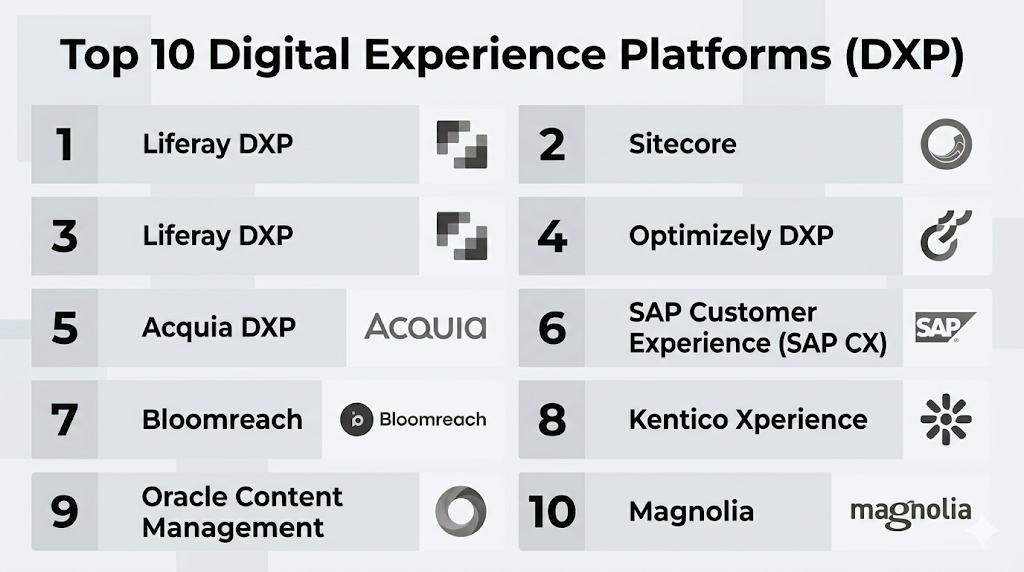
Top 10 Digital Experience Platforms (DXP)
#1 — Adobe Experience Manager (AEM)
Short description: Enterprise-grade DXP combining CMS, DAM, and personalization tools for large organizations.
Key Features
- Advanced content management
- Digital asset management (DAM)
- AI-driven personalization
- Omnichannel delivery
- Workflow automation
- Analytics integration
- Cloud-native deployment
Pros
- Comprehensive enterprise solution
- Strong AI capabilities
Cons
- High cost
- Complex implementation
Platforms / Deployment
Cloud / Hybrid
Security & Compliance
SSO, RBAC, GDPR, enterprise-grade security (specific certifications not publicly stated)
Integrations & Ecosystem
Extensive ecosystem across Adobe products and enterprise tools.
- APIs and SDKs
- Marketing automation tools
- Analytics integrations
- Third-party connectors
Support & Community
Strong enterprise support with extensive documentation.
#2 — Sitecore
Short description: A powerful DXP focused on personalization, customer data, and omnichannel delivery.
Key Features
- Personalization engine
- Customer data platform integration
- Content management
- Marketing automation
- Analytics
- Omnichannel delivery
- AI capabilities
Pros
- Strong personalization
- Enterprise-ready
Cons
- Expensive
- Complex setup
Platforms / Deployment
Cloud / Hybrid
Security & Compliance
SSO, RBAC, GDPR (others not publicly stated)
Integrations & Ecosystem
Wide integration ecosystem.
- APIs
- CRM integrations
- Marketing tools
Support & Community
Strong enterprise support.
#3 — Liferay DXP
Short description: Open-source-based DXP for portals, intranets, and enterprise applications.
Key Features
- Portal and intranet tools
- Content management
- Workflow engine
- User management
- Personalization
- API framework
- Integration tools
Pros
- Flexible and customizable
- Strong for enterprise portals
Cons
- Requires technical expertise
- UI can feel outdated
Platforms / Deployment
Cloud / Self-hosted
Security & Compliance
RBAC, authentication controls (others not publicly stated)
Integrations & Ecosystem
Flexible integrations.
- APIs
- Enterprise systems
- Custom extensions
Support & Community
Strong open-source community.
#4 — Optimizely DXP
Short description: DXP focused on experimentation, personalization, and digital optimization.
Key Features
- A/B testing
- Personalization
- CMS capabilities
- Analytics tools
- Experimentation platform
- Omnichannel delivery
- AI insights
Pros
- Excellent testing tools
- Strong optimization features
Cons
- Pricing complexity
- Requires expertise
Platforms / Deployment
Cloud
Security & Compliance
Basic enterprise security (details not publicly stated)
Integrations & Ecosystem
Strong marketing integrations.
- APIs
- Analytics tools
- Marketing platforms
Support & Community
Good support and documentation.
#5 — Acquia DXP
Short description: Drupal-based DXP offering flexibility and open-source benefits.
Key Features
- Drupal CMS
- Personalization tools
- Cloud hosting
- Content workflows
- Analytics
- API-first approach
- Multi-site management
Pros
- Open-source flexibility
- Strong Drupal ecosystem
Cons
- Requires Drupal expertise
- Setup complexity
Platforms / Deployment
Cloud / Hybrid
Security & Compliance
Enterprise security controls (details not publicly stated)
Integrations & Ecosystem
Rich Drupal ecosystem.
- APIs
- Plugins
- Third-party tools
Support & Community
Strong community support.
#6 — SAP Customer Experience (SAP CX)
Short description: Enterprise DXP integrated with SAP ecosystem for large businesses.
Key Features
- Customer data integration
- Commerce tools
- Personalization
- Analytics
- Content management
- Omnichannel capabilities
- AI-driven insights
Pros
- Strong enterprise integration
- End-to-end CX platform
Cons
- Complex ecosystem
- High cost
Platforms / Deployment
Cloud
Security & Compliance
Enterprise-grade security (details not publicly stated)
Integrations & Ecosystem
Deep SAP integrations.
- ERP integration
- APIs
- Marketing tools
Support & Community
Enterprise-level support.
#7 — Bloomreach
Short description: AI-driven DXP focused on e-commerce and personalization.
Key Features
- AI personalization
- Search and merchandising
- Content management
- Customer data insights
- Omnichannel delivery
- Analytics
- API integrations
Pros
- Strong AI features
- E-commerce focus
Cons
- Limited non-commerce use
- Pricing varies
Platforms / Deployment
Cloud
Security & Compliance
Basic enterprise controls (not publicly stated)
Integrations & Ecosystem
E-commerce integrations.
- APIs
- Commerce platforms
- Analytics tools
Support & Community
Good support resources.
#8 — Kentico Xperience
Short description: Hybrid DXP combining CMS, marketing, and e-commerce capabilities.
Key Features
- Content management
- Marketing automation
- Personalization
- E-commerce tools
- Analytics
- Email marketing
- Workflow management
Pros
- All-in-one solution
- Easier implementation
Cons
- Less flexible than headless
- Limited scalability for large enterprises
Platforms / Deployment
Cloud / On-premise
Security & Compliance
RBAC, authentication (others not publicly stated)
Integrations & Ecosystem
Moderate ecosystem.
- APIs
- CRM tools
- Marketing integrations
Support & Community
Good documentation and support.
#9 — Oracle Content Management
Short description: Enterprise DXP integrated with Oracle cloud ecosystem.
Key Features
- Content management
- Digital asset management
- AI tagging
- Omnichannel delivery
- Collaboration tools
- API-first architecture
- Analytics
Pros
- Strong enterprise integration
- Scalable cloud platform
Cons
- Complex setup
- Requires Oracle ecosystem
Platforms / Deployment
Cloud
Security & Compliance
Enterprise-grade security (not publicly stated)
Integrations & Ecosystem
Oracle ecosystem integrations.
- APIs
- Cloud services
- Enterprise tools
Support & Community
Enterprise-level support.
#10 — Magnolia
Short description: Flexible DXP with strong headless and hybrid capabilities.
Key Features
- Headless CMS
- Personalization tools
- Workflow management
- API-first approach
- Content authoring
- Multi-site support
- Integration framework
Pros
- Flexible architecture
- Developer-friendly
Cons
- Requires setup effort
- Smaller ecosystem
Platforms / Deployment
Cloud / Hybrid
Security & Compliance
RBAC, authentication (others not publicly stated)
Integrations & Ecosystem
Flexible integration framework.
- APIs
- Microservices
- Custom connectors
Support & Community
Moderate community with good docs.
Comparison Table (Top 10)
| Tool Name | Best For | Platform(s) Supported | Deployment | Standout Feature | Public Rating |
|---|---|---|---|---|---|
| Adobe Experience Manager | Enterprise | Web | Cloud/Hybrid | AI personalization | N/A |
| Sitecore | Enterprise | Web | Cloud/Hybrid | Customer data integration | N/A |
| Liferay DXP | Portals | Web | Cloud/Self-hosted | Open-source flexibility | N/A |
| Optimizely DXP | Marketing teams | Web | Cloud | Experimentation tools | N/A |
| Acquia DXP | Drupal users | Web | Cloud/Hybrid | Open-source ecosystem | N/A |
| SAP CX | Large enterprises | Web | Cloud | SAP integration | N/A |
| Bloomreach | E-commerce | Web | Cloud | AI personalization | N/A |
| Kentico Xperience | SMB | Web | Cloud/On-premise | All-in-one platform | N/A |
| Oracle Content Management | Enterprise | Web | Cloud | Oracle ecosystem | N/A |
| Magnolia | Flexible teams | Web | Cloud/Hybrid | Headless + hybrid CMS | N/A |
Evaluation & Scoring of Digital Experience Platforms
| Tool Name | Core | Ease | Integrations | Security | Performance | Support | Value | Weighted Total |
|---|---|---|---|---|---|---|---|---|
| Adobe Experience Manager | 10 | 6 | 10 | 9 | 9 | 9 | 6 | 8.7 |
| Sitecore | 9 | 6 | 9 | 9 | 9 | 8 | 6 | 8.4 |
| Liferay DXP | 8 | 6 | 8 | 7 | 8 | 7 | 8 | 7.7 |
| Optimizely DXP | 8 | 7 | 8 | 7 | 8 | 7 | 7 | 7.6 |
| Acquia DXP | 8 | 6 | 8 | 7 | 8 | 7 | 8 | 7.7 |
| SAP CX | 9 | 5 | 10 | 9 | 9 | 8 | 6 | 8.3 |
| Bloomreach | 8 | 7 | 8 | 7 | 8 | 7 | 7 | 7.6 |
| Kentico Xperience | 7 | 8 | 7 | 7 | 7 | 7 | 8 | 7.5 |
| Oracle Content Management | 9 | 6 | 9 | 9 | 9 | 8 | 6 | 8.3 |
| Magnolia | 8 | 6 | 8 | 7 | 8 | 7 | 7 | 7.6 |
Interpretation:
Scores are comparative and reflect relative strengths across categories. Enterprise platforms score higher in core features and integrations, while SMB tools often score better in ease of use and value. Choose based on your priorities rather than overall score alone.
Which Digital Experience Platform Is Right for You?
Solo / Freelancer
- Not ideal for most DXPs
- Consider lighter CMS or headless CMS instead
SMB
- Best: Kentico Xperience, Bloomreach
- Focus on ease of use and quick deployment
Mid-Market
- Best: Acquia DXP, Optimizely
- Balance scalability and usability
Enterprise
- Best: Adobe Experience Manager, Sitecore, SAP CX
- Strong governance, personalization, integrations
Budget vs Premium
- Budget: Liferay, Acquia
- Premium: Adobe, Sitecore, SAP
Feature Depth vs Ease of Use
- Feature-heavy: Adobe, Sitecore
- Easier: Kentico, Bloomreach
Integrations & Scalability
- Strong: SAP CX, Adobe, Oracle
- Moderate: Kentico, Magnolia
Security & Compliance Needs
- Enterprise-grade: Adobe, SAP, Oracle
- Moderate: Kentico, Bloomreach
Frequently Asked Questions (FAQs)
What is a Digital Experience Platform?
A DXP is a platform that helps manage, deliver, and optimize digital experiences across multiple channels using content, data, and personalization.
How is DXP different from CMS?
A CMS focuses on content management, while a DXP includes personalization, analytics, and customer experience tools.
Are DXPs expensive?
Yes, most enterprise DXPs are costly, though some open-source options are more affordable.
Do DXPs require developers?
Yes, implementation and customization typically require technical expertise.
Can DXPs integrate with CRM systems?
Yes, most DXPs integrate with CRM, marketing, and analytics tools.
Are DXPs secure?
Enterprise DXPs offer strong security, but configurations and integrations also matter.
What industries use DXPs?
Retail, finance, healthcare, media, and large enterprises commonly use DXPs.
Is DXP suitable for small businesses?
Generally no, unless they have complex digital experience needs.
Can DXPs support mobile apps?
Yes, most support omnichannel delivery including mobile apps.
What is the future of DXPs?
The future includes AI-driven personalization, composable architecture, and deeper data integration.
Conclusion
Digital Experience Platforms have become essential for organizations aiming to deliver seamless, personalized, and scalable digital journeys across multiple channels. They go far beyond traditional CMS solutions by combining content, data, personalization, and analytics into a unified system. However, the right DXP depends heavily on your business size, technical capabilities, and customer engagement goals. Enterprise solutions like Adobe Experience Manager and Sitecore offer unmatched depth, while platforms like Kentico and Acquia provide more accessible flexibility. The smartest approach is to shortlist a few platforms, evaluate their integration capabilities, test personalization features, and ensure they align with your long-term digital strategy before committing.
