Introduction
Data Annotation Platforms are specialized software tools that allow organizations to label and annotate datasets for training machine learning models. These platforms support text, image, audio, and video annotation, enabling supervised AI model development. They provide user-friendly interfaces, human-in-the-loop workflows, and automation features to ensure high-quality labeled data at scale.
Organizations use data annotation platforms to improve AI model accuracy, reduce labeling errors, and manage annotation workflows efficiently. These platforms are critical for computer vision, natural language processing, speech recognition, and other AI applications where labeled datasets are required.
Real World Use Cases
- Annotating images for computer vision models
- Labeling text for NLP applications
- Audio transcription and sentiment analysis
- Video frame annotation for object detection
- AI model training for autonomous vehicles
- Medical imaging labeling
- Chatbot training with labeled conversation datasets
- Sentiment analysis for customer feedback
Evaluation Criteria for Buyers
- Support for multi-modal data (text, image, audio, video)
- Human-in-the-loop and automated annotation features
- Workflow management and collaboration tools
- Quality assurance and validation mechanisms
- API and SDK integration
- Scalability for large datasets
- Reporting and analytics
- Multi-language support
- Security and access control
- Ease of use and onboarding
Best for: AI/ML teams, data scientists, annotation teams, and organizations developing supervised learning models.
Not ideal for: Teams with minimal AI needs or projects with pre-labeled datasets where annotation is unnecessary.
Key Trends in Data Annotation Platforms
- Increased AI-assisted annotation to speed up labeling
- Real-time collaboration and workflow management
- Support for multi-modal and multi-language datasets
- Cloud-native platforms with scalable infrastructure
- Human-in-the-loop quality assurance
- Integration with MLOps and AI pipelines
- Automated validation and quality scoring
- Enhanced reporting and analytics dashboards
- Open-source and customizable annotation frameworks
- Expansion of pre-built annotation templates and models
How We Selected These Tools (Methodology)
- Adoption in AI/ML annotation workflows
- Multi-modal annotation capabilities
- Human-in-the-loop and automated workflows
- Quality assurance and validation mechanisms
- Integration with AI pipelines and MLOps platforms
- Scalability for enterprise datasets
- Ease of use and team collaboration support
- Open-source vs commercial adoption
- Security and compliance features
- Support, documentation, and community engagement
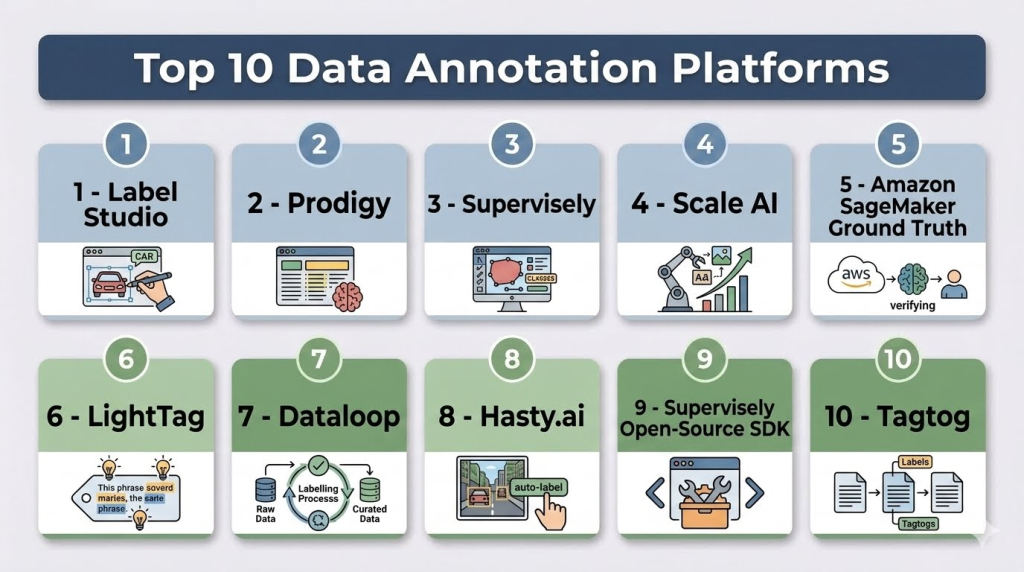
Top 10 Data Annotation Platforms
1- Label Studio
Short Description:
Label Studio is an open-source platform for annotating text, images, audio, and video with flexible human-in-the-loop workflows.
Key Features
- Multi-modal annotation support
- Custom labeling interfaces
- Human-in-the-loop workflows
- API and SDK integration
- Real-time collaboration
- Quality assurance tools
- Extensible plugin architecture
Pros
- Open-source and flexible
- Supports multiple data types
- Strong community and documentation
Cons
- Requires setup and configuration
- Advanced automation may require coding
Platforms / Deployment
Cloud, On-premise, Hybrid
Security & Compliance
RBAC, encryption, audit logs
Integrations & Ecosystem
- TensorFlow, PyTorch
- ML pipelines
- Cloud storage
Support & Community
Open-source community support
2- Prodigy
Short Description:
Prodigy is a commercial annotation platform for rapid NLP and computer vision labeling with active learning capabilities.
Key Features
- AI-assisted annotation
- Active learning workflows
- Multi-modal support
- Integration with SpaCy and ML frameworks
- Real-time model feedback
- API access for custom pipelines
- Export and reporting tools
Pros
- Fast annotation for developers
- Supports real-time active learning
- Flexible for NLP and CV
Cons
- Commercial license
- Limited enterprise deployment features
Platforms / Deployment
Cloud, On-premise
Security & Compliance
Not publicly stated
Integrations & Ecosystem
- SpaCy
- TensorFlow, PyTorch
- ML pipelines
Support & Community
Commercial support
3- Supervisely
Short Description:
Supervisely is an AI-assisted annotation platform for computer vision and multi-modal datasets with collaborative features.
Key Features
- AI-assisted labeling
- Collaborative workflow management
- Dataset versioning
- Multi-user support
- Real-time model predictions
- Cloud and local deployment
- Quality assurance tools
Pros
- Efficient for image and video labeling
- Strong CV capabilities
- Model-assisted annotation
Cons
- Paid platform
- Limited NLP/audio support
Platforms / Deployment
Cloud, On-premise
Security & Compliance
Encryption, access control
Integrations & Ecosystem
- PyTorch, TensorFlow
- Cloud storage
- ML pipelines
Support & Community
Enterprise support
4- Scale AI
Short Description:
Scale AI provides managed annotation services for high-volume datasets, integrating active learning and quality assurance workflows.
Key Features
- Multi-modal annotation (text, image, video, lidar)
- AI-assisted active learning
- Human-in-the-loop QA
- Scalable workforce management
- API integration
- Cloud deployment
- Reporting and analytics dashboards
Pros
- High-quality annotations
- Scalable for enterprise datasets
- Managed services reduce overhead
Cons
- Commercial service
- Cost can be high for large projects
Platforms / Deployment
Cloud
Security & Compliance
RBAC, encryption, compliance certifications
Integrations & Ecosystem
- ML pipelines
- Computer vision and NLP frameworks
- Cloud storage
Support & Community
Enterprise support
5- Amazon SageMaker Ground Truth
Short Description:
SageMaker Ground Truth is a managed data labeling service with active learning for machine learning models on AWS.
Key Features
- Human-in-the-loop workflows
- Active learning-based selection
- Multi-modal annotation
- Integration with SageMaker models
- Dataset versioning
- Quality control mechanisms
- Scalable labeling workforce
Pros
- Fully managed
- AWS ecosystem integration
- Active learning reduces labeling costs
Cons
- AWS-dependent
- Cloud-only deployment
Platforms / Deployment
Cloud
Security & Compliance
IAM, encryption, audit logs
Integrations & Ecosystem
- AWS SageMaker, S3
- ML pipelines
Support & Community
AWS enterprise support
6- LightTag
Short Description:
LightTag is a collaborative text annotation platform with active learning for NLP projects and team workflow management.
Key Features
- Active learning for text
- Team collaboration features
- Annotation workflow management
- Model-assisted suggestions
- Dataset analytics
- Version control
- API for integration
Pros
- NLP-focused
- Easy collaboration
- Human-in-the-loop optimization
Cons
- Limited multi-modal support
- Commercial license
Platforms / Deployment
Cloud
Security & Compliance
RBAC, encryption, SSO
Integrations & Ecosystem
- SpaCy
- ML pipelines
- Data export tools
Support & Community
Enterprise support
7- Dataloop
Short Description:
Dataloop is an end-to-end data management and annotation platform with AI-assisted labeling and workflow orchestration.
Key Features
- Active learning and model-in-the-loop labeling
- Multi-modal annotation
- Workflow automation and collaboration
- Cloud-native and scalable
- Real-time model predictions
- Dataset versioning
- Analytics dashboards
Pros
- Enterprise-grade features
- Scalable and cloud-ready
- Strong monitoring capabilities
Cons
- Paid platform
- Learning curve for advanced pipelines
Platforms / Deployment
Cloud, On-premise
Security & Compliance
Encryption, RBAC, audit logs
Integrations & Ecosystem
- ML pipelines
- Cloud storage
- BI tools
Support & Community
Enterprise support
8- Hasty.ai
Short Description:
Hasty.ai provides AI-assisted annotation for images and videos with active learning and collaborative features.
Key Features
- Active learning for CV datasets
- Model-assisted labeling
- Collaborative annotation
- Dataset versioning
- Real-time labeling
- Cloud deployment
- Visualization dashboards
Pros
- Fast annotation for CV datasets
- AI-assisted active learning
- Easy to use
Cons
- Commercial platform
- Cloud-only deployment
Platforms / Deployment
Cloud
Security & Compliance
Encryption, access control
Integrations & Ecosystem
- ML pipelines
- PyTorch, TensorFlow
- Cloud storage
Support & Community
Enterprise support
9- Supervisely Open-Source SDK
Short Description:
Supervisely SDK is an open-source framework for building custom annotation pipelines with active learning and AI-assisted labeling.
Key Features
- Python SDK for active learning
- Integration with ML workflows
- Model-in-the-loop sample selection
- Dataset management
- Multi-modal support
- Visualization tools
- Open-source and extensible
Pros
- Open-source flexibility
- Python-native
- Customizable pipelines
Cons
- Requires developer expertise
- No commercial support by default
Platforms / Deployment
Cloud, On-premise, Hybrid
Security & Compliance
Varies / N/A
Integrations & Ecosystem
- ML pipelines
- Annotation tools
Support & Community
Open-source community
10- Tagtog
Short Description:
Tagtog is a web-based platform for text annotation with AI-assisted labeling and collaborative features for NLP projects.
Key Features
- Text annotation and labeling
- Active learning-based suggestions
- Team collaboration tools
- API integration
- Dataset analytics
- Version control
- Quality assurance features
Pros
- User-friendly web interface
- Collaborative features
- Active learning suggestions
Cons
- Limited multi-modal support
- Commercial license
Platforms / Deployment
Cloud
Security & Compliance
RBAC, encryption
Integrations & Ecosystem
- ML pipelines
- NLP frameworks
- Data export
Support & Community
Enterprise support
Comparison Table
| Tool Name | Best For | Platforms Supported | Deployment | Standout Feature | Public Rating |
|---|---|---|---|---|---|
| Label Studio | Multi-modal annotation | Cloud, On-prem, Hybrid | Flexible open-source workflows | Open-source & customizable | N/A |
| Prodigy | NLP & CV | Cloud, On-prem | Active learning & AI-assisted | Developer-focused | N/A |
| Supervisely | CV datasets | Cloud, On-prem | Model-assisted labeling | Collaborative features | N/A |
| Scale AI | High-volume annotation | Cloud | Managed service | Scalable workforce | N/A |
| SageMaker Ground Truth | ML pipelines | Cloud | Managed AWS | Active learning integration | N/A |
| LightTag | NLP projects | Cloud | Team collaboration | Active learning for text | N/A |
| Dataloop | Enterprise annotation | Cloud, On-prem | AI-assisted workflow | Scalable & monitored | N/A |
| Hasty.ai | CV datasets | Cloud | Cloud-native | AI-assisted labeling | N/A |
| Supervisely SDK | Custom pipelines | Cloud, On-prem, Hybrid | Python SDK | Open-source customization | N/A |
| Tagtog | Text annotation | Cloud | Web-based | Collaborative labeling | N/A |
Evaluation & Scoring Table
| Tool Name | Core | Ease | Integrations | Security | Performance | Support | Value | Weighted Total |
|---|---|---|---|---|---|---|---|---|
| Label Studio | 9.2 | 8.8 | 9.0 | 8.7 | 8.9 | 8.8 | 8.9 | 8.90 |
| Prodigy | 9.0 | 8.7 | 8.9 | 8.8 | 8.8 | 8.7 | 8.6 | 8.79 |
| Supervisely | 9.1 | 8.6 | 8.8 | 8.8 | 8.9 | 8.7 | 8.7 | 8.81 |
| Scale AI | 9.1 | 8.6 | 8.9 | 8.8 | 8.9 | 8.7 | 8.6 | 8.81 |
| SageMaker Ground Truth | 9.0 | 8.5 | 8.8 | 8.8 | 8.8 | 8.7 | 8.6 | 8.74 |
| LightTag | 8.9 | 8.7 | 8.7 | 8.7 | 8.7 | 8.6 | 8.5 | 8.66 |
| Dataloop | 9.0 | 8.6 | 8.8 | 8.8 | 8.9 | 8.7 | 8.6 | 8.78 |
| Hasty.ai | 8.9 | 8.6 | 8.7 | 8.7 | 8.8 | 8.6 | 8.5 | 8.63 |
| Supervisely SDK | 8.8 | 8.5 | 8.6 | 8.7 | 8.7 | 8.5 | 8.5 | 8.60 |
| Tagtog | 8.9 | 8.6 | 8.7 | 8.7 | 8.8 | 8.6 | 8.5 | 8.63 |
Which Data Annotation Platform Is Right for You?
Solo / Freelancer
Label Studio and Supervisely SDK are suitable for small projects or prototyping.
SMB
Prodigy, LightTag, and Hasty.ai balance usability and annotation efficiency.
Mid-Market
Dataloop, SageMaker Ground Truth, and Supervisely offer enterprise-scale annotation and AI-assisted labeling.
Enterprise
Scale AI, Dataloop, and Hasty.ai provide managed services, scalability, and workflow orchestration for large teams.
Budget vs Premium
Open-source tools like Label Studio and Supervisely SDK are cost-effective; commercial platforms provide enhanced support and features.
Feature Depth vs Ease of Use
Scale AI and Dataloop provide enterprise features; Label Studio and Tagtog emphasize ease of use.
Integrations & Scalability
SageMaker Ground Truth, Dataloop, and Hasty.ai excel at pipeline integration and high-volume processing.
Security & Compliance Needs
Enterprise deployments should prioritize RBAC, encryption, auditing, and compliance for sensitive datasets.
Frequently Asked Questions
1- What is a data annotation platform?
A software platform for labeling and annotating datasets to train supervised machine learning models.
2- Why use a data annotation platform?
It ensures high-quality labeled data, improves model accuracy, and streamlines annotation workflows.
3- Which data types are supported?
Text, images, video, and audio are commonly supported.
4- Can these platforms integrate with ML pipelines?
Yes, most provide APIs or SDKs for integration with AI and ML workflows.
5- Are there open-source options?
Yes, Label Studio and Supervisely SDK are open-source.
6- Do they support active learning?
Many platforms like Prodigy, Scale AI, and SageMaker Ground Truth support AI-assisted active learning.
7- Can multiple users collaborate?
Yes, enterprise platforms provide multi-user and team workflow management.
8- Are these tools scalable?
Enterprise solutions like Dataloop, Scale AI, and Hasty.ai support large datasets.
9- How is quality assurance handled?
Through human-in-the-loop validation, consensus labeling, and automated QA tools.
10- Are these platforms secure?
Enterprise platforms provide encryption, RBAC, and audit logging to protect sensitive data.
Conclusion
Data Annotation Platforms are essential for building high-quality AI and ML datasets. Open-source solutions like Label Studio and Supervisely SDK provide flexibility and cost-efficiency, while enterprise platforms like Dataloop, Scale AI, and SageMaker Ground Truth offer scalable, managed annotation workflows with AI-assisted labeling. Selecting the right platform depends on dataset size, annotation complexity, integration needs, and team size. Piloting multiple tools ensures efficient, accurate, and compliant annotation workflows.
