Introduction
Blockchain Platforms are solutions that enable the development, deployment, and management of decentralized applications (dApps) and distributed ledgers. They provide the infrastructure for secure, transparent, and immutable transactions, supporting industries such as finance, supply chain, healthcare, and digital identity.
With the rise of decentralized finance, digital assets, and enterprise blockchain initiatives, these platforms are critical for trustworthy data sharing, smart contract execution, and secure recordkeeping.
Real-world use cases include
- Developing decentralized finance (DeFi) applications
- Supply chain transparency and provenance tracking
- Digital identity management and authentication
- Enterprise-grade secure transaction systems
- Tokenization of assets and NFT marketplaces
What buyers should evaluate
- Consensus mechanisms and network scalability
- Smart contract functionality and programming language support
- Security and compliance features
- Integration with existing enterprise systems
- Deployment options (public, private, hybrid)
- Performance and transaction throughput
- Developer tools, SDKs, and APIs
- Community and ecosystem support
- Data privacy and encryption capabilities
- Cost and licensing model
Best for: Enterprises, fintech companies, supply chain organizations, and developers building dApps
Not ideal for: Small-scale experimentation without need for decentralization or security guarantees
Key Trends in Blockchain Platforms
- Layer-2 solutions for improved scalability and transaction speed
- Cross-chain interoperability for asset transfer and data sharing
- Privacy-enhancing technologies like zero-knowledge proofs
- Enterprise-grade blockchain for supply chain and finance
- Integration with AI and IoT for secure automation
- Cloud-based blockchain-as-a-service (BaaS) offerings
- Tokenization of assets and NFT adoption
- Smart contract auditing and security tools
- Governance frameworks for decentralized networks
- Open-source frameworks gaining enterprise adoption
How We Selected These Tools
- Network scalability and throughput
- Smart contract support and programmability
- Security and privacy features
- Integration with enterprise systems and APIs
- Community adoption and developer ecosystem
- Deployment flexibility (public, private, hybrid)
- Performance benchmarking and transaction efficiency
- Enterprise readiness and support
- Interoperability and cross-chain capabilities
- Practical applicability for blockchain-based applications
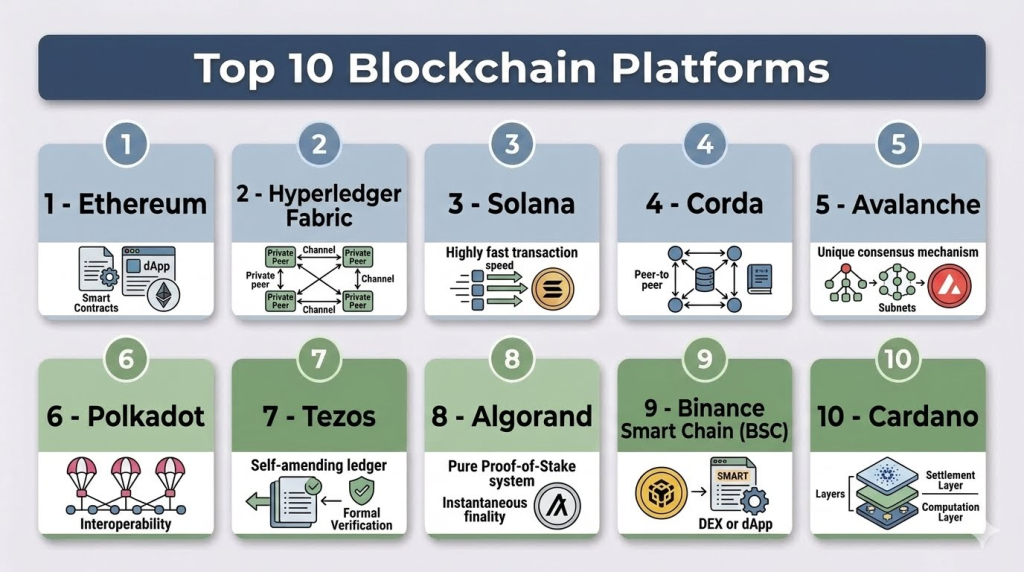
Top 10 Blockchain Platforms
1- Ethereum
Short description: Ethereum is a decentralized platform for smart contracts enabling the creation of dApps and decentralized finance applications.
Key Features
- Smart contract execution
- ERC standards for token creation
- Public blockchain with active community
- Layer-2 scaling solutions
- Developer tools and SDKs
- Multi-language support (Solidity, Vyper)
- Governance via Ethereum Improvement Proposals (EIPs)
Pros
- Large developer community
- Extensive tooling and integrations
- Wide adoption for dApps
Cons
- Scalability and high transaction fees
- Public network latency
Platforms / Deployment
- Cloud / Self-hosted / Public
Security & Compliance
- Encryption, decentralized consensus
- Not publicly stated
Integrations & Ecosystem
- Web3.js, Infura, MetaMask
- Layer-2 solutions
- DeFi and NFT ecosystems
Support & Community
Large global developer community
2- Hyperledger Fabric
Short description: Hyperledger Fabric is an enterprise-grade, permissioned blockchain platform for private networks and business applications.
Key Features
- Permissioned network architecture
- Chaincode smart contracts
- Modular consensus protocols
- Private channels for data privacy
- Integration with enterprise systems
- Governance and policy management
- Auditing and logging
Pros
- Enterprise-focused and secure
- Scalable and flexible
- Strong privacy controls
Cons
- Complex setup
- Steeper learning curve
Platforms / Deployment
- Cloud / On-prem / Hybrid
Security & Compliance
- RBAC, encryption, audit logs
- Not publicly stated
Integrations & Ecosystem
- SDKs in Java, Go, Node.js
- ERP and enterprise software integration
- Cloud BaaS providers
Support & Community
Enterprise support and active Hyperledger community
3- Solana
Short description: Solana is a high-performance blockchain platform optimized for fast and low-cost transactions, suitable for dApps and NFTs.
Key Features
- High throughput with Proof of History
- Low transaction fees
- Smart contract support (Rust, C, C++)
- Scalable network architecture
- Developer tools and SDKs
- NFT and DeFi ecosystem
- Real-time analytics
Pros
- Fast and low-cost transactions
- Growing developer ecosystem
- Suitable for high-volume applications
Cons
- Network centralization concerns
- Smaller enterprise adoption
Platforms / Deployment
- Cloud / Public
Security & Compliance
- Not publicly stated
Integrations & Ecosystem
- Solana SDKs, Web3 integration
- NFT marketplaces
- DeFi protocols
Support & Community
Active open-source and developer community
4- Corda
Short description: Corda is a permissioned blockchain platform designed for financial services and enterprise applications.
Key Features
- Private transactions and smart contracts
- Integration with banking and enterprise systems
- Notary service for consensus
- Modular architecture
- API and SDK support
- Privacy-focused design
- Auditing and logging
Pros
- Enterprise-ready for finance
- High privacy and compliance
- Interoperability with existing systems
Cons
- Limited public adoption
- Specialized use case focus
Platforms / Deployment
- Cloud / On-prem / Hybrid
Security & Compliance
- Encryption, privacy-preserving transactions
- Not publicly stated
Integrations & Ecosystem
- Java, Kotlin SDKs
- Enterprise system integration
- Financial consortium networks
Support & Community
Enterprise vendor support and community
5- Avalanche
Short description: Avalanche is a high-performance, scalable blockchain platform for DeFi, dApps, and asset tokenization.
Key Features
- High throughput consensus
- Low-latency transactions
- Smart contract support (EVM compatible)
- Subnets for custom blockchains
- Cross-chain interoperability
- Developer tools and SDKs
- NFT and DeFi ecosystems
Pros
- Fast and scalable
- EVM compatibility
- Flexible deployment via subnets
Cons
- Smaller enterprise adoption
- Newer ecosystem
Platforms / Deployment
- Cloud / Public
Security & Compliance
- Not publicly stated
Integrations & Ecosystem
- Ethereum compatibility
- DeFi protocols
- SDKs and APIs
Support & Community
Active developer community
6- Polkadot
Short description: Polkadot is a multi-chain platform enabling interoperability between blockchains and custom parachains.
Key Features
- Multi-chain interoperability
- Custom parachain creation
- Shared security and consensus
- Governance via on-chain voting
- Developer SDKs
- Cross-chain asset transfers
- Scalable network design
Pros
- Interoperable and flexible
- Scalable multi-chain architecture
- Strong community governance
Cons
- Complex development
- Learning curve for parachains
Platforms / Deployment
- Cloud / Public
Security & Compliance
- Not publicly stated
Integrations & Ecosystem
- Substrate SDK
- Cross-chain applications
- Blockchain interoperability tools
Support & Community
Active open-source and developer community
7- Tezos
Short description: Tezos is a self-amending blockchain platform supporting smart contracts and on-chain governance.
Key Features
- On-chain governance
- Smart contract execution
- Self-amending protocol
- Multi-language smart contract support
- NFT and DeFi ecosystem
- Developer SDKs
- Analytics and monitoring
Pros
- Built-in governance
- Flexible smart contract support
- Active community
Cons
- Smaller ecosystem compared to Ethereum
- Lower enterprise adoption
Platforms / Deployment
- Cloud / Public
Security & Compliance
- Not publicly stated
Integrations & Ecosystem
- Smart contract languages: Michelson, Ligo
- DeFi and NFT integration
- APIs and SDKs
Support & Community
Open-source community
8- Algorand
Short description: Algorand is a high-performance blockchain platform optimized for speed, low fees, and scalable applications.
Key Features
- Pure Proof-of-Stake consensus
- Smart contract support (TEAL)
- Fast transaction finality
- Low transaction fees
- Developer SDKs
- Multi-asset support
- DeFi and NFT ecosystem
Pros
- Fast and scalable
- Low transaction costs
- Enterprise and DeFi-ready
Cons
- Smaller developer community
- Less adoption for large-scale enterprise
Platforms / Deployment
- Cloud / Public
Security & Compliance
- Not publicly stated
Integrations & Ecosystem
- Python, Java, Go SDKs
- APIs for dApps
- DeFi and NFT integration
Support & Community
Open-source community
9- Binance Smart Chain (BSC)
Short description: BSC is a public blockchain platform compatible with Ethereum, supporting DeFi and NFT applications.
Key Features
- EVM compatible
- Fast and low-cost transactions
- Smart contract support
- Cross-chain asset bridging
- Developer SDKs
- DeFi and NFT ecosystem
- Analytics dashboards
Pros
- Fast and low fees
- EVM compatible
- Large DeFi ecosystem
Cons
- Centralization concerns
- Public network limitations
Platforms / Deployment
- Cloud / Public
Security & Compliance
- Not publicly stated
Integrations & Ecosystem
- Ethereum tools
- DeFi and NFT integration
- SDKs and APIs
Support & Community
Large open-source and community support
10- Cardano
Short description: Cardano is a proof-of-stake blockchain platform supporting smart contracts, dApps, and secure digital assets.
Key Features
- Proof-of-Stake consensus
- Smart contracts (Plutus)
- Low-cost transactions
- Governance and treasury system
- Developer SDKs
- Multi-asset support
- NFT ecosystem
Pros
- Energy-efficient PoS
- Secure and decentralized
- Multi-asset and NFT support
Cons
- Slower adoption
- Smaller developer ecosystem
Platforms / Deployment
- Cloud / Public
Security & Compliance
- Not publicly stated
Integrations & Ecosystem
- Plutus, Haskell SDKs
- APIs for dApps
- NFT and DeFi integration
Support & Community
Open-source community
Comparison Table
| Tool | Best For | Platform(s) | Deployment | Standout Feature | Public Rating |
|---|---|---|---|---|---|
| Ethereum | dApps & DeFi | Cloud / Public | Public | Large developer ecosystem | N/A |
| Hyperledger Fabric | Enterprise apps | Cloud / On-prem | Hybrid | Private channels & modular consensus | N/A |
| Solana | High-speed apps | Cloud / Public | Public | High throughput | N/A |
| Corda | Finance & enterprise | Cloud / On-prem | Hybrid | Privacy-focused | N/A |
| Avalanche | DeFi & dApps | Cloud / Public | Public | Subnet customization | N/A |
| Polkadot | Multi-chain apps | Cloud / Public | Public | Cross-chain interoperability | N/A |
| Tezos | Governance & smart contracts | Cloud / Public | Public | On-chain governance | N/A |
| Algorand | Fast & scalable apps | Cloud / Public | Public | Low transaction fees | N/A |
| Binance Smart Chain | DeFi & NFT | Cloud / Public | Public | EVM compatible & fast | N/A |
| Cardano | Secure dApps & assets | Cloud / Public | Public | Energy-efficient PoS | N/A |
Evaluation & Scoring of Blockchain Platforms
| Tool | Core (25%) | Ease (15%) | Integrations (15%) | Security (10%) | Performance (10%) | Support (10%) | Value (15%) | Weighted Total |
|---|---|---|---|---|---|---|---|---|
| Ethereum | 9 | 8 | 9 | 8 | 8 | 8 | 8 | 8.4 |
| Hyperledger Fabric | 8 | 7 | 8 | 9 | 8 | 8 | 8 | 8.0 |
| Solana | 9 | 8 | 8 | 7 | 9 | 7 | 8 | 8.1 |
| Corda | 8 | 7 | 8 | 9 | 8 | 8 | 8 | 8.0 |
| Avalanche | 9 | 8 | 8 | 7 | 9 | 7 | 8 | 8.1 |
| Polkadot | 8 | 7 | 8 | 8 | 8 | 7 | 8 | 7.9 |
| Tezos | 8 | 7 | 7 | 8 | 8 | 7 | 7 | 7.6 |
| Algorand | 8 | 7 | 7 | 8 | 8 | 7 | 7 | 7.6 |
| Binance Smart Chain | 8 | 8 | 8 | 7 | 8 | 7 | 8 | 7.9 |
| Cardano | 8 | 7 | 7 | 8 | 8 | 7 | 7 | 7.6 |
Which Blockchain Platform Is Right for You?
Solo / Freelancer
- Cardano, Tezos
Open-source and energy-efficient platforms for experimentation
SMB
- Solana, Binance Smart Chain, Algorand
Fast, low-cost public blockchains suitable for mid-scale apps
Mid-Market
- Ethereum, Avalanche, Polkadot
Scalable platforms for dApps and DeFi applications
Enterprise
- Hyperledger Fabric, Corda, Ethereum
Private and hybrid solutions for finance, supply chain, and secure enterprise apps
Budget vs Premium
- Budget: Cardano, Tezos, Binance Smart Chain
- Premium: Ethereum, Hyperledger Fabric, Corda
Feature Depth vs Ease of Use
- Ease: Algorand, Solana
- Depth: Hyperledger Fabric, Ethereum, Corda
Integrations & Scalability
- Best: Ethereum, Avalanche, Hyperledger Fabric
Security & Compliance Needs
- Enterprise-ready: Hyperledger Fabric, Corda, Ethereum
Frequently Asked Questions
1- What is a blockchain platform?
It is a framework for building decentralized applications and managing secure, immutable ledgers.
2- Can these platforms support smart contracts?
Yes, most platforms like Ethereum, Solana, and Tezos enable programmable contracts.
3- Are they suitable for enterprise applications?
Private and hybrid platforms like Hyperledger Fabric and Corda are designed for enterprises.
4- Do they support DeFi and NFTs?
Yes, Ethereum, Solana, Avalanche, and Binance Smart Chain support DeFi and NFT applications.
5- Can blockchain be deployed on-premises?
Enterprise platforms like Hyperledger Fabric and Corda support on-premises deployment.
6- Are there energy-efficient blockchain options?
Yes, Cardano and Algorand use PoS consensus for energy efficiency.
7- Can multiple blockchains interoperate?
Platforms like Polkadot enable cross-chain interoperability for assets and data.
8- What industries benefit most?
Finance, supply chain, healthcare, fintech, digital assets, and governance applications.
9- Are developer tools available?
Yes, most platforms offer SDKs, APIs, and developer communities.
10- How should I choose the right blockchain platform?
Consider your use case, deployment model, scalability, smart contract support, and ecosystem.
Conclusion
Blockchain Platforms provide secure, decentralized infrastructure for applications ranging from finance and supply chain to DeFi and NFTs. They offer immutability, transparency, and programmable smart contracts to enable modern decentralized solutions.
Selecting the right platform depends on use case, scalability, deployment needs, and community support. A practical approach is to shortlist platforms, pilot dApps or smart contracts, and validate performance, scalability, and integration before enterprise deployment.
