Introduction
Bot Management Tools are security solutions designed to detect, analyze, and control automated traffic (bots) interacting with websites, APIs, and applications. These tools help organizations differentiate between good bots (like search engine crawlers) and malicious bots (like scrapers, credential stuffers, and fraud bots), ensuring optimal performance, security, and user experience.
With the rise of automation, AI-driven attacks, and API-based architectures, bot traffic now accounts for a significant portion of internet traffic. Businesses must protect themselves against fraud, scraping, account takeovers, and resource abuse. Modern bot management platforms use machine learning, behavioral analysis, and real-time mitigation to handle sophisticated threats.
Common Use Cases
- Preventing credential stuffing and account takeovers
- Blocking web scraping and content theft
- Protecting APIs and mobile apps
- Stopping ad fraud and fake traffic
- Ensuring fair usage in eCommerce and ticketing systems
What Buyers Should Evaluate
- Bot detection accuracy and false positives
- Behavioral analysis capabilities
- Real-time mitigation and response speed
- Integration with WAF, CDN, and APIs
- Scalability and performance impact
- Ease of deployment and management
- Reporting and analytics visibility
- Customization and policy control
- Pricing and cost transparency
Best for: eCommerce platforms, SaaS companies, fintech firms, gaming platforms, and enterprises handling high volumes of user traffic
Not ideal for: Small websites with minimal traffic or platforms without exposure to automated abuse
Key Trends in Bot Management Tools
- AI-driven bot detection and behavioral analysis
- Rise of good bot vs bad bot classification engines
- API-first bot protection strategies
- Integration with Zero Trust security models
- Increased focus on mobile app protection
- Use of fingerprinting and device intelligence
- Real-time adaptive security policies
- Growth of managed bot mitigation services
- Integration with fraud prevention platforms
- Edge-based bot filtering using CDNs
How We Selected These Tools (Methodology)
- Market reputation and adoption
- Coverage of bot detection techniques
- Accuracy and false positive handling
- Performance and latency impact
- Security capabilities
- Integration ecosystem
- Scalability across business sizes
- Ease of deployment and usability
- Value for cost
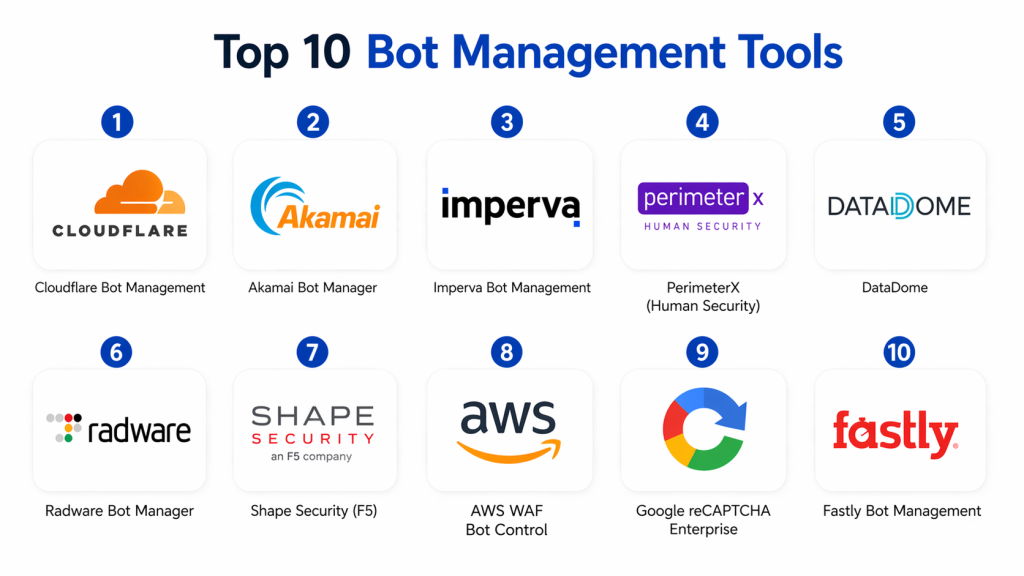
Top 10 Bot Management Tools
#1 — Cloudflare Bot Management
Short description :
Cloudflare Bot Management provides advanced bot detection using machine learning and global traffic intelligence. It identifies malicious bots in real time while allowing legitimate traffic. The platform integrates seamlessly with Cloudflare’s CDN and WAF. It is easy to deploy and scalable. Suitable for businesses of all sizes. Ideal for performance and security combined.
Key Features
- Machine learning-based detection
- Bot scoring system
- Real-time mitigation
- Integration with CDN and WAF
- API protection
- Global threat intelligence
Pros
- Easy to deploy
- Strong global coverage
Cons
- Advanced features cost more
- Limited deep customization
Platforms / Deployment
Cloud
Security & Compliance
SSO, MFA, RBAC, GDPR support
Integrations & Ecosystem
Integrates with modern web and cloud stacks
- APIs
- DevOps tools
- Cloud platforms
Support & Community
Strong documentation and large user community
#2 — Akamai Bot Manager
Short description :
Akamai Bot Manager offers enterprise-grade bot detection and mitigation. It leverages Akamai’s global network for large-scale protection. The platform focuses on advanced threat detection and analytics. It is widely used by large enterprises. Provides strong visibility into bot behavior. Best for high-traffic environments.
Key Features
- Behavioral detection
- Global network filtering
- Advanced analytics
- API protection
- Real-time mitigation
Pros
- High accuracy
- Enterprise scalability
Cons
- Expensive
- Complex setup
Platforms / Deployment
Cloud
Security & Compliance
Not publicly stated
Integrations & Ecosystem
Enterprise integrations
- SIEM tools
- Security platforms
Support & Community
Premium enterprise support
#3 — Imperva Bot Management
Short description :
Imperva Bot Management provides comprehensive bot protection with strong analytics and reporting. It detects sophisticated bots using behavioral analysis. The platform integrates with web and API security tools. It supports hybrid deployments. Suitable for enterprises with strict security needs. Offers strong visibility and control.
Key Features
- Behavioral analysis
- API protection
- Bot classification
- Real-time alerts
- Hybrid deployment
Pros
- Strong security features
- Flexible deployment
Cons
- Higher cost
- Complex configuration
Platforms / Deployment
Cloud / Hybrid
Security & Compliance
Varies / Not publicly stated
Integrations & Ecosystem
Supports enterprise integrations
- SIEM
- APIs
- Security tools
Support & Community
Enterprise-grade support
#4 — PerimeterX (Human Security)
Short description :
PerimeterX focuses on bot detection and fraud prevention using behavioral analytics. It specializes in protecting web applications and APIs. The platform is widely used in eCommerce. It offers real-time mitigation. Strong focus on user behavior analysis. Ideal for preventing account takeover and scraping.
Key Features
- Behavioral analytics
- Bot mitigation
- Fraud prevention
- API protection
- Real-time detection
Pros
- Strong fraud prevention
- Good analytics
Cons
- Pricing not transparent
- Requires tuning
Platforms / Deployment
Cloud
Security & Compliance
Not publicly stated
Integrations & Ecosystem
Integrates with web applications
- APIs
- Security platforms
Support & Community
Good support and documentation
#5 — DataDome
Short description :
DataDome provides real-time bot protection with strong AI-based detection. It focuses on protecting websites, APIs, and mobile apps. The platform offers high accuracy and low latency. It is easy to integrate. Suitable for eCommerce and digital platforms. Known for performance efficiency.
Key Features
- AI-based detection
- Real-time mitigation
- API protection
- Mobile app protection
- Low latency
Pros
- High accuracy
- Easy integration
Cons
- Premium pricing
- Limited customization
Platforms / Deployment
Cloud
Security & Compliance
Not publicly stated
Integrations & Ecosystem
Integrates with web and mobile platforms
- APIs
- CDNs
Support & Community
Strong customer support
#6 — Radware Bot Manager
Short description :
Radware Bot Manager uses behavioral modeling and device fingerprinting to detect bots. It provides real-time protection against automated threats. The platform supports hybrid deployments. It offers granular policy control. Suitable for enterprises with complex environments.
Key Features
- Device fingerprinting
- Behavioral detection
- Real-time mitigation
- API protection
- Hybrid support
Pros
- Strong detection capabilities
- Flexible deployment
Cons
- Requires expertise
- Complex setup
Platforms / Deployment
Cloud / Hybrid
Security & Compliance
Not publicly stated
Integrations & Ecosystem
Enterprise integrations
- Security tools
- APIs
Support & Community
Enterprise-level support
#7 — Shape Security (F5)
Short description :
Shape Security (F5) focuses on fraud prevention and bot mitigation. It uses AI-driven analysis to detect automated threats. The platform protects web and mobile applications. It is widely used in financial services. Offers strong real-time protection. Best for high-risk industries.
Key Features
- AI-based detection
- Fraud prevention
- Mobile protection
- Real-time mitigation
- Behavioral analysis
Pros
- Strong fraud detection
- High accuracy
Cons
- Expensive
- Enterprise-focused
Platforms / Deployment
Cloud
Security & Compliance
Varies / Not publicly stated
Integrations & Ecosystem
Integrates with F5 ecosystem
- Security tools
- APIs
Support & Community
Premium enterprise support
#8 — AWS WAF Bot Control
Short description :
AWS WAF Bot Control helps detect and manage bot traffic within AWS environments. It integrates with AWS WAF. It provides visibility into bot activity. It supports rule-based and automated detection. Ideal for AWS users.
Key Features
- Bot detection
- Integration with AWS WAF
- Traffic visibility
- Rule-based control
- Real-time monitoring
Pros
- Native AWS integration
- Easy deployment
Cons
- Limited outside AWS
- Requires AWS knowledge
Platforms / Deployment
Cloud
Security & Compliance
IAM, MFA, encryption
Integrations & Ecosystem
AWS ecosystem
- CloudFront
- APIs
Support & Community
Strong AWS support
#9 — Google reCAPTCHA Enterprise
Short description :
Google reCAPTCHA Enterprise helps detect bots using risk analysis. It minimizes friction for real users. It is widely used for login and forms protection. It integrates easily with applications. Suitable for businesses of all sizes.
Key Features
- Risk-based detection
- Invisible CAPTCHA
- Bot scoring
- Easy integration
- API support
Pros
- Easy to use
- Low user friction
Cons
- Limited advanced features
- CAPTCHA dependency
Platforms / Deployment
Cloud
Security & Compliance
Not publicly stated
Integrations & Ecosystem
Integrates with web apps
- APIs
- Web platforms
Support & Community
Large developer community
#10 — Fastly Bot Management
Short description :
Fastly Bot Management provides edge-based bot detection and mitigation. It integrates with Fastly’s CDN. The platform offers real-time control via APIs. It is suitable for developer-first teams. Provides strong performance and visibility.
Key Features
- Edge-based detection
- API control
- Real-time mitigation
- CDN integration
- Traffic analytics
Pros
- High performance
- Developer-friendly
Cons
- Learning curve
- Premium pricing
Platforms / Deployment
Cloud
Security & Compliance
Varies / Not publicly stated
Integrations & Ecosystem
API-driven integrations
- DevOps tools
- Cloud platforms
Support & Community
Good documentation
Comparison Table (Top 10)
| Tool Name | Best For | Platform | Deployment | Standout Feature | Public Rating |
|---|---|---|---|---|---|
| Cloudflare | SMB–Enterprise | Web | Cloud | Global bot intelligence | N/A |
| Akamai | Enterprise | Web | Cloud | Advanced analytics | N/A |
| Imperva | Security teams | Web | Hybrid | API protection | N/A |
| PerimeterX | eCommerce | Web | Cloud | Behavioral analytics | N/A |
| DataDome | Digital platforms | Web | Cloud | Real-time detection | N/A |
| Radware | Enterprise | Network | Hybrid | Device fingerprinting | N/A |
| Shape Security | Finance | Web | Cloud | Fraud prevention | N/A |
| AWS WAF | AWS users | Cloud | Cloud | Native integration | N/A |
| reCAPTCHA | SMB | Web | Cloud | Risk scoring | N/A |
| Fastly | Developers | Web | Cloud | Edge control | N/A |
Evaluation & Scoring of Bot Management Tools
| Tool | Core | Ease | Integrations | Security | Performance | Support | Value | Total |
|---|---|---|---|---|---|---|---|---|
| Cloudflare | 9 | 9 | 8 | 8 | 9 | 8 | 9 | 8.7 |
| Akamai | 10 | 7 | 8 | 9 | 10 | 9 | 6 | 8.6 |
| Imperva | 9 | 7 | 8 | 9 | 8 | 8 | 7 | 8.1 |
| PerimeterX | 9 | 7 | 8 | 8 | 8 | 8 | 7 | 8.0 |
| DataDome | 8 | 8 | 7 | 8 | 9 | 8 | 7 | 8.0 |
| Radware | 9 | 6 | 7 | 8 | 9 | 8 | 6 | 7.9 |
| Shape Security | 9 | 7 | 7 | 9 | 9 | 8 | 6 | 8.0 |
| AWS WAF | 8 | 8 | 9 | 8 | 8 | 8 | 8 | 8.2 |
| reCAPTCHA | 7 | 9 | 7 | 7 | 8 | 7 | 9 | 7.9 |
| Fastly | 8 | 7 | 9 | 7 | 9 | 7 | 8 | 8.0 |
These scores are comparative benchmarks. Higher scores indicate stronger overall capability. Enterprises may prioritize performance and security, while SMBs focus on ease and cost efficiency.
Which Bot Management Tool Is Right for You?
Solo / Freelancer
Choose simple tools like reCAPTCHA or Cloudflare
SMB
Cloudflare, DataDome
Mid-Market
Imperva, AWS WAF
Enterprise
Akamai, Radware, Shape Security
Budget vs Premium
Budget: reCAPTCHA, Cloudflare
Premium: Akamai, Shape
Feature Depth vs Ease of Use
Easy: Cloudflare
Advanced: Akamai
Integrations & Scalability
Cloud-native tools scale better
Security & Compliance Needs
Choose Imperva or Shape for strict needs
Frequently Asked Questions (FAQs)
1. What are Bot Management Tools?
Bot Management Tools are security systems that detect and block automated bots from interacting with websites and APIs. They analyze behavior, device signals, and traffic patterns. Their goal is to prevent fraud, scraping, and abuse. They help maintain system performance and security. They are widely used in modern cybersecurity stacks.
2. How do bot management systems detect bots?
They use behavioral analysis, machine learning models, and fingerprinting techniques. These systems analyze mouse movement, request patterns, and device signals. Some also use challenge-response systems. Risk scoring determines whether traffic is human or bot. Decisions are made in real time.
3. Are all bots harmful?
No, not all bots are harmful. Search engine crawlers and monitoring bots are beneficial. Harmful bots perform scraping, fraud, and credential stuffing. Bot management tools differentiate between good and bad bots. This classification is essential for proper website functioning.
4. Do bot management tools affect user experience?
Modern tools are designed to minimize user disruption. Many operate invisibly without CAPTCHA challenges. Only suspicious traffic is challenged. However, aggressive configurations may occasionally impact users. Proper tuning reduces false positives.
5. What industries need bot protection most?
eCommerce, fintech, travel, SaaS, ticketing platforms, and media companies are most affected. Any platform with login systems or APIs is at risk. Fraud-heavy industries benefit the most. High-traffic platforms are frequent targets.
6. What is credential stuffing?
Credential stuffing is a type of attack where stolen usernames and passwords are used to access accounts. Bots automate this process at scale. Bot management tools detect and block these attempts. They analyze login behavior and request patterns.
7. Can bot management tools stop scraping?
Yes, they can significantly reduce scraping activity. They identify abnormal request rates and patterns. Some tools block scraping attempts entirely. Others apply adaptive challenges. However, no system guarantees 100% prevention.
8. What is the difference between WAF and bot management?
WAF protects against application vulnerabilities like SQL injection. Bot management focuses on automated traffic detection. Both are complementary technologies. Many platforms combine both functions. Bot management handles behavioral threats.
9. Are cloud-based bot management tools better?
Cloud-based tools offer scalability and real-time updates. They are easier to deploy and maintain. On-prem solutions offer more control but require infrastructure. Most modern organizations prefer cloud-native models.
10. How much do bot management tools cost?
Pricing depends on traffic volume, features, and enterprise requirements. Some tools offer basic free tiers. Enterprise solutions are custom-priced. Costs increase with advanced analytics and API usage. Not publicly standardized.
Conclusion
Bot Management Tools have become essential in protecting digital ecosystems from increasingly sophisticated automated threats. From credential stuffing to large-scale scraping attacks, bots now represent one of the most persistent cybersecurity challenges.
Different platforms serve different needs—Cloudflare and reCAPTCHA offer easy entry points for SMBs and developers, while Akamai, F5, and Imperva deliver enterprise-grade intelligence and global protection capabilities. Meanwhile, specialized platforms like DataDome, Arkose Labs, and Netacea focus deeply on fraud prevention and behavioral detection.
Ultimately, choosing the right bot management solution depends on your traffic scale, fraud exposure, and integration needs. Most organizations benefit from combining bot management with WAF, CDN, and identity security systems for layered defense. A pilot-based evaluation approach is the most effective way to validate accuracy, performance, and user experience impact before full deployment.
