Introduction
B2B E-commerce Platforms help businesses sell products, services, parts, supplies, equipment, and wholesale goods to other businesses through a digital buying experience. In simple words, these platforms allow manufacturers, distributors, wholesalers, suppliers, and enterprise sellers to create online portals where business buyers can browse catalogs, request quotes, place bulk orders, manage approvals, view contract pricing, reorder products, and track purchases.
B2B e-commerce matters because business buyers now expect the same speed, convenience, and transparency they experience in consumer shopping, but with business-specific features such as account-based pricing, purchase approvals, credit terms, bulk ordering, negotiated catalogs, tax rules, and ERP integration. A strong B2B platform helps companies reduce manual sales work, improve buyer self-service, expand digital revenue, support distributors, and connect online orders directly with back-office systems.
Real-world use cases include:
- Wholesale ordering for distributors, retailers, dealers, and resellers.
- Manufacturer portals for spare parts, replacement parts, equipment, and repeat purchasing.
- Dealer and distributor commerce with account-specific catalogs, pricing, and credit rules.
- Self-service buyer portals for order history, invoices, reorders, quotes, and shipment tracking.
- Multi-channel B2B sales across online stores, sales reps, marketplaces, and partner networks.
- Contract-based pricing for negotiated customer terms and special buying agreements.
- ERP-connected commerce for inventory, pricing, tax, customer accounts, and order fulfillment.
Evaluation Criteria for Buyers:
- B2B buyer experience including account portals, quick order, reorder, quote requests, and approvals.
- Pricing flexibility for customer-specific pricing, volume discounts, contract pricing, and tiered pricing.
- Catalog management for large product catalogs, variants, SKUs, bundles, and custom catalogs.
- ERP and back-office integration for inventory, order management, customer data, invoices, and payments.
- Quote and negotiation workflows for sales-assisted and self-service buying.
- Account and role management for buyers, approvers, teams, dealers, branches, and distributors.
- Scalability for high order volume, large catalogs, multiple storefronts, regions, and currencies.
- Security controls such as SSO, RBAC, audit logs, encryption, and permission management.
- Omnichannel support for web, mobile, sales reps, marketplaces, and partner channels.
- Implementation fit based on budget, internal skills, customization needs, and time to launch.
Best for: B2B E-commerce Platforms are best for manufacturers, wholesalers, distributors, industrial suppliers, medical suppliers, office supply companies, automotive parts sellers, construction suppliers, foodservice distributors, enterprise sellers, and any organization selling to business buyers at scale.
Not ideal for: Very small businesses with only a few B2B customers may not need a dedicated B2B e-commerce platform. If orders are simple, product catalogs are small, and buyer-specific pricing is not required, a basic website, invoicing tool, or standard e-commerce platform may be enough until order complexity grows.
Key Trends in B2B E-commerce Platforms
- AI-assisted buying experiences are becoming more common as platforms help buyers search products, reorder faster, compare options, and receive smarter recommendations.
- Account-based personalization is becoming essential because business buyers expect pricing, catalogs, payment terms, and order history to match their company account.
- Composable commerce is gaining adoption as larger businesses want flexible architecture, APIs, and modular services instead of one rigid platform.
- ERP integration remains a top priority because B2B commerce depends heavily on live inventory, customer pricing, tax rules, credit limits, invoices, and fulfillment data.
- Self-service portals are reducing manual sales work by allowing buyers to manage quotes, orders, invoices, reorders, and support requests online.
- Hybrid B2B and B2C commerce is growing as many brands sell to distributors, dealers, retailers, and direct consumers from connected commerce operations.
- Marketplace and multi-vendor models are becoming more relevant for distributors and suppliers that want to expand assortment without owning every product.
- Mobile-first B2B ordering is increasing as field buyers, sales reps, dealers, and branch managers place orders from phones and tablets.
- Sales rep-assisted commerce is becoming more connected so internal teams can create quotes, guide buyers, manage carts, and support complex orders.
- Security and governance are becoming stronger buying criteria because B2B commerce platforms handle customer accounts, negotiated pricing, payment terms, and sensitive order data.
How We Selected These Tools
The tools in this list were selected based on their relevance to B2B commerce, market recognition, platform maturity, feature depth, integration capabilities, scalability, and practical fit for different business sizes.
Evaluation logic included:
- B2B feature depth across account management, pricing, quoting, catalogs, approvals, and self-service buying.
- Market recognition and adoption among manufacturers, distributors, wholesalers, brands, and enterprise commerce teams.
- Scalability for high traffic, large catalogs, multiple customer groups, multiple regions, and complex order volume.
- Integration ecosystem with ERP, CRM, PIM, OMS, payments, tax, shipping, analytics, and marketing tools.
- Platform flexibility for custom workflows, headless commerce, composable architecture, and API-driven commerce.
- Ease of use for administrators, merchandisers, sales teams, buyers, and implementation teams.
- Security and governance signals such as role-based access, audit trails, authentication, and enterprise controls.
- Buyer experience quality for browsing, searching, reordering, requesting quotes, and managing accounts.
- Support and partner ecosystem for implementation, migration, customization, and long-term platform growth.
- Practical buyer fit across SMB, mid-market, and enterprise B2B commerce operations.
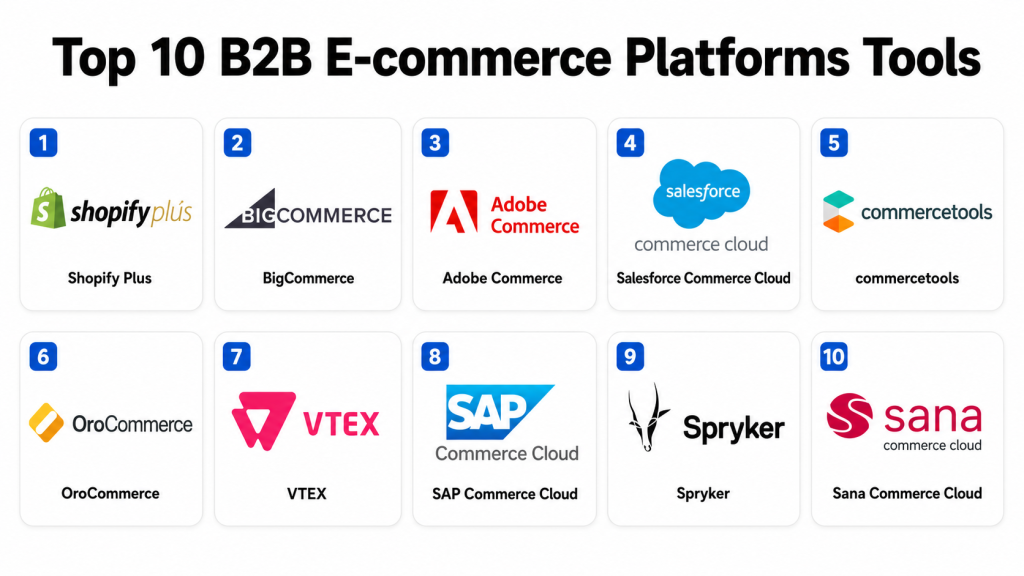
Top 10 B2B E-commerce Platforms Tools
1- Shopify Plus
Short description: Shopify Plus is an enterprise commerce platform that supports B2B and hybrid B2B plus DTC selling. It is useful for brands, wholesalers, and growing businesses that want a fast, modern commerce experience with strong ecosystem support.
Key Features
- B2B customer accounts and company profiles.
- Customer-specific pricing and catalogs.
- Bulk ordering and self-service buyer portals.
- Customizable storefront and checkout experience.
- Large app ecosystem for payments, shipping, tax, and marketing.
- Support for hybrid B2B and DTC commerce.
- API and headless commerce capabilities for advanced teams.
Pros
- Fast to launch compared with many enterprise platforms.
- Strong ecosystem of apps, developers, and implementation partners.
- Good fit for companies selling both B2B and direct-to-consumer.
Cons
- Complex B2B workflows may require apps, custom development, or enterprise configuration.
- Deep ERP integration can require careful planning.
- May not fit extremely complex distributor or manufacturer requirements without customization.
Platforms / Deployment
Web / Cloud
Security & Compliance
Shopify Plus commonly supports enterprise access controls, authentication options, permissions, secure checkout, and platform security controls. Specific certifications and compliance requirements should be confirmed during vendor evaluation.
Integrations & Ecosystem
Shopify Plus has a large commerce ecosystem and can connect with many business systems through apps, APIs, and implementation partners.
Common integration areas include:
- ERP systems.
- CRM platforms.
- PIM systems.
- Payment gateways.
- Shipping and fulfillment tools.
- Marketing and analytics tools.
Support & Community
Shopify Plus provides enterprise support, documentation, partner support, developer resources, and a large community. Its ecosystem is strong among commerce agencies, developers, DTC brands, wholesalers, and digital commerce teams.
2- BigCommerce
Short description: BigCommerce is an open SaaS commerce platform with B2B features, multi-storefront support, headless flexibility, and strong integration options. It is suitable for growing businesses, mid-market companies, and enterprises that want flexible commerce without heavy infrastructure management.
Key Features
- B2B buyer accounts and company-level permissions.
- Customer groups, price lists, and custom catalogs.
- Quote management and bulk ordering support.
- Multi-storefront management.
- Headless commerce and API-first capabilities.
- Integration with ERP, PIM, CRM, and payment systems.
- Support for hybrid B2B and B2C commerce models.
Pros
- Strong balance of SaaS simplicity and open integration flexibility.
- Good fit for mid-market and enterprise B2B sellers.
- Useful for businesses managing multiple storefronts or channels.
Cons
- Advanced B2B requirements may need configuration or partner support.
- Complex workflows may require integrations with external systems.
- Best results depend on a well-planned implementation.
Platforms / Deployment
Web / Cloud
Security & Compliance
BigCommerce commonly supports secure hosting, access controls, authentication features, and enterprise security options. Specific certifications and compliance coverage should be confirmed directly during procurement.
Integrations & Ecosystem
BigCommerce has a broad partner and integration ecosystem for commerce, finance, operations, and marketing workflows.
Common integration areas include:
- ERP systems.
- PIM platforms.
- CRM tools.
- Payment gateways.
- Shipping and tax tools.
- Marketplace and advertising channels.
Support & Community
BigCommerce provides documentation, support resources, implementation partners, developer tools, and customer success support. Its community is strong among mid-market commerce teams, agencies, developers, and B2B sellers.
3- Adobe Commerce
Short description: Adobe Commerce is a powerful commerce platform known for flexibility, customization, large catalog support, and enterprise commerce capabilities. It is well suited for businesses with complex B2B requirements, custom workflows, and deep integration needs.
Key Features
- Company accounts and buyer role management.
- Custom catalogs and account-specific pricing.
- Quote request and negotiation workflows.
- Large catalog and product configuration support.
- Flexible storefront customization and extensions.
- Strong integration possibilities with ERP, PIM, CRM, and analytics.
- Support for B2B, B2C, and hybrid commerce models.
Pros
- Strong customization depth for complex commerce requirements.
- Good fit for manufacturers, distributors, and enterprise sellers.
- Flexible architecture for unique B2B workflows.
Cons
- Implementation can be more complex than lighter SaaS platforms.
- Requires technical expertise or experienced implementation partners.
- Ongoing management may require more resources.
Platforms / Deployment
Web / Cloud / Enterprise deployment options may vary
Security & Compliance
Adobe Commerce commonly supports enterprise access controls, administrative permissions, secure commerce workflows, and platform security features. Specific certifications and compliance requirements should be confirmed directly.
Integrations & Ecosystem
Adobe Commerce has a strong ecosystem of extensions, developers, agencies, and enterprise integrations.
Common integration areas include:
- ERP systems.
- PIM platforms.
- CRM systems.
- Payment gateways.
- Shipping and tax tools.
- Adobe Experience Cloud products.
Support & Community
Adobe provides documentation, enterprise support options, partner services, developer resources, and a large commerce community. Its ecosystem is strong among enterprise developers, agencies, manufacturers, distributors, and digital commerce teams.
4- Salesforce Commerce Cloud
Short description: Salesforce Commerce Cloud supports digital commerce experiences for B2B and B2C businesses, especially organizations already using Salesforce CRM. It is useful for companies that want commerce, customer data, sales processes, and service workflows connected.
Key Features
- B2B storefront and buyer account management.
- Customer-specific catalogs and pricing support.
- CRM-connected commerce experiences.
- Order management and buyer self-service capabilities.
- Personalization and AI-assisted commerce features through the Salesforce ecosystem.
- Integration with sales, service, marketing, and customer data tools.
- Support for enterprise commerce operations.
Pros
- Strong fit for Salesforce-centered organizations.
- Useful for connecting commerce with sales and customer relationships.
- Good option for enterprise teams needing CRM-driven B2B experiences.
Cons
- Best value is often achieved within the Salesforce ecosystem.
- Implementation can require experienced Salesforce partners.
- May be broader and more expensive than smaller teams need.
Platforms / Deployment
Web / Cloud
Security & Compliance
Salesforce enterprise products commonly support role-based access, authentication options, auditability, encryption options, and administrative controls. Specific certifications and compliance needs should be confirmed during vendor review.
Integrations & Ecosystem
Salesforce Commerce Cloud connects commerce with CRM, sales, service, marketing, analytics, and business workflows.
Common integration areas include:
- Salesforce CRM.
- Marketing automation tools.
- Service platforms.
- ERP systems.
- Payment and tax tools.
- Data and analytics platforms.
Support & Community
Salesforce provides enterprise support, documentation, training, implementation partners, and a large community. Its ecosystem is strong among CRM administrators, commerce teams, Salesforce developers, and enterprise transformation teams.
5- commercetools
Short description: commercetools is a composable commerce platform built around APIs, headless commerce, and modular architecture. It is best suited for enterprises and digitally mature teams that want flexible B2B commerce experiences across multiple channels.
Key Features
- API-first and headless commerce architecture.
- Flexible product, pricing, cart, and checkout services.
- Support for complex B2B commerce workflows.
- Composable architecture for modular system design.
- Multi-channel and multi-region commerce support.
- Integration with ERP, PIM, CMS, CRM, and front-end frameworks.
- Developer-friendly tools for custom commerce experiences.
Pros
- Strong flexibility for custom and composable commerce strategies.
- Good fit for enterprises with modern architecture teams.
- Useful for businesses needing highly tailored buying experiences.
Cons
- Requires strong technical resources and implementation planning.
- Not ideal for teams wanting a simple out-of-the-box storefront.
- Total project scope can grow if architecture is not clearly defined.
Platforms / Deployment
Web / Cloud / Headless
Security & Compliance
commercetools commonly supports enterprise access controls, API security, authentication options, and administrative governance. Specific certifications and compliance requirements should be confirmed with the vendor.
Integrations & Ecosystem
commercetools is designed to connect with best-of-breed systems through APIs and composable architecture.
Common integration areas include:
- ERP systems.
- PIM platforms.
- CMS tools.
- CRM systems.
- Front-end frameworks.
- Payment, tax, and fulfillment services.
Support & Community
commercetools provides documentation, developer resources, enterprise support, partner support, and implementation guidance. Its community is strong among composable commerce teams, developers, solution architects, and enterprise digital teams.
6- OroCommerce
Short description: OroCommerce is a B2B-focused e-commerce platform built specifically for complex business selling. It is especially useful for manufacturers, distributors, wholesalers, and companies that need strong B2B account management, quoting, workflows, and marketplace support.
Key Features
- B2B account hierarchy and buyer role management.
- Request for quote and negotiation workflows.
- Customer-specific pricing and catalogs.
- Built-in CRM capabilities.
- Workflow automation for B2B purchasing processes.
- Support for marketplaces and multi-organization selling.
- Integration with ERP, PIM, payment, and fulfillment systems.
Pros
- Strong B2B-first platform orientation.
- Good fit for manufacturers, distributors, and wholesalers.
- Useful for complex quoting, account structures, and buying workflows.
Cons
- May require implementation support for complex deployments.
- Less familiar to some teams compared with larger commerce brands.
- Customization and integration depth should be validated during evaluation.
Platforms / Deployment
Web / Cloud / Self-hosted options may vary
Security & Compliance
OroCommerce commonly supports role-based access, permissions, workflow controls, and administrative security settings. Specific certifications and compliance requirements should be confirmed directly with the vendor.
Integrations & Ecosystem
OroCommerce connects with core systems needed for B2B commerce, especially where customer relationships, quotes, and account structures are important.
Common integration areas include:
- ERP systems.
- CRM workflows.
- PIM platforms.
- Payment gateways.
- Shipping and logistics tools.
- Marketplace and supplier systems.
Support & Community
OroCommerce provides documentation, partner support, implementation resources, and product guidance. Its community is strongest among B2B commerce teams, manufacturers, distributors, developers, and integration partners.
7- VTEX
Short description: VTEX is a digital commerce platform that supports B2B, B2C, marketplace, order management, and omnichannel commerce. It is useful for businesses that want connected commerce experiences across multiple sellers, regions, channels, and fulfillment models.
Key Features
- B2B and B2C commerce support.
- Marketplace and multi-seller capabilities.
- Order management and fulfillment orchestration.
- Account-based commerce workflows.
- Omnichannel commerce support.
- APIs and integration options.
- Catalog, pricing, and promotion management.
Pros
- Strong fit for marketplace and omnichannel commerce models.
- Useful for brands and distributors managing multiple channels.
- Built for connected commerce operations across sellers and buyers.
Cons
- May require implementation planning for complex B2B use cases.
- Some businesses may not need marketplace or omnichannel depth.
- Platform fit should be tested against ERP and catalog complexity.
Platforms / Deployment
Web / Cloud
Security & Compliance
VTEX commonly supports enterprise access controls, administrative permissions, secure commerce operations, and platform governance. Specific certifications and compliance coverage should be confirmed directly.
Integrations & Ecosystem
VTEX connects commerce with marketplaces, fulfillment, payment, ERP, and omnichannel systems.
Common integration areas include:
- ERP systems.
- Marketplace tools.
- Payment gateways.
- Logistics and fulfillment systems.
- CRM platforms.
- Analytics tools.
Support & Community
VTEX provides documentation, customer support, implementation partners, developer resources, and commerce guidance. Its community is strongest among omnichannel commerce teams, marketplace operators, brands, and enterprise commerce professionals.
8- SAP Commerce Cloud
Short description: SAP Commerce Cloud is an enterprise digital commerce platform that supports B2B and B2C commerce, especially for organizations using SAP ERP and broader SAP business systems. It is well suited for large enterprises with complex catalogs, pricing, and integration requirements.
Key Features
- B2B account and organization management.
- Contract pricing and customer-specific catalogs.
- Product content and catalog management.
- Integration with SAP ERP and business systems.
- Support for complex order and fulfillment processes.
- Omnichannel commerce capabilities.
- Personalization and commerce management tools.
Pros
- Strong fit for SAP-centered enterprises.
- Good option for complex B2B pricing, catalog, and ERP integration.
- Scalable for global and multi-entity commerce operations.
Cons
- Implementation can be complex and resource-intensive.
- Best value is usually achieved within the SAP ecosystem.
- Smaller businesses may find the platform too advanced for their needs.
Platforms / Deployment
Web / Cloud
Security & Compliance
SAP enterprise cloud products commonly support role-based access, authentication options, auditability, administrative controls, and data governance features. Specific certifications and compliance requirements should be validated during procurement.
Integrations & Ecosystem
SAP Commerce Cloud integrates with SAP ERP, customer data, product content, order management, and enterprise workflows.
Common integration areas include:
- SAP ERP.
- SAP customer experience tools.
- Product information systems.
- Order management systems.
- Payment and tax tools.
- Analytics and reporting platforms.
Support & Community
SAP provides enterprise support, implementation partners, training, documentation, and a large customer ecosystem. Its community is strong among SAP customers, enterprise commerce teams, IT leaders, and business transformation professionals.
9- Spryker
Short description: Spryker is a composable commerce platform designed for complex B2B, marketplace, and enterprise commerce models. It is useful for organizations that need flexible architecture, modular capabilities, and customized commerce workflows.
Key Features
- Composable commerce architecture.
- B2B commerce and marketplace capabilities.
- Modular services for catalog, pricing, checkout, and order workflows.
- Support for complex business models and custom processes.
- API-driven integration with enterprise systems.
- Multi-channel and multi-organization commerce support.
- Strong flexibility for technical teams.
Pros
- Good fit for complex B2B and marketplace models.
- Flexible architecture for unique commerce requirements.
- Useful for enterprises that want modular commerce control.
Cons
- Requires technical maturity and implementation expertise.
- Not ideal for companies wanting a simple plug-and-play storefront.
- Project scope can be high if requirements are not clearly defined.
Platforms / Deployment
Web / Cloud / Composable
Security & Compliance
Spryker commonly supports enterprise permissions, secure development practices, administrative controls, and platform governance. Specific certifications and compliance details should be confirmed during vendor review.
Integrations & Ecosystem
Spryker is designed for complex integration environments where commerce must connect with multiple enterprise systems.
Common integration areas include:
- ERP systems.
- PIM tools.
- Marketplace systems.
- CMS platforms.
- Payment and tax services.
- Fulfillment and logistics systems.
Support & Community
Spryker provides documentation, enterprise support, partner services, developer resources, and implementation guidance. Its community is strongest among enterprise commerce architects, developers, B2B commerce teams, and marketplace operators.
10- Sana Commerce Cloud
Short description: Sana Commerce Cloud is a B2B e-commerce platform known for ERP-integrated commerce experiences. It is especially useful for manufacturers, wholesalers, and distributors that want online ordering tightly connected with ERP data such as pricing, inventory, customer accounts, and order history.
Key Features
- ERP-integrated B2B commerce workflows.
- Customer-specific pricing and account data.
- Real-time inventory and order information from ERP systems.
- Buyer self-service portals.
- Product catalog and order management support.
- Quote, reorder, and account management capabilities.
- Support for manufacturers, distributors, and wholesalers.
Pros
- Strong fit for ERP-connected B2B commerce.
- Useful for companies that need accurate inventory and pricing online.
- Good option for manufacturers and distributors with repeat buyers.
Cons
- Best value depends on ERP integration quality.
- May be less suitable for highly custom composable commerce strategies.
- Advanced marketplace or DTC needs may require additional solutions.
Platforms / Deployment
Web / Cloud
Security & Compliance
Sana Commerce commonly supports access controls, account permissions, secure commerce workflows, and administrative settings. Specific certifications and compliance details should be confirmed directly with the vendor.
Integrations & Ecosystem
Sana Commerce Cloud is designed to connect closely with ERP systems and support B2B self-service buying based on live business data.
Common integration areas include:
- ERP systems.
- Payment gateways.
- Product data sources.
- Shipping and logistics tools.
- CRM systems.
- Analytics platforms.
Support & Community
Sana Commerce provides documentation, onboarding support, implementation guidance, customer success resources, and partner support. Its community is strongest among manufacturers, distributors, wholesalers, ERP users, and B2B commerce teams.
Comparison Table
| Tool Name | Best For | Platform Supported | Deployment | Standout Feature | Public Rating |
|---|---|---|---|---|---|
| Shopify Plus | Fast-launch B2B and hybrid commerce | Web | Cloud | Strong ecosystem and modern storefront experience | N/A |
| BigCommerce | Mid-market and enterprise B2B commerce | Web | Cloud | Open SaaS platform with B2B flexibility | N/A |
| Adobe Commerce | Complex customized B2B commerce | Web | Cloud / Enterprise | Deep customization and large catalog support | N/A |
| Salesforce Commerce Cloud | CRM-connected B2B selling | Web | Cloud | Commerce connected with Salesforce customer data | N/A |
| commercetools | Composable enterprise commerce | Web | Cloud / Headless | API-first and modular commerce architecture | N/A |
| OroCommerce | B2B-first manufacturers and distributors | Web | Cloud / Self-hosted options may vary | Purpose-built B2B workflows and quoting | N/A |
| VTEX | Marketplace and omnichannel B2B commerce | Web | Cloud | Marketplace and order management capabilities | N/A |
| SAP Commerce Cloud | SAP-centered enterprise commerce | Web | Cloud | Deep SAP ERP and enterprise integration fit | N/A |
| Spryker | Complex B2B and marketplace models | Web | Cloud / Composable | Modular architecture for advanced commerce | N/A |
| Sana Commerce Cloud | ERP-integrated B2B commerce | Web | Cloud | Real-time ERP-driven pricing and inventory | N/A |
Evaluation & Scoring of B2B E-commerce Platforms
| Tool Name | Core 25% | Ease 15% | Integrations 15% | Security 10% | Performance 10% | Support 10% | Value 15% | Weighted Total |
| Shopify Plus | 8 | 9 | 8 | 8 | 9 | 9 | 8 | 8.40 |
| BigCommerce | 8 | 8 | 9 | 8 | 9 | 8 | 8 | 8.30 |
| Adobe Commerce | 9 | 7 | 9 | 8 | 8 | 8 | 7 | 8.05 |
| Salesforce Commerce Cloud | 8 | 7 | 9 | 9 | 9 | 8 | 7 | 8.10 |
| commercetools | 9 | 6 | 10 | 8 | 9 | 8 | 7 | 8.20 |
| OroCommerce | 9 | 7 | 8 | 8 | 8 | 8 | 8 | 8.05 |
| VTEX | 8 | 8 | 8 | 8 | 9 | 8 | 8 | 8.15 |
| SAP Commerce Cloud | 9 | 6 | 9 | 9 | 9 | 8 | 7 | 8.05 |
| Spryker | 9 | 6 | 9 | 8 | 8 | 8 | 7 | 7.85 |
| Sana Commerce Cloud | 8 | 8 | 9 | 8 | 8 | 8 | 8 | 8.15 |
The scoring is comparative and should be used as a practical starting point, not a final buying decision. Enterprise teams may value ERP integration, customization, composable architecture, and global scalability more than speed of setup. Mid-market sellers may prioritize ease of use, fast launch, buyer self-service, and predictable operations. A platform with a slightly lower score may still be the best fit if it matches your ERP, catalog complexity, pricing rules, buyer workflows, and internal technical resources. Buyers should test each platform with real customer accounts, product catalogs, pricing scenarios, and order workflows before final selection.
Which B2B E-commerce Platform Is Right for You?
Solo / Freelancer
Solo consultants, independent sellers, and freelancers usually do not need a heavy B2B commerce platform unless they sell products to business buyers at scale. Shopify Plus or BigCommerce may be practical if the business is growing and needs account-based pricing, wholesale ordering, or a more professional buyer portal.
For very small B2B selling, a simpler e-commerce setup, invoicing tool, or manual order process may be enough. A dedicated B2B platform becomes valuable when the seller needs repeat ordering, custom pricing, buyer roles, quote workflows, and integration with inventory or accounting systems.
SMB
SMBs should focus on ease of setup, clean buyer experience, customer-specific pricing, quick order, reordering, payment flexibility, and simple integrations. Shopify Plus, BigCommerce, OroCommerce, and Sana Commerce Cloud can be good options depending on business complexity.
If the company has a standard product catalog and wants quick launch, Shopify Plus or BigCommerce may be strong choices. If the business has complex B2B accounts, quoting, or distributor workflows, OroCommerce may be better. If ERP accuracy is the top priority, Sana Commerce Cloud may be a practical fit.
Mid-Market
Mid-market businesses often need stronger features because they manage multiple customer groups, larger catalogs, negotiated pricing, sales rep workflows, and ERP-connected operations. BigCommerce, Shopify Plus, Adobe Commerce, OroCommerce, VTEX, Sana Commerce Cloud, and Salesforce Commerce Cloud can all be relevant depending on system fit.
If the business wants open SaaS flexibility, BigCommerce may be strong. If customization is important, Adobe Commerce or OroCommerce may fit better. If sales and CRM alignment matter, Salesforce Commerce Cloud can be useful. If omnichannel or marketplace expansion is important, VTEX may be worth evaluating.
Enterprise
Enterprises usually need complex pricing, multi-region operations, large catalogs, role-based account structures, ERP integration, global performance, security governance, and multiple storefronts. Adobe Commerce, Salesforce Commerce Cloud, commercetools, SAP Commerce Cloud, Spryker, VTEX, BigCommerce, and Shopify Plus are strong enterprise candidates.
Enterprise buyers should focus on architecture, integration depth, scalability, governance, extensibility, partner support, and long-term commerce strategy. The best platform is not always the easiest one; it is the one that can support complex business rules, global customers, internal sales teams, procurement buyers, and future digital channels.
Budget vs Premium
Budget-focused buyers should start by defining the most important B2B requirements. If the need is fast launch and simple B2B selling, Shopify Plus or BigCommerce may offer practical value. If ERP integration is the main need, Sana Commerce Cloud may reduce operational friction by keeping commerce data connected with back-office systems.
Premium buyers should consider Adobe Commerce, Salesforce Commerce Cloud, commercetools, SAP Commerce Cloud, Spryker, and VTEX when requirements are complex. These platforms are better suited when the business needs enterprise architecture, global scaling, custom workflows, API flexibility, and deep system integration.
Feature Depth vs Ease of Use
Shopify Plus and BigCommerce are often easier for teams that want faster launch, modern storefronts, and strong ecosystem support. Sana Commerce Cloud can also be practical for businesses that prioritize ERP-connected ordering and buyer self-service.
Adobe Commerce, SAP Commerce Cloud, commercetools, and Spryker offer deeper flexibility for complex enterprise use cases. OroCommerce is strong for B2B-first workflows, while VTEX is useful for marketplace and omnichannel models. Buyers should choose feature depth when workflows are complex and choose ease of use when adoption speed matters more.
Integrations & Scalability
B2B e-commerce platforms must integrate with ERP, CRM, PIM, OMS, payments, tax, shipping, inventory, and analytics systems. For B2B sellers, integration quality is often more important than storefront design because buyers need accurate pricing, inventory, order status, credit terms, and invoices.
Scalability depends on product catalog size, buyer account structures, order volume, pricing complexity, storefront count, and regional requirements. Large organizations should validate APIs, connector availability, performance, data sync frequency, order routing, and support for multiple entities before final selection.
Security & Compliance Needs
B2B commerce platforms handle sensitive customer accounts, negotiated pricing, payment terms, tax details, invoices, order history, and business identities. Buyers should review role-based access, SSO, MFA, encryption, audit logs, administrative permissions, secure checkout, and data governance controls.
Highly regulated companies should also evaluate data residency, account-level permissions, buyer approval controls, order audit trails, and integration security. A strong B2B platform should make buying easier while protecting commercial data and customer-specific terms.
Frequently Asked Questions
1- What are B2B E-commerce Platforms?
B2B E-commerce Platforms are software systems that help businesses sell products or services to other businesses online. They support features like customer-specific pricing, bulk ordering, quote requests, buyer accounts, approval workflows, and ERP integration.
2- Who should use B2B E-commerce Platforms?
Manufacturers, wholesalers, distributors, suppliers, industrial sellers, medical suppliers, office supply businesses, and enterprise brands benefit most from B2B e-commerce platforms. They are especially useful when buyers need repeat ordering, custom pricing, or self-service access.
3- How is B2B e-commerce different from B2C e-commerce?
B2B e-commerce usually involves account-based pricing, bulk orders, negotiated terms, quote workflows, buyer roles, approval chains, tax rules, and ERP integration. B2C e-commerce is usually simpler and focuses on individual consumers, standard pricing, and faster checkout.
4- What features are most important in a B2B e-commerce platform?
Important features include customer accounts, company profiles, custom pricing, catalogs, quotes, bulk ordering, reordering, approval workflows, ERP integration, payment terms, tax support, and self-service portals. The best feature set depends on business complexity.
5- How much do B2B E-commerce Platforms cost?
Pricing varies by vendor, transaction volume, catalog size, users, storefronts, integrations, hosting model, customization, and support needs. Many enterprise platforms use custom pricing, so buyers should request quotes based on actual business requirements.
6- How long does implementation take?
Implementation depends on catalog complexity, ERP integration, pricing rules, storefront design, buyer workflows, data migration, and custom development. A simpler SaaS launch can move faster, while enterprise projects usually require phased planning and testing.
7- What are common mistakes when choosing a B2B e-commerce platform?
Common mistakes include ignoring ERP integration, underestimating pricing complexity, choosing only based on storefront design, skipping buyer workflow testing, and failing to involve sales and customer service teams. Buyers should test real ordering scenarios before selecting a platform.
8- Can B2B E-commerce Platforms support custom pricing?
Yes, most leading B2B platforms support customer-specific pricing, contract pricing, volume discounts, tiered pricing, and custom catalogs. The depth of pricing support varies, so buyers should test real pricing rules during evaluation.
9- Do B2B E-commerce Platforms integrate with ERP systems?
Yes, many B2B platforms integrate with ERP systems for inventory, pricing, customer accounts, orders, invoices, tax, and fulfillment. Buyers should validate integration depth, data sync frequency, and exception handling before final selection.
10- Are B2B E-commerce Platforms useful for manufacturers?
Yes, manufacturers can use B2B e-commerce platforms for dealer ordering, spare parts sales, distributor portals, customer self-service, product catalogs, quotes, and order tracking. ERP integration is especially important for manufacturers with complex inventory and pricing.
Conclusion
B2B E-commerce Platforms help businesses modernize how they sell to other businesses by creating digital buying experiences that support account-based pricing, bulk orders, quote requests, buyer portals, ERP integration, and self-service purchasing. Shopify Plus and BigCommerce are strong options for fast-moving teams that want modern SaaS commerce, while Adobe Commerce, Salesforce Commerce Cloud, SAP Commerce Cloud, commercetools, and Spryker are better suited for more complex enterprise needs. OroCommerce is a strong B2B-first choice, VTEX is useful for marketplace and omnichannel models, and Sana Commerce Cloud is practical for ERP-connected manufacturers and distributors. The best platform depends on your buyer workflows, pricing rules, catalog size, ERP environment, technical resources, and growth plans. Start by shortlisting two or three tools, test them with real buyer accounts and pricing scenarios, validate integrations and security, and then scale once your sales, operations, and customer teams trust the digital ordering process.
