Introduction
Application Lifecycle Management (ALM) suites are end-to-end platforms that manage the entire software development lifecycle—from requirements gathering and planning to development, testing, deployment, and maintenance. Instead of using multiple disconnected tools, ALM suites provide a unified system where teams can collaborate, track progress, and ensure quality across all stages of application delivery.
In modern software environments driven by Agile and DevOps, ALM suites have become essential for maintaining speed, consistency, and traceability. They help organizations reduce development risks, improve collaboration between teams, and ensure compliance in regulated industries.
Common use cases include:
- Managing software development lifecycle end-to-end
- Aligning business requirements with technical implementation
- Coordinating development, QA, and operations teams
- Tracking defects, test cases, and releases
- Ensuring compliance and audit readiness
What buyers should evaluate:
- Requirement and workflow management capabilities
- Test management integration
- DevOps and CI/CD support
- Traceability across lifecycle stages
- Reporting and analytics dashboards
- Scalability for enterprise workloads
- Security, compliance, and governance features
- Ease of adoption and usability
- Integration ecosystem
Best for: Enterprises, large engineering teams, regulated industries, and organizations managing complex software systems.
Not ideal for: Small teams or startups that only need lightweight project or task management tools.
Key Trends in ALM Suites
- AI-driven lifecycle automation for testing, code analysis, and planning
- Deep DevOps integration with CI/CD pipelines and cloud-native workflows
- Shift-left testing approaches embedded into development cycles
- Unified DevSecOps platforms integrating security into ALM workflows
- Cloud-native ALM adoption replacing legacy on-prem systems
- Low-code customization for workflows and dashboards
- Real-time collaboration features across global teams
- Advanced traceability across requirements, code, and testing
- Increased focus on compliance automation for regulated industries
- Microservices and container support within ALM workflows
How We Evaluate ALM Suites (Methodology)
- Market adoption and enterprise usage
- Coverage of full software lifecycle stages
- Integration with DevOps, CI/CD, and testing tools
- Scalability and performance under enterprise workloads
- Security, governance, and compliance capabilities
- Ease of use and learning curve
- Reporting and traceability depth
- Ecosystem and third-party integrations
- Pricing efficiency and value delivery
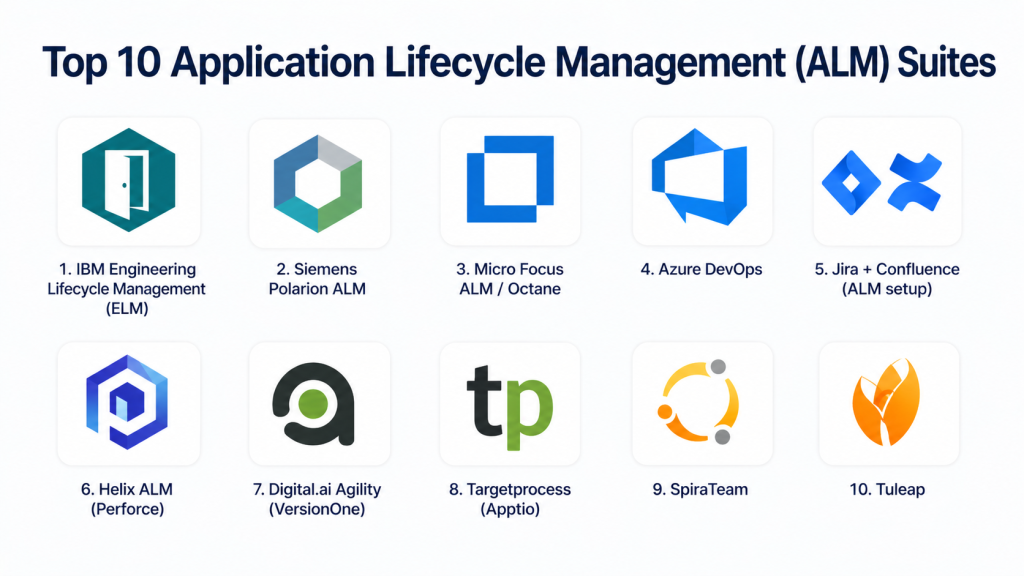
Top 10 Application Lifecycle Management (ALM) Suites
#1 — IBM Engineering Lifecycle Management (ELM)
Short description:
IBM ELM is a powerful enterprise ALM suite designed for complex engineering and software systems. It integrates requirements management, change control, quality management, and reporting into a unified platform. It is widely used in aerospace, automotive, and defense industries. The platform supports deep traceability across the entire lifecycle. IBM ELM is built for highly regulated environments requiring strict governance.
Key Features
- End-to-end lifecycle traceability
- Requirements and change management
- Test management integration
- Compliance reporting
- Risk management
Pros
- Strong enterprise-grade capabilities
- Excellent traceability
Cons
- Complex to implement
- High cost
Platforms / Deployment
Web / On-premise / Hybrid
Security & Compliance
RBAC, audit logs, compliance-ready for regulated industries
Integrations & Ecosystem
Integrates with IBM tools and DevOps systems
- Jira
- Git tools
- CI/CD pipelines
Support & Community
Enterprise-level support
#2 — Siemens Polarion ALM
Short description:
Polarion ALM is a unified application lifecycle management solution focused on traceability and compliance. It is widely used in safety-critical industries. The platform supports requirements, testing, and release management in a single system. It is known for strong collaboration features. Polarion enables real-time lifecycle visibility.
Key Features
- Requirements and test management
- End-to-end traceability
- Workflow automation
- Agile and V-model support
- Reporting dashboards
Pros
- Strong compliance support
- Unified ALM platform
Cons
- Steep learning curve
- Expensive for smaller teams
Platforms / Deployment
Web / Cloud / On-premise
Security & Compliance
RBAC, audit trails, industry compliance support
Integrations & Ecosystem
Supports integration with engineering tools
- Jira
- Jenkins
- Git systems
Support & Community
Enterprise support and documentation
#3 — Micro Focus ALM / Octane
Short description:
Micro Focus ALM and Octane provide enterprise-grade application lifecycle management capabilities. They support agile, DevOps, and hybrid methodologies. The platform offers strong testing and defect tracking capabilities. It is widely used in large IT organizations. Octane enhances performance and scalability.
Key Features
- Test and defect management
- Agile planning tools
- Release tracking
- DevOps integration
- Reporting and analytics
Pros
- Scalable enterprise solution
- Strong testing integration
Cons
- Complex UI
- Requires training
Platforms / Deployment
Web / Cloud / On-premise
Security & Compliance
Enterprise security controls
Integrations & Ecosystem
Integrates with CI/CD and testing tools
- Jenkins
- Selenium
- Jira
Support & Community
Enterprise support
#4 — Atlassian Jira + Confluence (ALM setup)
Short description:
Jira combined with Confluence forms a lightweight ALM solution for agile teams. It supports issue tracking, documentation, and workflow management. It is highly customizable through plugins. The platform is widely adopted in software development. It is best suited for agile environments.
Key Features
- Issue and requirement tracking
- Agile boards
- Documentation integration
- Workflow automation
- Reporting dashboards
Pros
- Highly flexible
- Large ecosystem
Cons
- Requires configuration
- Plugin dependency
Platforms / Deployment
Web / Cloud / Self-hosted
Security & Compliance
SSO, RBAC, audit logs
Integrations & Ecosystem
Extensive integrations
- GitHub
- Bitbucket
- Slack
Support & Community
Large global community
#5 — Azure DevOps
Short description:
Azure DevOps is a Microsoft ALM platform offering end-to-end development lifecycle management. It includes repositories, pipelines, testing, and work tracking. The platform is highly scalable and enterprise-ready. It integrates tightly with Microsoft ecosystems. It is ideal for DevOps-driven teams.
Key Features
- CI/CD pipelines
- Work item tracking
- Test management
- Code repositories
- Agile planning
Pros
- Strong DevOps integration
- Scalable
Cons
- Microsoft dependency
- Complex setup
Platforms / Deployment
Web / Cloud
Security & Compliance
Enterprise-grade security, RBAC
Integrations & Ecosystem
Microsoft ecosystem integration
- GitHub
- Azure services
Support & Community
Enterprise support
#6 — Helix ALM (Perforce)
Short description:
Helix ALM provides requirements, test, and issue management in a unified platform. It is designed for regulated and complex development environments. The tool supports full lifecycle traceability. It is widely used in engineering-heavy industries.
Key Features
- Requirements management
- Test case tracking
- Issue tracking
- Traceability matrix
- Reporting tools
Pros
- Strong traceability
- Good for regulated industries
Cons
- UI complexity
- Learning curve
Platforms / Deployment
Web / On-premise
Security & Compliance
RBAC, audit logs
Integrations & Ecosystem
Supports DevOps integrations
- Jenkins
- Git
Support & Community
Enterprise support
#7 — CollabNet VersionOne (Digital.ai Agility)
Short description:
This ALM platform focuses on agile planning and DevOps integration. It supports enterprise-scale agile transformation. The platform provides visibility across teams and workflows. It is widely used in large organizations.
Key Features
- Agile planning tools
- Portfolio management
- Reporting dashboards
- DevOps integration
- Collaboration features
Pros
- Strong agile support
- Enterprise scalability
Cons
- Complex UI
- Expensive
Platforms / Deployment
Cloud / Hybrid
Security & Compliance
Enterprise-grade controls
Integrations & Ecosystem
Supports DevOps toolchains
Support & Community
Enterprise support
#8 — Targetprocess (Apptio)
Short description:
Targetprocess is a visual ALM and agile planning tool. It provides strong portfolio and workflow management capabilities. The platform is highly customizable. It is suitable for enterprise agile scaling.
Key Features
- Agile planning
- Portfolio management
- Workflow visualization
- Reporting dashboards
Pros
- Highly visual interface
- Flexible workflows
Cons
- Learning curve
- Premium pricing
Platforms / Deployment
Cloud
Security & Compliance
RBAC, compliance-ready
Integrations & Ecosystem
Integrates with agile tools
Support & Community
Good enterprise support
#9 — SpiraTeam
Short description:
SpiraTeam is an ALM platform combining requirements, testing, and defect tracking. It supports full lifecycle traceability. The tool is suitable for QA-driven teams. It offers strong reporting capabilities.
Key Features
- Requirements management
- Test management
- Bug tracking
- Release planning
Pros
- Integrated ALM suite
- Strong traceability
Cons
- UI limitations
- Moderate scalability
Platforms / Deployment
Web / Cloud / On-premise
Security & Compliance
RBAC
Integrations & Ecosystem
Supports integrations
Support & Community
Vendor support
#10 — Tuleap
Short description:
Tuleap is an open-source ALM platform offering project management, agile support, and DevOps integration. It is flexible and customizable. The platform is suitable for technical teams. It supports both traditional and agile workflows.
Key Features
- Agile and waterfall support
- Requirements tracking
- Git integration
- Project management
Pros
- Open-source
- Flexible
Cons
- Requires setup
- Limited enterprise polish
Platforms / Deployment
Web / Self-hosted
Security & Compliance
Not publicly stated
Integrations & Ecosystem
Git and CI/CD integrations
Support & Community
Open-source community support
Comparison Table
| Tool Name | Best For | Platform(s) | Deployment | Standout Feature | Public Rating |
|---|---|---|---|---|---|
| IBM ELM | Enterprises | Web | Hybrid | Lifecycle traceability | N/A |
| Polarion ALM | Regulated industries | Web | Hybrid | Compliance support | N/A |
| Micro Focus ALM | Large IT orgs | Web | Hybrid | Test management | N/A |
| Jira + Confluence | Agile teams | Web | Cloud | Flexibility | N/A |
| Azure DevOps | DevOps teams | Web | Cloud | CI/CD integration | N/A |
| Helix ALM | Engineering teams | Web | On-premise | Traceability | N/A |
| VersionOne | Agile enterprises | Web | Cloud | Portfolio management | N/A |
| Targetprocess | Enterprises | Web | Cloud | Visual workflows | N/A |
| SpiraTeam | QA teams | Web | Hybrid | Lifecycle integration | N/A |
| Tuleap | Open-source teams | Web | Self-hosted | Flexibility | N/A |
Evaluation & Scoring of ALM Suites
| Tool | Core | Ease | Integrations | Security | Performance | Support | Value | Total |
|---|---|---|---|---|---|---|---|---|
| IBM ELM | 10 | 6 | 9 | 10 | 9 | 9 | 6 | 8.5 |
| Polarion | 9 | 7 | 8 | 9 | 9 | 9 | 7 | 8.3 |
| Micro Focus ALM | 9 | 6 | 9 | 9 | 8 | 8 | 6 | 8.0 |
| Jira + Confluence | 9 | 8 | 10 | 8 | 8 | 9 | 8 | 8.6 |
| Azure DevOps | 10 | 7 | 10 | 9 | 9 | 9 | 7 | 8.8 |
| Helix ALM | 9 | 7 | 8 | 8 | 8 | 8 | 7 | 8.0 |
| VersionOne | 8 | 7 | 8 | 8 | 8 | 8 | 6 | 7.7 |
| Targetprocess | 8 | 8 | 8 | 8 | 8 | 8 | 7 | 7.9 |
| SpiraTeam | 8 | 7 | 7 | 7 | 7 | 8 | 8 | 7.6 |
| Tuleap | 7 | 8 | 7 | 7 | 7 | 7 | 9 | 7.5 |
Which ALM Suite Is Right for You?
Solo / Small Teams
Jira + Confluence or Tuleap works best for simplicity and cost efficiency.
SMB
SpiraTeam and Azure DevOps offer balanced capabilities.
Mid-Market
Targetprocess and Helix ALM provide scalable workflows.
Enterprise
IBM ELM and Polarion ALM are ideal for complex regulated environments.
Budget vs Premium
Open-source tools are budget-friendly; enterprise tools provide full lifecycle governance.
Feature Depth vs Ease of Use
Simple tools are easier, while enterprise ALM suites offer deeper control.
Integrations & Scalability
Choose platforms with strong DevOps and CI/CD integration.
Security & Compliance Needs
Enterprises should prioritize audit trails, RBAC, and compliance certifications.
Frequently Asked Questions (FAQs)
1. What is an ALM suite?
An ALM suite manages the entire software lifecycle from requirements to deployment. It unifies planning, development, testing, and release processes. This improves coordination between teams. It ensures traceability across all stages. It is essential for complex software systems.
2. How is ALM different from project management tools?
Project management tools focus on tasks and timelines. ALM suites cover the full software lifecycle. They include testing, development, and deployment. ALM tools provide deeper traceability. They are more suitable for software engineering teams.
3. Who uses ALM tools?
Developers, QA engineers, product managers, and DevOps teams use ALM tools. They are also used by enterprise architects. Regulated industries rely heavily on them. They help manage complex systems. They ensure compliance and quality.
4. Are ALM tools only for large enterprises?
No, but they are most beneficial for complex projects. Smaller teams may use lightweight alternatives. Enterprises require advanced traceability. Complexity increases value in large systems. Choose based on scale.
5. Do ALM tools support Agile and DevOps?
Yes, most modern ALM tools support Agile and DevOps. They integrate with CI/CD pipelines. They enable continuous delivery workflows. They support iterative development. This improves efficiency.
6. Are ALM suites expensive?
Enterprise ALM suites can be expensive. Open-source or lightweight tools are more affordable. Pricing depends on features and scale. Larger organizations typically invest more. ROI comes from efficiency gains.
7. Can ALM tools integrate with other systems?
Yes, integration is a key feature. They connect with Git, CI/CD tools, and testing platforms. APIs enable extensibility. Integration improves workflow automation. It ensures seamless development pipelines.
8. Are ALM tools secure?
Most enterprise tools include RBAC, audit logs, and encryption. Security varies by vendor. Compliance support is common in enterprise solutions. Proper configuration is important. Security is critical for regulated industries.
9. What industries use ALM tools?
Industries include aerospace, automotive, healthcare, finance, and IT. Any sector with complex software systems uses ALM. Regulated industries rely heavily on traceability. They ensure compliance and quality. They are widely adopted globally.
10. What are alternatives to ALM suites?
Alternatives include project management and DevOps tools. However, they lack full lifecycle coverage. ALM suites provide end-to-end control. They are more structured and integrated. They are preferred for complex systems.
Conclusion
Application Lifecycle Management (ALM) suites are essential for managing modern software development at scale. They provide end-to-end visibility, strong traceability, and seamless collaboration across teams. From agile startups to highly regulated enterprises, ALM tools help ensure that software is delivered efficiently, securely, and with high quality.
Choosing the right ALM suite depends on your organization’s complexity, compliance requirements, and workflow structure. Instead of focusing only on features, teams should evaluate integration capabilities, scalability, and long-term maintainability. A well-chosen ALM platform becomes the backbone of efficient software delivery and continuous improvement.
