Introduction
AI Evaluation & Benchmarking Frameworks help teams test, compare, monitor, and improve AI systems before they are used by real users. In simple words, these frameworks help answer one important question: Is this AI system accurate, safe, useful, and reliable enough for real business use?
AI products today are not limited to simple models. Many applications use large language models, retrieval systems, prompts, agents, embeddings, vector databases, feedback loops, and automated workflows. Because of this complexity, manual checking is not enough. Teams need structured evaluation systems that can test response quality, hallucination risk, factual accuracy, relevance, safety, bias, latency, cost, and consistency.
AI Evaluation & Benchmarking Frameworks are useful for testing chatbot responses, checking RAG output quality, comparing multiple AI models, validating prompt changes, monitoring production AI behavior, and preventing quality drops after updates.
Buyers should evaluate these tools based on:
- Evaluation metric flexibility
- RAG and LLM evaluation support
- Dataset management
- Prompt and model comparison
- CI/CD integration
- Human feedback workflow
- Traceability and observability
- Security and access controls
- Deployment flexibility
- Documentation and support quality
Best for: AI engineers, ML engineers, data scientists, platform teams, product teams, QA teams, and enterprises building production-ready AI applications.
Not ideal for: teams only doing small experiments, one-time AI demos, or basic manual testing where there is no production risk or compliance requirement.
Key Trends in AI Evaluation & Benchmarking Frameworks
- LLM-as-a-judge evaluation is becoming common for checking response quality, helpfulness, relevance, and tone.
- RAG evaluation is now a major requirement because teams must test both retrieved context and final generated answers.
- Agent workflow evaluation is gaining importance as AI systems use tools, memory, multi-step reasoning, and automated decisions.
- Human feedback integration is becoming important because automated scores alone cannot always capture user satisfaction.
- Regression testing for AI systems is critical because small prompt or model changes can create unexpected output issues.
- Trace-based evaluation helps teams understand where a failure happened inside a prompt chain, retrieval step, or agent workflow.
- Open-source evaluation tools remain attractive for developer teams that need flexibility and cost control.
- Governance-ready evaluation is becoming important for enterprises that need audit trails, access control, and review history.
- Cost and latency benchmarking is now part of AI quality evaluation, especially for production applications.
- Multi-model comparison is becoming more common as teams compare proprietary models, open-source models, and fine-tuned models.
How We Selected These Tools
These tools were selected based on practical usefulness for AI teams, not just popularity. The focus is on tools that help teams evaluate real AI applications, compare model behavior, test prompts, monitor quality, and improve production reliability.
Selection factors included:
- Recognition in AI engineering and ML communities
- Support for LLM, RAG, model, or agent evaluation
- Ability to create custom metrics or scoring logic
- Support for datasets, traces, feedback, and experiments
- Developer experience through SDKs, APIs, or notebooks
- Usefulness for automated testing and release workflows
- Fit for different teams, from solo developers to enterprises
- Integration options with AI development stacks
- Deployment flexibility such as cloud, self-hosted, or hybrid
- Practical value for production AI quality improvement
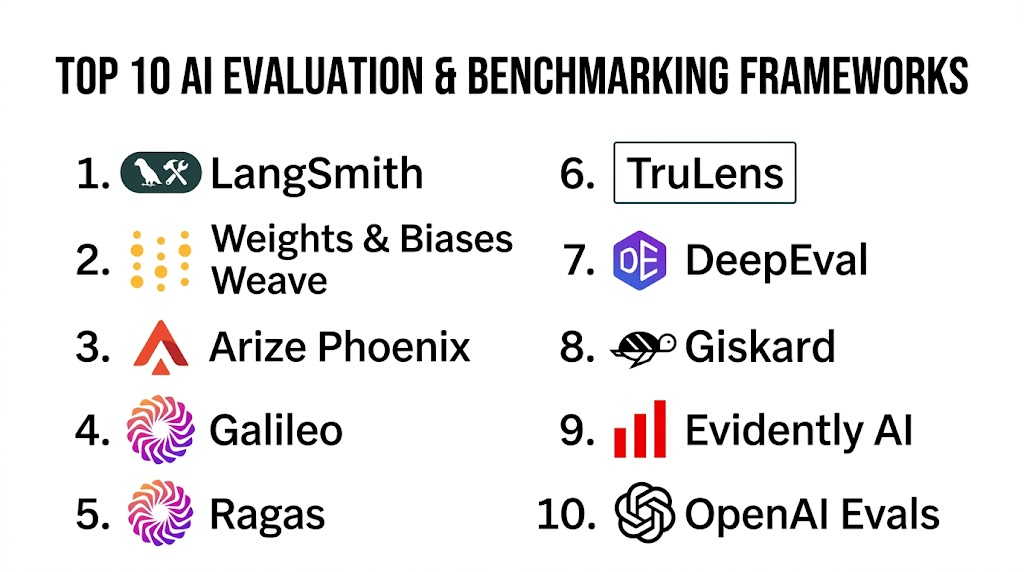
Top 10 AI Evaluation & Benchmarking Frameworks
1. LangSmith
LangSmith is an AI application development, tracing, evaluation, and monitoring platform. It is especially useful for teams building LLM applications, prompt chains, RAG pipelines, and agent workflows. Teams using LangChain-style development often find LangSmith valuable because it connects debugging, testing, evaluation, and production monitoring.
Key Features
- Tracing for LLM chains, agents, and tool calls
- Dataset-based evaluation workflows
- Prompt comparison and testing
- Human feedback and annotation support
- Production monitoring for AI applications
- Debugging views for complex workflows
- Evaluation support for application-level quality checks
Pros
- Strong option for teams already using LangChain.
- Helpful for debugging complex LLM workflows.
- Connects development, evaluation, and monitoring in one workflow.
Cons
- May feel less necessary for teams not using LangChain-style workflows.
- Advanced evaluation setup may require learning time.
- Enterprise features may vary by plan.
Platforms / Deployment
Web, SDK-based workflows, Cloud, Hybrid, Varies by plan
Security & Compliance
SSO/SAML, RBAC, audit logs, and enterprise controls may vary by plan. Specific compliance details are not always publicly stated for every plan.
Integrations & Ecosystem
LangSmith works strongly with the LangChain ecosystem and also supports broader LLM application workflows through SDKs and APIs.
Common ecosystem areas include:
- LangChain
- LangGraph
- Python workflows
- JavaScript and TypeScript workflows
- LLM providers
- Evaluation datasets
- Application tracing
Support & Community
LangSmith has strong documentation and benefits from the wider LangChain community. Enterprise support and onboarding options may vary depending on plan.
2. Weights & Biases Weave
Weights & Biases Weave supports LLM application evaluation, tracing, experiment tracking, and AI application observability. It is a strong fit for ML teams already using Weights & Biases for experiment tracking and model lifecycle workflows.
Key Features
- LLM evaluation workflows
- Trace tracking for AI applications
- Dataset-based testing
- Experiment comparison
- Custom scorers
- Integration with ML experiment workflows
- Support for prompt and model evaluation
Pros
- Strong for ML teams already using Weights & Biases.
- Good experiment tracking and comparison workflow.
- Useful for connecting traditional ML evaluation with LLM evaluation.
Cons
- May feel heavy for very small teams.
- Best value comes when used with the wider Weights & Biases ecosystem.
- Some advanced features may vary by plan.
Platforms / Deployment
Web, Python SDK, Cloud, Varies by plan
Security & Compliance
Enterprise security controls may include access management and organization-level governance. Specific compliance details vary by plan and should be confirmed directly. If not confirmed, mark as Not publicly stated.
Integrations & Ecosystem
Weights & Biases Weave fits well into ML engineering workflows where teams already track experiments, datasets, models, and performance.
Common ecosystem areas include:
- Weights & Biases platform
- Python workflows
- Model tracking
- Dataset evaluation
- LLM tracing
- Custom scoring functions
Support & Community
Weights & Biases has mature documentation, strong ML community adoption, and enterprise support options. Weave is best suited for teams that already follow structured ML development practices.
3. Arize Phoenix
Arize Phoenix is an open-source AI observability and evaluation framework. It helps teams trace, debug, evaluate, and improve LLM applications. It is particularly useful for RAG systems, hallucination analysis, retrieval quality checks, and production troubleshooting.
Key Features
- Open-source AI observability
- LLM tracing and evaluation
- RAG evaluation support
- Hallucination and relevance analysis
- Experiment comparison
- Debugging for AI pipelines
- Support for production troubleshooting
Pros
- Strong open-source option for AI observability and evaluation.
- Useful for debugging RAG and LLM pipelines.
- Flexible for technical teams that want visibility into AI workflows.
Cons
- Self-hosted use requires engineering effort.
- Enterprise capabilities may require commercial options.
- New users may need time to understand observability workflows.
Platforms / Deployment
Web, Python, Cloud, Self-hosted, Hybrid
Security & Compliance
Security depends on deployment model. For self-hosting, the user controls infrastructure security. Managed platform security and compliance details vary by plan.
Integrations & Ecosystem
Arize Phoenix supports practical AI observability workflows and can be used with common AI development stacks.
Common ecosystem areas include:
- Python
- LLM tracing
- RAG pipelines
- Evaluation datasets
- Observability workflows
- AI debugging workflows
Support & Community
Phoenix has active documentation and community adoption. Open-source users mainly rely on documentation and community resources, while commercial support depends on available platform plans.
4. Galileo
Galileo is an AI evaluation and observability platform focused on improving the quality of generative AI applications. It helps teams test prompts, compare model outputs, monitor AI quality, and identify production issues.
Key Features
- LLM evaluation workflows
- Prompt and model comparison
- AI quality monitoring
- Dataset-based testing
- Team collaboration workflows
- Analytics for production AI behavior
- Quality scoring and review workflows
Pros
- Strong focus on production AI quality.
- Useful for teams that need both evaluation and monitoring.
- Good fit for structured review and governance workflows.
Cons
- May be more platform-oriented than lightweight developer frameworks.
- Pricing and feature access may vary by plan.
- Smaller teams may prefer open-source tools first.
Platforms / Deployment
Web, Cloud, Varies by plan
Security & Compliance
Enterprise security controls may be available depending on plan. Specific compliance details should be verified directly. If not confirmed, use Not publicly stated.
Integrations & Ecosystem
Galileo is designed for teams that need evaluation, monitoring, and quality control for generative AI applications.
Common ecosystem areas include:
- Prompt testing
- Model comparison
- Dataset evaluation
- Production observability
- AI quality analytics
- Enterprise AI workflows
Support & Community
Support is generally platform-led. Documentation, onboarding, and support tiers may vary depending on the plan and customer requirements.
5. Ragas
Ragas is an open-source framework focused on evaluating RAG pipelines and LLM applications. It is widely used by technical teams that need practical metrics for answer quality, context relevance, faithfulness, and retrieval performance.
Key Features
- RAG-specific evaluation metrics
- Faithfulness scoring
- Context precision and recall checks
- Answer relevance evaluation
- Dataset-driven evaluation
- Open-source developer workflow
- Useful for automated testing pipelines
Pros
- Strong option for RAG evaluation.
- Lightweight and developer-friendly.
- Good for teams that want open-source flexibility.
Cons
- Not a complete enterprise platform by itself.
- Requires engineering setup and metric understanding.
- Production monitoring may require additional tools.
Platforms / Deployment
Python, Local, Self-hosted, Developer-managed environments
Security & Compliance
Security depends on the user’s own environment and infrastructure. Compliance certifications for the open-source framework itself are not publicly stated.
Integrations & Ecosystem
Ragas works well with Python-based AI workflows and can be combined with RAG frameworks, orchestration tools, and CI/CD pipelines.
Common ecosystem areas include:
- Python
- LangChain
- LlamaIndex
- RAG pipelines
- Evaluation datasets
- CI/CD workflows
Support & Community
Ragas has open-source documentation and community usage. Support depends on community resources or third-party implementation partners.
6. TruLens
TruLens is an open-source evaluation and tracking framework for LLM applications, especially RAG systems. It helps teams evaluate groundedness, relevance, and answer quality using feedback functions.
Key Features
- Feedback functions for AI applications
- RAG evaluation support
- Groundedness checks
- Relevance scoring
- Experiment tracking
- LLM pipeline instrumentation
- Useful for technical evaluation workflows
Pros
- Strong for evaluating RAG output quality.
- Flexible feedback function approach.
- Useful for understanding why an output passes or fails.
Cons
- Requires technical setup.
- May need additional tools for complete production monitoring.
- Less suitable for non-technical business users.
Platforms / Deployment
Python, Local, Self-hosted, Varies by setup
Security & Compliance
Security depends on the deployment environment. Compliance certifications for the open-source framework itself are not publicly stated.
Integrations & Ecosystem
TruLens works well in Python AI development workflows and can support common RAG and LLM application patterns.
Common ecosystem areas include:
- Python
- LangChain
- LlamaIndex
- RAG pipelines
- Vector database workflows
- Notebook-based experimentation
Support & Community
TruLens has documentation and community resources for technical users. Enterprise-level support depends on vendor or implementation arrangement.
7. DeepEval
DeepEval is an open-source LLM evaluation framework designed for developers who want test-style evaluation for AI applications. It helps teams create repeatable tests for LLM outputs, RAG systems, conversations, and custom quality metrics.
Key Features
- LLM output evaluation metrics
- RAG and conversational evaluation
- Custom metric creation
- Benchmark-style testing
- CI/CD-friendly evaluation
- Synthetic dataset support
- Developer-first testing approach
Pros
- Strong for automated LLM regression testing.
- Easy to understand for software engineering teams.
- Flexible for custom evaluation scenarios.
Cons
- Advanced governance may require a managed platform.
- Metric design still requires care.
- Production observability may require additional tools.
Platforms / Deployment
Python, Local, Self-hosted, Cloud through associated platform
Security & Compliance
Open-source usage depends on local environment security. Managed platform security details vary by plan. If not confirmed, use Not publicly stated.
Integrations & Ecosystem
DeepEval fits well into engineering workflows where teams want automated testing for AI applications.
Common ecosystem areas include:
- Python
- CI/CD pipelines
- RAG evaluation
- LLM benchmarks
- Custom metrics
- Confident AI platform
Support & Community
DeepEval has active documentation and open-source community use. Commercial support may depend on associated platform offerings.
8. Giskard
Giskard is an AI testing and evaluation platform focused on quality, risk, security, and responsible AI. It supports testing for LLM applications as well as traditional ML systems, making it useful for teams that need reliability and risk-aware evaluation.
Key Features
- AI model testing
- LLM evaluation support
- Risk and vulnerability checks
- Bias and robustness testing
- Test suite creation
- Responsible AI workflows
- Open-source and platform options
Pros
- Strong focus on AI risk and responsible AI.
- Useful for teams working with sensitive AI applications.
- Supports both LLM and broader ML testing use cases.
Cons
- Advanced workflows may require technical setup.
- Some features may vary by edition.
- Not always the simplest choice for lightweight prompt testing.
Platforms / Deployment
Python, Web, Cloud, Self-hosted, Hybrid, Varies by edition
Security & Compliance
Security and compliance features vary by deployment and plan. If not confirmed for a specific edition, use Not publicly stated.
Integrations & Ecosystem
Giskard works well in AI governance and quality testing workflows where teams need structured validation.
Common ecosystem areas include:
- Python
- ML models
- LLM applications
- AI test suites
- CI/CD workflows
- Responsible AI processes
Support & Community
Giskard provides documentation and commercial support options. Community strength is useful for technical teams focused on AI testing and risk management.
9. Evidently AI
Evidently AI is an open-source AI evaluation and observability platform used for model monitoring, drift detection, performance analysis, and quality reporting. It is useful for teams evaluating both traditional ML systems and AI application quality.
Key Features
- Open-source model monitoring
- Data drift detection
- Model performance reports
- AI quality checks
- Custom dashboards
- Test-based monitoring
- Production model observability
Pros
- Strong for ML monitoring and drift detection.
- Flexible open-source foundation.
- Useful for repeatable reports and dashboards.
Cons
- LLM-specific evaluation may require additional setup.
- Teams focused only on prompt testing may prefer specialized LLM tools.
- Advanced platform features may vary by plan.
Platforms / Deployment
Python, Web, Cloud, Self-hosted, Hybrid
Security & Compliance
Security depends on deployment model. Managed platform compliance and enterprise controls vary by plan. If not confirmed, use Not publicly stated.
Integrations & Ecosystem
Evidently AI fits into ML and AI operations workflows where monitoring, drift analysis, and reporting are important.
Common ecosystem areas include:
- Python
- ML pipelines
- Data quality workflows
- Drift detection
- Dashboards
- Production monitoring
Support & Community
Evidently AI has strong documentation and open-source community adoption. Commercial support and onboarding depend on plan.
10. OpenAI Evals
OpenAI Evals is an evaluation framework for testing AI model behavior and benchmarking outputs. It is useful for teams that want to create structured, repeatable evaluations for prompts, tasks, and model responses.
Key Features
- Custom evaluation creation
- Benchmark-style testing
- Prompt and model comparison
- Regression check workflows
- Developer-oriented setup
- Task-specific evaluation logic
- Useful for repeatable testing
Pros
- Good for custom benchmark creation.
- Useful for structured prompt and model evaluation.
- Flexible for developer-managed workflows.
Cons
- Requires technical setup.
- Not a full observability platform by itself.
- Teams may need additional dashboards or monitoring tools.
Platforms / Deployment
Python, Local, Self-hosted, Developer-managed environments
Security & Compliance
Security depends on the user’s own environment and connected services. Compliance certifications for the framework itself are not publicly stated.
Integrations & Ecosystem
OpenAI Evals can be used in developer workflows where teams need repeatable model and prompt evaluation.
Common ecosystem areas include:
- Python
- Custom evaluation scripts
- Prompt testing
- Model comparison
- Benchmark datasets
- CI/CD workflows through custom setup
Support & Community
Documentation and community examples are available. Teams should expect engineering ownership for setup, maintenance, and interpretation.
Comparison Table
| Tool Name | Best For | Platform(s) Supported | Deployment | Standout Feature | Public Rating |
|---|---|---|---|---|---|
| LangSmith | LangChain-based AI application teams | Web, SDKs | Cloud / Hybrid | Tracing and evaluation for LLM workflows | N/A |
| Weights & Biases Weave | ML teams extending into LLM evaluation | Web, Python SDK | Cloud / Varies | Evaluation connected to ML experiment tracking | N/A |
| Arize Phoenix | Open-source AI observability and RAG debugging | Web, Python | Cloud / Self-hosted / Hybrid | Tracing plus LLM evaluation | N/A |
| Galileo | Production AI quality and observability teams | Web | Cloud / Varies | AI quality monitoring and evaluation workflows | N/A |
| Ragas | RAG evaluation for developer teams | Python | Self-hosted / Local | RAG-specific metrics | N/A |
| TruLens | RAG feedback and groundedness evaluation | Python | Local / Self-hosted | Feedback functions for LLM apps | N/A |
| DeepEval | LLM regression testing and CI/CD evaluations | Python | Local / Cloud via platform | Unit-test-like LLM evaluation | N/A |
| Giskard | Responsible AI testing and model risk checks | Python, Web | Cloud / Self-hosted / Hybrid | AI risk and vulnerability testing | N/A |
| Evidently AI | ML monitoring, drift, and quality reporting | Python, Web | Cloud / Self-hosted / Hybrid | Drift and model quality monitoring | N/A |
| OpenAI Evals | Custom benchmark and prompt evaluation | Python | Local / Developer-managed | Custom evaluation framework | N/A |
Evaluation & Scoring of AI Evaluation & Benchmarking Frameworks
| Tool Name | Core (25%) | Ease (15%) | Integrations (15%) | Security (10%) | Performance (10%) | Support (10%) | Value (15%) | Weighted Total |
|---|---|---|---|---|---|---|---|---|
| LangSmith | 9 | 8 | 9 | 8 | 8 | 8 | 8 | 8.35 |
| Weights & Biases Weave | 8 | 8 | 9 | 8 | 8 | 8 | 8 | 8.15 |
| Arize Phoenix | 9 | 7 | 8 | 7 | 8 | 8 | 9 | 8.10 |
| Galileo | 8 | 8 | 7 | 8 | 8 | 8 | 7 | 7.75 |
| Ragas | 8 | 7 | 8 | 6 | 7 | 7 | 9 | 7.55 |
| TruLens | 8 | 7 | 7 | 6 | 7 | 7 | 8 | 7.25 |
| DeepEval | 8 | 8 | 8 | 6 | 7 | 7 | 9 | 7.80 |
| Giskard | 8 | 7 | 7 | 7 | 7 | 7 | 8 | 7.45 |
| Evidently AI | 8 | 7 | 7 | 7 | 8 | 8 | 8 | 7.60 |
| OpenAI Evals | 7 | 6 | 7 | 6 | 7 | 6 | 8 | 6.80 |
The scoring is comparative and should be used as a practical selection guide, not as an absolute ranking. A tool with a lower overall score may still be the best choice for a specific use case. For example, Ragas can be a better fit than a larger platform if the team mainly needs RAG evaluation. Security scores are conservative where public details are limited. The best approach is to test shortlisted tools with your own prompts, datasets, models, and production requirements.
Which AI Evaluation & Benchmarking Frameworks Tool Is Right for You?
Solo / Freelancer
Solo developers usually need low setup effort, simple workflows, and affordable tools. Open-source and developer-managed frameworks are often the best starting point.
Recommended options:
- Ragas for RAG evaluation
- DeepEval for test-style LLM evaluation
- OpenAI Evals for custom benchmark workflows
- TruLens for feedback-based experiments
These tools allow independent builders to start small, create basic evaluation datasets, and improve AI quality without adopting a large platform too early.
SMB
Small and growing businesses need practical evaluation without heavy operational complexity. The goal is to prevent AI quality issues while keeping the workflow manageable.
Recommended options:
- LangSmith for LangChain-based applications
- Arize Phoenix for open-source observability
- DeepEval for CI/CD evaluation
- Evidently AI for model monitoring and reporting
SMBs should focus on tools that support repeatable testing, basic monitoring, and clear quality metrics without requiring a large AI governance team.
Mid-Market
Mid-market teams usually need collaboration, shared datasets, dashboards, and integration with development workflows. They may also need to evaluate multiple AI applications across teams.
Recommended options:
- Weights & Biases Weave for ML-heavy teams
- LangSmith for LLM application teams
- Galileo for AI quality workflows
- Arize Phoenix for observability and evaluation
Mid-market buyers should prioritize tools that improve collaboration between AI engineers, QA teams, product managers, and platform teams.
Enterprise
Enterprises need strong governance, access control, auditability, scalability, support, and security review. They should avoid choosing tools based only on developer preference.
Recommended options:
- LangSmith for complex LLM workflows
- Weights & Biases Weave for ML platform alignment
- Galileo for production AI quality
- Giskard for responsible AI and risk testing
- Evidently AI for monitoring and drift analysis
- Arize Phoenix for observability-focused AI teams
Enterprises should validate security controls, data handling, access management, deployment flexibility, and integration with existing platforms before adoption.
Budget vs Premium
Budget-focused teams should begin with Ragas, TruLens, DeepEval, OpenAI Evals, Arize Phoenix, or Evidently AI. These tools provide open-source or developer-managed options.
Premium buyers may prefer LangSmith, Weights & Biases Weave, Galileo, Giskard, or managed Arize options when they need collaboration, governance, support, and production monitoring.
Feature Depth vs Ease of Use
If the team wants deep technical flexibility, Ragas, TruLens, DeepEval, and OpenAI Evals are strong choices. If the team wants a more complete platform experience, LangSmith, Weights & Biases Weave, Galileo, Arize Phoenix, and Giskard are stronger options.
Integrations & Scalability
Teams should choose tools that fit their current AI stack. LangChain users may prefer LangSmith. ML platform teams may prefer Weights & Biases Weave. RAG-first teams may test Ragas, TruLens, and Arize Phoenix. Teams focused on governance may consider Giskard and Galileo.
Security & Compliance Needs
Security-focused teams should review SSO/SAML, MFA, RBAC, audit logs, encryption, data retention, private deployment options, and compliance documentation. If sensitive data is involved, self-hosted or hybrid deployment may be more suitable than a fully managed setup.
Frequently Asked Questions
1. What is an AI Evaluation & Benchmarking Framework?
An AI Evaluation & Benchmarking Framework helps teams test AI outputs, compare model behavior, and measure quality using repeatable methods. It supports better decisions before releasing AI systems to real users.
2. Why do teams need AI evaluation tools?
AI systems can produce inconsistent, incorrect, or unsafe responses. Evaluation tools help detect these problems early by testing accuracy, relevance, hallucination risk, safety, and reliability.
3. Are AI evaluation frameworks only for large companies?
No. Small teams and solo developers can use open-source tools like Ragas, TruLens, DeepEval, Arize Phoenix, Evidently AI, and OpenAI Evals. Larger teams may need managed platforms for governance and collaboration.
4. What is the difference between AI evaluation and AI monitoring?
AI evaluation checks quality through tests, datasets, and metrics. AI monitoring watches live system behavior, including errors, latency, drift, cost, and production performance.
5. Can these tools evaluate RAG applications?
Yes. Tools like Ragas, TruLens, Arize Phoenix, LangSmith, DeepEval, and Galileo can support RAG evaluation. They help test retrieval quality, context relevance, faithfulness, and answer quality.
6. What are common pricing models for these tools?
Pricing varies. Some frameworks are open-source and free to use, while managed platforms may charge based on users, usage, features, data volume, or enterprise support.
7. What is the most common mistake in AI evaluation?
A common mistake is using only one metric. AI quality should be evaluated using multiple signals such as relevance, accuracy, faithfulness, safety, latency, cost, and user feedback.
8. Can AI evaluation tools integrate with CI/CD pipelines?
Yes. Developer-focused tools like DeepEval, Ragas, TruLens, and OpenAI Evals can be connected with CI/CD workflows. Platform tools may also support structured release evaluation.
9. How should a company start with AI benchmarking?
Start with a small set of real examples, define clear quality criteria, run baseline tests, compare outputs, and gradually add evaluation into development and release workflows.
10. What security features should buyers check before selecting a tool?
Buyers should check access controls, SSO/SAML, MFA, RBAC, audit logs, encryption, deployment options, data retention rules, and compliance documentation where required.
Conclusion
AI Evaluation & Benchmarking Frameworks are becoming essential for teams that want reliable, safe, and useful AI applications. The right tool depends on your team size, AI maturity, use case, deployment preference, security needs, and engineering workflow. A developer building a RAG prototype may prefer Ragas, DeepEval, TruLens, or OpenAI Evals, while a larger organization may need LangSmith, Weights & Biases Weave, Galileo, Giskard, Evidently AI, or Arize Phoenix for stronger governance and production visibility. The best next step is to shortlist two or three tools, test them with real prompts and datasets, compare results, review security needs, and choose the framework that fits your actual AI workflow.
