Introduction
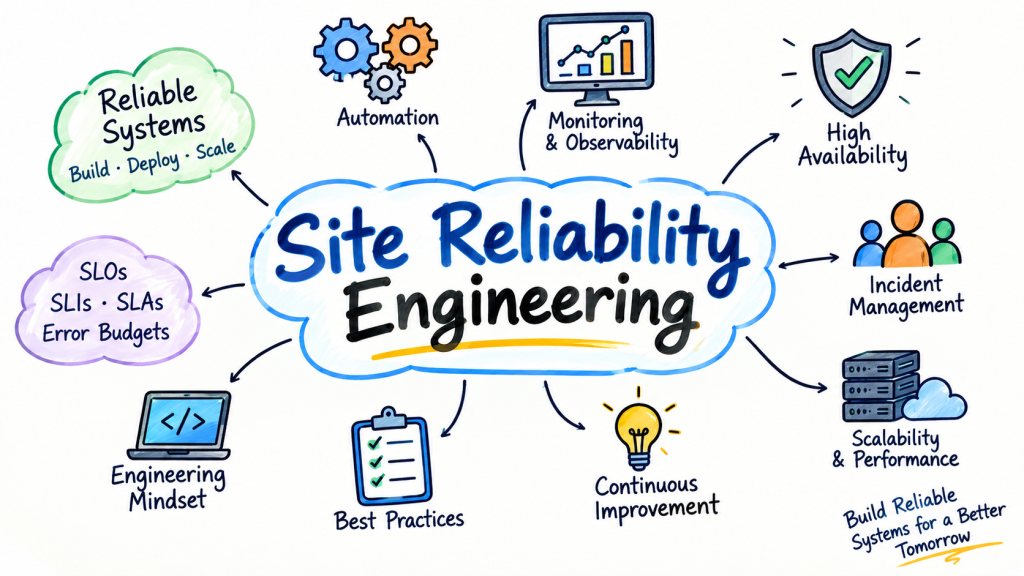
Running software systems smoothly at scale is rarely about luck. Instead, it demands intentional architecture, clear visibility, and an obsession with preventing unplanned downtime.
When services fail, businesses lose customer trust within seconds. That reality has transformed how modern teams view operational stability and resilience.
Software engineering principles are now solving what used to be purely manual operational chores. Through platforms like https://www.sreschool.in/
engineers learn to eliminate repetitive manual tasks and build robust software infrastructure.
+-------------------------------------------------------------+
|               TRADITIONAL OPS vs SRE PARADIGM               |
+--------------------------+----------------------------------+
| Traditional Operations   | Site Reliability Engineering     |
+--------------------------+----------------------------------+
| Siloed deployments       | Shared production responsibility |
| Manual server patching   | Infrastructure as Code (IaC)     |
| 100% target uptime myth  | Pragmatic Error Budget model     |
| Blame-heavy postmortems  | Blameless systemic incident review|
+--------------------------+----------------------------------+
Industry studies consistently show that over seventy percent of outages stem directly from unexpected code deployments and configuration drift.
Adopting structured reliability frameworks minimizes these expensive system failures. This comprehensive guide walks you through every core element needed to run resilient production systems.
SRE Training: A Practical Path to Modern Operations Expertise
Hands-on SRE Training bridges the persistent disconnect between rapid software feature delivery and rock-solid platform stability. Many engineers transition into reliability work having only maintained legacy infrastructure or written application code in isolated local staging environments.
True operational readiness requires you to dive straight into real production scenarios. You must learn how distributed architectures behave when networks partition, cloud regions degrade, or traffic spikes unpredictably.
A mentor-led curriculum helps you master automation pipelines, telemetry gathering, and container runtimes through realistic system outage simulations.
Level 1: System Internals (Linux, Networking, Storage Architecture)
  │
  ▼
Level 2: Codified Systems (Terraform, GitOps, Kubernetes Clusters)
  │
  ▼
Level 3: Telemetry & Signals (Metrics, Distributed Tracing, Logs)
  │
  ▼
Level 4: Production Governance (SLOs, Error Budgets, Chaos Engineering)
Reliability engineering is fundamentally about building self-healing architecture rather than serving as a human safety net. By pursuing structured SRE Training, developers and sysadmins develop the muscle memory to write software that manages systems automatically, freeing their teams from recurring operational firefighting.
SRE Certification: Validate Your Skills and Advance Your Technology Career
Earning a formal SRE Certification demonstrates your ability to operate large-scale distributed architectures under pressure. Hiring managers actively search for engineers who understand systems holistically rather than candidates who simply memorize vendor tool definitions.
Preparing for these assessments forces you to think deeply about system limits, risk management, and software architectural trade-offs. The validation shows prospective employers that you can safeguard mission-critical platforms and reduce operational risk across diverse cloud ecosystems.
Industry compensation data shows that verified reliability professionals earn roughly twenty to twenty-five percent higher salaries compared to standard systems administrators. Earning an SRE Certification sets you apart as a high-impact engineer who can balance software velocity with production availability.
SRE Course: A Complete Learning Roadmap for Beginners and Professionals
Enrolling in an in-depth SRE Course gives you a methodical path from fundamental concepts to enterprise-grade production patterns. Jumping blindly between disconnected tutorials often leaves critical knowledge gaps in networking protocols, kernel debugging, and telemetry architecture.
A cohesive learning journey walks you systematically through Linux primitives, infrastructure automation, distributed logging, container scheduling, and zero-downtime releases. Each practical module builds on the previous one to reinforce your troubleshooting intuition.
| Engineering Stage | Core Focus Areas | Hands-On Milestone Project |
| Foundational | Linux OS, GitOps, Shell Automation | Build a hardened, automated base VM |
| Intermediate | Docker, Kubernetes, Terraform IaC | Deploy a self-healing microservice cluster |
| Advanced | Observability, Chaos Tests, Telemetry | Implement dynamic SLO-based alerting gates |
A well-structured SRE Course provides the blueprints and real-world debugging context you need to tackle edge cases and solve hard production incidents with confidence.
Site Reliability Engineering Training: Master the Core Concepts, Practices, and Tools
Comprehensive Site Reliability Engineering Training anchors your daily engineering work around service level realities:
- Service Level Indicators (SLIs): Direct measurements of platform health, such as request latency and error rates.
- Service Level Objectives (SLOs): Target reliability thresholds agreed upon with product teams to guide release velocity.
- Service Level Agreements (SLAs): External commitments detailing contractual remedies if system availability slips.
- Error Budgets: The allowable room for system failure that determines whether you ship fast or pause to stabilize.
Balancing feature deployment speed against system resilience prevents organizational friction. When your team burns through its allocated error budget, new feature rollouts halt until reliability work stabilizes the platform.
   [ Available Error Budget > 0% ]
                 │
                 ▼
     Deploy Features Rapidly
                 │
                 ▼
   [ Error Budget Depleted to 0% ]
                 │
                 ▼
Freeze Releases ──► Remediate Technical Debt ──► Restore Resiliency
Through dedicated Site Reliability Engineering Training, you master these feedback loops, learning to prioritize technical debt payoff using concrete data rather than gut feeling.
Site Reliability Engineering Certification: Understanding the Evolution of Modern IT Operations
Pursuing a Site Reliability Engineering Certification clarifies how modern production operations broke free from traditional IT management. In legacy waterfall environments, systems teams threw packaged software over an organizational wall to operations engineers who owned uptime.
This separation created conflicting incentives: developers wanted constant change, while operators fought for absolute stagnation to avoid outages. Modern reliability engineering solves this rift by introducing shared ownership, programmable infrastructure, and blameless post-mortems.
       LEGACY WATERFALL WALL                         SRE UNIFIED LIFECYCLE
 Developers           Operators             [Developers + Site Reliability Engineers]
(Push Features)     (Prevent Outages)                           │
       │                   │                                    ▼
       └──► [THE WALL] ◄───┘                  Shared Telemetry & Joint Error Budgets
          Friction & Blame                      Continuous Collaboration & Automation
Preparing for an advanced Site Reliability Engineering Certification reframes how you treat system downtime. Outages are treated as valuable learning opportunities that uncover software design flaws, transforming your incident reviews into permanent resilience improvements.
SRE Tutorial: Essential Technologies for Smarter and Automated Operations
Working through a practical SRE Tutorial is often the fastest way to turn abstract architectural theory into working automation scripts. Instead of merely reading documentation, building a complete observability stack teaches you how data flows during critical incidents.
Application Traces ──┐
Metric Exporters    ──┼──► [Collector / Agent] ──► Central Storage ──► Dashboards & Alerts
Server System Logs ──┘
Consider this foundational step-by-step telemetry pipeline walkthrough:
- Instrument Application Code: Export standard metrics using Prometheus client libraries directly within your services.
- Collect and Aggregate Telemetry: Deploy collector daemons across your hosts to scrape operational data without adding latency.
- Establish SLI Baselines: Create PromQL queries that calculate your success-to-failure ratios across five-minute rolling windows.
- Automate Alert Routing: Define alert rules that trigger only when burn rates threaten to consume your error budget within thirty-six hours.
- Enact Automated Runbooks: Connect alerting webhooks to autoscaling policies and circuit breakers to isolate failing pods instantly.
Executing an end-to-end SRE Tutorial like this shows you how telemetry signals directly drive automated self-healing across your infrastructure.
SRE Tools: Building Expertise in Continuous Delivery and Engineering Excellence
Selecting the right SRE Tools provides visibility into complex architectures and simplifies routine infrastructure maintenance:
- Infrastructure as Code: Tools like Terraform and OpenTofu codify multi-cloud assets into declarative, repeatable git repositories.
- Container Orchestration: Kubernetes automates workload scheduling, declarative canary rollouts, and internal health checks.
- Observability Stacks: Prometheus, Grafana, OpenTelemetry, and Jaeger gather metrics, traces, and log lines into centralized interfaces.
- Incident Collaboration: PagerDuty and Opsgenie route high-severity alerts based on active escalation matrices.
- Chaos Engineering: Gremlin and Chaos Mesh inject targeted CPU, memory, and network failures to uncover latent architectural weaknesses.
Tool mastery is not about collecting vendor brand names; it is about knowing precisely which utility isolates the root cause of an outage fastest.
Honing your proficiency across modern SRE Tools allows you to automate configuration management, spot system bottlenecks, and safeguard production environments efficiently.
SRE Best Practices: Developing Skills for Intelligent and Automated IT Operations
Adopting proven SRE Best Practices helps teams eliminate toilsome work—the repetitive, manual tasks that scale linearly with user traffic. If an operational task requires manual human intervention every single week, it should be automated through software.
Cultivating a blameless engineering culture is equally critical. When outages strike, focus investigations entirely on systemic and architectural gaps rather than individual human error.
                      BLAMELESS INCIDENT RETROSPECTIVE
+-------------------------------------------------------------------------------+
| INCIDENT: Database Connection Pool Exhaustion                                 |
+-------------------------------------------------------------------------------+
| What Failed:                                                                  |
| - Connection pools saturated under a 4x unexpected traffic spike.             |
| - Alerts failed to notify operators until API latencies reached 12 seconds.    |
|                                                                               |
| Systemic Contributing Factors:                                                |
| - Default thread pool allocations were never updated after the last release.  |
| - Telemetry alarms were linked to static thresholds rather than burn rates.   |
|                                                                               |
| Actionable Engineering Remediation:                                           |
| 1. Codify dynamic connection pool scaling in Kubernetes helm charts.          |
| 2. Implement automated circuit breakers to shed non-critical background jobs. |
| 3. Add burn-rate latency alerts directly into the team chat channels.         |
+-------------------------------------------------------------------------------+
Disciplined teams run continuous chaos experiments directly inside pre-production pipelines. These controlled network partitions and latency tests validate that failover systems work as designed.
Applying these SRE Best Practices transforms unpredictable operational fire drills into repeatable, transparent engineering workflows.
SRE Engineer: Your Roadmap to Scalable Machine Learning Operations
The modern SRE Engineer plays an essential role in running large-scale data and machine learning workloads. Operating intelligent models introduces operational challenges that traditional stateless applications never encounter.
Reliability specialists working with intelligent systems must monitor data distribution drift, model inference latency, GPU memory usage, and distributed pipeline failures.
When upstream data schemas change without warning, entire inference pipelines can silently produce corrupt results despite standard infrastructure remaining healthy.
Traditional SRE Workload                Machine Learning Reliability Workload
+-----------------------------+         +-----------------------------+
| Application Uptime (99.9%)  |         | Model Prediction Latency    |
| CPU & Memory Saturation     |         | Feature Store Data Drift    |
| HTTP Error Rate Responses   |         | GPU Allocation & Utilization|
| Disk I/O & Network Traffic  |         | Training Pipeline Restarts  |
+-----------------------------+         +-----------------------------+
As organizations scale their production AI investments, the demand for cross-functional platform engineers continues to surge.
An adaptable SRE Engineer builds automated pipelines that handle model rollbacks, track data quality metrics, and manage high-performance compute clusters without manual overhead.
SRE Training in India: Strengthening Modern Data Management and Delivery Skills
The demand for high-quality SRE Training in India has grown significantly as global development teams migrate core infrastructure engineering to major regional tech hubs.
Indian tech centers in Bengaluru, Hyderabad, Pune, and the National Capital Region are no longer just maintenance outposts; they architect and support the backbone of global digital commerce.
Enterprises are rapidly phasing out isolated support tiers in favor of multidisciplinary site reliability groups. Engineers who master modern observability, distributed orchestration, and automated remediation find themselves uniquely positioned for strategic engineering roles.
Selecting structured SRE Training in India provides working engineers with local community meetups, real-world case studies, and practical production engineering environments.
This deep exposure prepares engineering teams to design, scale, and protect modern distributed architectures across international markets.
Frequently Asked Questions About sreschool
What core technical topics are covered in the training programs?
The curriculum focuses on modern distributed systems engineering, Linux performance analysis, Infrastructure as Code using Terraform, container orchestration via Kubernetes, continuous delivery pipelines, distributed tracing, OpenTelemetry metrics aggregation, chaos engineering, and automated incident management.
How does site reliability engineering differ from traditional DevOps?
DevOps represents an organizational philosophy aimed at breaking down silos between software developers and operational staff. Site Reliability Engineering serves as a concrete, highly opinionated implementation of that philosophy by using software engineering practices to solve operational problems.
Are these programs suitable for developers who lack extensive systems administration experience?
Software engineers benefit immensely from this training because the coursework leverages programming skills to tackle infrastructure challenges. You will learn to apply core software engineering patterns directly to production system configuration, observability instrumentation, and distributed cluster operations.
Can system administrators and operations professionals transition into this domain through the course?
Traditional systems administrators and IT support staff will learn how to automate manual tasks using Python, Go, and shell scripting, step into Infrastructure as Code, and run containerized workloads at scale to modernize their careers.
What hands-on laboratory environments are provided during the program?
Learners work directly inside simulated real-world multi-cloud production clusters, facing controlled failure injections, unexpected traffic spikes, configuration drifts, and live monitoring scenarios that require practical triage and remediation.
How do the course materials help engineers master SLOs and error budgets?
The modules break down the math and organizational buy-in behind reliability metrics, guiding you through setting actionable Service Level Indicators, calculating error budgets, and using that telemetry to govern delivery speed versus stability.
What specific tools and observability software will I learn to use?
Training covers industry-standard tools including Kubernetes, Docker, Helm, Terraform, Prometheus, Grafana, Alertmanager, Jaeger, OpenTelemetry, GitOps workflows, and incident escalation tools like PagerDuty.
How does this curriculum prepare engineers for industry-standard certification exams?
The syllabus matches real-world scenarios and testing topics found in premier operational certifications, providing mock exams, architectural breakdowns, debugging walk-throughs, and review sessions.
Is there guidance on managing machine learning and high-throughput data pipelines?
Learners explore operating data-intensive systems, covering GPU provisioning, model inference latency metrics, pipeline recovery, and telemetry for modern data platforms.
How does learning reliability engineering improve my long-term career growth?
Companies running software in the cloud prioritize system availability, making skilled reliability engineers essential. Mastering these principles opens career paths into senior systems engineering, platform architecture, and technical leadership.
Final Thoughts
Modern software delivery moves quickly, but speed means little if your production platform cannot handle real-world traffic. High availability requires thoughtful operational principles, shared ownership, reliable telemetry, and an engineering culture focused on automating repetitive work.
Take the time to build strong foundations in system architecture, continuous feedback loops, and automated mitigation strategies. As you put these resilience practices to work across your pipelines, you transform system maintenance from stressful firefighting into a scalable, predictable engineering discipline.
