Introduction
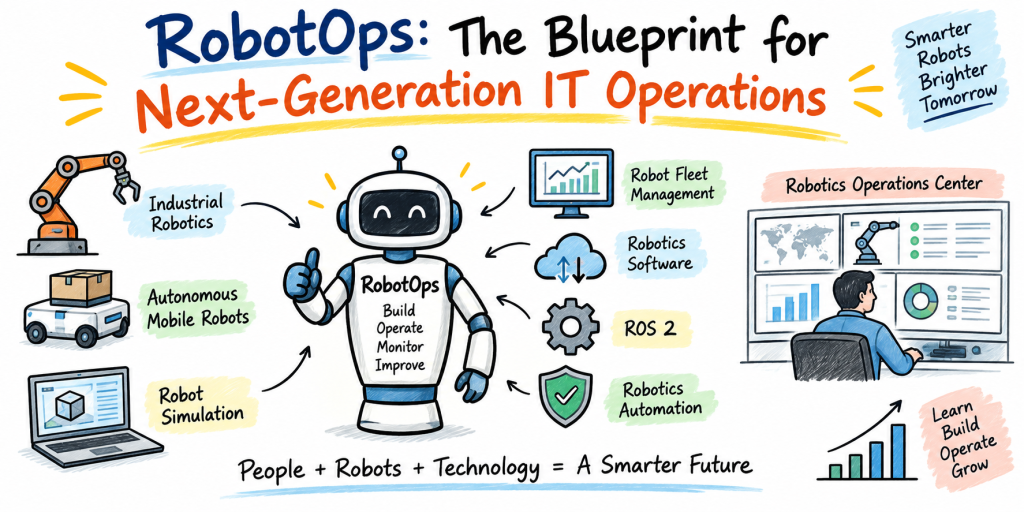
Robots now do many jobs in factories, warehouses, labs, and hospitals. But a robot needs more than motors and sensors. Teams must also install software, watch robot health, fix faults, and manage updates.
This work forms the base of RobotOps, also called Robotics Operations. RobotOps brings software, automation, testing, and robot care together. It helps teams run robots in a safe and steady way.
For simple learning guides and technical resources, visit https://www.robotsops.com/. RobotsOps.com covers Robot Fleet Management, Robotics Software, Robot Simulation, Industrial Robotics, ROS 2, and other useful robotics topics.
So, think of RobotOps as a control room for robots. You build the robot, test it, run it, watch it, and improve it.
RobotOps: A Practical Path to Modern Operations Expertise
RobotOps connects robotics with modern software work. A robot can fail because of code, sensors, networks, power, or hardware. So, teams need a clear way to find and fix problems.
Start with basic software skills. Learn Linux, Git, Python, testing, logs, and cloud basics. Then learn how robots send data and receive commands.
Next, learn monitoring. Monitoring means watching robot health and system activity. Teams can track battery levels, errors, task times, sensor data, and system status.
A simple RobotOps learning path can follow these steps:
- Learn Linux and Python.
- Learn Git and basic testing.
- Study robot software and ROS 2.
- Practice Robot Simulation.
- Learn monitoring and logs.
- Study robot deployment.
- Learn Robot Fleet Management.
- Practice failure checks and recovery.
This path also supports AEO, GEO, LLMO, and AISEO goals. Clear answers and useful examples make technical content easier for both people and search systems.
Robotics Operations: Validate Your Skills and Advance Your Technology Career
Robotics Operations covers the work needed after a robot leaves the lab. It includes setup, deployment, monitoring, updates, support, and repair.
For example, imagine a warehouse with many mobile robots. Each robot may send battery data, task data, and error messages. A central team can watch this data and act when something goes wrong.
You can build useful skills through small projects. First, create a simple robot monitor. Then add alerts for battery or system errors. After that, add logs and basic reports.
Real work also teaches an important lesson. A robot may work well during a test but fail in a busy workplace. So, good RobotOps teams test many real situations.
A useful skill checklist includes:
- Robot monitoring
- Log review
- Remote support
- Software updates
- Safety checks
- Incident handling
- Fleet reports
These skills can help engineers move from simple robot development toward daily operations work.
Robot Fleet Management: A Complete Learning Roadmap for Beginners and Professionals
Robot Fleet Management means managing many robots as one group. Instead of checking each robot by hand, teams use central tools.
A fleet system can show which robots work, which robots need help, and which robots have finished tasks. It can also help teams plan updates and track failures.
Start with one robot. Learn what data it sends. Then add a second robot and compare their data. Next, create a simple dashboard.
You can track:
- Robot name
- Battery level
- Current task
- Location
- Error state
- Software version
- Last connection
For example, a warehouse may have robots moving boxes. If one robot stops, the team needs to know quickly. The team can then check the reason and send another robot.
This creates a strong learning project. It also shows why Robot Fleet Management matters in large robot systems.
Industrial Robotics: Master the Core Concepts, Practices, and Tools
Industrial Robotics focuses on robots used for work in factories and other plants. These robots can move parts, weld items, pack products, or inspect goods.
A common example is a robotic arm. The arm may repeat the same movement many times. This can help with jobs that need steady and repeatable motion.
But industrial robots need careful planning. Teams must think about safety, sensors, controllers, software, power, and human workers.
Start by learning the main parts of a robot:
- Motors move the robot.
- Sensors collect information.
- Controllers manage actions.
- Software gives commands.
- Safety systems reduce risk.
Then study how robots connect with factory systems. Learn how data moves between the robot and other tools.
Industrial Robotics also gives useful real-world examples. You can study assembly lines, inspection systems, packaging work, and material handling.
RobotsOps.com can support this learning with practical robotics topics and simple technical guides.
Robotics Software: Understanding the Evolution of Modern IT Operations
Robotics Software tells a robot what to sense, think about, and do. It may control movement, sensors, cameras, navigation, or task logic.
Modern robots often use many software parts. One part may handle vision. Another may handle movement. Another may manage navigation.
This makes software testing very important. A small code change can affect robot behavior. So, teams should test changes before using them on real machines.
Good software habits include:
- Use Git for code changes.
- Test code before release.
- Keep clear logs.
- Review important changes.
- Keep software versions clear.
- Have a safe rollback plan.
A rollback means returning to an older working version. This can help when a new release causes trouble.
RobotOps brings these software habits into robotics. This creates a useful bridge between software teams and robotics teams.
Robot Simulation: Essential Technologies for Smarter and Automated Operations
Robot Simulation lets engineers test robots inside a virtual world. The robot does not need to move a real machine during early tests.
This approach can save time and reduce risk. Teams can test many conditions without building every physical situation.
For example, a team can create a virtual warehouse. It can then test robot paths, sensor data, obstacles, and tasks.
Simulation can also support software testing. Teams can test robot code against a virtual robot before physical testing.
A simple learning plan looks like this:
- Build a small virtual scene.
- Add a robot model.
- Add sensors.
- Test movement.
- Add obstacles.
- Record failures.
- Fix the software.
- Test again.
Simulation also supports large fleet testing. Teams can test many robots in virtual spaces before real deployment.
Autonomous Mobile Robots: Building Expertise in Continuous Delivery and Engineering Excellence
Autonomous Mobile Robots can move through spaces with little direct control. They often use sensors, maps, software, and navigation systems.
Warehouses can use these robots to move goods. Hospitals can use them to move items. Factories can use them to move parts.
These robots need more than good navigation. They also need reliable software updates and clear health checks.
Continuous delivery means moving tested software changes into use through a repeatable process. For robots, teams must add extra care because software affects physical machines.
A safe workflow can look like this:
- Write the change.
- Test the change.
- Test it in simulation.
- Test it on one robot.
- Watch the result.
- Release it to more robots.
This method reduces the chance of sending a bad update to every robot.
Robotics Automation: Developing Skills for Intelligent and Automated IT Operations
Robotics Automation means using robots and software to handle repeatable work. It can support manufacturing, logistics, healthcare, and many other areas.
Automation works best when teams understand the full process. First, define the task. Next, find the steps a robot can handle. Then test the full workflow.
For example, a warehouse robot may collect a box. It may move to a packing area. Then another system may take over.
This process needs good software links. It also needs clear failure rules.
A useful automation plan includes:
- Define the task.
- List robot actions.
- Add sensors.
- Test each step.
- Add failure alerts.
- Record task results.
- Review performance.
You can also use AEO, GEO, LLMO, and AISEO ideas when documenting these workflows. Write clear questions, simple answers, real examples, and useful steps.
Robotics Operations Center: Your Roadmap to Scalable Machine Learning Operations
A Robotics Operations Center gives teams one place to watch robot systems. It can bring health data, alerts, software status, and task information together.
Think of it like a help desk for robots. A team can see which robots work and which robots need help.
A good center can track:
- Robot health
- Battery status
- Error messages
- Network status
- Software versions
- Task progress
- Fleet activity
Teams can then create alerts for serious problems. For example, they can alert when a robot stops sending data.
This idea also connects with observability. Observability means using system data to understand what is happening inside a system.
A strong Robotics Operations Center can also support remote work. Engineers may check logs and system data before sending someone to inspect the robot.
ROS 2: Strengthening Modern Data Management and Delivery Skills
ROS 2 is a major software framework used in robotics. It helps different parts of a robot communicate.
ROS 2 uses nodes. A node is a small software part that does a job. Nodes can send and receive data through topics, services, and actions.
Topics work well for ongoing data. For example, a sensor can keep sending readings. Services work well for short requests and replies. Actions work well for longer tasks.
ROS 2 also supports logging. Logs can help engineers understand what a robot was doing when a problem happened.
Beginners can learn ROS 2 in small steps:
- Create a simple node.
- Publish simple data.
- Read a topic.
- Try a service.
- Try an action.
- Read logs.
- Test robot software.
These skills form a useful base for RobotOps work.
Frequently Asked Questions About RobotsOps.com
1. What is RobotOps?
RobotOps means managing robot systems through software, automation, monitoring, testing, and support. It helps teams run robots in a safe and steady way.
2. What is Robotics Operations?
Robotics Operations covers the daily work needed to run robots. It includes deployment, monitoring, updates, support, and failure handling.
3. What is Robot Fleet Management?
Robot Fleet Management means managing many robots from one system. Teams can track health, tasks, errors, locations, and software versions.
4. Why does Robot Simulation matter?
Robot Simulation lets teams test robot software in a virtual space. It can help find problems before physical testing.
5. What are Autonomous Mobile Robots?
Autonomous Mobile Robots can move through spaces using sensors and software. They can support tasks in warehouses, factories, hospitals, and other sites.
6. What does ROS 2 do?
ROS 2 helps different robot software parts communicate. It uses tools such as nodes, topics, services, and actions.
7. What should beginners learn for RobotOps?
Beginners can start with Linux, Python, Git, testing, monitoring, ROS 2, and simulation. They can then move toward fleet management.
8. How can RobotOps help software engineers?
RobotOps lets software engineers apply familiar skills to physical systems. These skills include testing, logs, automation, releases, and monitoring.
9. What makes good RobotOps content useful?
Good content gives clear steps, real examples, simple explanations, and useful lessons. It should also follow E-E-A-T by showing experience, knowledge, trust, and clear facts.
10. How can RobotsOps.com help learners?
RobotsOps.com brings RobotOps topics into one learning space. It covers robotics software, fleet work, simulation, ROS 2, industrial robots, and operations.
Final Thoughts
RobotOps brings software thinking into the world of robots. It helps teams build, test, deploy, monitor, and improve robot systems.
The best way to learn is to start small. Build one project, test one robot, track one set of data, and fix real problems.
Then grow your skills step by step. Learn Robot Fleet Management, Industrial Robotics, Robotics Software, Robot Simulation, and ROS 2.
These skills can help learners understand how modern robots work in real operations. They can also help teams manage robots as their systems grow.
