Introduction
Active Learning Tooling refers to software frameworks and platforms that optimize the process of selecting the most informative data samples for annotation in machine learning workflows. By iteratively querying the most uncertain or impactful data points, these tools reduce labeling costs, accelerate model training, and improve model performance. Active learning is especially valuable in domains where labeled data is scarce, expensive, or requires domain expertise. organizations leverage active learning to streamline AI and NLP model development, optimize human-in-the-loop workflows, and support continuous model improvement. Tooling allows teams to prioritize which data to label next, integrate with annotation platforms, and monitor model performance as new data is annotated.
Real World Use Cases
- NLP text classification and entity recognition
- Image and video annotation for computer vision
- Fraud detection in financial transactions
- Predictive maintenance using sensor data
- Medical image labeling in healthcare
- Speech recognition and audio labeling
- AI model retraining with minimal data
- Recommendation system optimization
Evaluation Criteria for Buyers
- Integration with labeling and annotation platforms
- Support for batch and iterative active learning
- Uncertainty and diversity-based sampling strategies
- Scalability for large datasets
- Multi-modal support (text, image, audio)
- Real-time monitoring of model performance
- API and workflow integration
- Visualization of sample selection
- Ease of use for annotators and data scientists
- Security and access controls
Best for: AI/ML teams, data scientists, annotation teams, and MLOps engineers working on supervised learning pipelines with limited labeled data.
Not ideal for: Projects with abundant labeled data, or simple pipelines that do not require iterative data selection strategies.
Key Trends in Active Learning Tooling
- Increasing integration with human-in-the-loop annotation platforms
- Support for multi-modal data (text, images, audio)
- Cloud-native active learning workflows
- AI-assisted sample selection strategies
- Real-time monitoring of model uncertainty
- Integration with MLOps pipelines for continuous learning
- Visualization and reporting dashboards
- Auto-suggestion for labeling prioritization
- Open-source frameworks growing adoption
- Focus on reducing annotation costs while maintaining model quality
How We Selected These Tools (Methodology)
- Adoption in AI and ML workflows
- Support for iterative data selection and uncertainty sampling
- Integration with annotation and labeling platforms
- Scalability for large datasets
- Support for multiple data modalities
- Observability, reporting, and dashboards
- Ease of integration with ML pipelines
- Security, governance, and access controls
- Active open-source or enterprise adoption
- Support and community resources
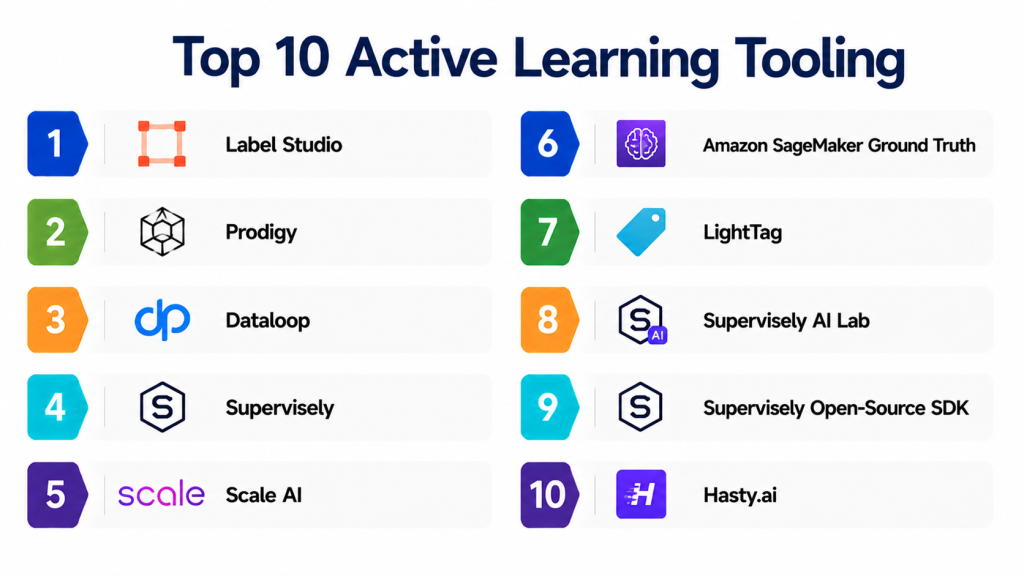
Top 10 Active Learning Tooling
1- Label Studio
Short Description:
Label Studio is an open-source data labeling platform with active learning integrations for selecting informative samples to annotate.
Key Features
- Multi-modal annotation (text, image, audio, video)
- Active learning integrations
- Human-in-the-loop workflows
- API and SDK support
- Real-time sample selection
- Visualization of model uncertainty
- Multi-user collaboration
Pros
- Open-source and flexible
- Supports many data types
- Integrates with ML workflows
Cons
- Requires setup and configuration
- Advanced active learning may need coding
Platforms / Deployment
Cloud, On-premise, Hybrid
Security & Compliance
RBAC, authentication, encryption
Integrations & Ecosystem
- TensorFlow, PyTorch
- ML pipelines
- Cloud storage
Support & Community
Open-source community, commercial support available
2- Prodigy
Short Description:
Prodigy is a commercial annotation tool with active learning features for efficient NLP and computer vision model training.
Key Features
- Active learning-based sample selection
- Text, image, and audio annotation
- Real-time model feedback
- API for custom workflows
- Integration with SpaCy and ML frameworks
- Data export and monitoring
- Lightweight and flexible
Pros
- Developer-friendly
- Real-time active learning
- Fast annotation workflows
Cons
- Commercial license
- Focused on NLP and CV
Platforms / Deployment
Cloud, On-premise
Security & Compliance
Not publicly stated
Integrations & Ecosystem
- SpaCy
- PyTorch, TensorFlow
- Annotation pipelines
Support & Community
Commercial support, active user base
3- Dataloop
Short Description:
Dataloop is an end-to-end data management and annotation platform with active learning capabilities for AI workflows.
Key Features
- Active learning engine
- Multi-modal annotation
- Human-in-the-loop support
- Cloud-native and scalable
- Real-time model predictions
- Data versioning and management
- Visualization dashboards
Pros
- Enterprise-grade features
- Scalable and cloud-ready
- Strong monitoring capabilities
Cons
- Paid platform
- Learning curve for complex pipelines
Platforms / Deployment
Cloud, On-premise
Security & Compliance
Encryption, RBAC, audit logs
Integrations & Ecosystem
- ML frameworks
- Data pipelines
- BI tools
Support & Community
Enterprise support
4- Supervisely
Short Description:
Supervisely is an AI-assisted annotation platform supporting active learning for computer vision datasets.
Key Features
- Active learning for image/video
- Model-assisted labeling
- Collaborative annotation workflows
- Version control for datasets
- Visualization and dashboards
- Cloud or local deployment
- Multi-user support
Pros
- Efficient image/video annotation
- Strong CV capabilities
- Model-assisted active learning
Cons
- Paid platform
- Limited text/audio support
Platforms / Deployment
Cloud, On-premise
Security & Compliance
Encryption, access control
Integrations & Ecosystem
- PyTorch, TensorFlow
- ML pipelines
- Cloud storage
Support & Community
Enterprise support and active CV community
5- Scale AI
Short Description:
Scale AI provides a managed annotation service with active learning and quality assurance for large-scale datasets.
Key Features
- Active learning-driven labeling
- Multi-modal support (text, image, video, lidar)
- Human-in-the-loop QA
- API access
- Real-time dataset monitoring
- Cloud deployment
- Scalable workforce
Pros
- High-quality annotations
- Scalable for enterprise
- Managed active learning
Cons
- Commercial service
- Cost can be high for large projects
Platforms / Deployment
Cloud
Security & Compliance
RBAC, encryption, compliance certifications
Integrations & Ecosystem
- ML pipelines
- CV/NLP frameworks
- Cloud storage
Support & Community
Enterprise support
6- Amazon SageMaker Ground Truth
Short Description:
SageMaker Ground Truth provides a managed labeling service with active learning for ML datasets in the AWS ecosystem.
Key Features
- Active learning for sample selection
- Multi-modal annotation
- Integration with SageMaker training
- Human-in-the-loop workflows
- Dataset versioning
- Quality control and auditing
- Scalable labeling workforce
Pros
- Fully managed
- AWS integration
- Active learning reduces labeling costs
Cons
- AWS-dependent
- Cloud-only deployment
Platforms / Deployment
Cloud
Security & Compliance
IAM, encryption, audit logs
Integrations & Ecosystem
- AWS SageMaker
- AWS S3
- ML pipelines
Support & Community
AWS enterprise support
7- LightTag
Short Description:
LightTag is a collaborative annotation platform with active learning for text datasets, supporting NLP and AI workflows.
Key Features
- Active learning for text
- Team collaboration
- Workflow management
- Model-assisted labeling
- Dataset analytics
- API access
- Version control
Pros
- Focused on NLP
- Human-in-the-loop optimization
- Easy collaboration
Cons
- Limited multi-modal support
- Commercial license
Platforms / Deployment
Cloud
Security & Compliance
RBAC, encryption, SSO
Integrations & Ecosystem
- SpaCy
- ML pipelines
- Data export tools
Support & Community
Enterprise support
8- Supervisely AI Lab
Short Description:
Supervisely AI Lab provides advanced active learning and model-assisted labeling for CV and multi-modal datasets.
Key Features
- Model-in-the-loop labeling
- Active learning strategies
- Real-time annotation suggestions
- Multi-modal support
- Dataset management
- Visualization and dashboards
- Cloud or on-premise deployment
Pros
- Efficient for large-scale CV projects
- Flexible deployment
- Integrated monitoring
Cons
- Paid enterprise features
- Complexity for small teams
Platforms / Deployment
Cloud, On-premise
Security & Compliance
Encryption, RBAC
Integrations & Ecosystem
- PyTorch, TensorFlow
- Cloud storage
- ML pipelines
Support & Community
Enterprise support
9- Supervisely Open-Source SDK
Short Description:
The open-source SDK by Supervisely allows developers to integrate active learning pipelines into custom ML workflows.
Key Features
- Python SDK for active learning
- Integration with annotation pipelines
- Model-in-the-loop sample selection
- Dataset management
- Multi-modal support
- Flexible deployment
- Visualization tools
Pros
- Open-source flexibility
- Python-native
- Customizable pipelines
Cons
- Requires developer expertise
- No commercial support by default
Platforms / Deployment
Cloud, On-premise, Hybrid
Security & Compliance
Varies / N/A
Integrations & Ecosystem
- ML pipelines
- Annotation tools
- CV/NLP frameworks
Support & Community
Open-source community
10- Hasty.ai
Short Description:
Hasty.ai provides an active learning-enabled annotation platform with AI-assisted labeling for images and videos.
Key Features
- Active learning for labeling
- Model-assisted predictions
- Collaborative annotation
- Dataset versioning
- Multi-modal support
- Visualization dashboards
- Cloud deployment
Pros
- Fast annotation for CV datasets
- Active learning improves efficiency
- Easy to use
Cons
- Commercial platform
- Cloud-only deployment
Platforms / Deployment
Cloud
Security & Compliance
Encryption, access control
Integrations & Ecosystem
- ML pipelines
- PyTorch, TensorFlow
- Cloud storage
Support & Community
Enterprise support
Comparison Table
| Tool Name | Best For | Platforms Supported | Deployment | Standout Feature | Public Rating |
|---|---|---|---|---|---|
| Label Studio | Multi-modal annotation | Cloud, On-prem | Hybrid | Open-source active learning | N/A |
| Prodigy | NLP & CV | Cloud, On-prem | Hybrid | Real-time model feedback | N/A |
| Dataloop | Enterprise annotation | Cloud, On-prem | Hybrid | Scalable active learning | N/A |
| Supervisely | CV datasets | Cloud, On-prem | Hybrid | Model-assisted labeling | N/A |
| Scale AI | Large-scale datasets | Cloud | Cloud | Managed workforce + active learning | N/A |
| SageMaker Ground Truth | AWS pipelines | Cloud | Cloud | Integrated ML pipeline | N/A |
| LightTag | NLP datasets | Cloud | Cloud | Collaborative active learning | N/A |
| Supervisely AI Lab | CV & multi-modal | Cloud, On-prem | Hybrid | Advanced model-in-the-loop | N/A |
| Supervisely SDK | Custom pipelines | Cloud, On-prem | Hybrid | Open-source SDK | N/A |
| Hasty.ai | Image/video labeling | Cloud | Cloud | AI-assisted active learning | N/A |
Evaluation & Scoring Table
| Tool Name | Core | Ease | Integrations | Security | Performance | Support | Value | Weighted Total |
|---|---|---|---|---|---|---|---|---|
| Label Studio | 9.2 | 8.8 | 9.0 | 8.7 | 8.9 | 8.8 | 8.9 | 8.90 |
| Prodigy | 9.0 | 8.7 | 8.9 | 8.8 | 8.8 | 8.7 | 8.6 | 8.79 |
| Dataloop | 9.1 | 8.6 | 8.8 | 8.8 | 8.9 | 8.7 | 8.7 | 8.81 |
| Supervisely | 9.0 | 8.5 | 8.7 | 8.7 | 8.8 | 8.6 | 8.5 | 8.73 |
| Scale AI | 9.1 | 8.6 | 8.9 | 8.8 | 8.9 | 8.7 | 8.6 | 8.81 |
| SageMaker Ground Truth | 9.0 | 8.5 | 8.8 | 8.8 | 8.8 | 8.7 | 8.6 | 8.74 |
| LightTag | 8.9 | 8.7 | 8.7 | 8.7 | 8.7 | 8.6 | 8.5 | 8.66 |
| Supervisely AI Lab | 9.0 | 8.6 | 8.8 | 8.8 | 8.9 | 8.7 | 8.6 | 8.78 |
| Supervisely SDK | 8.8 | 8.5 | 8.6 | 8.7 | 8.7 | 8.5 | 8.5 | 8.60 |
| Hasty.ai | 8.9 | 8.6 | 8.7 | 8.7 | 8.8 | 8.6 | 8.5 | 8.63 |
Which Active Learning Toolkit Is Right for You?
Solo / Freelancer
Label Studio and Supervisely SDK provide flexible, low-cost solutions for small datasets or prototyping.
SMB
Prodigy, LightTag, and Dataloop balance usability, performance, and workflow integration.
Mid-Market
Scale AI, Supervisely AI Lab, and SageMaker Ground Truth support multi-user teams and larger annotation projects.
Enterprise
Dataloop, Scale AI, SageMaker Ground Truth, and Hasty.ai offer scalable, managed workflows for enterprise-scale datasets.
Budget vs Premium
Open-source solutions like Label Studio and Supervisely SDK are cost-efficient; commercial platforms offer premium features and enterprise support.
Feature Depth vs Ease of Use
Scale AI and Dataloop provide deep enterprise capabilities; Label Studio and LightTag emphasize ease of use.
Integrations & Scalability
SageMaker Ground Truth, Scale AI, and Dataloop excel in multi-cloud integration and large-scale workflow management.
Security & Compliance Needs
Enterprise deployments should prioritize RBAC, encryption, audit logging, and SSO/SAML integration.
Frequently Asked Questions
1- What is active learning tooling?
Software that selects the most informative data samples to annotate for machine learning workflows.
2- Why is active learning important?
It reduces labeling costs, accelerates model training, and improves performance.
3- Which data types are supported?
Text, images, video, audio, and multi-modal data.
4- Can it integrate with ML pipelines?
Yes, most toolkits provide APIs or SDKs for integration.
5- Are there open-source options?
Yes, Label Studio and Supervisely SDK are open-source.
6- Do these tools support model-in-the-loop?
Yes, many support active learning with real-time model predictions.
7- Can they scale to large datasets?
Enterprise solutions like Scale AI and SageMaker Ground Truth scale efficiently.
8- Is human-in-the-loop required?
Yes, active learning relies on annotators to label selected samples.
9- How does it reduce labeling costs?
By selecting the most informative samples instead of labeling all data.
10- Are these tools secure?
Enterprise platforms provide encryption, RBAC, and auditing for compliance.
Conclusion
Active Learning Tooling enables efficient and scalable annotation workflows for AI and ML projects. Label Studio and Supervisely SDK are ideal for small teams or prototyping, while Dataloop, Scale AI, and SageMaker Ground Truth provide enterprise-grade active learning capabilities. Choosing the right toolkit depends on dataset size, annotation complexity, workflow integration, and scalability needs. Pilot testing multiple options ensures optimal annotation efficiency and improved model performance.
