Introduction
OTA Firmware Update Platforms allow organizations to remotely deploy firmware, software, security patches, and configuration updates to connected devices without requiring physical access. OTA, or Over-the-Air updating, has become a critical capability for IoT devices, connected vehicles, industrial equipment, consumer electronics, medical devices, and smart infrastructure.
As connected device fleets continue to grow, manual firmware updates become costly, slow, and risky. OTA platforms help organizations maintain device security, improve performance, fix vulnerabilities, introduce new features, and ensure regulatory compliance. A robust OTA platform can significantly reduce operational costs while improving customer experience and device reliability.
Real World Use Cases
- Updating IoT sensors and gateways remotely
- Deploying security patches to industrial devices
- Managing firmware for connected vehicles
- Updating smart home devices and appliances
- Maintaining healthcare and medical equipment
- Supporting retail kiosks and digital signage
- Managing edge computing infrastructure
Evaluation Criteria for Buyers
- Firmware deployment automation
- Device fleet scalability
- Security and update verification
- Rollback and recovery mechanisms
- Device monitoring capabilities
- Multi-device support
- Integration flexibility
- Compliance and audit controls
- Deployment scheduling options
- Cost and operational efficiency
Best for: IoT manufacturers, automotive companies, healthcare organizations, telecom providers, industrial operators, and enterprises managing connected devices.
Not ideal for: Organizations with very small device fleets or environments where devices are manually maintained on-site.
Key Trends
- Zero-touch firmware deployment is becoming standard.
- AI-driven update scheduling is gaining traction.
- Differential updates are reducing bandwidth consumption.
- Security-first OTA architectures are becoming essential.
- Edge computing integration continues to expand.
- Digital twin technology is improving deployment validation.
- Multi-cloud OTA management is growing in popularity.
- Automated compliance reporting is becoming more important.
- Container-based updates are increasingly supported.
- Secure firmware signing is now a core requirement.
Methodology
The platforms in this list were evaluated using:
- Industry adoption
- OTA deployment capabilities
- Security architecture
- Scalability and reliability
- Ease of deployment
- Device compatibility
- Integration ecosystem
- Monitoring capabilities
- Vendor maturity
- Customer support quality
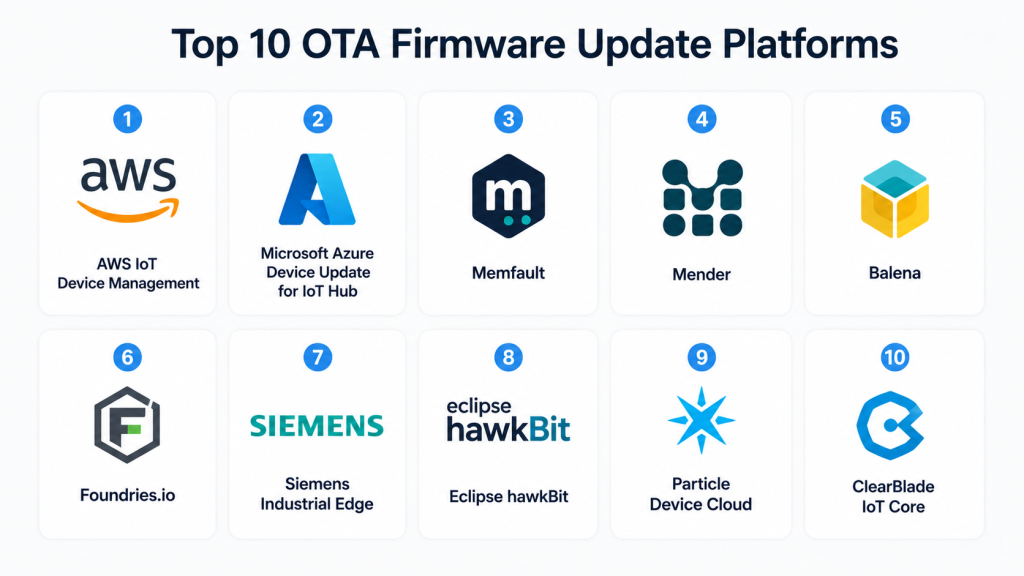
Top 10 OTA Firmware Update Platforms
1- AWS IoT Device Management
Short Description
AWS IoT Device Management provides secure OTA update capabilities alongside fleet management, monitoring, and device lifecycle services for large-scale IoT deployments.
Key Features
- OTA firmware deployment
- Fleet management
- Secure tunneling
- Device provisioning
- Bulk update rollout
- Monitoring and diagnostics
- AWS ecosystem integration
Pros
- Excellent scalability
- Strong cloud infrastructure
- Mature IoT ecosystem
Cons
- Best suited for AWS users
- Complexity can increase with large deployments
Platforms / Deployment
Cloud
Security & Compliance
Encryption, IAM controls, audit logging, RBAC.
Integrations & Ecosystem
Integrates deeply with AWS cloud services and IoT infrastructure.
- AWS IoT Core
- AWS Lambda
- CloudWatch
- Security Hub
Support & Community
Large global community and extensive documentation.
2- Microsoft Azure Device Update for IoT Hub
Short Description
Azure Device Update provides secure OTA updates for IoT devices managed through Azure IoT Hub.
Key Features
- OTA firmware deployment
- Device grouping
- Staged rollouts
- Update compliance reporting
- Monitoring tools
- Rollback capabilities
- Security validation
Pros
- Strong Microsoft ecosystem
- Enterprise scalability
- Good reporting capabilities
Cons
- Azure-focused deployment
- Requires Azure expertise
Platforms / Deployment
Cloud
Security & Compliance
Encryption, RBAC, auditing, identity management.
Integrations & Ecosystem
- Azure IoT Hub
- Azure Monitor
- Microsoft Security Services
- Azure Analytics
Support & Community
Strong enterprise support and training resources.
3- Memfault
Short Description
Memfault combines OTA updates, device observability, diagnostics, and monitoring into a single platform for embedded and IoT devices.
Key Features
- OTA firmware updates
- Device diagnostics
- Crash reporting
- Fleet monitoring
- Update management
- Device health analytics
- Performance insights
Pros
- Excellent diagnostics capabilities
- Developer-friendly platform
- Strong observability features
Cons
- Focused primarily on embedded devices
- Advanced features may require higher plans
Platforms / Deployment
Cloud
Security & Compliance
Encryption, secure update workflows, audit capabilities.
Integrations & Ecosystem
- Embedded development tools
- CI/CD pipelines
- Device monitoring platforms
- Analytics systems
Support & Community
Growing developer community and strong documentation.
4- Mender
Short Description
Mender is a widely used OTA update platform that supports secure firmware and software updates across Linux-based devices.
Key Features
- OTA updates
- Rollback protection
- Fleet management
- Update scheduling
- Device monitoring
- Secure deployments
- Open architecture
Pros
- Strong rollback capabilities
- Open-source option available
- Flexible deployment models
Cons
- Linux-focused
- Advanced enterprise features may require paid editions
Platforms / Deployment
Cloud, Self-hosted, Hybrid
Security & Compliance
Encryption, authentication, secure update verification.
Integrations & Ecosystem
- Linux environments
- CI/CD systems
- Embedded devices
- IoT ecosystems
Support & Community
Active community and extensive documentation.
5- Balena
Short Description
Balena enables remote management and OTA updates for containerized edge and IoT devices.
Key Features
- OTA deployments
- Container management
- Fleet monitoring
- Remote access
- Device configuration
- Application updates
- Centralized management
Pros
- Developer-friendly
- Strong container support
- Easy deployment workflows
Cons
- Container-centric approach
- Enterprise capabilities vary by plan
Platforms / Deployment
Cloud, Hybrid
Security & Compliance
Secure communication and encrypted updates.
Integrations & Ecosystem
- Docker
- Raspberry Pi
- Edge devices
- Open-source ecosystems
Support & Community
Strong community support and developer resources.
6- Foundries.io
Short Description
Foundries.io provides secure OTA updates and device lifecycle management for Linux and embedded systems.
Key Features
- OTA firmware updates
- Secure boot support
- Device lifecycle management
- Fleet monitoring
- Security updates
- Continuous delivery workflows
- Linux support
Pros
- Security-focused
- Modern deployment workflows
- Strong lifecycle management
Cons
- Linux-centric platform
- Technical expertise required
Platforms / Deployment
Cloud, Hybrid
Security & Compliance
Secure boot, encryption, update validation.
Integrations & Ecosystem
- Linux platforms
- Cloud infrastructure
- CI/CD tools
- Embedded devices
Support & Community
Good documentation and enterprise support.
7- Siemens Industrial Edge
Short Description
Siemens Industrial Edge includes software deployment and update management capabilities for industrial environments.
Key Features
- OTA updates
- Industrial device management
- Security controls
- Monitoring
- Application deployment
- Manufacturing integration
- Fleet visibility
Pros
- Industrial specialization
- Strong manufacturing support
- Enterprise scalability
Cons
- Manufacturing-focused
- Complex deployment
Platforms / Deployment
Hybrid
Security & Compliance
Industrial-grade security controls and access management.
Integrations & Ecosystem
- Siemens automation platforms
- Manufacturing systems
- Industrial applications
- Edge infrastructure
Support & Community
Strong enterprise and industrial support.
c
Short Description
Eclipse hawkBit is an open-source OTA update framework designed for large-scale software and firmware updates.
Key Features
- OTA updates
- Rollout management
- Device targeting
- Campaign management
- Multi-tenant architecture
- Open-source flexibility
- API support
Pros
- Open-source
- Highly customizable
- Strong scalability
Cons
- Requires technical expertise
- Enterprise support varies
Platforms / Deployment
Self-hosted
Security & Compliance
Authentication, update verification, access controls.
Integrations & Ecosystem
- IoT platforms
- Custom applications
- Device management systems
- APIs
Support & Community
Active open-source community.
9- Particle Device Cloud
Short Description
Particle provides integrated OTA updates and device management for connected products and IoT deployments.
Key Features
- OTA updates
- Device monitoring
- Fleet management
- Device diagnostics
- Secure deployment
- Product lifecycle support
- Remote configuration
Pros
- Easy implementation
- Complete IoT platform
- Good developer experience
Cons
- Best suited for Particle ecosystem
- Enterprise flexibility may vary
Platforms / Deployment
Cloud
Security & Compliance
Encryption, authentication, secure communication.
Integrations & Ecosystem
- Particle hardware
- Cloud services
- APIs
- Analytics tools
Support & Community
Strong developer-focused support.
10- ClearBlade IoT Core
Short Description
ClearBlade provides device management and OTA deployment capabilities for enterprise IoT and edge deployments.
Key Features
- OTA updates
- Fleet management
- Device monitoring
- Edge computing support
- Security controls
- Analytics
- Workflow automation
Pros
- Flexible deployment
- Strong IoT functionality
- Real-time monitoring
Cons
- Smaller ecosystem than hyperscalers
- Enterprise adoption varies
Platforms / Deployment
Cloud, Hybrid
Security & Compliance
Encryption, identity controls, audit capabilities.
Integrations & Ecosystem
- Enterprise applications
- Cloud services
- Industrial software
- IoT infrastructure
Support & Community
Professional support and implementation services.
Comparison Table
| Tool Name | Best For | Platforms Supported | Deployment | Standout Feature | Public Rating |
|---|---|---|---|---|---|
| AWS IoT Device Management | Large IoT Fleets | Web | Cloud | Fleet Management | N/A |
| Azure Device Update | Enterprise IoT | Web | Cloud | Update Compliance Reporting | N/A |
| Memfault | Embedded Devices | Web | Cloud | Diagnostics & Observability | N/A |
| Mender | Linux Devices | Linux, Web | Hybrid | Rollback Protection | N/A |
| Balena | Containerized Devices | Linux, Web | Hybrid | Container Updates | N/A |
| Foundries.io | Secure Linux Fleets | Linux | Hybrid | Lifecycle Security | N/A |
| Siemens Industrial Edge | Manufacturing | Web | Hybrid | Industrial Integration | N/A |
| Eclipse hawkBit | Open Source Deployments | Web | Self-hosted | Customizability | N/A |
| Particle Device Cloud | Connected Products | Web | Cloud | Complete IoT Platform | N/A |
| ClearBlade IoT Core | Enterprise IoT | Web | Hybrid | Edge Computing Support | N/A |
Evaluation & Scoring Table
| Tool Name | Core | Ease | Integrations | Security | Performance | Support | Value | Weighted Total |
| AWS IoT Device Management | 9.5 | 8.8 | 9.5 | 9.3 | 9.4 | 9.0 | 8.5 | 9.09 |
| Azure Device Update | 9.3 | 8.7 | 9.4 | 9.2 | 9.3 | 9.0 | 8.6 | 9.01 |
| Memfault | 9.0 | 8.8 | 8.8 | 8.9 | 9.1 | 8.7 | 8.8 | 8.87 |
| Mender | 9.1 | 8.6 | 8.5 | 9.0 | 8.9 | 8.8 | 9.0 | 8.88 |
| Balena | 8.8 | 9.0 | 8.4 | 8.5 | 8.8 | 8.6 | 9.0 | 8.73 |
| Foundries.io | 8.9 | 8.3 | 8.5 | 9.2 | 8.8 | 8.6 | 8.7 | 8.72 |
| Siemens Industrial Edge | 9.1 | 8.0 | 8.7 | 9.1 | 9.2 | 8.8 | 8.2 | 8.79 |
| Eclipse hawkBit | 8.7 | 7.9 | 8.5 | 8.8 | 8.8 | 8.2 | 9.2 | 8.58 |
| Particle Device Cloud | 8.8 | 8.9 | 8.5 | 8.7 | 8.7 | 8.6 | 8.9 | 8.72 |
| ClearBlade IoT Core | 8.8 | 8.4 | 8.6 | 8.8 | 8.8 | 8.5 | 8.7 | 8.66 |
The scores above provide a comparative assessment across major evaluation categories. Organizations should weigh factors such as scalability, security, operational complexity, and integration requirements according to their specific deployment goals.
Which OTA Firmware Update Platform Is Right for You?
Solo / Freelancer
Mender and Balena are strong choices due to their flexibility, simplicity, and developer-focused workflows.
SMB
Particle Device Cloud and Foundries.io provide a good balance of usability, security, and operational efficiency.
Mid-Market
AWS IoT Device Management, Azure Device Update, and Memfault offer strong scalability and monitoring capabilities.
Enterprise
AWS, Azure, Siemens Industrial Edge, and ClearBlade provide enterprise-grade deployment, security, and management capabilities.
Budget vs Premium
Open-source solutions such as Eclipse hawkBit and Mender can reduce costs, while enterprise platforms offer deeper automation and governance.
Feature Depth vs Ease of Use
Balena emphasizes simplicity, while AWS and Azure provide broader functionality and ecosystem integrations.
Integrations & Scalability
AWS and Azure remain leaders for organizations requiring extensive integrations and large-scale deployments.
Security & Compliance Needs
Organizations in regulated industries should prioritize platforms with secure boot, encryption, rollback protection, auditing, and compliance reporting.
Frequently Asked Questions
1- What is an OTA Firmware Update Platform?
An OTA Firmware Update Platform enables organizations to remotely deploy firmware and software updates to connected devices without physical access.
2- Why are OTA updates important?
OTA updates improve security, fix bugs, add features, and reduce maintenance costs across distributed device fleets.
3- Can OTA updates be rolled back?
Many platforms support rollback mechanisms that allow devices to return to a previous version if an update fails.
4- Are OTA updates secure?
Modern platforms use encryption, authentication, digital signatures, and validation processes to protect updates.
5- Which industries use OTA updates most?
Automotive, manufacturing, healthcare, consumer electronics, telecommunications, and smart city projects rely heavily on OTA technology.
6- Can OTA updates work offline?
Most updates require connectivity, but some platforms support delayed deployment when devices reconnect.
7- What is differential updating?
Differential updating transfers only changed portions of firmware, reducing bandwidth consumption and deployment time.
8- How scalable are OTA platforms?
Enterprise-grade platforms can manage updates across thousands or even millions of devices.
9- What should buyers evaluate first?
Security, scalability, rollback support, device compatibility, and integration capabilities should be among the first evaluation criteria.
10- What is the biggest OTA deployment challenge?
Ensuring reliable updates across diverse device types and network conditions remains one of the biggest operational challenges.
Conclusion
OTA Firmware Update Platforms play a critical role in maintaining the security, reliability, and functionality of connected devices. As organizations continue to expand their IoT and edge deployments, automated firmware management becomes essential for operational efficiency and risk reduction. AWS IoT Device Management and Azure Device Update remain strong choices for cloud-centric organizations, while Memfault and Mender provide excellent options for embedded and Linux-based environments. Siemens Industrial Edge serves industrial deployments particularly well, and Eclipse hawkBit offers flexibility for organizations seeking open-source solutions. The right platform depends on your device ecosystem, security requirements, deployment scale, and operational priorities. Before selecting a platform, organizations should evaluate integration capabilities, test deployment workflows, validate security controls, and conduct pilot projects to ensure long-term success.
